

What Does Cedarwood Smell Like? Pencil Shavings, Cedar Chests and the Juniper in the Bottle
What does cedarwood smell like? Dry, woody and quietly balsamic, with a faint sweetness, a whisper of smoke and a clean, sharpened-wood edge. Most people know it before they can name it: the inside of a cedar chest, a fresh pencil, a sauna, a forest floor at dusk. But here is the catch nobody tells you. Those four memories come from at least three different trees, and only one of them is a true cedar.
So instead of another list of adjectives, this guide follows the smell back to its sources. You’ll learn why the classic pencil smell is really a juniper (and why pencil makers once tore down fences to get it), why your grandmother’s cedar chest went quiet and how to wake it up, how the three cedarwood oils on the market differ, how cedarwood compares with sandalwood and cypress, and what to blend it with in a Nebulizing Diffuser®.
What Does Cedarwood Smell Like? The Short Answer
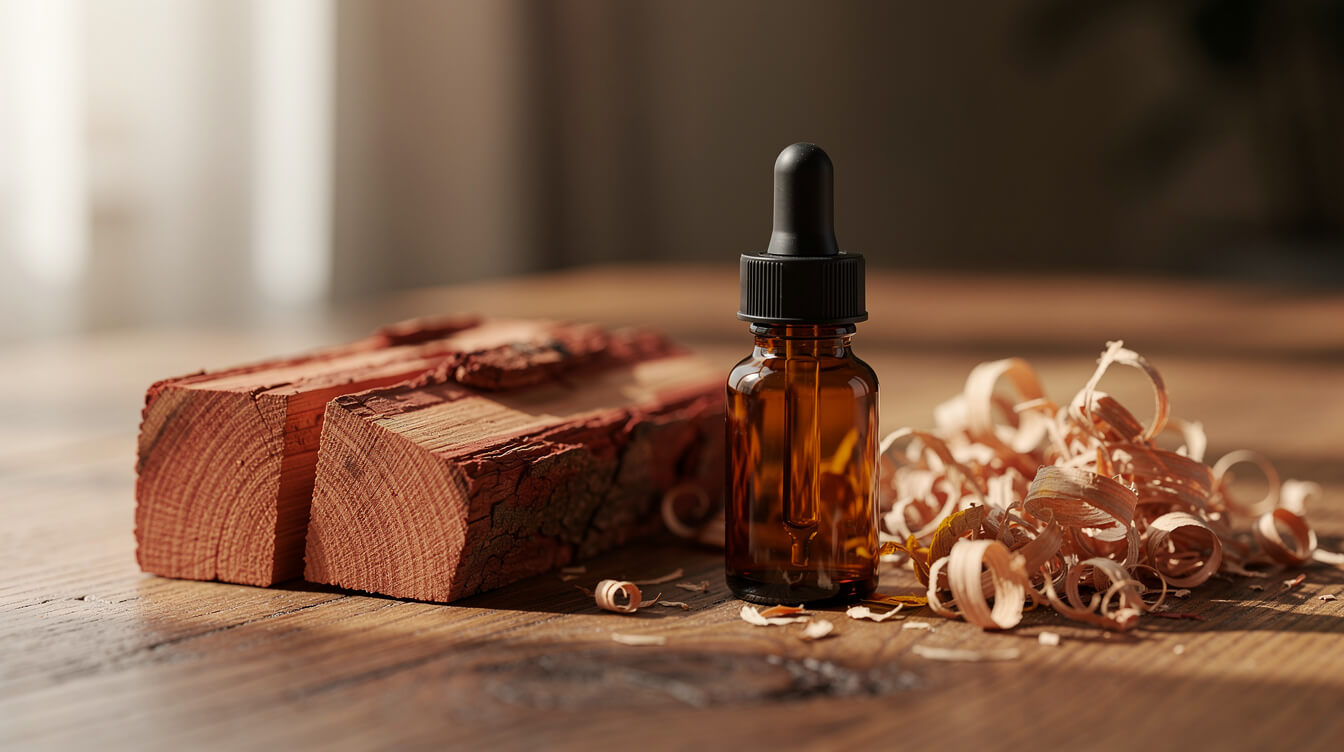
Cedarwood smells dry, woody and warm, like freshly cut timber with a soft balsamic sweetness underneath. Depending on the oil, you’ll also notice a sharp pencil-shaving bite, a hint of smoke or leather, or a mellow, almost honeyed resin note. It is a base note, so it starts quiet and stays for hours.
Put into words, this is what most noses pick up from a scent strip:
Dry and woody. The first and loudest impression. Clean, sawn wood with no green sap and no sweetness up front.
Sharp or soft, depending on the tree. Virginian and Texas oils have a bright, pencil-like edge. Atlas, the oil we sell, is rounder and more balsamic.
Faintly smoky and leathery. A dusky facet that shows up in the dry-down, strongest in Texas cedarwood.
Warm and lightly sweet. The last hours on the strip, when the sharper parts have faded and a soft resinous warmth is left.
What cedarwood doesn’t have is fruit, flowers or a cool, minty lift. That steady, unshowy character is exactly why perfumers use it as a base in thousands of fragrances, and why it reads as “calm” in a room rather than “fresh.”
Is cedarwood a good smell?
For most people, yes. It’s one of the most widely liked wood notes, unisex and easy to live with. If a cedarwood oil strikes you as harsh, it’s usually a Virginian or Texas oil smelled straight from the bottle. Spread thin through a room, or softened with citrus, it turns smooth and cozy.
Why Cedarwood Smells Like a Pencil (and Why Atlas Doesn’t)
Ask ten people what cedarwood smells like and at least a few will say “a pencil.” They are more right than they know, and the history explains why.
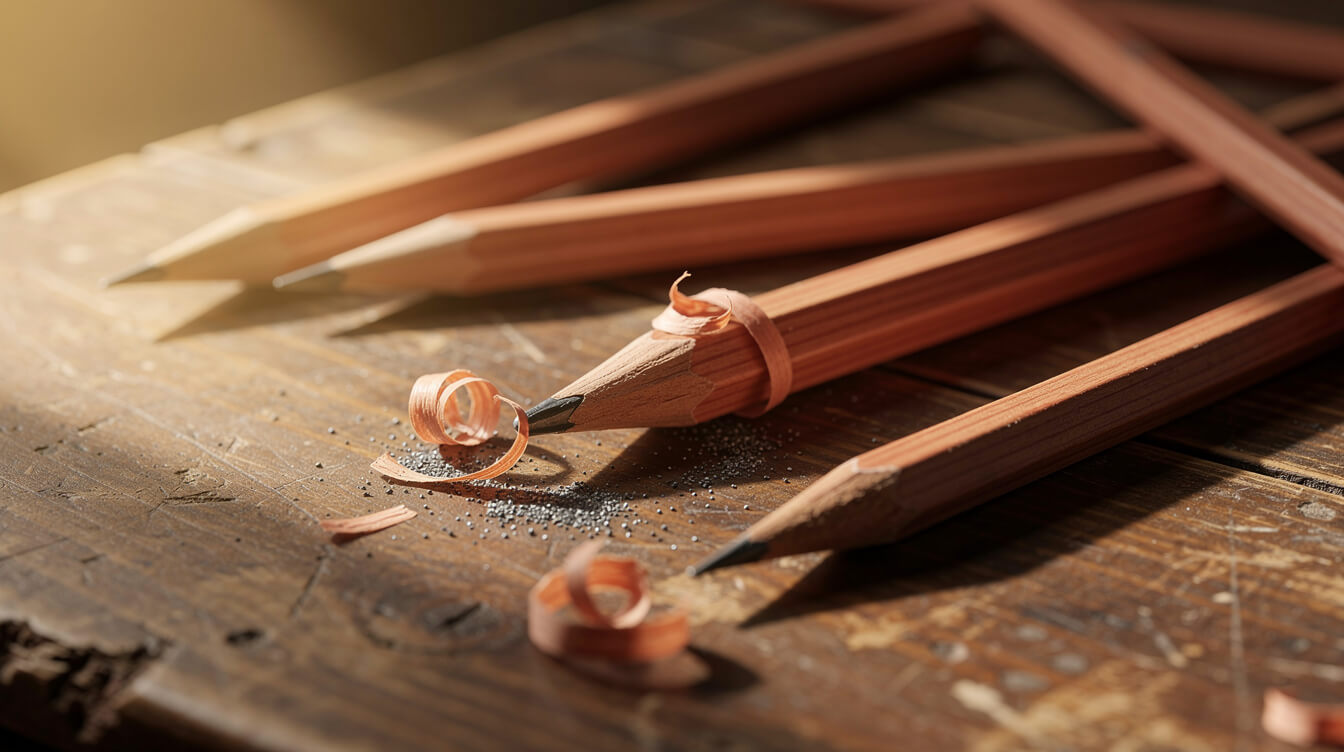
From the mid-1800s into the early 1900s, the wood inside American pencils was eastern red cedar, Juniperus virginiana. It sharpened cleanly, held its shape, and released a bright, sharp, woody smell every time you turned it in a sharpener. That tree is a juniper, not a true cedar. And it is the very same tree that is distilled into Virginian cedarwood oil today. So the classic pencil smell is, quite literally, the smell of Virginian cedarwood.
The great pencil-wood shortage
Demand for pencils kept climbing and the old red cedar ran short. Red cedar was so valuable to pencil makers that old red cedar fence rails were torn down and sold to them at a healthy profit, according to the University of Vermont’s tree history archive. (Henry David Thoreau, whose family ran a cedar-pencil business in Concord, spent years improving their pencils.)
The industry’s answer came from the West. In 1910, a subsidiary of the Eagle Pencil Company opened the first slat mill for incense-cedar (Calocedrus decurrens) in San Leandro, California. Here’s the part we love: according to California Cedar Products, the pencil makers initially pushed back, and the pale blonde incense-cedar slats had to be stained reddish-brown to look like the eastern red cedar everyone expected. Customers were buying a color and a smell, not just a writing tool.
Today, most quality wood-cased pencils are incense-cedar, and many budget pencils use other woods entirely. That’s why a pencil from your childhood desk and a pencil from today can smell noticeably different. The older, sharper, more “cedar” pencil smell belongs to Virginian juniper.
Where does the pencil note come from?
Virginian cedarwood oil is built mostly from three molecules, all sesquiterpenes (big, slow-evaporating fifteen-carbon compounds): α-cedrene, thujopsene and cedrol. Typical specifications put each of them in the tens of percent. Together they make the dry, sharp, sawdust-bright character. Interestingly, pure cedrol on its own is only faintly woody. The pencil effect comes from the blend, not one hero molecule.
Atlas cedarwood (Cedrus atlantica), the true cedar from Morocco’s Atlas Mountains and the oil inside our Cedarwood Essential Oil, is built differently. Its main molecules are the himachalenes, plus warm, slightly sweet atlantones. Published GC analyses of Atlas oil find cedrol at only trace levels, around a third of a percent. So Atlas smells like cedar wood, but not much like a pencil. It is softer, more balsamic, a little honeyed and a little like a forest floor. Our Oil of the Day profile of Atlas cedarwood walks through those molecules in more detail.
If you want that sharp, nostalgic school-desk smell, you’re looking for Virginian. If you want something warmer and more rounded to anchor a blend, Atlas is the one.

Sign Up to Get Your FREE
e-Book ($9.99 Value)
The Cedar Chest Smell, and How to Bring It Back
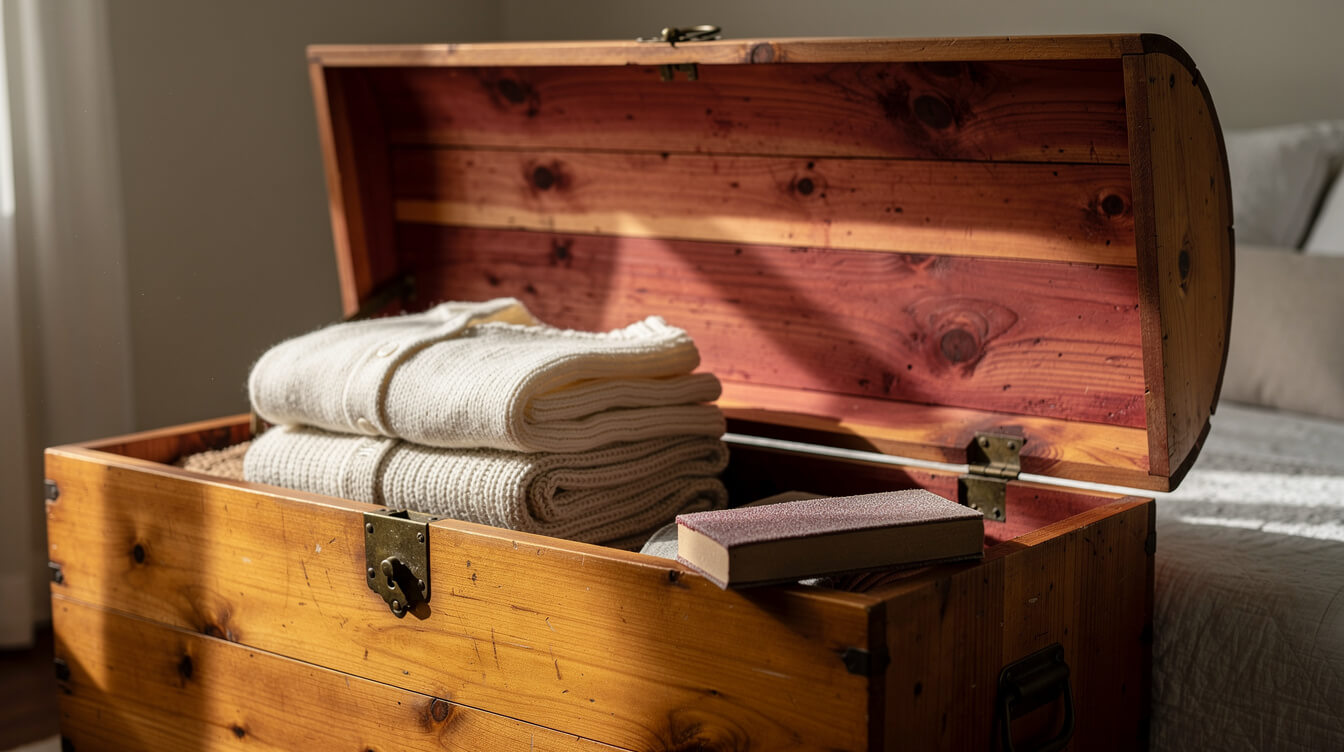
The second great cedar memory is the hope chest or cedar closet. That deep, sweet-sharp smell when the lid opens comes from aromatic red cedar lining boards, which are (you guessed it) the same Juniperus virginiana as pencils and Virginian oil. The scent lives in the oil trapped in the heartwood.
Why the smell fades
Cedarwood oil is volatile. Over months and years, the oil near the surface of the boards slowly evaporates and the exposed layer oxidizes and dulls. The wood deeper down still holds plenty of oil. It just can’t reach the air. That’s why a twenty-year-old chest can smell of almost nothing until you scrape it.
How to bring the cedar smell back
Woodworkers have a simple fix: sand it. A light pass with fine sandpaper over the interior boards removes the tired surface layer and exposes fresh, oil-rich wood. Many people find the smell returns within minutes, and the wood turns from dull brown back to that rosy red. A few practical tips:
Go light. You only need to scuff the surface, not reshape the boards. Vacuum the dust out afterward.
Never seal the cedar. Varnish, lacquer or paint traps the oil inside the wood and ends the smell for good.
Keep the lid closed. A shut chest lets the scent build up inside. An open one lets it drift away.
Repeat every few years. Each sanding buys another stretch of scent.
What a cedar chest can and can’t do
Cedar chests have long been sold as moth protection, but Colorado State University Extension’s clothes-moth fact sheet is refreshingly honest about this. Red cedar oils can kill clothes moth larvae only when the oils are in high concentration. They don’t repel the adult moths, and one study the sheet cites suggests chests more than three years old are practically useless for killing larvae. What a well-made chest does do is keep moths out physically, thanks to a tight-fitting lid. So enjoy the smell for what it is: a beautiful, traditional scent, not a pest-control system.
Can you scent a cedar chest with a few drops of oil instead? You can, but remember that a chest smells of Virginian juniper. A drop of Atlas cedarwood on a cotton pad will give you a warm cedar note, but it won’t be an exact match for that classic hope-chest smell.
Three Cedarwoods (Plus One Imposter), Three Different Smells
Because “cedar” is a common name rather than a botanical one, at least four different trees end up in cedar products. Only one of them is a true cedar. Here’s how they compare by nose:
Atlas cedarwood (Cedrus atlantica, a true cedar, Morocco): warm, rounded, balsamic and faintly sweet, with a soft forest-floor depth. The least “pencil” of the group. This is the oil we sell.
Virginian cedarwood (Juniperus virginiana, a juniper, USA): dry, sharp and bright. The classic pencil-shaving and cedar-chest smell.
Texas cedarwood (Juniperus ashei and relatives, a juniper, USA and Mexico): built from the same family of molecules as Virginian but heavier, with a smoky, leathery, slightly tarry character.
Western red cedar (Thuja plicata, a thuja, Pacific Northwest): the sauna, shingle and garden-fence smell. Sharper, sweeter and almost spicy. Its signature odor is linked to a molecule called methyl thujate, which neither Virginian nor Atlas oil contains. It’s rarely sold as an essential oil.
One extra caution: cedarleaf oil is a different product again, distilled from the leaves of a thuja rather than the wood, and it smells green and camphoraceous rather than woody. Don’t swap it for cedarwood in a blend.
If you’d like to go deeper on how Atlas and Virginian compare chemically, and why we chose Atlas, our complete cedarwood essential oil guide covers sourcing and the species question in full.

Sign Up to Get Your FREE Essential Oils e-Book ($9.99 Value)
What Blends With Cedarwood (and How to Diffuse It)

Cedarwood is a team player. On its own it can feel a little austere, but as a base note it gives brighter oils something to stand on, and it makes a blend last. Perfumers often call it a fixative for exactly this reason. These are the pairings we come back to most:
Sweet orange. The easiest partner. Juicy citrus on top, dry wood underneath, like an orange peeled next to a woodstove. Try our Sweet Orange Essential Oil.
Bergamot. Brighter, more elegant and a little floral. Bergamot and cedar is a classic cologne pairing. See Bergamot Essential Oil.
Lavender. Cedar sweetens and softens around lavender, turning it from herbal to cozy. A favorite for winding down in the evening with our Lavender Essential Oil.
Frankincense. Wood and resin together: quiet, deep and contemplative. Pair it with Frankincense Essential Oil.
Vetiver. Earth on wood, for a very grounded, smoky blend. Use vetiver sparingly. Our guide to what vetiver smells like explains why a little goes a long way.
Three cedarwood blends to try
Woodstove Orange: 5 parts Sweet Orange, 2 parts Atlas Cedarwood, 1 part Frankincense.
Evening Cologne: 4 parts Bergamot, 2 parts Lavender, 2 parts Atlas Cedarwood.
Cabin Library: 4 parts Sweet Orange, 2 parts Atlas Cedarwood, 1 part Vetiver.
Looking for more? Our fennel, orange and cedarwood blend and the mandarin and cedarwood front-door blend are two of our readers’ favorite cedar recipes.
Diffusing cedarwood in a Nebulizing Diffuser®
A Nebulizing Diffuser® uses pressurized air (Bernoulli’s principle) to break pure oil into a fine mist, with no water and no heat. That suits cedarwood well, because its heavy, slow-evaporating molecules stay intact instead of being cooked or watered down. Two tips keep it running smoothly:
Let cedarwood be the minority. Atlas cedarwood is thicker than citrus oils. Running it as one-quarter to one-third of a blend, with a thin citrus oil making up the rest, keeps the oil flowing through the glass atomizer. Our FAQ on diffusing thick oils explains the mechanics.
Clean after heavy blends. Wood and resin oils can leave a light residue. A quick rinse with isopropyl alcohol, as in our Nebulizing Diffuser® cleaning guide, keeps the glass clear.
Run your Nebulizing Diffuser® in short cycles at a low setting. Cedarwood is a quiet note that builds up gently, and intermittent diffusion keeps your nose from tuning it out. Browse our handcrafted Nebulizing Diffusers® if you’re ready to try it.
Cedarwood vs Sandalwood vs Cypress: How They Differ
These three are the woods people mix up most often, so here’s how to tell them apart by nose.
Cedarwood vs sandalwood
Cedarwood is dry and sharp. Sandalwood is creamy and soft, with a milky sweetness and almost no edge. If cedar is a freshly sawn plank, sandalwood is polished, oiled wood that’s warm to the touch. They work beautifully together, with cedar adding structure and sandalwood adding smoothness. For the full picture, read what sandalwood smells like.
Cedarwood vs cypress
Cypress oil is distilled mostly from the needles and twigs, not the heartwood, so it smells green, piney and resinous, much closer to a fresh evergreen branch than to a cut log. Think of cypress as the living tree and cedarwood as the lumber. Together they make a convincing walk-in-the-woods blend.
What smells similar to cedarwood?
If you like cedarwood, you’ll probably enjoy other wood and resin notes: sandalwood and its gentler stand-in amyris, vetiver, frankincense and patchouli in small amounts. Each has its own personality, but all of them share that slow, grounding base-note quality.

Join Our Exclusive Member Club to get Big Discounts!
What Does Cedarwood Smell Like? FAQs
How would you describe the smell of cedarwood?
Dry, woody, warm and lightly balsamic, with a faint sweetness and sometimes a sharp pencil-shaving or smoky edge. Atlas cedarwood is softer and rounder. Virginian and Texas cedarwood are sharper and drier.
Why does cedarwood smell like a pencil?
Because classic American pencils were made from eastern red cedar, Juniperus virginiana, the same tree used for Virginian cedarwood oil. Most quality pencils switched to incense-cedar in the twentieth century, so older pencils and Virginian oil share that nostalgic smell.
Is cedarwood a masculine or feminine scent?
Neither. Cedarwood is used across men’s, women’s and unisex perfumes. On its own it reads as clean and woody. Paired with florals like lavender it feels soft, and with citrus or leather notes it feels crisp.
Why does my cedar closet not smell anymore?
The oil at the surface of the wood has evaporated and oxidized. Lightly sand the boards to expose fresh wood, vacuum the dust, and keep the doors closed so the scent can build. Never seal or varnish aromatic cedar.
Does Atlas cedarwood smell the same as Virginian?
No. Atlas, a true cedar, is warmer, sweeter and more balsamic. Virginian, a juniper, is drier and sharper, with the classic pencil note. They’re built from different molecules, so they aren’t interchangeable in a blend.
How much cedarwood should I use in a Nebulizing Diffuser®?
In a Nebulizing Diffuser®, treat cedarwood as part of a blend rather than a solo oil. A blend that’s about one-quarter to one-third cedarwood, with a lighter oil like orange or bergamot making up the rest, keeps the scent balanced and the oil flowing smoothly.
Is cedarwood oil safe to diffuse around pets and children?
Diffuse in a well-ventilated room for short, intermittent sessions, keep a door open so pets can leave, and never apply oils to pets. Keep essential oils out of children’s reach. If you’re pregnant, nursing, managing a health condition or taking medication, ask your clinician before using any essential oil.
So what does cedarwood smell like? It depends on which tree you’re holding. The sharp pencil and hope-chest smell is Virginian juniper. The sauna smell is western red cedar. And the warm, balsamic, forest-floor note is Atlas, the true cedar. Start with our pure Atlas Cedarwood Essential Oil, add a bright citrus partner, and let your Nebulizing Diffuser® do the rest.