

Why Citrus Oils Leave a Film on Your Holiday Table (and Lavender Doesn’t)
November is when the good wood comes out: the sideboard gets cleared for platters and the dining table gets its holiday polish. A reader asked whether her morning orange blend might be leaving something behind on it. It’s a lovely question, and the answer lies in the oil’s own color.
Reader Question: “Will Diffusing Leave a Film on My Wood Furniture?”
It can, but only close to the unit, and it depends far more on which oil you pour than on how long you run it. A Nebulizing Diffuser® sends out pure oil as a fine mist, with no water to carry it. Most of that mist evaporates in the air and becomes the scent you enjoy. A small share of the finest droplets drifts down within a few feet of the glass. If the opening points at the same polished surface session after session, whatever in those droplets can’t evaporate stays put, and over weeks it builds into a faint, slightly tacky haze.
The Jewel: Citrus Oils Carry Wax, Distilled Oils Don’t
Sweet orange, lemon and the other bright citrus oils are cold-pressed from the peel, not distilled. Pressing carries along a little of what’s in the rind: waxes, and the pigments that give orange oil its sunset color. The international standard for expressed sweet orange oil (ISO 3140) allows 1 to 4% residue on evaporation. That’s the share still sitting in the dish after the scent has gone. A 10 ml bottle of orange therefore holds roughly a tenth to four-tenths of a milliliter of material that will never become scent. Steam-distilled oils such as lavender, eucalyptus and peppermint behave very differently. Waxes can’t travel with steam, so these oils evaporate almost completely. The exceptions among distilled oils are the slow, heavy base notes (vetiver, sandalwood, patchouli), which linger for days before they lift.

Sign Up to Get Your FREE
e-Book ($9.99 Value)
Three Small Habits for the Holiday Table
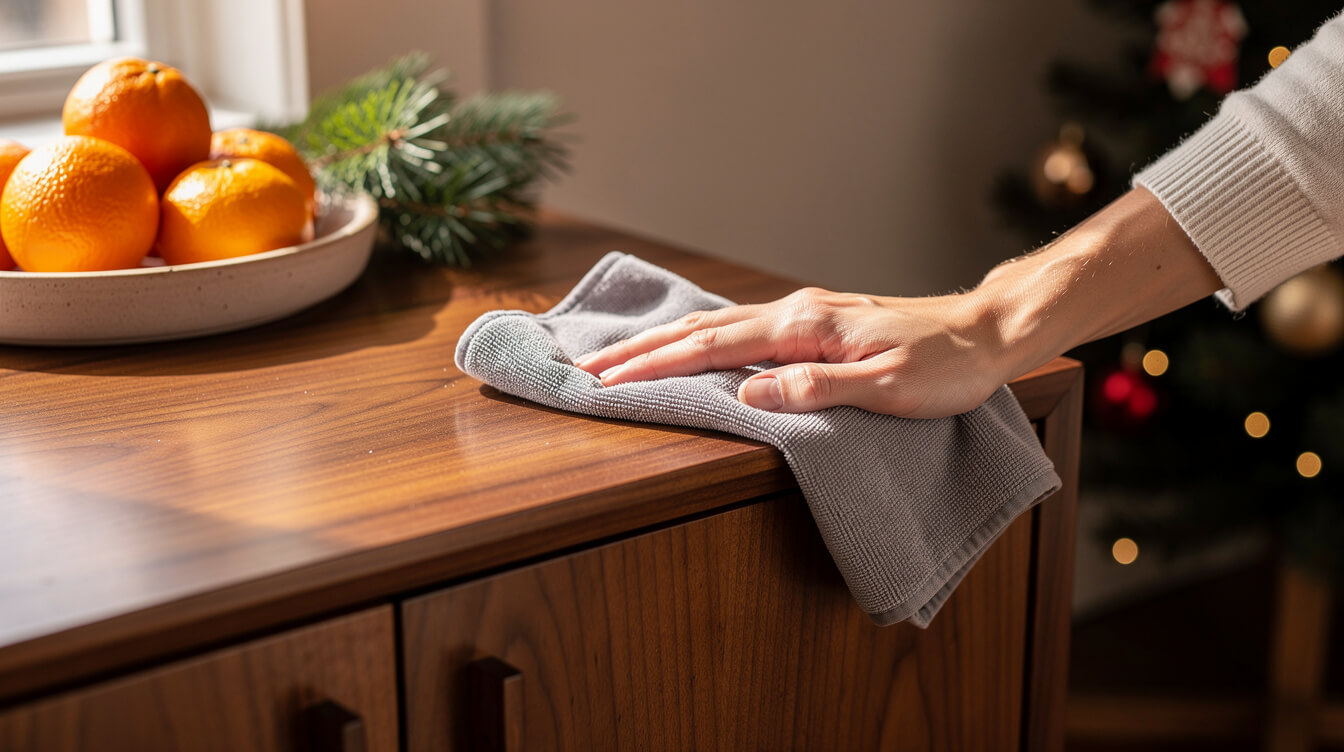
First, turn the glass cap so the opening faces the open middle of the room, not the sideboard. Second, give the unit a few feet of breathing room from polished antiques and leather, and set the base on a cork coaster or a small ceramic tray. Third, on citrus-heavy weeks, run a dry microfiber cloth over nearby surfaces every few days. If a haze has already formed, follow with a cloth barely dampened in mild soapy water, then dry it straight away. Our guide to filling, settings and placement has more on finding the right spot. And if guests are coming, try letting lavender or a fresh pine lead the blend, with citrus as the bright accent rather than the bulk.
May your table gleam and your rooms smell like the season. A little air between the glass and the good wood is all it takes.
Warmly,
Chad