

Essential Oils for Stress: The Olfactory Pathway, the Research, and Why Particle Size Matters
Searching for essential oils for stress turns up the same ten lists everywhere, and almost all of them stop at the same place: a name, a one-line claim, and a recommendation to add some drops to water. They rarely explain how a scent reaches the part of your brain that governs how tense or settled you feel, and they almost never mention the one physical detail that decides whether an aroma molecule arrives at your sense of smell at all.
This guide goes the other way. We start with the pathway, smell to limbic system to the body’s stress-response circuitry, then look at what published research actually says about five of the most-studied oils, and finish with the number no roundup cites: particle size. Nothing here treats, cures, or prevents any condition. It is about how aroma is delivered, what the science suggests, and how to set up a calming ritual you can measure for yourself.
How Stress Reaches Your Brain: The HPA Axis in Plain English
Before we talk about oils, it helps to know what we are talking about reaching. When your brain perceives a demand, a small region called the hypothalamus signals the pituitary gland, which signals the adrenal glands. This relay is called the HPA axis (hypothalamic-pituitary-adrenal), and it is the body’s built-in alert system. It is meant to switch on briefly and then switch off.
The reason aromatherapy is even worth discussing in this context is location. The hypothalamus sits inside the limbic system, the cluster of brain structures tied to emotion and memory. And as it happens, the sense of smell has an unusually direct line into exactly that neighborhood. Most of our senses route through a relay station before reaching the emotional brain. Smell largely does not. That anatomical shortcut is why a single familiar scent can shift how a room feels almost instantly, and it is the foundation everything below is built on.
To be clear about what this is and is not: creating a calming atmosphere is a ritual and a sensory experience, not a medical intervention. If stress is persistent or affecting your health, that is a conversation for a qualified professional. What follows is about ambiance, mechanism, and self-observation.
The Olfactory Pathway: Why Smell Is the Fastest Route to the Limbic System
Here is the mechanism most articles skip. When an aroma molecule is suspended in the air and you breathe in, it travels to a patch of tissue high in the nasal cavity called the olfactory epithelium. Embedded there are millions of olfactory receptor neurons. A molecule binds to a receptor, the neuron fires, and the signal passes to the olfactory bulb just above.
From the olfactory bulb, the signal projects directly into limbic structures, including the amygdala and the hippocampus, and from there it has access to the hypothalamus. In plain terms: an aroma molecule that successfully reaches and binds a receptor has a remarkably short path to the emotional and regulatory centers of the brain. That is the whole reason scent and mood are so tightly linked.
Notice the hinge in that sentence: an aroma molecule that successfully reaches a receptor. Every benefit anyone claims for inhaled aromatherapy depends on molecules actually arriving at that olfactory epithelium, intact and in enough quantity to bind. Hold onto that, because Section 4 is where most diffusing setups quietly fall short.
Sign Up to Get Your FREE
e-Book Here…
The Five Most-Studied Oils for Stress and What Research Suggests
These five appear most often in peer-reviewed aromatherapy literature. The honest summary of that literature: many studies are small, methods vary, and findings describe associations and self-reported outcomes rather than guaranteed effects. With that framing, here is what each oil brings and what researchers have looked at.
1. Lavender
The most-researched of all calming oils. Its profile is dominated by linalool and linalyl acetate, two molecules that have been the subject of considerable study into how inhaled aroma relates to relaxation and a settled mood. Lavender is the usual starting point for anyone building a wind-down ritual. For more on its chemistry, see the benefits of lavender oil.
2. Bergamot
A bright citrus oil rich in limonene and linalyl acetate. Bergamot is frequently studied in the context of mood and relaxation, and many people find its fresh, slightly floral citrus character lifts the atmosphere of a room without being sharp. It pairs naturally with lavender.
3. Clary Sage
Warm, herbaceous, and slightly nutty, clary sage is a long-standing favorite for evening calm and is often included in relaxation-focused aromatherapy research. It is distinct from common garden sage and tends to read as soft rather than medicinal.
4. Frankincense
A resinous, grounding base note with a long history in meditative and contemplative practice. Frankincense is associated in aromatherapy with slowing down and centering, and it anchors a blend so the lighter, brighter notes linger.
5. Ylang Ylang
A rich, sweet floral often included in studies on relaxation and mood. A little goes a long way; it is intense and can dominate a blend, so it is usually used as a small accent. If your goal is an evening ritual, you may also want our guide to essential oils for sleep, since calm and rest overlap heavily.
Putting the five together
You do not need all five at once. A practical way to start is a two-oil base of lavender with a single drop of bergamot, which gives you a soft floral grounded by a bright citrus lift. From there you can swap in clary sage for a warmer, more herbaceous evening, add a touch of frankincense when you want the blend to feel slower and more centered, or use the smallest accent of ylang ylang on days you want something richer. Keep the count low. On a waterless diffuser, a few drops carry further than you expect, and restraint is what keeps a blend from turning heavy.
Particle Size and Olfactory Uptake: The Number Almost No Article Mentions
This is the jewel, and it is the reason two people using the same oil can have completely different experiences. For an aroma molecule to do anything at all, it has to stay airborne long enough to be inhaled and reach the olfactory epithelium high in the nasal cavity. Whether it does that depends heavily on the size of the droplet carrying it.
Aromatherapy and inhalation science generally point to a fine particle range, on the order of roughly one to three microns, as well suited to staying suspended in air and being carried on the breath to the upper nasal passages. Larger droplets behave differently. They are heavier, they settle out of the air faster, and a meaningful share lands on surfaces, your furniture, the floor, the diffuser itself, before it is ever inhaled.
Here is why that matters for stress relief specifically. A water-based ultrasonic unit works by vibrating a plate to fling water into a mist, and the essential oil rides along on comparatively large, water-laden droplets. Those droplets are heavier and tend toward the larger end of the range, so more of your oil settles before it reaches your nose. You may smell the room, but a smaller fraction of the molecules is actually arriving at the receptors that connect to the limbic system.
No competitor roundup tells you this, because most of them assume a water diffuser and never question the delivery. But if the entire mechanism depends on molecules reaching the olfactory epithelium, then particle size is not a footnote. It is the difference between scenting a room and actually delivering aroma to your sense of smell.
Join Now and Get a Coupon for 10% Off!
Nebulizing Diffuser® vs Ultrasonic for a Stress-Relief Ritual
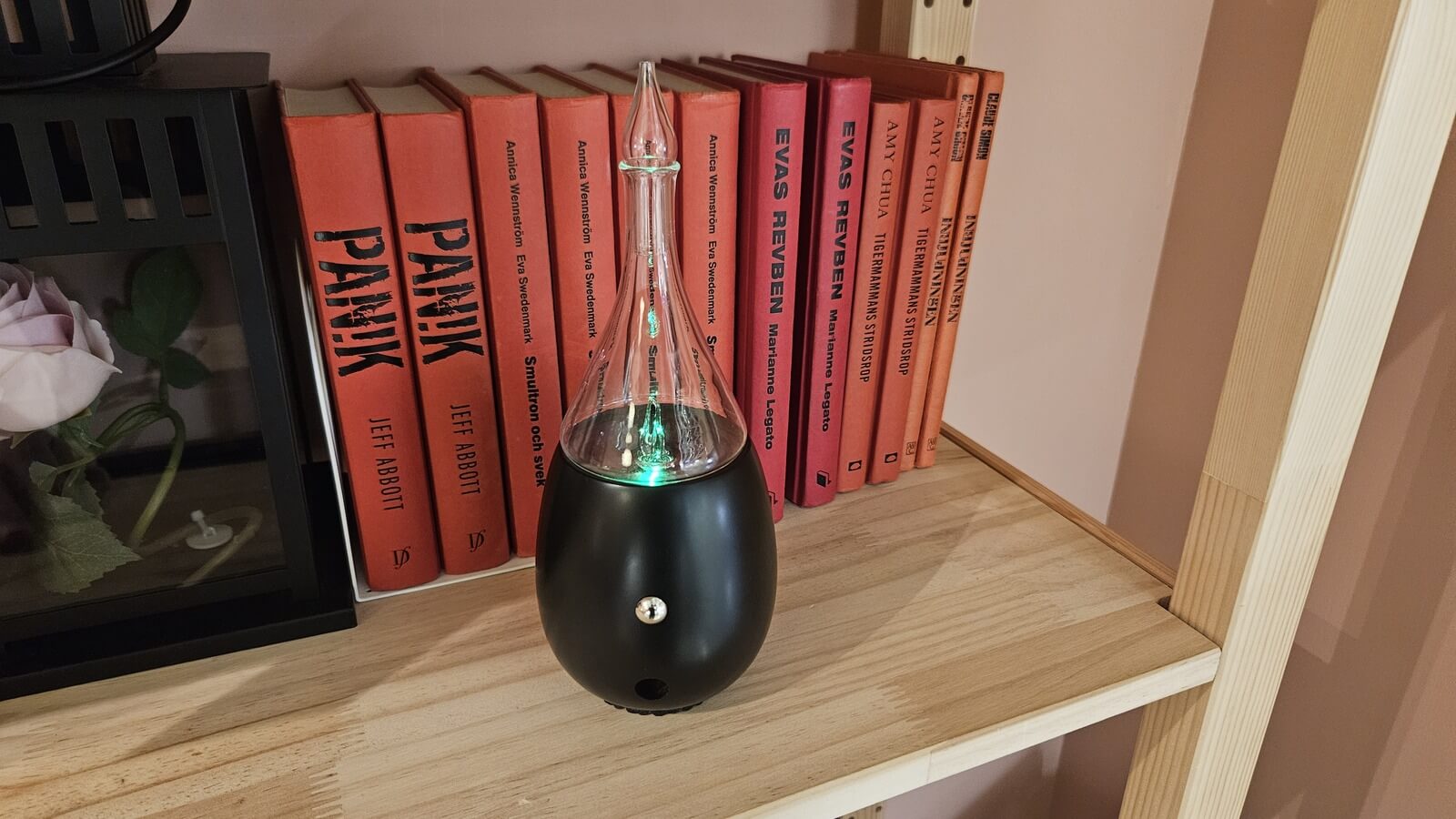
A Nebulizing Diffuser® takes a different route to the air. Instead of water and vibration, it uses a pressurized air stream passing over a glass tube. By Bernoulli’s Principle, that fast-moving air creates a low-pressure zone that draws neat, undiluted oil up and shatters it into an extremely fine mist. No water dilutes it. No heat degrades it. We walk through the full mechanism in our Nebulizing Diffuser®: The Complete Guide.
Three consequences follow that matter for a calming ritual. First, the mist is fine and dry, which keeps droplets in the size range that stays airborne and travels to the olfactory epithelium. Second, because there is no heat and no water, the delicate molecules that make lavender and bergamot what they are stay intact rather than being cooked or diluted. Third, you are diffusing pure essential oil, not oil suspended in a tank of water, so what reaches your nose is the oil itself.
If you are weighing which device suits your space, our waterless diffuser buyer’s guide compares coverage, noise, and oil compatibility in detail. For a stress-relief corner, the goal is simple: get intact aroma molecules into the air at a size your sense of smell can actually receive. The starter sets in our Nebulizing Diffuser® Collection pair the diffuser with the five oils above.
Build a Calm-Down Corner That Actually Reaches Your Senses
A handcrafted Nebulizing Diffuser, real wood and medical-grade Pyrex glass, atomizes pure undiluted oil into a fine mist with no water and no heat. It is the delivery method built to put aroma molecules into the air at the particle size your sense of smell responds to best.
A 14-Day Self-Test: Measure Your Own Response
Aromatherapy is personal. Rather than take anyone’s word, including ours, run a simple two-week observation and let your own ratings tell you what works. This is self-observation for a relaxation ritual, not a clinical test, and the only equipment you need is a notebook.
- Pick one oil or blend from the five above and keep it constant for the full two weeks. Lavender, or lavender with a drop of bergamot, is a sensible starting point.
- Choose one consistent time each day, the half hour before bed works well, and run your Nebulizing Diffuser® in short intermittent cycles in a small, closed room.
- Rate yourself before and after on a simple 1 to 10 scale of how tense or settled you feel. Write both numbers down with the date.
- Keep everything else steady. Same room, same lighting, same routine, so the scent is the main variable you are changing.
- Review the trend after 14 days. Look at the average gap between your before and after numbers, not any single day.
Some people see a clear, consistent shift in their self-ratings. Others find a particular oil does little for them and a different one lands better, which is exactly why a personal test beats a generic list. Whatever you find, you will have replaced a vague claim with your own data, which is the most honest way to build a ritual worth keeping.

Join Our Exclusive Member Club to get Big Discounts!
Final Thoughts
The conversation about essential oils for stress gets far more useful once you follow the whole pathway: a molecule reaches your olfactory epithelium, binds a receptor, and signals straight into the limbic system that houses your stress-response circuitry. Choose well-studied oils, respect that the research describes associations rather than promises, and pay attention to the one variable everyone else ignores, the particle size that decides whether the aroma reaches your senses at all.
When you want a delivery method built around that last point, fine, dry, undiluted mist with no water and no heat, explore the handcrafted Nebulizing Diffuser® Collection and run your own fourteen-day test. Let your ratings, not a listicle, decide what belongs in your calm-down corner.