


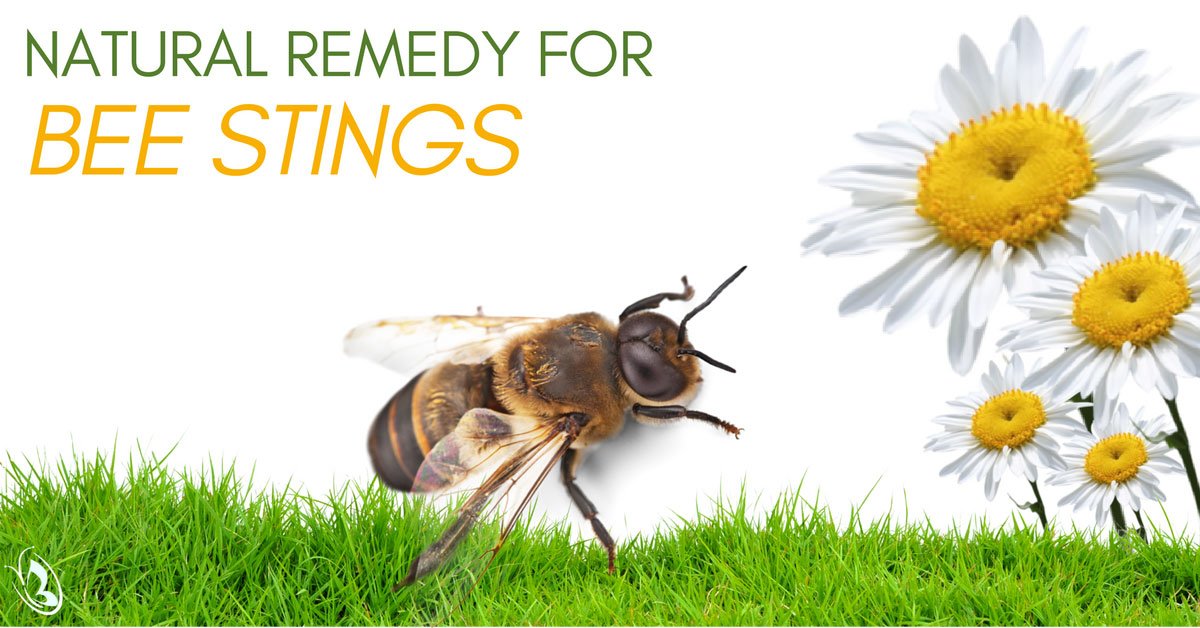
Natural Remedy for Bee Stings: The 7-Minute Field Protocol + Aromatherapy Guide (2026)
If you have just been stung and you can read this calmly, that is the first piece of good news: ordinary bee, wasp, and hornet stings almost always settle down with simple home care. A natural remedy for bee stings is not one magic ingredient; it is a short, calm sequence. Remove the stinger the right way, cool the skin, choose a pantry-based topical, then let a steady aromatherapy environment carry you through the next few hours.
This 2026 guide walks through that sequence in plain English. You will find the seven-minute field protocol, the six warning signs that mean stop and call for help, the chemistry behind honey and baking soda poultices, a safe topical dilution chart for essential oils, and the role of a true Nebulizing Diffuser® in setting a recovery atmosphere. Everything here is written so a non-allergic adult or a careful parent can act with confidence in the moment, and so you understand why each step works rather than just being told to do it.
What Just Happened: The First 7 Minutes

Almost every panic moment after a sting comes from doing too much, too fast. The first seven minutes shape the rest of the day, so handle them in order:
- Move away from the area. Honeybees can only sting once and the act is fatal for them, but wasps, hornets, and yellow jackets sting repeatedly and signal nearby kin with alarm pheromones. Walking calmly twenty or thirty feet away is safer than swatting.
- Scrape, do not pinch, the stinger. Honeybee stingers continue pumping venom for up to a minute after the bee is gone. Squeezing with tweezers or fingernails compresses the venom sac and pushes more melittin and apamin into the skin. Scrape sideways with the dull edge of a credit card, a clean butter knife, or a fingernail held flat.
- Wash the site with cool soap and water. This carries away surface venom, dirt, and any bacteria the stinger picked up on its way in.
- Apply a cold pack for ten minutes on, ten minutes off. Cold tightens local blood vessels, which slows the spread of venom proteins and dampens swelling and itch. Wrap ice in a thin cloth so you are not freezing the skin directly. The U.S. Centers for Disease Control still names cold compression as the single most reliable first step for insect bites and stings, ahead of any specific topical.
- Elevate if you can. A sting on the wrist or ankle behaves more politely when the limb is raised on a pillow for the first hour. Gravity is on your side here.
- Resist the urge to scratch. Histamine release at the site causes the itch; scratching releases more histamine, breaks the skin barrier, and invites infection. Keep your hands busy with the next step instead.
- Choose one topical soother and apply it. Not a stack of four. Pick honey, baking soda paste, apple cider vinegar, or a diluted essential oil blend. Give it twenty to thirty minutes before deciding it is not working.
If you do that calmly and in that order, most healthy adults will see the swelling plateau within the first hour and start to subside by hour three. The rest of this guide is about what to put on the skin and what to put in the air during that window.
Stop and Check: The Warning Signs That Mean Skip Home Care
Sign Up to Get Your FREE
e-Book Here…
Every honest article on a natural remedy for bee stings has to start with a hard line: home care is for local reactions in people who are not allergic. If any of the following appear within minutes to a couple of hours of being stung, stop reading and get medical help right away. This is a non-negotiable safety filter:
- Hives or welts spreading away from the sting site, especially on the face, chest, or back
- Swelling of the lips, tongue, throat, or eyelids
- Difficulty breathing, wheezing, or a sudden tight or scratchy feeling in the throat
- Dizziness, lightheadedness, fainting, or a rapid or weak pulse
- Nausea, vomiting, cramping, or sudden diarrhea after the sting
- A previous severe reaction to any sting, or a known venom allergy in the household
These are signs of anaphylaxis, a whole-body allergic reaction that can escalate in fifteen minutes. If anyone carries an epinephrine auto-injector for known sting allergy, this is the moment to use it and then still call emergency services. Multiple stings in one event (more than ten in a healthy adult, or more than a few in a child) also warrant a call to a clinician even without obvious allergic signs, simply because the total venom load adds up.
Two quieter signs are also worth respecting: a sting inside the mouth or throat (which can swell on its own without an allergy), and any sting that does not seem to settle at all over 24 hours. Both deserve a phone call to a doctor. Nothing in the home-remedy world is a substitute for trained eyes when the situation drifts outside the ordinary.
Pantry-First Soothers (and the Chemistry of Why They Actually Work)
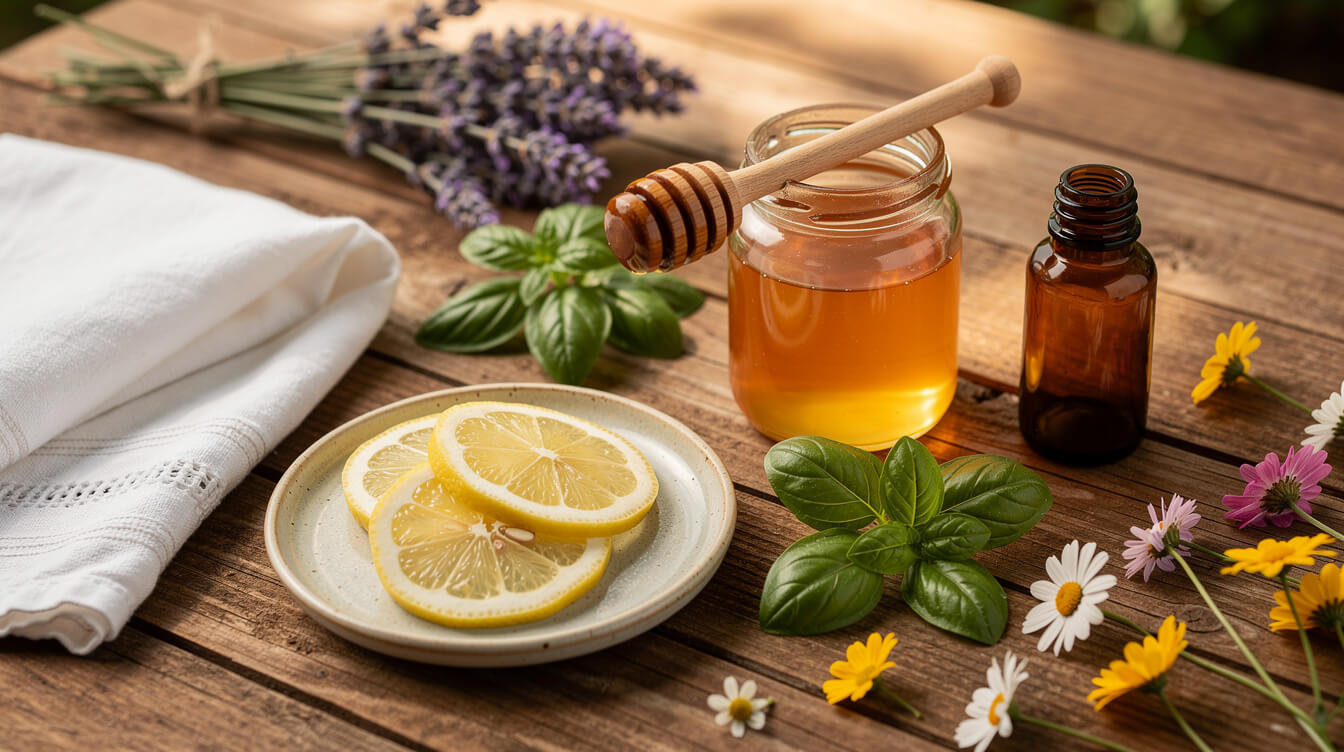
Most kitchens already hold three excellent options. Each works through a different mechanism, so pick the one whose action best matches what is bothering you most: pain, swelling, or itch.
Raw Honey: the Slow, Gentle Hero
It feels almost poetic to use honey on a bee sting, but the rationale is real. Raw, unprocessed honey produces small amounts of hydrogen peroxide through an enzyme called glucose oxidase, which gives it a mild antiseptic effect on broken skin. Its high sugar content also draws water out of irritated tissue (an osmotic pull) that reduces local swelling. Apply a thin layer over the cleaned sting site, cover with a loose bandage or square of gauze so the honey does not migrate, and leave for thirty to sixty minutes before rinsing.
Use raw, opaque, slow-pour honey rather than the clear, pasteurized supermarket variety. The pasteurized kind has been heated and filtered enough to inactivate most of the enzyme that produces the helpful peroxide.
Baking Soda Paste: Itch and Swelling, Fast
Wasp venom skews acidic, while bee venom skews mildly acidic to neutral, so a mildly alkaline paste of baking soda and water is a reasonable buffer for either. More importantly, the paste cools the skin as it dries and creates light osmotic pressure on the swelling. Mix roughly one teaspoon of plain baking soda with just enough water to make a thick paste, smooth it over the sting, and leave for ten to fifteen minutes before rinsing with cool water. Repeat after a one-hour break if the itch returns.
Raw Apple Cider Vinegar: a Targeted Counter to Itch
For wasp stings in particular, dabbing the site with a cotton ball soaked in raw, unfiltered apple cider vinegar can blunt the burning-itch sensation within minutes. The mild acid changes the local skin pH and seems to interfere with the irritant receptors firing under the surface. Hold the cotton ball in place for five to ten minutes; if the skin feels stung by the vinegar itself, dilute it 1:1 with cool water before reapplying. Sensitive skin and children’s skin almost always need that dilution.
What About the Plantain Leaf Trick?
If you garden or hike, plain broadleaf plantain (Plantago major) growing along most lawns and trails is a respected old-school field poultice. Chew or crush one or two clean leaves, place the resulting paste on the sting, and hold for ten to fifteen minutes. Plantain contains the iridoid glycoside aucubin, which is mildly antiseptic, and its high mucilage content forms a soothing barrier. Yarrow and fresh basil leaves work in a similar way. None of these are required, but if you are caught out in the open without a kitchen, knowing the plant is a quiet superpower.
Bee, Wasp, or Hornet? Knowing Changes Your Plan
Sign Up to Get Your FREE Essential Oils e-Book Here
People say “bee sting” generically, but the insect matters for two reasons: how many times it can sting you, and what its venom actually contains. A quick field identification saves time on aftercare and helps you avoid a second hit.
- Honeybees are fuzzy, golden-brown, roughly half an inch long, and almost always associated with flowers, hives, or a calm hum. They sting once and die. The stinger stays behind, so removal (scraped, not pinched) is the priority. Venom is acidic enough that some people swear baking soda paste is the cleanest match.
- Bumblebees are larger, rounder, and very fuzzy. They almost never sting unless physically handled or trapped, and like honeybees they leave a stinger. Treat exactly like a honeybee sting.
- Yellow jackets are slim, smooth, sharply yellow-and-black, and the species most likely to crash your picnic. They sting repeatedly and aggressively, especially in late summer when their colonies are stressed. No stinger to scrape; just clean, cool, and treat.
- Paper wasps are slender, brownish or reddish, with long dangling legs in flight. They sting more than once if they feel cornered. Their venom is more alkaline, which is the basis of the old “vinegar for wasps, baking soda for bees” rule of thumb.
- Hornets (including bald-faced hornets) are large and fast and pack the highest dose of venom per sting. They will pursue a perceived threat well away from the nest. Hornet stings tend to hurt more, swell more, and itch longer; the protocol stays the same, but expect to repeat the cold-pack and topical cycle for a full day.
One practical note that gets overlooked: if you are stung near a nest, walk (do not run) directly away from the area for at least fifty feet before you stop to treat. Alarm pheromones travel quickly, and the worst thing you can do is sit down ten feet away to apply your baking soda paste. Treat the sting somewhere quiet.
Essential Oils for Sting-Site Comfort: The 5% Topical Dilution Math
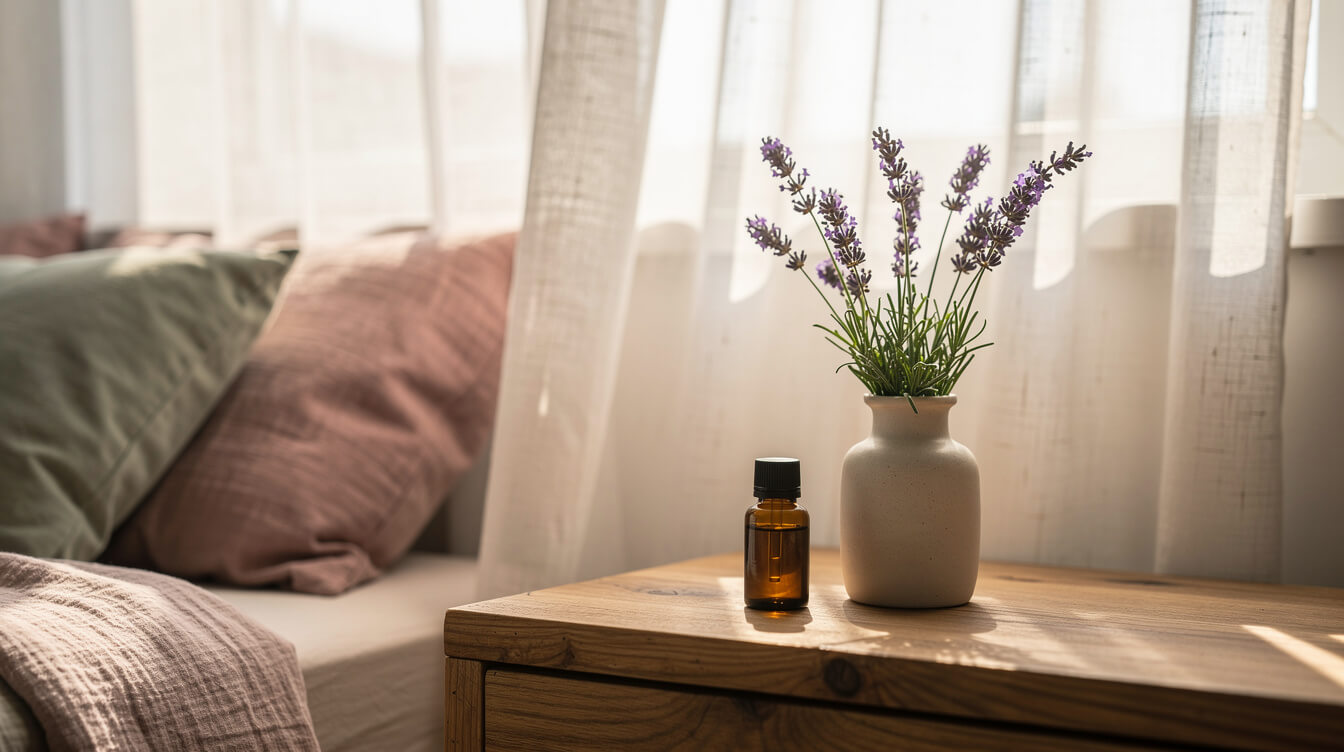
Essential oils belong in this conversation, but with one important framing: on a sting, you are using them topically, diluted into a carrier oil, on a single small spot. This is not aromatherapy in the inhalation sense yet (that part comes in the next section). Topical application is where careful arithmetic matters.
The standard cosmetic dilution for essential oils on intact adult skin is 2%. For a small, targeted spot like a sting, where you want a stronger local effect on a square inch of skin and not on the whole arm, you can step up to 5%. That math is friendlier than it sounds:
- 5% spot dilution: 5 drops of essential oil per 1 teaspoon (5 ml) of carrier oil
- 2% body dilution (for children over two, sensitive skin, or larger areas): 2 drops per 1 teaspoon of carrier oil
- 1% gentle dilution (for facial skin, very young children, pregnancy): 1 drop per 1 teaspoon of carrier oil
Mix in a small ceramic ramekin or dark glass dish, dip a clean cotton swab into the blend, dab onto the sting, and re-apply every two to three hours for the first day. Choose your carrier oil by what you have on hand and how the skin feels: fractionated coconut oil for a light, fast-absorbing feel; sweet almond or jojoba for slightly slower, more nourishing slip; olive oil in a pinch.
The Five Essential Oils Worth Reaching For
- Lavender (Lavandula angustifolia). The first oil most aromatherapists name for sting comfort, and for good reason: its dominant constituents linalool and linalyl acetate are both well studied for soothing irritated skin. The exact linalool to linalyl-acetate ratio in your bottle is what decides whether you feel a soft, herbaceous calm or a sharp, camphorous note; for sting comfort, a lavender with at least 30% linalyl acetate behaves best.
- Tea Tree (Melaleuca alternifolia). A clean, sharp oil rich in terpinen-4-ol with a long aromatherapy track record for keeping a small skin disruption tidy. See our full guide to Tea Tree’s chemistry and uses. Always dilute; tea tree is one of the few oils that can sting tender skin if applied neat.
- Eucalyptus (Eucalyptus globulus). Its hallmark monoterpene 1,8-cineole gives a cooling, clearing sensation that pairs well with the after-feel of a cold pack. Our complete eucalyptus guide covers its full chemistry and blending notes. Skip for children under ten and for anyone with a history of breathing sensitivity to camphor-style oils.
- Roman Chamomile (Chamaemelum nobile). The quietest, most forgiving oil on this list. High in calming esters, particularly suited to children’s sensitive skin at the 1% dilution. Has a soft apple-floral note that most people find pleasant.
- Sweet Basil (Ocimum basilicum). An underused classic for skin irritation, especially when paired one drop to one drop with lavender at the 5% spot dilution. Its dominant linalool reinforces lavender’s calming work without adding heat.
One simple blend for the daypack: 3 drops lavender + 1 drop tea tree + 1 drop chamomile in 1 teaspoon of jojoba. Pre-mix it in a small dark glass bottle the day before a hike, and you have a 5% spot solution that travels well. If you would rather skip the mixing, a ready-to-use Lavender roll-on essential oil from your bag will do the same job in one motion.
What to Avoid on a Sting
Cinnamon, clove, oregano, and thyme are powerful in the right context, but their high phenol and aldehyde content makes them too irritating for already-inflamed skin. Citrus oils (lemon, bergamot, grapefruit) can be photosensitizing on sun-exposed skin for up to twelve hours, which is the opposite of what you want on a summer arm. Save those for the Nebulizing Diffuser®, not the cotton swab.
Atmosphere Aftercare: How Pure Aromatherapy Supports Recovery
Join Now and Get a Coupon for 10% Off!
The topical work is only half the equation. A sting is a small physical shock that often comes with an outsized emotional one, especially for children or anyone who has been jumpy around insects since the last time it happened. The hours after a sting are an excellent moment for a calm, low-effort aromatherapy environment. This is where a true Nebulizing Diffuser® earns its keep.
The reason matters. Ultrasonic diffusers mix essential oils with water and break the mixture into a fine mist using a vibrating disc, which dilutes the aromatic molecules and shortens their useful life in the room. Reed diffusers use a slow-evaporating synthetic carrier that often masks the natural oil chemistry. Heat-based plug-ins (the kind that burn a wax or a pad) literally cook the most volatile and most calming molecules out of the oil before they ever reach the air.
A Nebulizing Diffuser® uses Bernoulli’s Principle: a small air stream draws pure, undiluted essential oil up a glass tube and shears it into ultra-fine droplets in the room air. No water, no heat, no plastic in the oil path. The same linalool and 1,8-cineole and terpinen-4-ol that work on the sting topically arrive in the air at full strength. The complete guide to nebulizing aromatherapy covers the physics in detail; the short version is that it is the only home delivery method that does not compromise the molecules you actually wanted.
Two Recovery Blends for the Nebulizing Diffuser®
These are short, three-oil blends sized for a typical desktop Nebulizing Diffuser® session of fifteen to thirty minutes. Add the drops directly to the empty glass reservoir and run the unit on a low intermittent cycle.
- The “settle down” blend. 4 drops Lavender + 2 drops Roman Chamomile + 2 drops Bergamot. Soft, slightly sweet, very forgiving. Good for the first hour back inside.
- The “clear-headed” blend. 3 drops Eucalyptus + 3 drops Lemon + 2 drops Peppermint. A brisker, cooler atmosphere that pairs well with a cold cloth on the sting site and a glass of water. Use earlier in the day, not before sleep.
For anyone who tends toward anxiety after an unexpected scare, our broader piece on calming aromatherapy oils walks through nine more options and the plant chemistry that supports them. A quiet bedroom session in the evening, with the Nebulizing Diffuser® running for fifteen minutes and then off, is the kind of small ritual that turns a bumpy afternoon into a restful night. If your bedroom is small or you sleep light, our quietest bedroom-friendly Nebulizing Diffusers® are sized for exactly that scenario.
Frequently Asked Questions About Natural Bee Sting Remedies
What is the fastest way to soothe a bee sting?
The fastest comfort comes from a sequence, not a single trick. Scrape the stinger out within the first minute, wash the site with cool soap and water, apply a cold pack for ten minutes, then choose one pantry soother (honey, baking soda paste, or apple cider vinegar). Most non-allergic adults feel a noticeable drop in pain and itch within fifteen to twenty minutes of finishing that sequence.
How do you stop a bee sting from itching?
Itch comes from histamine release at the sting site. Cold is the simplest counter; a cold pack or a chilled wet cloth applied for ten minutes on, ten minutes off blunts the histamine cycle. After the skin has cooled, a 5% spot dilution of lavender and Roman chamomile in jojoba oil takes over for the next few hours. Avoid scratching; scratching releases more histamine and restarts the itch clock.
Does toothpaste really work on a bee sting?
It works inconsistently. The mild alkalinity of some toothpastes can temporarily neutralize the discomfort of an acidic honeybee sting, but most modern toothpastes also contain peppermint or menthol that irritates already-sensitive skin, and abrasive whitening agents that you do not want on a broken skin barrier. A baking soda paste does the alkaline job more cleanly. Save the toothpaste for your teeth.
Can you put lavender essential oil directly on a bee sting?
Lavender is one of the few oils traditionally considered safe enough for very short, undiluted use on small adult skin areas, but the careful answer for 2026 is to always dilute. A 5% spot dilution (5 drops lavender per teaspoon of carrier oil) works just as well, is gentler on children, and reduces the small risk of sensitization that comes from repeated neat application of any essential oil over years.
How long does a normal bee sting last?
For a non-allergic adult, expect mild pain and burning for the first few hours, peak swelling and itch in the first 24 hours, and gradual fade over two to five days. Honeybee stings often clear within 48 hours; wasp and hornet stings can linger for three to five days because of higher venom volume. If a sting is still angry-looking, hot, and growing on day three, that is a sign of possible infection rather than ongoing reaction, and a clinic visit is worth the trip.
Are essential oils safe to diffuse around pets after a sting in the house?
Cats in particular metabolize phenol-rich essential oils slowly and can build up toxicity over time. The two blends recommended above are written for human-only rooms. If pets share the space, keep the Nebulizing Diffuser® session short (under fifteen minutes), make sure the animal can leave the room freely, and prefer the lavender and chamomile blend over the eucalyptus and peppermint one. When in doubt, run the unit in a closed room your pet does not have access to.
Should I diffuse essential oils before or after applying the topical remedy?
Either order works. A common pattern is: cold pack and topical first, then a short Nebulizing Diffuser® session about thirty minutes later, once the worst of the pain has stepped back. The aromatherapy session is for atmosphere and emotional reset; the topical is for the skin. They are not competing for the same job.
The Calm Takeaway
A bee sting is rarely the emergency it feels like in the first minute. The real natural remedy for bee stings is a calm, ordered sequence: scrape, wash, cool, soothe, breathe. Choose one pantry-based topical, follow it with a careful 5% essential oil spot dilution if you want a stronger second wave, and let a Nebulizing Diffuser® running pure essential oils carry the atmosphere of the next hour or two. Watch for the warning signs of allergic reaction; trust your instincts if something feels bigger than ordinary; and treat the whole event as an excuse for a quiet evening with the windows open and something soft on the Nebulizing Diffuser®.
If you want to deepen your home aromatherapy practice for everything from summer scrapes to the steady rhythms of sleep and focus, our team has been hand-building Nebulizing Diffusers® and writing about the chemistry behind them for more than a decade. We will be here the next time the picnic gets interesting.

From personal experience I’ve found that putting tomato sauce on a bee sting tremendously helps! I just got stung today and honey did nothing to stop the pain, but within maybe 10 seconds of applying tomato sauce the pain dimmed dramatically. My dad got stung by a wasp a little while ago in a cafe and we had nothing to help with the pain except tomato sauce and after about a minute since applying it he said the pain had definitely dulled.
I have used the baking soda trick – it does work. Hardest part is getting the stinger out in piece.
Great to know article. I did not know about Meat tenderizer as a Natural Remedy for Bee Stings.
People don’t distinguish between bees and wasps most of the time. Bees would rather not sting you because when they do, they die. Please don’t bother them and they won’t bother you.
Helpful information, I didn’t know about the use of essential oil.
Great ideas
We have used the first three but never thought of adding essential oils….
ty for the info and will be sharing 🙂
Very informative and interesting information! So many Great Remedies for Bee Stings. Thank you!
I am differently sharing this with all my friends.. thank you!!
I am going to share this info with friends and family. There will surely be someone benefit this spring and summer.
Thank you!!!
I’ve been stung so many times in childhood! I wonder if they react to a certain chemical that is from a certain diet or something?
I’ve been stung twice on the sole of my foot as a kid, from memory a baking soda paste helped a lot with the itch – my mum uses this remedy for any type of bite! 🙂
I did not know you can use essential oils for insect stings. I learned something new!
I’ve used baking soda for bee stings before.
Very informative & timely article!
It’s good to know
Good remedies. I didn’t know about the honey.
Thank you for this information 🙂 I’ve knowledge of some of the remedies, but definitely not all!
Good article!
I can honestly say I have never been stung but this is great info to know!
Pinning this!