

What Does Vetiver Smell Like? Smoky Earth, Wet Roots, and the Bacteria That Help Make the Scent
What does vetiver smell like? Earthy, smoky and woody, like damp roots pulled from dark soil, with a dry, slightly leathery finish and a surprising flash of grapefruit-green at the very top. It’s cool rather than warm, deep rather than sweet, and it lingers for hours. If patchouli is the smell of the forest floor, vetiver is the smell of what’s underneath it.
That’s the answer you’ll find on every candle and cologne page ranking for this question. This guide goes underground. We’ll name the trace molecule, less than a rounding error in the bottle, that chemists finally proved is the real “vetiver” smell in 2021. We’ll explain why part of the scent appears to be made with help from bacteria living inside the root, why the grass itself barely smells of anything, and why the Indonesian vetiver we bottle smells smokier than the Haitian vetiver in most perfumes. Then we’ll cover what smells similar, three blends, and how to diffuse such a thick oil without trouble.
What Does Vetiver Smell Like? The Short Answer
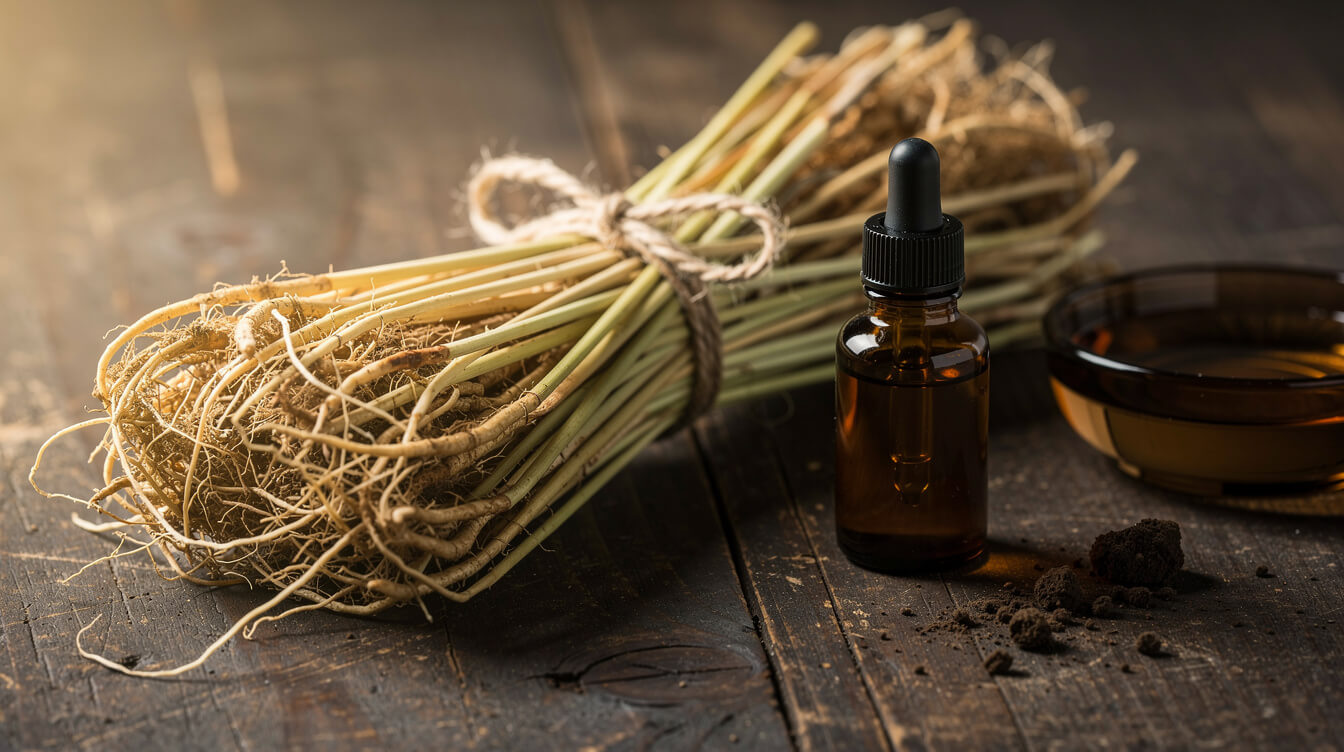
Vetiver oil is steam-distilled from the roots of Chrysopogon zizanioides, a tall tropical grass. Ask perfumers, and the same handful of words comes back every time:
Earthy and rooty. The core of it. Freshly turned soil, a root cellar, wet stone after rain.
Smoky. A dry, almost charred note, stronger in some origins than others (more on that below).
Woody and dry. Not the creamy wood of sandalwood or the pencil-shaving wood of cedar. Vetiver’s wood is fibrous and slightly bitter, like the inside of a basket.
Green and faintly citrus. In the first minutes there’s a cool, grassy, grapefruit-peel brightness that surprises people who expect only earth.
Leathery and nutty in the dry-down. After an hour, the smoke softens into something warm, dry and a little like roasted nuts or old leather.
How vetiver changes on a paper strip
Dip a paper strip and smell it at three points. In the first minute you get the green, grapefruit-like lift with earth right underneath. At thirty minutes the heart opens: smoky, rooty, deep. Hours later (often the next morning) the strip still smells of dry, clean wood with a whisper of sweetness. Vetiver is one of the longest-lasting oils in any collection, which is why perfumers treat it as a fixative that holds lighter notes in place.
What vetiver does not smell like
It isn’t sweet, floral or fruity, and despite the grass, it isn’t “grassy” in the lawn-clippings sense. It’s also not the bright, lemony grass smell of lemongrass, a cousin in the same grass family. If a vetiver candle smells powdery-sweet and instantly loud, you’re usually smelling a perfumer’s accord built around a little vetiver (or a vetiver derivative), not the oil itself. Our vetiver essential oil guide covers how the oil is extracted and used.
The Trace Molecule That Makes Vetiver Smell Like Vetiver
Vetiver oil is one of the most complicated materials in perfumery. Chemists have identified around 155 components in it, out of several hundred related sesquiterpene molecules. The single biggest one is usually khusimol, a heavy alcohol. You’d expect the biggest molecule to carry the smell. For decades nobody could say for sure which one did.
In 2021, a team led by Benjamin List (who shared the 2021 Nobel Prize in Chemistry that same year for organocatalysis) and Givaudan fragrance chemist Philip Kraft settled the question. Writing in Angewandte Chemie, they built one candidate molecule from scratch in an eleven-step synthesis so they could smell it pure, with no other vetiver compounds around it. The winner was a ketone with an unwieldy name: (+)-2-epi-ziza-6(13)-en-3-one. They described it as having the “pronounced and typical vetiver character,” a dry, transparent, woody-ambery note.
29 trillionths of a gram
The number that makes this molecule special is its odor threshold: 29 picograms per liter of air. A picogram is a trillionth of a gram. For comparison, khusimone, the vetiver ketone perfumers had long pointed to, makes up about 2% of the oil and has a threshold of 4.7 nanograms per liter. That’s about 160 times weaker. So a molecule present only in trace amounts can out-shout the oil’s bulk ingredients, simply because your nose is so much more sensitive to it.
Vetiver’s smell, decoded by molecule
The same paper summarized where vetiver’s other facets come from, which maps neatly onto what you smell on the strip:
Grapefruit-green top: α-vetivone, β-vetivone and nootkatone. Nootkatone is also the signature molecule of grapefruit itself, which is why the two oils pair so well.
Earthy, damp-soil note: geosmin, the same molecule behind the smell of rain on dry ground (our petrichor post explains why your nose is so tuned to it).
Creamy, sandalwood-like softness: mainly isovalencenol.
The “this is vetiver” signature: 2-epi-ziza-6(13)-en-3-one, plus related ziza-ketones.
This is also why the old claim that “vetiver can’t be copied” has held up so well. The key note lives in a trace molecule that took a Nobel laureate’s lab eleven steps to make. If you love decoding scents this way, our companion piece on what sandalwood smells like tells a similar one-molecule story.

Sign Up to Get Your FREE
e-Book Here…
Why the Grass Doesn’t Smell but the Root Does

People who see vetiver growing for the first time are often disappointed. Brush the long, stiff blades and you get very little: a faint, ordinary green-grass smell. That’s because the plant doesn’t store its aromatic oil in the leaves at all. It stores it underground, in specialized oil-producing cells in the root’s outer tissue, the cortex.
And there’s a lot of root. A mature vetiver clump sends a dense, fibrous curtain of roots straight down, often 2 to 3 meters deep. That’s why the plant is famous in erosion control as a living retaining wall. Growers usually wait 18 months or more before digging. The roots are washed, dried and chopped, then distilled for many hours, because the heavy molecules are reluctant to leave the plant material.
The bacteria in the bottle
Here’s the part no candle or cologne page mentions. In 2008, Italian researchers (Del Giudice and colleagues) published a study in Environmental Microbiology titled “The microbial community of Vetiver root and its involvement into essential oil biogenesis.” Using light and electron microscopy, they found bacteria living inside the very cells that produce vetiver oil, sitting in close contact with the oil itself.
Their findings went further than “there are microbes in the root”:
Sterile plants made a different oil. Vetiver grown in the lab with no microbes produced only trace amounts of oil, and with a strikingly different composition from field-grown plants.
The bacteria could rework the oil. Root bacteria isolated by the team could feed on vetiver’s sesquiterpenes and, in doing so, released many compounds that are typical of commercial vetiver oils.
They seemed to switch on the plant’s own chemistry. Several strains could trigger expression of a vetiver sesquiterpene synthase gene, one of the plant’s oil-building enzymes.
The authors framed this carefully, as support for a hypothesis rather than a closed case, and the 2021 Angewandte paper still calls bacterial involvement a matter of speculation. But it’s a lovely idea to hold while you smell the oil: some of that earthy depth may be a joint production between the root and its microbes. It also helps explain why vetiver from different soils smells so different, which brings us to your bottle.
What Smells Similar to Vetiver? Plus Three Vetiver Blends
No other oil is a perfect substitute, but several share part of vetiver’s personality. Knowing which part helps you blend:
Patchouli: the closest relative in mood. Both are earthy, dark and long-lasting, and both carry geosmin-like soil notes. Patchouli is sweeter, more camphorous and more “wet forest floor”; vetiver is drier, smokier and more rooty.
Cedarwood: shares the dry wood and the staying power, without the earth or smoke. Cedarwood makes vetiver feel cleaner and more structured.
Grapefruit: the surprise match. Because both contain nootkatone, grapefruit amplifies vetiver’s hidden citrus top. It’s a classic perfumery pairing.
Sandalwood and amyris: creamy woods that echo vetiver’s soft isovalencenol facet.
Oakmoss and smoky tea: in perfume, vetiver often sits beside mossy, inky and lapsang-souchong-style smoky notes. These come from other materials, but if you love those smells, you’ll probably love vetiver.
Three blends that show off vetiver
Each recipe is in parts, so you can scale it to your bottle. Keep vetiver at roughly a quarter or less of the mix, for reasons we’ll cover in the next section. Mix in a clean glass vial and let it rest a day.
Grapefruit Root: 5 parts Grapefruit, 3 parts Bergamot, 2 parts Vetiver. The nootkatone pairing: bright, bitter-fresh citrus with a cool, earthy floor underneath.
Smoke & Spice: 5 parts Sweet Orange, 2 parts Cedarwood, 1 part Clove Bud, 1 part Black Pepper, 1 part Vetiver. Warm, dry and autumnal, like a wood-paneled room on a cold evening.
Night Garden: 4 parts Lavender, 3 parts Bergamot, 2 parts Ylang Ylang, 1 part Vetiver. Floral and soft on top, with vetiver giving the blend a grounded, velvety finish.
For more pairing ideas, our Amber Hour blend pairs vetiver with sweet orange and clove bud, and the essential oil blending chart explains how to balance top, heart and base notes.

Sign Up to Get Your FREE Essential Oils e-Book Here
Diffusing Vetiver in a Nebulizing Diffuser®

A Nebulizing Diffuser® works on Bernoulli’s Principle: a fast stream of air passing over a fine glass tube draws pure oil up and breaks it into a microscopic mist. There’s no water and no heat. For an oil whose character depends on trace molecules, that matters. Heat favors the lightest molecules first, so vetiver’s grapefruit-green top can vanish while the heavier smoke lingers, and water dilutes an oil that’s already quiet in the air. Cold atomization sends the whole oil into the room together.
Thick oil, thin partner
Vetiver’s heavy molecules give it a thick, slow, syrupy texture, and on its own it barely climbs the fine glass tube of a Nebulizing Diffuser®. The fix is simple: use vetiver as the base of a blend, not the whole bottle. Keep it to about a quarter or less and let thinner oils like citrus or lavender carry it, as in the blends above. Our FAQs on why sandalwood and vetiver barely nebulize and using thick oils in a Nebulizing Diffuser® walk through the details. If a vetiver-heavy blend has left residue, wipe the glass with a little isopropyl alcohol once it’s cool and dry.
Smell it from the doorway
Because vetiver is a low, slow scent, you’ll notice it most when you walk back into a room, not while sitting next to the glass. Run a short, intermittent cycle, leave for ten minutes and come back. That’s when the earthy, smoky depth reads clearly. You can browse every handcrafted model in our handcrafted Nebulizing Diffuser® collection.
Java vs. Haiti: Why Some Vetiver Smells Smokier
Vetiver isn’t one smell. It changes with where it’s grown, and perfumers sort it mainly by origin. Haiti is the giant: according to the 2021 Angewandte paper, about 60% of the world’s vetiver oil comes from the Les Cayes area of southern Haiti, out of a global market of roughly 300 to 400 tonnes a year. Indonesia, centered on the Garut region of West Java, is another major source, alongside India, Réunion (“Bourbon” vetiver) and others.
How the origins compare
Haitian vetiver: the classic perfumery style. Cleaner and brighter, with a clear grapefruit-green top, refined dry wood and only a touch of smoke.
Javanese (Indonesian) vetiver: darker and noticeably smokier from the first sniff, with a deeper earthy body and a spicier, longer dry-down. The smoke softens over time, leaving sweet, dry wood.
Indian vetiver (khus): the traditional oil, often from wild or heritage plants. It’s frequently described as greener and more rooty-herbal, prized in attars.
Soil, climate, plant variety and distillation practice all play a part. And if the 2008 bacteria research holds up, so do the microbes living in each region’s roots.
What’s in our bottle
Our Vetiver Essential Oil is sourced from Indonesia, so it sits on the darker, smokier side of the family. That makes it a strong, grounding base in small amounts and a natural match for citrus, spice and woods. If you’ve only smelled vetiver in a bright Haitian-style cologne, expect ours to read deeper and more earthy. If you’re after the brighter side, pair it with grapefruit as in the Grapefruit Root blend above.

Join Our Exclusive Member Club to get Big Discounts!
What Does Vetiver Smell Like? FAQs
How would you describe the smell of vetiver?
Earthy, smoky and woody, like damp roots and dark soil, with a cool grapefruit-green lift at the top and a dry, leathery, slightly nutty finish. It’s deep rather than sweet and lasts for hours.
What does vetiver grass smell like?
The living grass smells of very little, just faint green grass. The aromatic oil is stored in the roots, so the famous vetiver smell only appears when the roots are dug, dried and distilled.
What smells similar to vetiver?
Patchouli is the closest in mood (earthy and dark, but sweeter). Cedarwood shares the dry wood, and grapefruit shares the citrus top, since both contain nootkatone. In perfume, vetiver often sits beside oakmoss and smoky tea notes.
Why does my vetiver smell different from a vetiver cologne?
Origin and formulation. Many colognes use bright Haitian vetiver or vetiver derivatives in a blended accord. Indonesian vetiver, like ours, is darker and smokier. A cologne also carries many other notes that change how vetiver reads.
Is vetiver a masculine scent?
It has a long history in men’s fragrance, but the smell itself is unisex. Paired with citrus and spice it leans classic-cologne; paired with ylang ylang, rose or lavender it reads soft and floral-woody.
Can I diffuse vetiver on its own?
It’s too thick to nebulize well by itself. Use it as about a quarter or less of a blend with thinner oils such as citrus, bergamot or lavender.
Is it safe to diffuse vetiver around family and pets?
Diffuse in a ventilated room, keep sessions short and intermittent, and make sure pets can leave the room. If you’re pregnant, nursing, managing a health condition or taking medication, ask your clinician before using any essential oil. Never ingest essential oils.
So what does vetiver smell like? Earth, smoke and dry roots, with a hidden flash of grapefruit, built on a trace molecule your nose can detect at 29 trillionths of a gram per liter, and perhaps shaped in part by the bacteria living in the root. Once you know that, you’ll smell it differently. To bring that cool, grounded depth home, start with our pure Vetiver Essential Oil, one of the blends above and a short, intermittent setting. For more ways to use it, see our Oil of the Day on vetiver.