

Essential Oil Blending Chart: Ratios, Notes & the Science of Scent
An essential oil blending chart is the fastest way to stop guessing and start building blends that actually smell balanced — but most charts only hand you ratios, not the reason those ratios exist. If you’ve ever loaded a blend into your Organic Aromas Nebulizing Diffuser® and the scent came out stronger, weaker, or just different than you expected, the recipe usually isn’t the problem. It’s the chemistry of how different oil molecules evaporate, and how your diffusion method treats them.
Below you’ll find a complete essential oil blending chart covering all five aroma families, the real science behind the 30/50/20 note ratio (the part most guides skip), safe dilution numbers for topical blends, five tested starter recipes, and the one mechanical detail that decides whether your blend smells the way you designed it from the first mist to the last.
Essential Oil Blending Chart: Quick-Reference Guide
Oils fall into five fragrance families — Citrus, Floral, Herbal, Spicy, and Woody — and each one tends to play a top, middle, or base role in a blend. A zesty top-note blend can brighten a room in seconds; a woody base note settles in and lingers for hours. This chart follows the 30/50/20 rule: 30% top notes, 50% middle (heart) notes, and 20% base notes, measured by drop count rather than volume.
Families mix in predictable ways. Citrus pairs well with Floral, Woody, Herbal, and Spicy oils. Floral teams up with Herbal and Woody for soft bouquets. Herbal adds a fresh edge to Citrus or Floral. Spicy oils bring warmth to Citrus or Floral blends. Woody oils anchor Floral or Herbal combinations with deep, grounding depth.
| Oil Family | Example Oils | Note Role | Compatible With | Typical Ratio (drops) | Why It’s Used |
|---|---|---|---|---|---|
| Citrus | Bergamot, Lemon, Sweet Orange | Top | Floral, Woody, Herbal, Spicy | 3 | Bright, fast-opening scent |
| Herbal | Eucalyptus, Rosemary, Peppermint | Top – Middle | Citrus, Floral | 3–5 | Fresh, clarifying edge |
| Floral | Lavender, Geranium, Chamomile | Middle | Citrus, Herbal, Woody | 5 | Rounds out the body of the blend |
| Spicy | Cinnamon Leaf, Ginger, Clove Bud | Middle | Citrus, Floral | 5 | Adds warmth and depth |
| Woody | Sandalwood, Cedarwood Atlas, Frankincense, Vetiver | Base | Floral, Herbal | 2 | Grounds and extends the scent |
Want a hands-on way to test family pairings before committing a full bottle? Our Essential Oil Blending Lab Kit comes with sample sizes across all five families, so you can experiment with ratios before buying full-size bottles.
Why the 30/50/20 Ratio Actually Works (The Chemistry Most Charts Skip)
Every essential oil blending chart tells you to use fewer drops of base notes and more drops of top notes. Almost none explain why — and the answer is volatility, not tradition.
Top-note oils like citrus and light herbals are made mostly of small, light monoterpene molecules (limonene, linalool) with boiling points roughly in the 175–220°C range. They evaporate fast, which is exactly why they hit your nose first — and exactly why a blend needs more of them (that 30%) to keep the opening impression from vanishing in minutes.
Base-note oils — sandalwood, frankincense, patchouli, vetiver — are built from heavier sesquiterpenes and alcohols with boiling points that often run 280–300°C or higher. They release slowly and linger for hours, which is why the chart only calls for 20%: a little goes a long way, and too much can smother the top and middle notes entirely.
Here’s the detail that matters once the blend leaves the bottle: how you diffuse it determines whether that ratio survives contact with the air. Heat-based diffusion (candle warmers, heated reservoirs, reed evaporation) preferentially drives off the lightest, most volatile molecules first — so a blend that smelled balanced in the bottle can smell citrus-heavy in the first ten minutes and nearly scentless by the second hour, as the top notes burn off faster than the base notes ever get a chance to release. Heavy base-note oils can also build up residue on ultrasonic membranes and heated wicks over time, since they’re too viscous to fully atomize through a vibrating membrane or wick the way lighter oils do — we cover that mechanism in detail in our guide to diffusing heavy base notes like vetiver.
A Nebulizing Diffuser® works differently: it uses Bernoulli’s principle — a fast-moving air current that mechanically pulls neat oil up a glass tube and atomizes it into a fine mist — with no heat and no water involved. Because the oil is atomized as a liquid mixture rather than selectively evaporated by molecular weight, the ratio you mixed is much closer to the ratio you actually smell, from the first minute of diffusing to the last drop in the tube. That’s the real reason a blending chart is worth following precisely if you’re nebulizing, and worth treating as a rough guideline if you’re not. (For a deeper side-by-side on how the two mechanisms compare, see our Nebulizing Diffuser® vs. ultrasonic diffuser breakdown.)
There’s also a perception factor layered on top of the chemistry: your nose doesn’t register every molecule equally. Heavy, resinous base notes tend to have very low odor detection thresholds — meaning it takes far fewer airborne molecules for your nose to notice them — while light top notes generally need a higher concentration in the air before they register at all. That’s part of why 2 drops of frankincense can hold its own against 3 drops of bergamot in the same blend: the ratio isn’t just about how fast each oil evaporates, it’s also about how sensitive your nose is to what’s being released.

Sign Up to Get Your FREE Essential Oils e-Book Here
Note Categories and Roles: Top, Heart, and Base
Three note categories work together to build a rounded blend. Top notes (light, fast-releasing) give a bright, immediate welcome. Heart notes (the core aromas) smooth the transition and add body. Base notes (deep, slow-releasing) anchor the blend so it doesn’t fade within the hour.
| Note Category | Role | Examples | Ratio |
|---|---|---|---|
| Top | Light, quick-release scent that arrives first | Bergamot, Lemon | 30% |
| Heart | Core aroma that fills out the body | Lavender, Geranium | 50% |
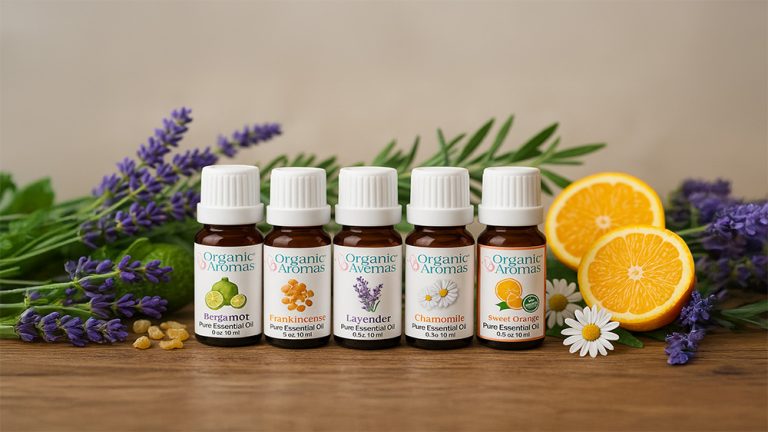
| Base | Rich, lingering scent that anchors the blend | Frankincense, Sandalwood | 20% |
Recipe Call-Out: Get Grounded
- 3 drops Bergamot
- 5 drops Lavender
- 2 drops Frankincense
Customization Tips for Building Your Own Blends
Once you’re comfortable with the base chart, here’s how to make it your own:
- Adjust one note category at a time. If a blend feels too sharp, cut a top-note drop before touching anything else — that’s usually the fix.
- Keep a simple log — a notebook or spreadsheet works fine. Note the date, exact drop counts, and which diffuser or carrier oil you used, since that changes how the blend reads.
- Let a new blend rest 48 hours before judging it. The molecules continue to interact after mixing, and a blend that smells sharp on day one often mellows into something rounder by day three.
- Swap within a family before swapping across one. Cedarwood Atlas for Sandalwood keeps the same base-note role with a warmer, woodsier finish — a much smaller change than replacing it with a citrus.
Sign Up to Get Your FREE
e-Book Here…
Safe Dilution and Carrier-Oil Ratios

A blending chart for your Nebulizing Diffuser® doesn’t need dilution — neat oil is the point. But the same ratios get applied differently once a blend goes onto skin in a carrier oil. Here are the dilution limits we recommend for topical blends:
| Application | Drops per 1 oz (30 ml) Carrier | Dilution | Carrier Oil |
|---|---|---|---|
| Children | 1–3 | ≈ 0.5% | Sweet Almond or Jojoba |
| Adults (daily/long-term) | 10–20 | up to 3% | Sweet Almond or Jojoba |
| Short-term (2 weeks or less) | 30–60 | up to 10% | Sweet Almond or Jojoba |
A few oils need extra caution regardless of dilution. Cold-pressed citrus oils — lemon, bergamot, grapefruit — are phototoxic, meaning they can cause skin reactions in sunlight after topical use. Keep lemon oil under 2%, grapefruit under 4%, and clove bud under 0.5% in any topical blend, and see our full dilution chart and safety guide for the complete list. Let a finished topical blend rest at least 48 hours in a cool, dark spot before using it — that gives the notes time to settle and reduces the chance of a sharp, unbalanced first impression.
5 Tested Blends to Start Your Chart With
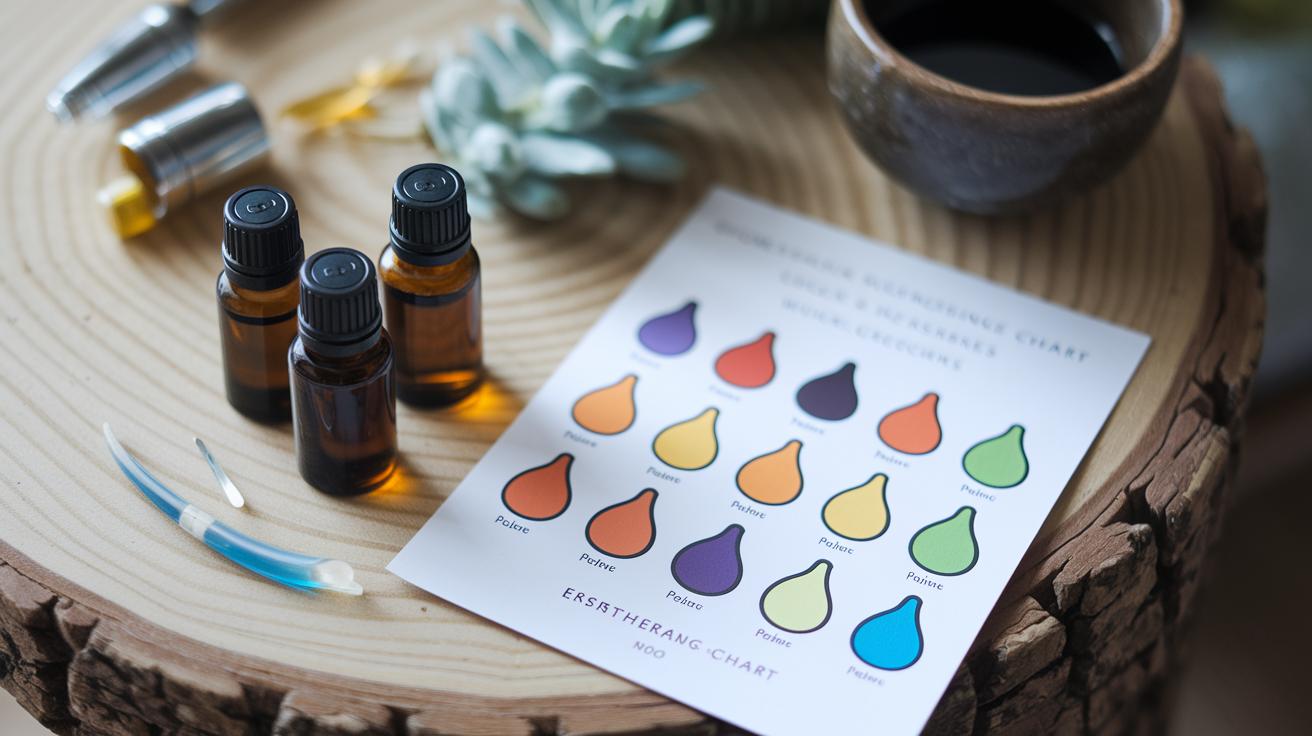
| Goal | Oils & Drops | Mood |
|---|---|---|
| Calming evening | Lavender (3), Chamomile (2), Sandalwood (1) | Soft, unwinding |
| Morning energy | Lemon (2), Peppermint (2), Rosemary (1) | Bright, alert |
| Grounding | Frankincense (3), Patchouli (2) | Calm, centered |
| Focus session | Eucalyptus (3), Tea Tree (2), Lemon (1) | Clear, clarifying |
| Bedtime wind-down | Lavender (3), Chamomile (2), Frankincense (1) | Restful ambiance |
Treat these five as a starting chart, not a rulebook. If the Calming Evening blend is your entry point, our deeper dive on essential oils for stress covers the olfactory research behind why lavender-forward blends tend to work for winding down. For a seasonal spin on this same 30/50/20 logic, see our cozy fall blend recipes for your Nebulizing Diffuser®. The Bedtime Wind-Down blend, for instance, works because the lavender top note opens the room quickly while the frankincense base keeps a whisper of scent going long after you’ve fallen asleep — exactly the kind of note-timing a Nebulizing Diffuser® preserves that a heated warmer can’t.

Join Our Exclusive Member Club to get Big Discounts!
How to Store, Label, and Update Your Blending Chart
A blending chart is only useful if you can reproduce what worked. A little organization goes a long way:
- Label each amber glass bottle with the blend name, date mixed, and exact drop ratio — something like “Summer Citrus, 6/12, 4 drops bergamot : 3 drops grapefruit.”
- Always store finished blends in amber or cobalt glass. Clear glass lets light degrade the oils and shorten shelf life.
- Note any carrier-oil swap directly on the label (“switched to fractionated coconut oil”) so you can track how it changes absorption and scent throw.
- Keep a digital copy of your chart (a shared spreadsheet or notes app works fine) so you can pull up a ratio from your phone instead of reconstructing it from memory.
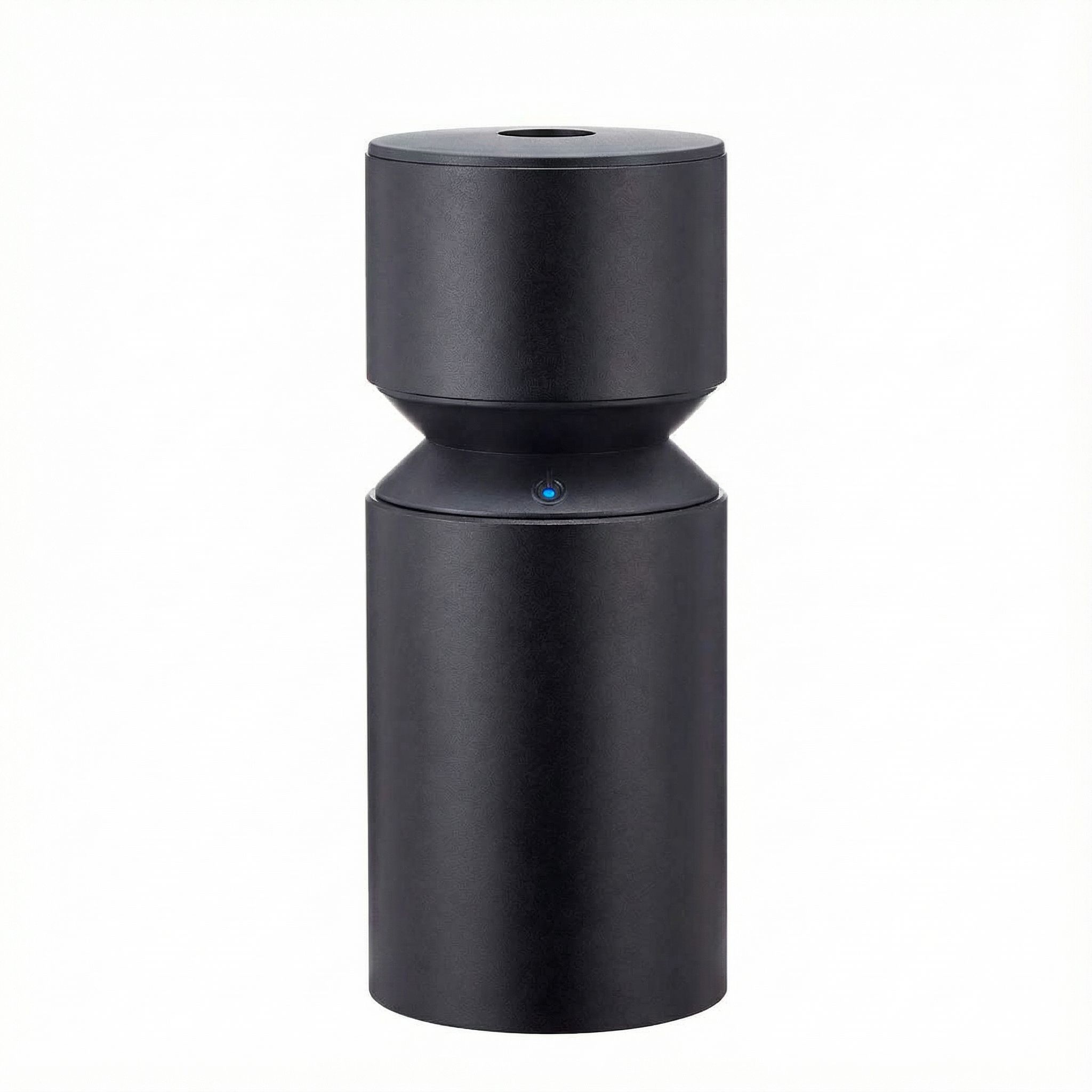
Your Ratio, Preserved From First Mist to Last
The Smart Mobile Mini – Nebulizing Diffuser® atomizes your blend with room-temperature airflow instead of heat or water, so the 30/50/20 ratio you mixed is the ratio you actually smell — wireless, rechargeable, and app-controlled.
Final Words: Your Essential Oil Blending Chart
You now have a complete essential oil blending chart: fragrance families and how they pair, the 30/50/20 note ratio and the volatility chemistry behind it, safe topical dilution limits, five tested starter blends, and a simple system for labeling and storing what you make. The one variable most charts never mention is your diffusion method — and it’s the difference between a blend that smells the way you designed it and one that fades or shifts within the hour. Keep experimenting, log what works, and let your chart grow with you.
Essential Oil Blending Chart FAQ
What is the 30/50/20 essential oil blending rule?
It’s a beginner-friendly ratio for building a balanced blend: 30% top notes (light, fast-opening oils like lemon or bergamot), 50% middle/heart notes (the body of the blend, such as lavender or geranium), and 20% base notes (deep, lingering oils like frankincense or sandalwood), measured by drop count.
What are the five essential oil fragrance families?
Citrus (bright, uplifting), Floral (soft, comforting), Herbal (fresh, clarifying), Spicy (warm, energizing), and Woody (deep, grounding). Each family tends to play a top, middle, or base role, and they combine in fairly predictable ways — citrus pairs with almost everything, while woody oils anchor floral or herbal blends.
Why do base notes need fewer drops than top notes?
Base-note oils like sandalwood and frankincense are made of heavier molecules that evaporate slowly and linger for hours, so a small amount goes a long way. Top-note oils are lighter and evaporate within minutes, so a blend needs more drops of them just to keep the opening scent from disappearing too fast.
Do I need to dilute essential oils in a Nebulizing Diffuser®?
No. A Nebulizing Diffuser® atomizes pure, undiluted essential oil using room-temperature airflow — no water and no heat. Dilution with a carrier oil only applies to topical use, such as roll-ons or massage oils.
Why does the same blend smell different in different diffusers?
Heat-based and ultrasonic methods can release the lightest top-note molecules faster than the heavier base notes, so the ratio you smell shifts over time. A Nebulizing Diffuser® atomizes the blend mechanically rather than selectively evaporating it, so the ratio you mixed stays closer to the ratio you smell throughout the session.
What are the safe dilution ratios for topical blends?
For children, use 1–3 drops per ounce (about 0.5%) of carrier oil. For adult daily use, 10–20 drops (up to 3%). For short-term use of two weeks or less, 30–60 drops (up to 10%). Sweet almond and jojoba are both gentle carrier-oil choices.
Are any essential oils phototoxic in topical blends?
Yes. Cold-pressed citrus oils can cause a skin reaction in sunlight after topical use. Keep lemon oil under 2%, grapefruit under 4%, and clove bud under 0.5% dilution in any blend applied to skin that will see sun exposure.
How should I store and label my blends?
Use amber or cobalt glass bottles to protect the oils from light, and label each one with the blend name, date mixed, and exact drop ratio. Note any carrier-oil swaps directly on the label so you can track how they change the scent or absorption.
Why does my blend smell different after a day or two?
Essential oil molecules continue interacting after mixing. Top notes soften first, and the middle and base notes round out over roughly 48 hours — which is why we recommend letting a fresh blend rest before judging the final scent.
Can I substitute oils within the same blending chart?
Yes — swapping within the same family and note role keeps the blend’s structure intact. Cedarwood Atlas can stand in for Sandalwood as a base note, for example, while changing the mood only slightly toward a warmer, woodsier finish.