

Essential Oils for Candles: What Actually Throws Scent (and the Heat Problem)
Pour a warm bath of light across the room, add a scent you love, and a candle feels like the easiest luxury there is. So it is no surprise that essential oils for candles is one of the most-searched phrases in the whole DIY-scent world. What is surprising is how much of that advice quietly sets you up to fail. Add a few drops of your favorite oil to melted wax, light the wick, and… the room barely smells like anything. Where did the scent go?
The honest answer lives in chemistry that most candle tutorials skip: heat is both the thing that carries a scent and the thing that destroys it. Over more than twelve years of listening to how our customers scent their homes, one pattern comes up again and again — people love the ritual of a candle but wish the aroma lasted, traveled, and smelled like the beautiful oil in the bottle rather than a faint ghost of it. This guide gives you the tested load rates, the oils that genuinely perform, the ones that fail, and the one method that sidesteps the heat problem entirely.
Why Essential Oils in Candles Behave Differently Than You Expect
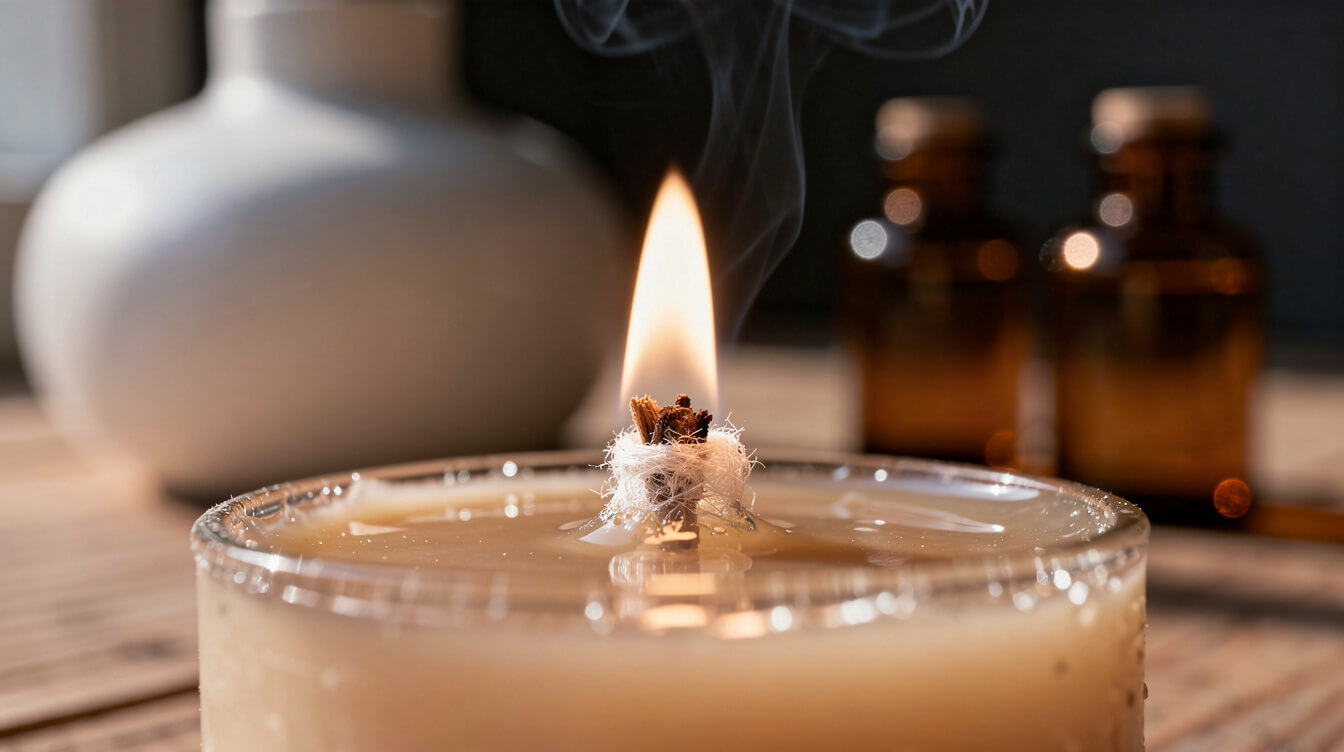
An essential oil is not a single ingredient. It is a living blend of dozens — sometimes hundreds — of volatile aromatic molecules, each with its own weight, its own personality, and its own flashpoint (the temperature at which it starts to vaporize and burn off). The bright, lifted “top notes” you smell the instant you open a bottle are the lightest, most fragile of these molecules. They are also the first to be lost to heat.
A candle is a heat engine. The flame at the wick burns at roughly 1,000°C, and even the melt pool of wax hovers around 50–70°C for hours. When you dissolve essential oil into wax and light it, three things happen at once. Some of the oil evaporates gently and reaches your nose — this is the good part, called hot throw. Some of it sits in cooler wax and never releases — wasted. And some of it is heated past its flashpoint and chemically shifts or simply combusts before it can travel — the notorious “scent shift” that makes a candle smell muddy, flat, or faintly burnt.
This is why the same oil can smell glorious in the bottle and disappointing in a candle. It also explains a confusion many beginners run into: the difference between cold throw (how the unlit candle smells on a shelf) and hot throw (how it smells burning). An oil can have a gorgeous cold throw and a weak hot throw, which is a polite way of saying the flame is eating your fragrance. If you want the full breakdown of what combustion does to scent, our guide on the combustion chemistry of diffusers versus candles goes deeper on the mechanism.
The Best Essential Oils for Candles (and the Ones That Quietly Fail)
Not all oils are built for the flame. The best candidates share three traits: a strong hot throw, resistance to scent shift under heat, and good behavior in natural soy wax, which is notoriously stingy about releasing fragrance. Candle-industry testing consistently surfaces the same short list of reliable performers, along with tested load rates expressed as a percentage of your total wax-plus-oil weight:
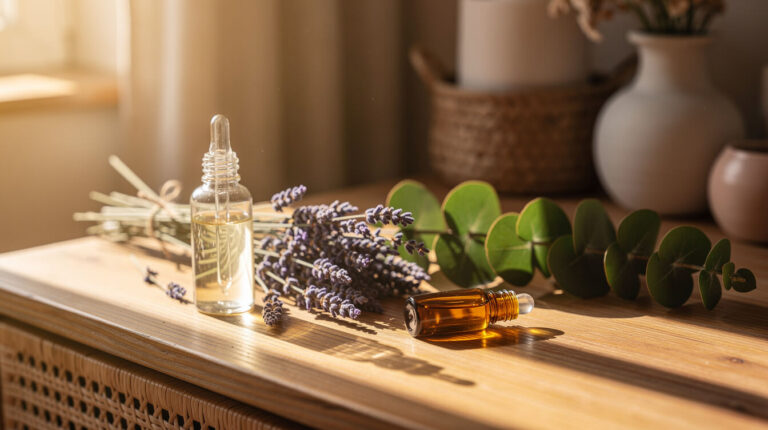
- Lavender (Bulgarian) — earthy, floral, forgiving. Tested load rate 3–6%. The safest place for a beginner to start.
- Litsea Cubeba (May Chang) — a green, grassy lemon. Tested load rate 3–6%. This is your citrus workhorse.
- Petitgrain — bright orange-and-green from the bitter orange tree. Tested load rate 6–9%.
- Ylang Ylang — rich, sophisticated floral with a hot throw that stays true to the bottle. Load rate 3–6%.
- Eucalyptus — camphorous, spa-like, with an unusually strong cold throw too. Load rate around 6%.
Now the part almost no one tells you: the two most requested candle scents on earth — lemon and sweet orange — are among the worst raw essential oils for candles. Lemon oil has a weak hot throw and shifts unpleasantly when you push the amount up; sweet orange behaves the same way. The professional fix is substitution, not brute force. Reach for Litsea Cubeba when you want lemon and Petitgrain when you want orange. Both are close aromatic cousins that survive the heat where the obvious choice does not. Citrus lovers should also note that some of these oils are phototoxic on skin, which matters if you are pairing candle-making with body-care projects.
Sign Up to Get Your FREE Essential Oils e-Book Here
How Much Essential Oil to Use in Candles: Tested Load Rates
The single most common mistake in home candle-making is measuring fragrance in “drops.” Drops are fine for a rollerball; they are meaningless for a candle, where you are scenting hundreds of grams of wax. Professionals measure by weight, as a percentage of the finished candle. For essential oils, the practical window is 6 to 10 percent for a satisfying hot throw — noticeably higher than the 6–8% typical of synthetic fragrance oils, because natural oils simply do not throw as aggressively.
Here is the math in plain terms. Say you are making a candle with 200 grams of soy wax. A 9% load means 200 × 0.09 ≈ 18 grams of essential oil — roughly a third of a standard 60 mL bottle in a single candle. That number tends to stop people cold, and it should, because it exposes the real trade-off nobody advertises: an honest all-natural essential-oil candle is expensive to make. This is precisely why the vast majority of “essential oil candles” sold on shelves are actually scented with fragrance oils, or a blend, with a few real drops added so the label can whisper the words.
A few working rules that save wax and money:
- Add oil at the right temperature — too hot and you flash off the top notes before the candle is even poured; the usual sweet spot is around 84°C (185°F) for soy, then stir gently.
- Choose a natural wax that cooperates. Soy is beautiful and clean-burning but a weak thrower; coconut-soy blends release scent more generously.
- Cure before you judge. Soy candles need one to two weeks of cure time for the oil to bind fully into the wax — test a “dud” only after it has rested.
- Never chase throw by exceeding about 10%. Past that, oil pools, the wick drowns, and you invite sooting and flashpoint risk rather than more fragrance.
The Heat Problem: Why Candles Waste Your Most Delicate Oils
Return to that fragile top-note molecule for a moment. In lavender, a large share of the calming, characteristic aroma comes from two compounds — linalool and linalyl acetate — whose delicate ratio is exactly what makes good lavender smell like lavender rather than soap. Linalyl acetate is heat-sensitive; sustained warmth encourages it to break down and oxidize, nudging the scent toward something sharper and more medicinal. A candle subjects your oil to hours of exactly that kind of heat, every single burn.
So even when you do everything right — heat-stable oil, correct load rate, patient cure — a candle is fundamentally asking a delicate, volatile material to survive a low-grade furnace. You will always lose some of the top and heart notes to the flame. What reaches your nose is a heavier, cooked-down version of the oil you fell in love with. For many scents that is perfectly pleasant. For the truly delicate ones — fine lavenders, citrus, jasmine, neroli — it is a genuine loss. That trade-off is also why some people find candles leave a stuffy, heavy air in a closed room; our look at whether scented candles affect indoor air unpacks the soot-and-particulate side of the story.
None of this makes candles bad. It makes them a specific tool with a specific cost. The question worth asking is simple: if what you actually love is the pure aroma of the oil, is setting it on fire really the best way to enjoy it?
Sign Up to Get Your FREE
e-Book Here…
A Cooler Way to Enjoy Pure Essential Oils: Nebulizing Diffusion

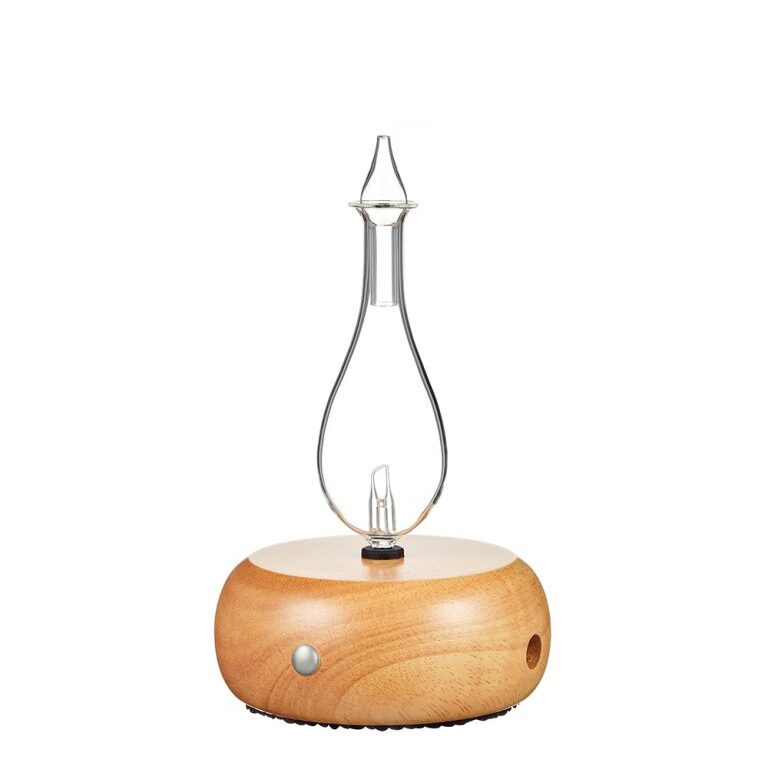
There is a category of scent device that never heats the oil at all. A Nebulizing Diffuser® works on Bernoulli’s Principle: a pressurized stream of air passes across a small glass tube, creating a pocket of low pressure that draws pure essential oil up and shatters it into an ultra-fine aromatic cloud. No water dilutes it, and critically, no heat touches it. The oil that leaves the glass is the same oil that was in the bottle — top notes, heart notes, base notes and delicate ratios intact.
This is the honest counterpoint to the candle. Where a flame cooks off your lightest molecules, nebulizing diffusion atomizes them at room temperature and sends the complete scent into the air. It is also far more efficient with the oil: you scent a whole room from a few drops rather than sacrificing a third of a bottle to a single candle. Because our Nebulizing Diffusers® are handcrafted from real wood and medical-grade Pyrex glass — no plastic, no reservoir of water — the aroma stays clean and true, and cleanup is simple (here is our step-by-step cleaning guide). If you have been building a collection of candle-grade oils, the handcrafted Nebulizing Diffuser® collection is the setting that finally lets those oils smell the way the distiller intended.
The same logic applies to blending your own signature aromas rather than committing them to wax — something we explore in our guide to building a natural scent from essential oils. The freedom to change scent in seconds, with no melt pool to wait on, is its own quiet luxury.
Love the Oils? Skip the Flame
A handcrafted Nebulizing Diffuser® delivers pure, undiluted essential oil into the air with no water and no heat — so the full, delicate scent you paid for actually reaches you.
Making Naturally Scented Candles: Labeling, Safety, and Realistic Expectations
If you have read this far and still want to pour candles — wonderful, so do many of our customers. A few grounded expectations will save you frustration. First, understand what you are allowed to say. The term “naturally scented” legally applies only to products fragranced exclusively with natural materials: essential oils, distillates (hydrosols), oleoresins, and natural isolates. The moment you add a synthetic fragrance oil to boost throw, the candle is no longer “naturally scented,” however few drops you use. Honest labeling protects both your customers and your reputation.
Second, respect the flashpoint on safety grounds, not just scent grounds. Every essential oil has a flashpoint listed on its safety data sheet, and you should never add oil to wax that is hotter than that number — doing so is both a fire hazard and a guaranteed way to flash off the fragrance. Keep a thermometer in the pour, always.
Third, set your expectations by wax and oil honestly:
- A single-oil candle will smell simpler than a fragrance-oil candle. That purity is the point, not a flaw.
- Herbaceous, woody, and resinous oils (lavender, eucalyptus, cedarwood, patchouli) generally out-throw delicate florals and raw citrus.
- Expect to spend more per candle than a fragrance-oil recipe. Real oils, real cost.
- If a scent you love simply refuses to perform in wax — many jasmines, neroli, and true rose fall here — that is your signal it belongs in a heat-free method instead.
Eucalyptus is a reliable starting point if you want a scent that performs in both worlds; our complete guide to eucalyptus covers its aroma profile and pairings in depth.

Join Our Exclusive Member Club to get Big Discounts!
Frequently Asked Questions About Essential Oils for Candles
Can you put essential oils directly in candle wax?
Yes, but add them by weight (aim for 6–10% of the finished candle) at the correct temperature — around 84°C / 185°F for soy — and never above the oil’s flashpoint. Adding a few random drops to already-cooling wax is the usual reason a homemade candle ends up barely scented.
Why does my essential oil candle have no smell when burning?
Most often one of three things: the load rate was too low, the oil has a naturally weak hot throw (lemon and sweet orange are common culprits), or the candle has not cured. Soy candles need one to two weeks for the oil to bind into the wax before you can fairly judge the hot throw.
Which essential oils have the best hot throw in candles?
Lavender, eucalyptus, litsea cubeba, petitgrain, ylang ylang, cedarwood, and most resinous or herbaceous oils perform well. Delicate florals like jasmine and neroli and raw citrus like lemon and orange tend to disappoint.
Are essential oil candles better than a diffuser?
For pure scent fidelity and efficiency, no. A candle heats the oil and burns off its most delicate notes, and it consumes a great deal of oil per candle. A Nebulizing Diffuser® releases the complete, unheated aroma from a few drops. A candle wins only when the flame and glow are part of the experience you want.
Final Thoughts: Match the Method to the Oil
Essential oils for candles can absolutely smell beautiful — if you choose heat-stable oils, measure by weight, cure with patience, and accept that some of your most delicate notes will always be given to the flame. That is the honest bargain of a candle. But if what you truly want is the full, living scent of a pure essential oil — the exact aroma the distiller captured, top notes and all — the answer is to keep the heat out of the equation. Let the flame be for atmosphere, and let a Nebulizing Diffuser® be for scent. Your oils, and your nose, will know the difference.