

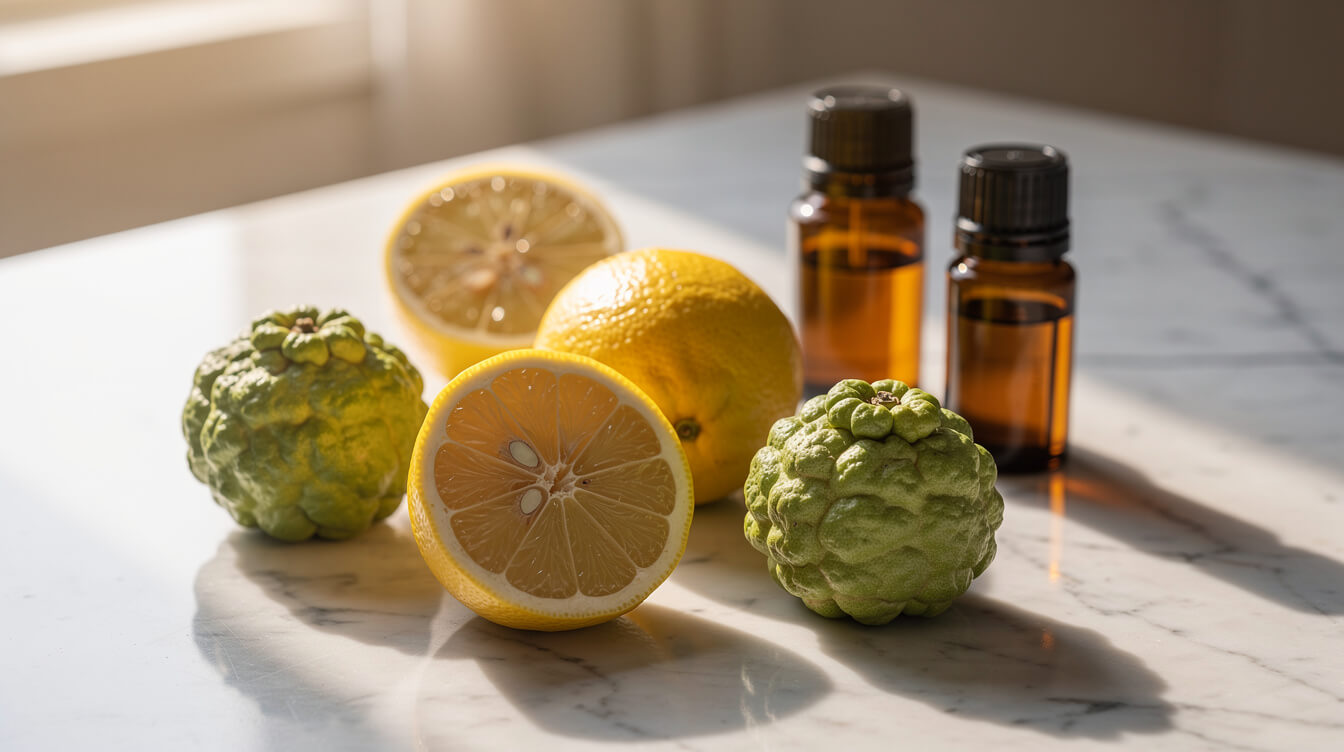
Phototoxic Essential Oils: The Citrus and Sun Chemistry Most Guides Skip
Search phototoxic essential oils and you will meet the same short list over and over: a column of citrus oils, a warning to stay out of the sun, and almost nothing about why. The lists are not wrong. They are just shallow. They rarely explain the chemistry behind the reaction, they almost never cite the specific concentrations that separate a safe blend from a hospital visit, and not one of them mentions the single delivery method that avoids the whole problem.
This guide goes the other way. We start with what is actually happening in your skin cells, name the oils that matter (and the surprising ones that do not), put real numbers on the safe-use levels that most articles skip, and explain why a steam-distilled lemon oil is fine while a cold-pressed one is not. Then we cover the timing rule that turns a relaxing evening into a three-day burn, and finish with the reason airborne diffusion sidesteps phototoxicity entirely. Nothing here is medical advice. It is about safety and how aroma is delivered.
What Phototoxic Essential Oils Actually Are (and Why It Is Not an Allergy)
Phototoxicity is one of the most predictable reactions in all of aromatherapy. Robert Tisserand, the author of Essential Oil Safety, calls it “one of the most predictable and incontestable toxic reactions.” It happens when certain molecules land on your skin, sit there, and then meet ultraviolet light. The light supplies the energy; the molecule supplies the damage.
The molecules responsible are almost all furanocoumarins, often shortened to FCs. When an FC such as bergapten reaches a skin cell (a keratinocyte) and you step into sunlight or under a sunbed, the UVA radiation kicks the molecule into a high-energy state. In that state it binds directly to the DNA inside the cell, sometimes locking two strands of the double helix together. Those crosslinks warp the DNA, the cell dies, and the visible result looks and feels like a surprise sunburn, often with blistering and lingering brown pigmentation at the edges.
Two details make this worth understanding rather than just memorizing. First, FCs are potent in tiny amounts. They usually make up less than one percent of an essential oil, yet even 0.1 percent can be enough to burn. Second, this is not an allergy. A true allergic reaction recruits your immune system and tends to look like hives. Phototoxicity, also called photoirritation or phytophotodermatitis, is a direct chemical-plus-light injury. You can react the very first time you are exposed, no prior sensitization required. If you want the broader picture on choosing gentle, well-made oils, our guide to choosing pure, non-toxic essential oils is a useful companion to this one.
It helps to know what the reaction looks like, since it rarely announces itself the way a normal burn does. A mild case may show up as nothing more than a patch of brown pigmentation, or as faint redness with mild stinging. More serious cases blister, sometimes in dramatic streaks that trace exactly where a few drops ran down the skin. After the skin recovers from the burn, the discoloration often lingers for weeks or even months before it finally fades, because the injury pushes pigment-producing cells into the wrong layer of skin. That delayed, lingering mark is a signature of phototoxicity that ordinary sunburn does not leave.
The Phototoxic Essential Oils List: Cold-Pressed Citrus and a Few Surprises
Most phototoxic oils are cold-pressed (expressed) citrus, but not all of them are citrus, and not every citrus oil is phototoxic. Here is the list that matters, drawn from Tisserand and Young, Essential Oil Safety (2nd edition, 2014).
Commonly available essential oils that are phototoxic:
- Bergamot (cold pressed)
- Lemon (cold pressed)
- Lime (cold pressed)
- Grapefruit (cold pressed)
- Bitter orange (cold pressed)
- Mandarin leaf
- Angelica root
- Cumin
- Rue
- Tagetes
- Fig leaf absolute
- Opopanax
Notice the surprises. Angelica root, cumin, rue, tagetes and fig leaf are not citrus at all, yet they carry enough furanocoumarins to react. Fig leaf is one of the worst offenders, because it contains both psoralen and bergapten, two of the most potent FCs known.
Citrus oils that are not considered phototoxic:
- Sweet orange (cold pressed or steam distilled)
- Tangerine (cold pressed or steam distilled)
- Mandarin (cold pressed or steam distilled)
- Blood orange
- Yuzu
- Bergamot FCF (furanocoumarin-free)
- Steam-distilled lemon, lime and bergamot
This is why a blanket “all citrus is dangerous in the sun” rule is misleading. Sweet orange and tangerine are fine. Cold-pressed lemon and lime are not. The difference comes down to which FCs the plant makes and how the oil was extracted, which we will unpack in a moment. If you are comparing lemon oils for a blend, our breakdown of the three main types of lemon essential oil shows how origin and processing change the oil in your bottle.
Sign Up to Get Your FREE
e-Book Here…
The Numbers Most Guides Skip: Safe-Use Levels and Bergapten Content
Here is where almost every roundup goes quiet. Phototoxicity is dose-dependent, which means there are published concentrations below which an oil is considered safe to use on skin that will see daylight. These maximum dermal use levels come from Tisserand and Young and from the International Fragrance Association (IFRA). They apply to leave-on products, the kind that stay on your skin rather than washing off.
Maximum dermal use levels for skin exposed to sunlight (Tisserand & Young, 2014):
- Bergamot (expressed): 0.4 percent
- Lime (expressed): 0.7 percent
- Bitter orange (expressed): 1.25 percent
- Lemon (expressed): 2.0 percent
- Grapefruit (expressed): 4.0 percent
- Mandarin leaf: 0.17 percent
- Cumin: 0.4 percent
- Angelica root: 0.78 percent
- Rue: 0.15 percent
Put that 0.4 percent for bergamot in context. In a 10 ml roller bottle of carrier oil, that is roughly one drop of bergamot. The IFRA guideline tightens this further at the fragrance level, capping total furanocoumarins in a finished product at just 0.0015 percent. These are not arbitrary. They trace back to a 1974 IFRA standard set after decades of documented burns. Our essential oil dilution chart and safety guide shows how to hit numbers this low without guesswork.
The other number worth knowing is how much of the active compound each oil actually carries. Bergamot oil contains roughly 0.11 to 0.33 percent bergapten, with about 0.2 percent being typical. Compare that to oils people assume are risky but are not: expressed tangerine sits near 0.005 percent, parsley leaf around 0.002 percent, distilled lime around 0.0003 percent, and yuzu near 0.0001 percent. That is the difference between a burn and a non-event. Bergamot carries roughly forty times the bergapten of tangerine, which is exactly why bergamot is the oil behind most documented aromatherapy phototoxicity cases.
Join Now and Get a Coupon for 10% Off!
Distilled vs Expressed vs FCF: Why the Same Citrus Can Be Safe or Risky
The single most useful thing you can learn about phototoxicity is that the extraction method, not just the plant, decides the risk. Furanocoumarins are relatively heavy, non-volatile molecules. They do not evaporate easily, which has a direct consequence for how oils are made.
Cold pressing (expression) rasps the whole fruit peel and collects everything in it, including the heavy furanocoumarins. That is why cold-pressed bergamot, lemon and lime are phototoxic. Steam distillation, by contrast, carries over only the lighter, volatile aroma molecules and leaves most of the FCs behind. The result is dramatic. One analysis found that a distilled lemon oil contained 22 times less bergapten and 930 times less citropten than an expressed lemon oil. That is why steam-distilled citrus oils are not considered phototoxic, even though a trace of FCs may remain.
The third option is FCF, short for furanocoumarin-free. Bergamot FCF is regular bergamot that has been put through fractional distillation to strip out the bergapten while keeping most of the scent. It gives you the bright, sparkling bergamot aroma without the sun risk, which is why it shows up in so many fine fragrances.
There is a fascinating reason plants bother to make these compounds at all, and it explains why two bottles of the same oil can differ. Furanocoumarins are a plant defense. They are mildly toxic to the insects and larvae that would otherwise eat the leaves and peel, and that toxicity is switched on by sunlight in the bug just as it is in us. Tisserand notes a telling example: parsnips growing in regions with parsnip moths produce more furanocoumarins than parsnips in regions without them, and a plant under fresh attack can ramp its FC levels up in response. The same species, grown in a different place or season, can carry a different FC load. It is a useful reminder that “natural” and “gentle” are not the same word, and that batch and origin genuinely matter.
The practical takeaway lives on the label. If a citrus oil says “cold pressed” or “expressed,” treat it as phototoxic and respect the use levels above. If it says “steam distilled” or “FCF,” it is generally safe for daytime skin use. When you are blending these into anything that touches skin, pair the citrus oil with a well-chosen carrier; our guide to the best carrier oils for essential oils covers the options, and our deep dive on bergamot essential oil looks at the oil that started the whole conversation.
The Timing Rule: The 12 to 18 Hour Window
Phototoxic reactions are sneaky because there is usually no warning at the moment of exposure. You feel nothing while it is happening. The burn develops hours later and keeps worsening for one to three days, which is why so many people never connect the dots back to the oil they used the night before.
The guidance from Tisserand and Young is specific: if you apply a phototoxic oil to your skin above its maximum use level, keep that skin away from UV light for 12 to 18 hours. Research going back to 1977 found that UV exposure any time within roughly 12 hours of application can trigger a reaction. And UV means more than the beach. Tanning beds are a documented and frequent cause.
The case files make it vivid. One woman applied undiluted bergamot oil to her limbs to relax, took a steam bath that drove the oil deeper into her skin, then spent twenty minutes under a sunbed. She was hospitalized for a week with extensive burns. In another report, a teenager dabbed undiluted bergamot on his neck to help him sleep, played soccer under partly cloudy skies the next day, and woke the following morning, about 30 hours after applying the oil, to a neck covered in painful blisters. The lesson is not “never use citrus.” It is “respect the dose and the daylight.”
Two reassuring facts balance the warnings. There is generally no phototoxic risk if the oil is in a product that washes off, like a soap or shampoo, or if the treated skin stays covered so UV never reaches it. The risk is specifically about phototoxic oils left on exposed skin that then meets light.
Diffusing Citrus Safely: Why a Nebulizing Diffuser® Sidesteps the Risk
Reread the mechanism one more time, because it contains the loophole: phototoxicity requires the furanocoumarins to be sitting on your skin when UV light arrives. No oil on the skin means no phototoxic pathway, no matter how much sun you get. That is the quiet reason airborne diffusion is the safest way to enjoy bright citrus aromatics.
A Nebulizing Diffuser® disperses pure, undiluted essential oil into the air as an ultra-fine, dry mist. It uses pressurized air rather than water or heat, so what fills the room is aroma, not a film of oil on your forearms. The furanocoumarins are not being painted onto your skin and then taken into the sun. You get the lift of cold-pressed bergamot, grapefruit or lemon as a scent in the air, while the dermal-plus-UV reaction that drives phototoxicity simply never gets set up.
A few sensible caveats keep this honest. Diffusion is about scent in the air, so this is not a license to rub citrus oils on your skin before a sun-filled day. And because oils can settle onto skin during a sauna or steam inhalation, those close, humid uses are a different story than open-room diffusing. For everyday aromatic enjoyment, though, a Nebulizing Diffuser® removes the variable that causes the burns. If you want to build bright daytime blends without a second thought about the sun, our library of essential oil blends for your Nebulizing Diffuser® is a good place to start.
This is exactly the kind of problem the Raindrop Smart Nebulizing Diffuser® was built for: it delivers pure citrus oils into the air with no water, no heat and no skin contact, so a sun-loving scent like cold-pressed grapefruit becomes an everyday pleasure instead of a daytime worry.

Join Our Exclusive Member Club to get Big Discounts!
Frequently Asked Questions About Phototoxic Essential Oils
Is lemon essential oil phototoxic?
Cold-pressed (expressed) lemon oil is phototoxic, with a maximum dermal use level of about 2 percent on skin that will see sunlight. Steam-distilled lemon oil is not considered phototoxic, because distillation leaves most of the furanocoumarins behind. Always check how your lemon oil was extracted.
Can I diffuse bergamot and then go outside?
Yes. Phototoxicity requires the oil to be on your skin when UV light hits it. Diffusing bergamot puts the aroma in the air, not on your skin, so stepping outdoors afterward does not create the reaction. The caution applies to bergamot applied directly to skin, not to airborne diffusion.
How long after applying a citrus oil should I avoid the sun?
If you apply a phototoxic oil to your skin above its safe-use level, keep that skin out of direct sun and away from tanning beds for 12 to 18 hours. Below the published maximum use levels, the risk is considered negligible, but sunbathers should avoid phototoxic oils on exposed skin entirely.
Is bergamot FCF safe in the sun?
Yes. FCF means furanocoumarin-free. The bergapten has been removed by fractional distillation, so bergamot FCF is considered non-phototoxic and is the usual choice when a product needs the bergamot scent on skin that will see daylight.
Are all citrus essential oils phototoxic?
No. Sweet orange, tangerine, mandarin, blood orange and yuzu are not considered phototoxic, and any steam-distilled or FCF citrus oil is generally safe. The main concern is cold-pressed bergamot, lemon, lime, grapefruit and bitter orange.
Final Thoughts
Phototoxic essential oils are not something to fear, just something to understand. The reaction is real and occasionally severe, but it is also completely predictable: a furanocoumarin on the skin, plus UV light, within about half a day. Know which oils carry FCs, respect the published use levels, read your labels for “cold pressed” versus “steam distilled” or “FCF,” and give treated skin its 12 to 18 hours away from the sun.
And when you simply want the bright, uplifting aroma of citrus without doing the safety math, let the air do the work. Explore the handcrafted Nebulizing Diffuser® Collection and enjoy cold-pressed bergamot or grapefruit as a scent that fills the room, not a risk you wear into the sun.