

Essential Oils for Focus: What the Research Shows and How to Diffuse Them
Search essential oils for focus and you find the same handful of lists: a few oil names, a line of praise for each, and a nudge to add some drops to water. That is a fine starting point, but it skips the two things that decide whether a scent does anything for your concentration at all. The first is the pathway, how an aroma molecule actually reaches the part of your brain that holds attention. The second is delivery, the plain physical question of whether enough of that molecule ever reaches your nose.
This guide takes the long way on purpose. We start with the pathway, then look at what published studies genuinely found for five of the most-researched oils, build four diffuser blends keyed to different moments of the workday, and finish with the quiet mistake that cancels out almost everyone’s focus routine. Nothing here treats, cures, or prevents any condition. It is about how aroma is delivered, what the research suggests, and how to set up a focus ritual you can test for yourself.
How a Scent Reaches the Part of Your Brain That Pays Attention
Before we name a single oil, it helps to know what the scent is actually reaching. When you inhale an aroma, its molecules land on the olfactory epithelium high in your nose, bind to receptors, and fire a signal to the olfactory bulb. From there the message takes an unusually short road. Most senses route through a relay station, the thalamus, before reaching the emotional brain. Smell largely does not. It feeds almost directly into the limbic system, the cluster of structures tied to memory, emotion, and arousal.
That shortcut is why a single familiar scent can change how a room feels almost instantly. Attention is partly a matter of arousal, the gentle dial between drowsy and alert, and the limbic system sits close to the machinery that turns that dial. This is the same anatomical reason aromatherapy is worth discussing for mood at all, a point we cover in depth in our guide to essential oils for stress and the olfactory pathway. For focus, it means a well-chosen aroma is not magic. It is a sensory cue with a direct line to the part of you that decides how switched-on you feel.
The Five Most-Studied Oils for Focus, and What the Research Actually Found
Here is where most roundups wave a hand and move on. They will tell you rosemary is good for the mind without ever saying what was measured. Below are five of the best-studied oils for alertness and cognitive performance, with the specific findings competitors leave out. Read them as associations observed in controlled settings, not promises.
Rosemary. This is the most interesting one. In a 2012 study published in Therapeutic Advances in Psychopharmacology, Moss and Oliver measured blood plasma levels of 1,8-cineole, a key aromatic compound in rosemary, after participants sat in a rosemary-scented room. The higher a person’s absorbed 1,8-cineole, the better their speed and accuracy on cognitive tasks. The effect tracked the actual dose of the molecule in the bloodstream. An earlier 2003 study by the same group associated rosemary aroma with improved performance on some memory and alertness measures compared with no aroma at all. No other focus listicle names the compound or the dose relationship, and that detail is the whole point.
Peppermint. In a 2008 study, Moss and colleagues reported that peppermint aroma was associated with enhanced memory and heightened alertness relative to ylang-ylang and a no-aroma control. Menthol gives peppermint its bright, cooling lift, the sensory equivalent of opening a window. It is the oil to reach for when you feel foggy rather than wired. Our overview of organic peppermint essential oil and its everyday uses covers its character in more detail.
Lemon. Bright citrus oils are rich in limonene and carry a clean, wide-awake quality. Lemon in particular has been studied for its uplifting effect on mood, and a frequently cited Japanese workplace observation reported fewer data-entry errors when lemon was diffused in an office. Treat that as an observational report rather than a controlled promise, but it fits the pattern: a fresh, sharp aroma pairs naturally with alert work. See our guide to the benefits and uses of lemon essential oil.
Basil. Sweet basil, high in linalool, has a green, herbaceous brightness that traditional practice has long reached for to clear mental fatigue. The research base is thinner than rosemary’s, so think of basil as a supporting note that lifts a heavy blend rather than a headline act.
Frankincense. The odd one out, and a useful one. Frankincense is grounding rather than stimulating. It encourages slower, deeper breathing, which is exactly what a scattered, over-caffeinated mind needs before it can settle into deep work. Pair it with a bright top note and you get focus without the jittery edge.
Sign Up to Get Your FREE
e-Book Here…
Four Diffuser Blends for Focus, Tuned to the Workday
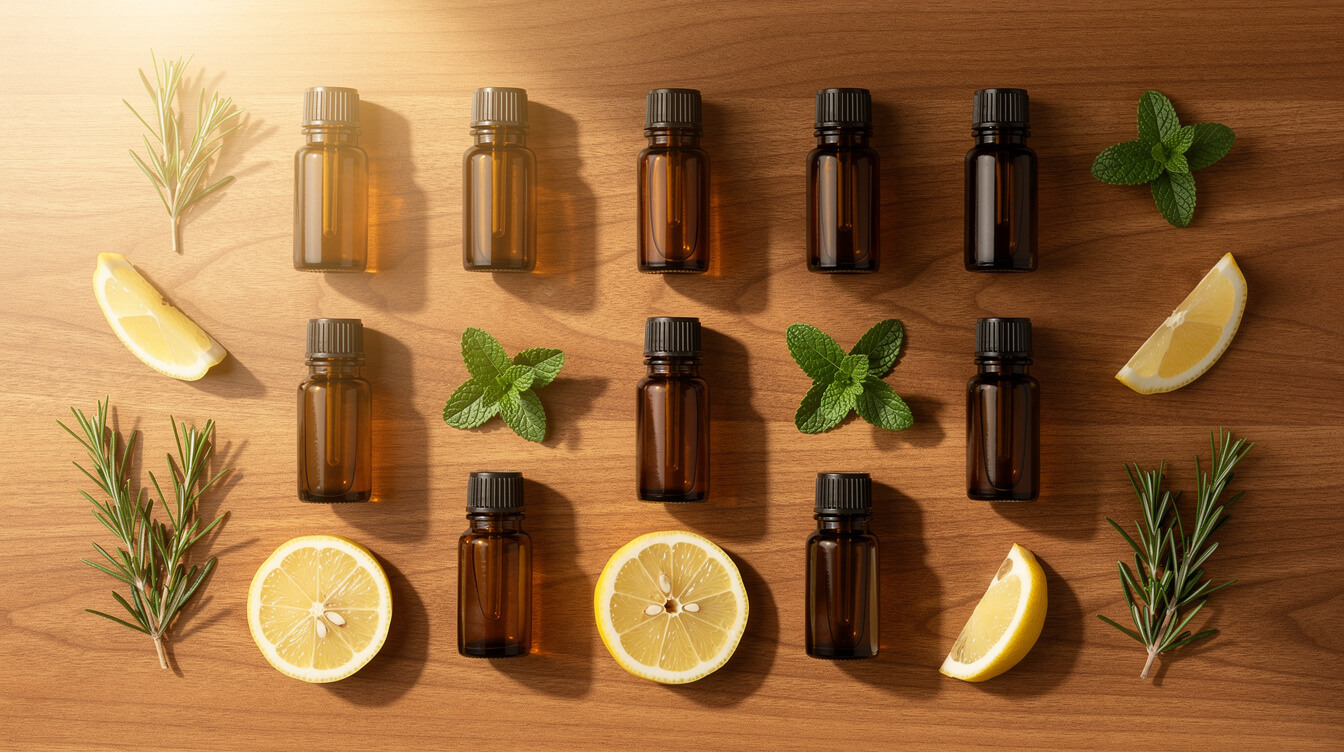
Focus is not one state. The concentration you need at nine in the morning is different from the second wind you are chasing at three in the afternoon. A good blend respects note structure: a bright top note for the first impression, a herbaceous middle for staying power, and a grounding base so the whole thing does not feel frantic. The drop counts below are starting ratios for a small-to-medium room. Adjust to your own nose, and read our deeper explanation of how note structure shapes a diffuser blend if you want to build your own.
Morning Deep Work. Rosemary 3 drops, lemon 2, peppermint 1. The rosemary carries the cognitive workhorse, lemon opens it up, and a single drop of peppermint keeps the edges crisp. This is the blend for your hardest, most demanding block of the day.
Afternoon Slump Reset. Peppermint 2 drops, lemon 3, rosemary 1. Heavier on the cooling, wide-awake notes, because the afternoon dip calls for a jolt of freshness rather than more intensity. Run it when your eyes start to glaze.
Creative Flow. Bergamot 3 drops, frankincense 2, rosemary 1. Bergamot is bright but mellow, frankincense slows the breath, and a touch of rosemary keeps the mind sharp. This is the blend for open-ended, idea-generating work rather than grind-it-out tasks.
Calm Concentration. Frankincense 2 drops, bergamot 2, basil 1. For the busy, slightly anxious days when focus keeps slipping into worry. It is the gentlest of the four, built to settle first and sharpen second.
Why a Nebulizing Diffuser® Changes How Focus Oils Are Delivered
Here is the variable almost every focus article ignores. The compounds that do the work in a focus blend, 1,8-cineole in rosemary, limonene in lemon, menthol in peppermint, are light, volatile top notes. They are the brightest, most fleeting molecules in the bottle, and they are precisely the ones a delivery method can lose.
A water-and-heat method waters down the picture, literally. An ultrasonic diffuser drips a few drops of oil into a tank of water and breaks it into a damp fog that is mostly water vapor, which dilutes the concentration of aroma molecules reaching your nose. A Nebulizing Diffuser® works on a completely different principle. It uses a stream of pressurized air drawn across a glass reservoir, an application of Bernoulli’s principle, to atomize pure, undiluted essential oil into an ultra-fine dry mist. No water. No heat. The result is a higher concentration of the actual aromatic compounds, and the fine particle size keeps them airborne long enough to reach the olfactory epithelium where focus begins.
For a workspace, that combination matters more than the marketing usually admits, a theme we explore in our piece on why more businesses are scenting their offices. If you want a delivery method built around keeping those bright top notes intact, explore the handcrafted Nebulizing Diffuser® Collection, or the app-controlled Smart Nebulizing Diffuser® if you want your focus cycles to run on a schedule you set.

Join Now and Get a Coupon for 10% Off!
The Mistake That Makes Focus Oils Stop Working: Olfactory Adaptation

You can pick the perfect oils, blend them flawlessly, and still get nothing, for one simple reason almost no roundup mentions: olfactory adaptation. Your smell receptors are built to notice change, not constancy. Within roughly 15 to 20 minutes of a steady aroma, they stop reporting it, which is why you cannot smell your own home but a visitor can. Leave a focus blend running all day and your nose quietly tunes it out. The cue fades, and with it the effect.
The fix is intermittent diffusing. Run your blend for 15 to 20 minutes, switch off for 40, then repeat. Tie each burst to a work block and the aroma becomes a punctuation mark for your attention rather than wallpaper. A second mistake is overdosing. More peppermint or rosemary does not mean more focus; past a point it tips from sharp to overwhelming and can leave some people with a tension headache. A few drops is plenty. Rotating between two or three blends across the week also keeps each one feeling novel, which is the entire point.
This is also why a focus routine looks different from a study-cramming session or a calm-down ritual. If your goal is exam preparation, our guide to the best essential oils for studying focus is built for that specific use, and readers looking at focus and calm support together may find our overview of essential oils for focus and calm a useful companion. Match the routine to the task, not the other way around.
Building a Focus Routine You Can Actually Measure
A routine beats a one-off every time, and a measured routine beats a vague one. Try this for two weeks. In the morning, start your Morning Deep Work blend on a 20-minutes-on, 40-minutes-off cycle through your hardest block. After lunch, switch to the Afternoon Slump Reset when the dip hits. Keep a simple note beside your desk and rate your focus from one to five at the end of each block. Change only one variable at a time, the blend, the timing, or the room, so you can tell what actually moved the needle.
Two practical notes. First, your nose is the final authority. An aroma you genuinely dislike will work against you no matter what a study says, so a blend you find pleasant and alerting beats a “correct” one you have to tolerate. Second, output drops when residue builds up, because it narrows the air channel and weakens the mist, so a quick routine clean keeps your dose consistent, as covered in our walkthrough on how to clean your Nebulizing Diffuser®. Let your own ratings, not a listicle, decide what earns a place on your desk.

Join Our Exclusive Member Club to get Big Discounts!
Frequently Asked Questions
What is the single best essential oil for focus? Rosemary is the most-studied for cognitive performance, thanks to its 1,8-cineole content and the dose relationship researchers have observed. That said, the best oil is the one whose scent you find genuinely pleasant and alerting. An aroma you dislike pulls your attention the wrong way.
How many drops should I use? In a Nebulizing Diffuser®, start with five to eight total drops for a small room and less in a tight space. Because nebulizing delivers undiluted oil, you generally need fewer drops than a water-based method to reach the same intensity.
Can I diffuse focus oils around children or pets? Keep concentrations low, ventilate the room, and check guidance for the specific oil. Peppermint and rosemary in particular carry common cautions around young children and pets, so favor short, intermittent sessions and never diffuse in a closed room they cannot leave.
Do focus oils replace sleep, water, and breaks? No. Aroma is a cue and an environment, not a substitute for the fundamentals. It works best stacked on top of decent rest, hydration, and regular breaks, not in place of them.
Final Thoughts
The conversation about essential oils for focus gets far more useful once you follow the whole chain: a molecule reaches your olfactory epithelium, signals straight into the limbic system that governs arousal and attention, and shifts how switched-on the room feels. Choose well-studied oils, respect that the research describes associations rather than guarantees, deliver them in a way that preserves the bright top notes, and cycle them so your nose never tunes them out.
When you want a delivery method built around that last point, a fine, dry, undiluted mist with no water and no heat, explore the handcrafted Nebulizing Diffuser® Collection and run your own two-week test. Let your focus ratings, not a roundup, decide what belongs on your desk.