

Myrrh vs Frankincense: How the Two Sacred Resins Really Differ (Scent, Chemistry, Skin & Blending)
Myrrh vs frankincense is one of the oldest comparisons in the world of scent. The two resins have travelled together for at least three thousand years, from the incense roads of southern Arabia to the gifts of the Magi, and they still sit side by side on almost every essential oil shelf. Yet they are not two versions of the same thing. One is bright, piney and lifting; the other is dark, bitter and balsamic. One is mostly resin; the other is mostly gum. And for two thousand years, one has cost two to three times as much as the other.
This guide sets them side by side the way a perfumer or a resin trader would: where each comes from, what is actually inside the tear, how each oil smells and behaves in the air, what is traditional (and what is honestly unproven) for skin, and how to blend them so they flatter each other in a Nebulizing Diffuser® instead of gumming it up. If you only want the short answer, the next section gives it to you in one glance.
Myrrh vs Frankincense at a Glance
Source tree. Frankincense comes from Boswellia trees (mainly B. sacra in Oman and Yemen, B. carterii in Somalia, plus B. frereana, B. serrata and B. papyrifera). Myrrh comes from Commiphora trees, chiefly C. myrrha in Somalia, Ethiopia and Yemen.
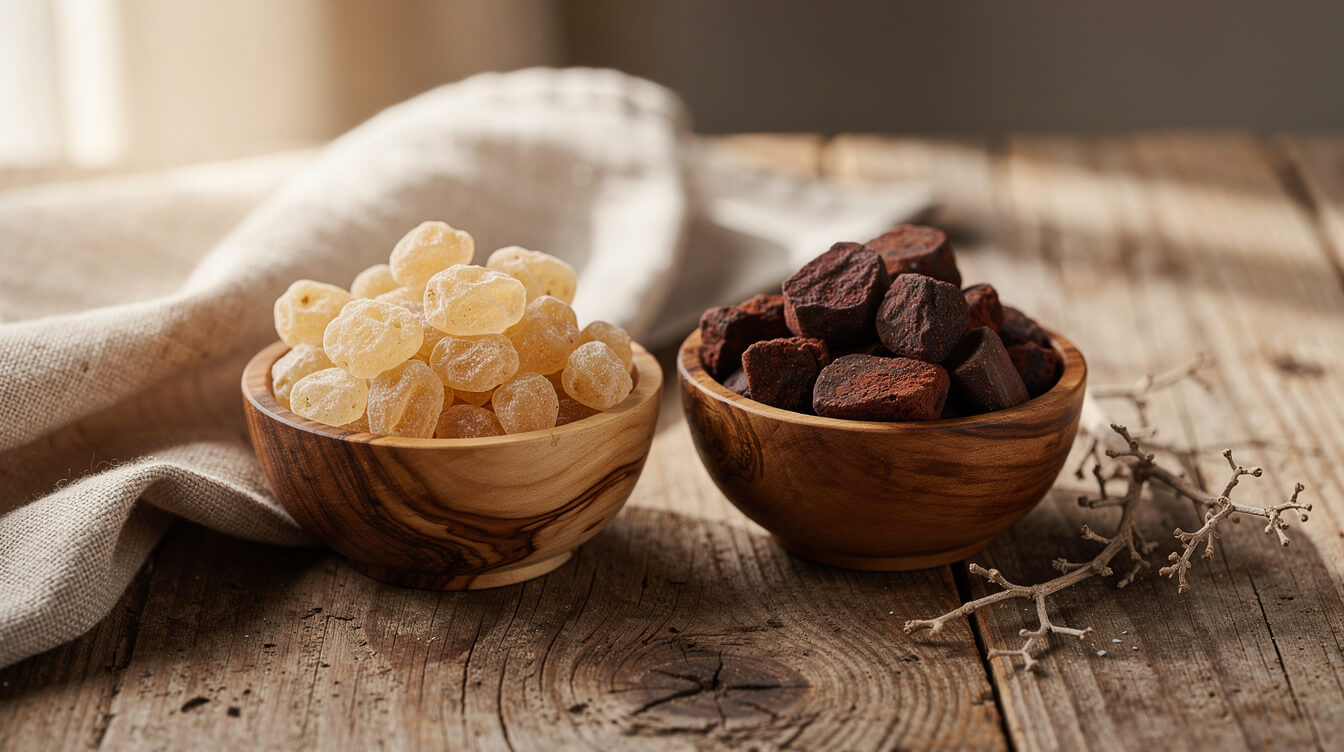
What the tear looks like. Frankincense dries into pale, milky-gold to almost white tears that look like frosted glass. Myrrh dries into darker, reddish-brown, irregular lumps with an oily, waxy break.
What it is made of. Frankincense is resin-dominant. Myrrh is gum-dominant. (This one fact explains most of their differences, so it gets its own section below.)
Dominant aroma chemistry. Frankincense oil is led by light monoterpenes, above all α-pinene, with limonene behind it. Myrrh oil is led by heavy furanosesquiterpenes: furanoeudesma-1,3-diene, curzerene and lindestrene.
Smell. Frankincense: pine needles, lemon peel, cracked pepper and the cool stone of an old church. Myrrh: warm, bitter, balsamic and earthy, with a faintly medicinal, mushroom-like depth.
Role in a blend. Frankincense is a heart note that lifts. Myrrh is a base note that anchors and lingers.
Price. Myrrh has been the costlier resin since Roman times, and it still is. On our own shelf, Myrrh Essential Oil starts at $45 while Frankincense Essential Oil starts at $15.
Even the names tell you this. Frankincense comes from the Old French franc encens, roughly “true” or “noble incense”. Its other name, olibanum, traces to the Arabic al-lubān, “the milk”, after the white sap that weeps from a cut in the bark. Myrrh comes from the Semitic root m-r-r, meaning “bitter”. One was named for its purity, the other for its taste.
Same Family, Different Trees: Boswellia vs Commiphora
Both trees belong to the Burseraceae, the torchwood or incense-tree family, which also gives perfumery elemi and palo santo. They grow in the same harsh, sun-baked band of land around the Horn of Africa and the southern Arabian Peninsula, often within sight of each other. That shared geography is why ancient caravans carried them together and why they still arrive as a pair in our imagination.
Up close, they are very different trees. Boswellia sacra is a small, papery-barked tree that can cling to bare limestone. Harvesters make shallow cuts called tappings, let the milky sap bead and harden for about two weeks, then scrape off the tears and cut again, with later harvests in the season generally prized as the better grades. Commiphora myrrha is a thorny, scrubby shrub-tree. Its resin seeps from natural cracks or cuts as a pale yellow liquid that darkens to deep red-brown as it dries.
Species matters more for frankincense than for myrrh, because the different Boswellia species smell noticeably different. Sacra and carterii are the classic bright, piney-lemon profiles; frereana is softer; papyrifera has a distinctive fruity octyl-acetate note. We cover the frankincense species in depth in our guide to diffusing frankincense aromatherapy oil the right way, and the slow, resin-heavy distillation of myrrh in our myrrh essential oil guide. Here, the focus is what separates the two once they are side by side.
Sign Up to Get Your FREE
e-Book ($9.99 Value)
The Hidden Difference: Frankincense Is Mostly Resin, Myrrh Is Mostly Gum
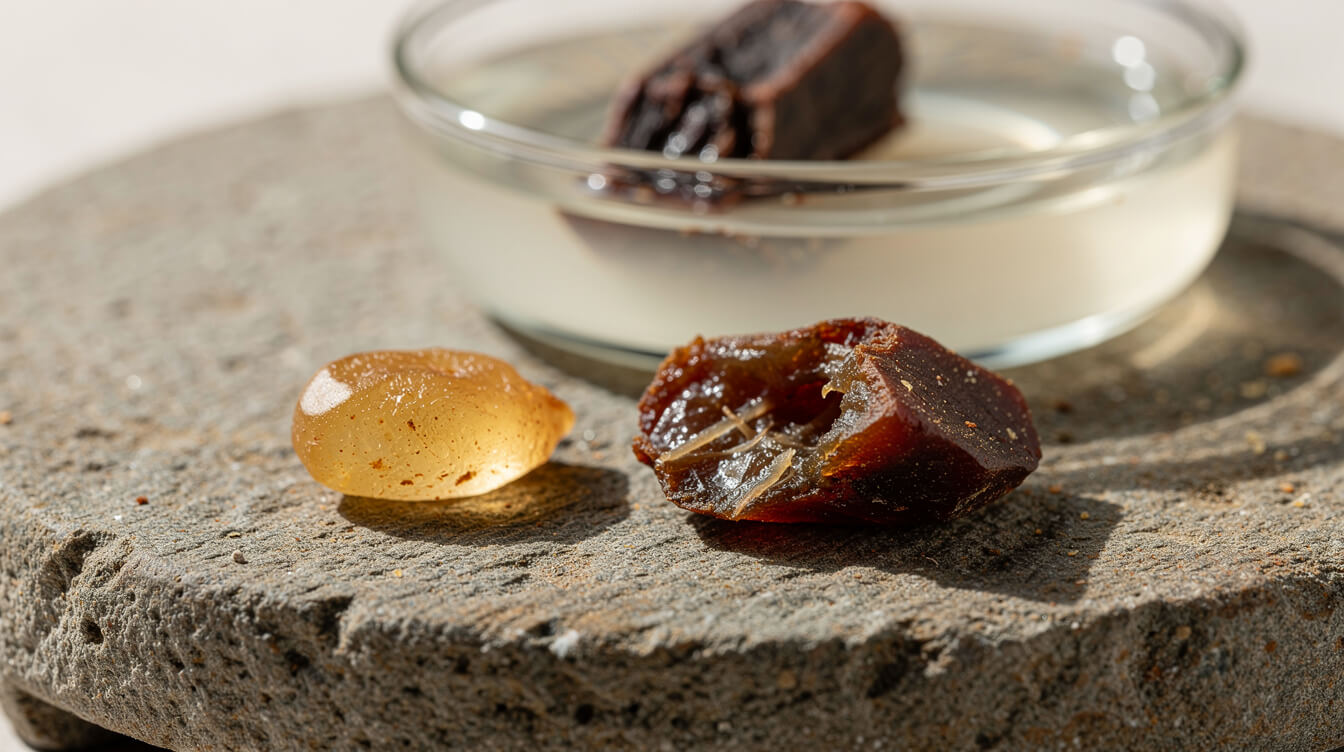
Both substances are technically oleo-gum-resins: a mixture of three things the tree makes at once. There is volatile oil (the part that becomes essential oil), resin (alcohol-soluble, hard and glassy, the part that burns) and gum (water-soluble sugars, the same family of material as gum arabic). The two resins carry these in almost opposite proportions.
The old pharmacopoeia figures make the point plainly. The British Pharmaceutical Codex of 1911 gives olibanum as roughly 60 to 70 percent resin, 27 to 35 percent gum and 3 to 8 percent volatile oil. For myrrh it gives about 25 to 40 percent resin, 57 to 61 percent gum and 2.5 to 8 percent volatile oil. Frankincense is a resin with some gum in it. Myrrh is a gum with some resin in it.
Once you know that, a lot of history and practice suddenly makes sense:
Why frankincense became the incense. Resin melts and burns cleanly on a coal, releasing a fragrant white smoke. Gum chars. Myrrh on a charcoal tends to smoulder and give a darker, more bitter smoke, which is why it was so often blended into incense rather than burned alone.
Why myrrh became the unguent, the wine and the tincture. Rub myrrh with a little water and it turns into a milky, yellowish emulsion, because its abundant gum dissolves and carries the oil and resin with it. Old pharmacists used exactly that behavior as an identity test. It is also why myrrh was steeped into wine, worked into ointments and used in embalming far more than it was burned.
Why myrrh oil feels heavier and stickier. The volatile fraction of myrrh is built from bigger molecules (more on that next), and what little oil the gum-heavy resin gives up is rich in them. A low and variable oil yield, combined with a scrubby tree from a narrow growing region, is a large part of why myrrh oil costs more.
This is the comparison most guides skip. They list benefits side by side as if the two resins were interchangeable. In the hand, the coal and the bottle, they behave like different materials, because they are.
Myrrh vs Frankincense Scent Chemistry: Pine-Bright vs Bitter-Deep
Open a bottle of each and your nose tells you the story before a lab does. The chemistry simply explains why.
Frankincense: a monoterpene oil
Gas chromatography of Boswellia sacra and carterii oils typically finds α-pinene as the dominant molecule, often somewhere between about 35 and 70 percent depending on species, origin and harvest, with limonene, β-phellandrene, myrcene and p-cymene behind it. These are monoterpenes: small, 10-carbon molecules. α-Pinene boils at roughly 155°C and lifts off a blotter quickly, which is why frankincense opens bright, airy and piney before settling into a warmer, softly resinous heart.
One honest note: the boswellic acids that make frankincense famous in supplement research are big, non-volatile molecules that stay behind in the still. The essential oil is a different material from a frankincense extract, a point we unpack in our Oil of the Day on frankincense chemistry.
Myrrh: a furanosesquiterpene oil
Myrrh oil is built on a completely different skeleton. Its signature molecules are furanosesquiterpenes: 15-carbon sesquiterpenes carrying a small oxygen ring. Published analyses of Commiphora myrrha repeatedly find furanoeudesma-1,3-diene, curzerene and lindestrene at the top, with furanoeudesma-1,3-diene alone reported anywhere from about 9 to over 50 percent across samples. That wide range is itself useful: it is one reason two bottles of “myrrh” can smell so different.
Bigger, heavier molecules evaporate slowly, boiling well above 250°C. That is why myrrh reads as warm, bitter and long-lasting, and why it acts as a base note. The faintly medicinal, earthy, almost mushroom-like edge some people notice is part of that furan-ring character, and it is exactly what makes real myrrh so hard to fake convincingly.
What that means in the air
Put the two together and they occupy different floors of the same building. Frankincense fills the room first and brightens it; myrrh arrives underneath, rounds off frankincense’s sharper pine edge and stays after frankincense has faded. That is the perfumer’s reason the pairing has lasted, and it is far more useful than any list of “8 benefits”. It also tells you how to dose them, which we come to below.

Sign Up to Get Your FREE Essential Oils e-Book ($9.99 Value)
Myrrh vs Frankincense for Skin: Tradition, Evidence and Safety
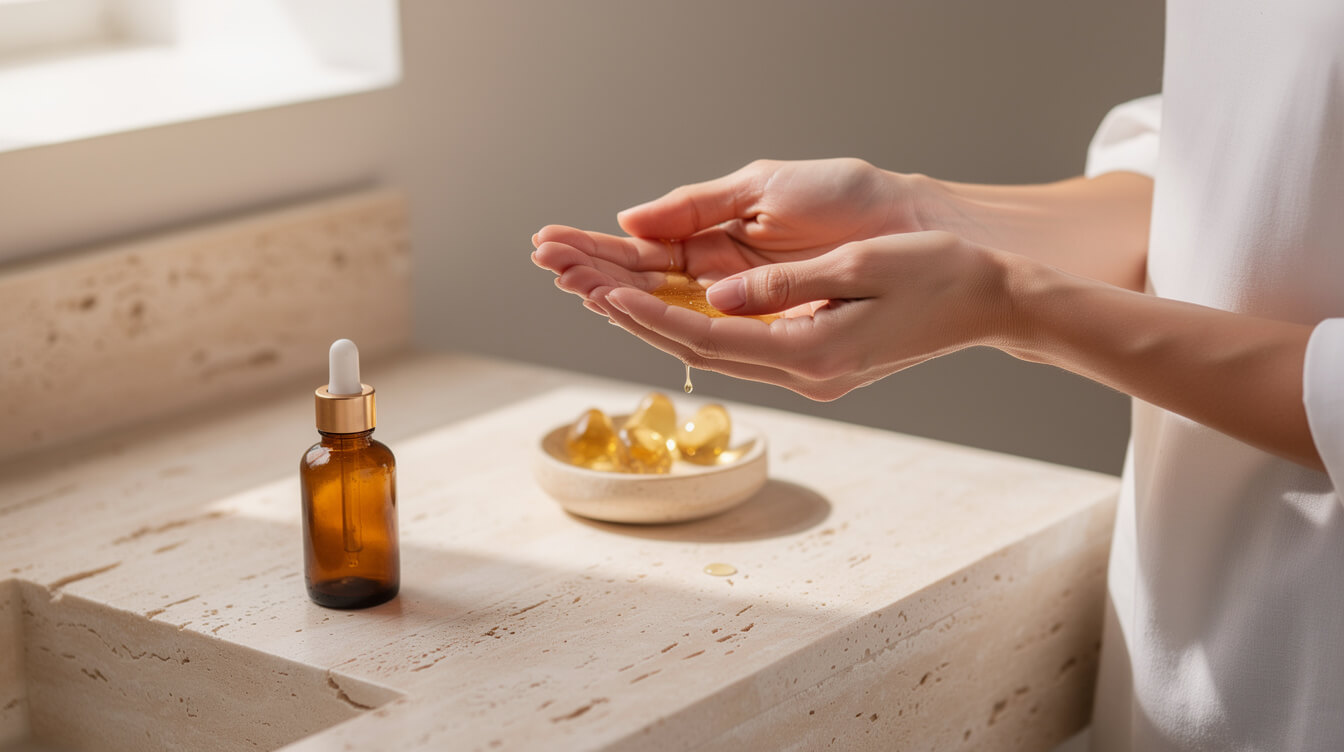
Both resins have a long cosmetic history. Egyptian and Greek perfumers worked them into unguents and fragrant oils, and today both turn up in “mature skin” facial oils, balms and serums. If you are comparing myrrh vs frankincense for skin, here is the honest picture.
What the evidence actually is. Most of the skin research on these resins comes from cell cultures and animal studies, often on extracts rather than on the essential oils you buy in a bottle. That is interesting science, but it is not proof that a few drops in your moisturizer will change your skin, and we won’t pretend otherwise. Where they genuinely earn their place in skincare is as fragrance and as part of a calming, sensory ritual: frankincense brings a clean, bright resin note, and myrrh a warm, grounding depth.
How to use them gently. Never apply either oil neat. For the face, around 1 percent (roughly 1 drop of essential oil per teaspoon, about 5 ml, of a carrier) is a sensible ceiling; for body oils, up to about 2 percent. Patch test on the inner forearm for 24 hours first. Our guide to what carrier oils really do explains which carriers suit which skin.
Frankincense: watch the age of the bottle. Frankincense is rich in α-pinene and limonene, which oxidize as the oil ages and is exposed to air and light. Oxidized terpenes are a known cause of skin sensitization. Keep the cap tight, store it cool and dark, and retire an old bottle that has turned sharp or sticky rather than putting it on your face.
Myrrh: extra caution in pregnancy. Robert Tisserand and Rodney Young’s reference Essential Oil Safety flags myrrh for caution during pregnancy. If you are pregnant or breastfeeding, skip topical myrrh and check with your midwife or doctor before using it in any form.
For everyone, the gentlest way to enjoy either resin is through the air rather than on the skin, which brings us to blending.
How to Blend Myrrh and Frankincense in a Nebulizing Diffuser®
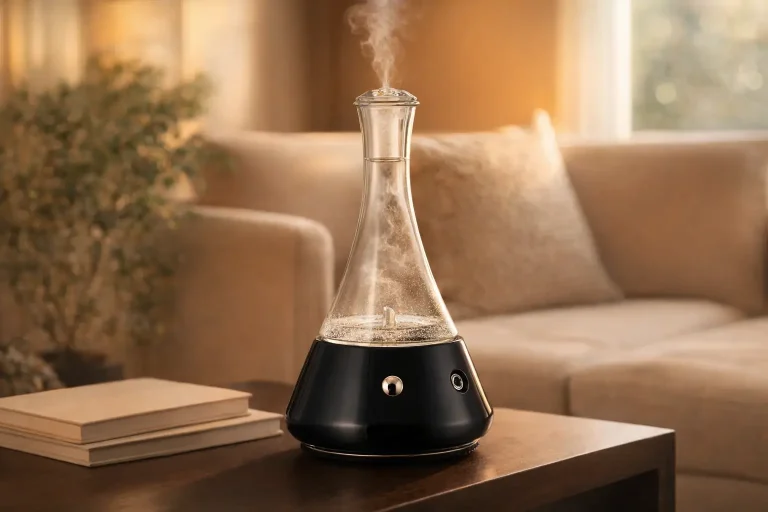
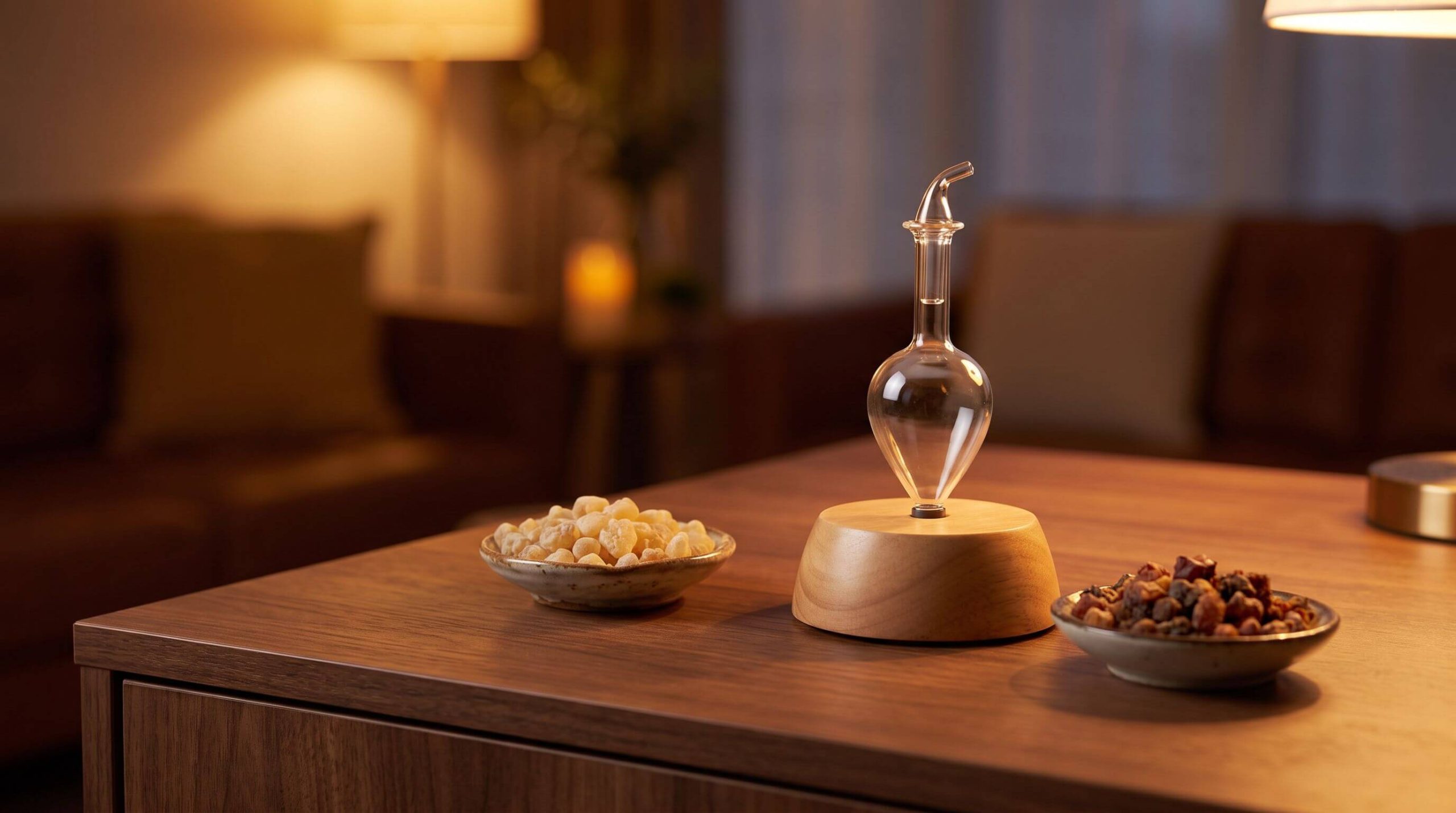
A Nebulizing Diffuser® uses Bernoulli’s Principle: a stream of air passes over a fine glass tube and draws pure essential oil up into a cloud of micro-droplets. There is no water and no heat, so the full chemistry of the oil reaches the room, including heavy base notes that a warm plate would dull. That is good news for resins. It does come with one practical rule from our own customer-care team: thick resin oils such as myrrh and frankincense should not be run alone. Diffused neat, session after session, they can slowly leave a sticky film inside the micro-tubes.
The resin-vs-gum chemistry above gives you the fix. Let the lighter oil carry the heavier one. Keep frankincense as the majority, keep myrrh as a minority accent, and add a thin, bright citrus to keep the whole blend flowing. These are our suggested starting ratios; adjust them by nose.
The Temple Classic (3 : 1 : 2)
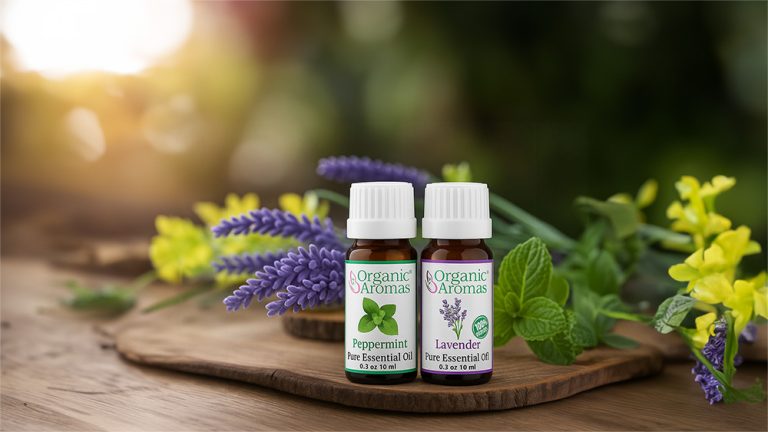
3 parts Frankincense Essential Oil, 1 part Myrrh Essential Oil, 2 parts Sweet Orange Essential Oil. Sweet orange is mostly limonene, so it thins the blend and adds a soft, sweet glow that makes the resins feel warm rather than solemn. This is the one to start with.
Evening Vespers (4 : 1 : 2)
4 parts frankincense, 1 part myrrh, 2 parts Bergamot Essential Oil. Bergamot’s floral, tea-like brightness (we explore it in what bergamot really smells like) lets the myrrh read as velvet rather than bitterness. Lovely for unwinding at dusk.
Quiet Hour (3 : 1 : 2)
3 parts frankincense, 1 part myrrh, 2 parts Lavender Essential Oil. Clean, herbal and calming. A good choice for a reading corner or a slow Sunday morning.
A few habits keep resin blends sweet-smelling and your device running smoothly. Mix the blend in a separate clean bottle and let it sit for a day so the notes marry. Run shorter intermittent sessions, since resin notes linger in a room. If you love a heavier myrrh accent, a dilution medium such as Augeo Clean Multi helps keep sticky oils moving; follow the label. Most importantly, give the glass a rinse after a resin session. Our step-by-step guide to cleaning a Nebulizing Diffuser® takes ten minutes, and if output ever drops after resins, our troubleshooting guide walks through clearing a slow tube.

Join Our Exclusive Member Club to get Big Discounts!
Why Myrrh Has Cost More Than Frankincense for 2,000 Years
Here is a detail almost no modern comparison mentions. In Book 12 of his Natural History, written around 77 AD, Pliny the Elder recorded what Romans paid for these resins. The best frankincense sold for 6 denarii a pound, the second grade for 5 and the third for 3. Myrrh was dearer across the board: cultivated myrrh fetched up to 11 denarii, Erythrean and Troglodyte myrrh up to 16, and stacte, the prized liquid myrrh, anywhere from 3 to an extraordinary 50 denarii a pound.
So top-grade myrrh cost roughly two to almost three times the best frankincense in first-century Rome. Today our myrrh oil starts at three times the price of our frankincense. The reasons rhyme across twenty centuries: myrrh comes from a slower, scrubbier tree in a narrower region, its resin is mostly gum rather than oil, and every bottle represents a lot of raw material for very little finished oil.
That price is also why myrrh is so often stretched or substituted. Because it is used as an accent, a single bottle goes a long way in the ratios above, and pairing it with the far more affordable frankincense is both the classic and the economical way to enjoy it. If you want to hear both resins at their fullest, pure and undiluted by water, explore our handcrafted Nebulizing Diffusers® in real wood and medical-grade Pyrex glass.
Myrrh vs Frankincense: Frequently Asked Questions
Which smells better, myrrh or frankincense?
Neither, objectively; they do different jobs. Frankincense is brighter, fresher and more approachable, so most people prefer it on its own. Myrrh is deeper, warmer and more bitter, and it shines as an accent beneath frankincense or citrus rather than solo.
Can I use myrrh and frankincense together?
Yes, and they are better together. Frankincense’s light monoterpenes open the blend and myrrh’s heavy furanosesquiterpenes anchor it. Start around 3 parts frankincense to 1 part myrrh, and add a thin citrus such as sweet orange or bergamot when diffusing.
Is myrrh or frankincense better for skin?
There is no good evidence that either essential oil outperforms the other on skin; most skin research uses extracts in lab or animal studies. Choose by scent, always dilute (about 1 percent for the face), patch test first, avoid oxidized frankincense, and avoid topical myrrh in pregnancy.
Why is myrrh oil more expensive than frankincense oil?
Myrrh resin is mostly water-soluble gum with a small and variable oil content, it comes from a slower-growing shrub-tree in a narrow region, and distilling it is slow. It has been the dearer resin since at least Pliny’s day, when top myrrh cost two to nearly three times the best frankincense.
Can I diffuse myrrh or frankincense on its own?
Both are thick resin oils. In a Nebulizing Diffuser® we recommend blending them with a thinner oil rather than running either neat, and rinsing the glass after resin sessions so the micro-tubes stay clear.
The Bottom Line on Myrrh vs Frankincense
Frankincense and myrrh share a family, a homeland and a legend, but they are opposites in almost every way that matters to your nose. Frankincense is resin-rich, pinene-bright and generous. Myrrh is gum-rich, furan-dark, scarce and precious. Used together, with frankincense leading and myrrh in a supporting role, they create one of the most complete scent pairings in aromatherapy, the same warm, sacred atmosphere people have paid dearly for since antiquity. Start with the Temple Classic, keep your glass clean, and let the lighter resin carry the deeper one.