

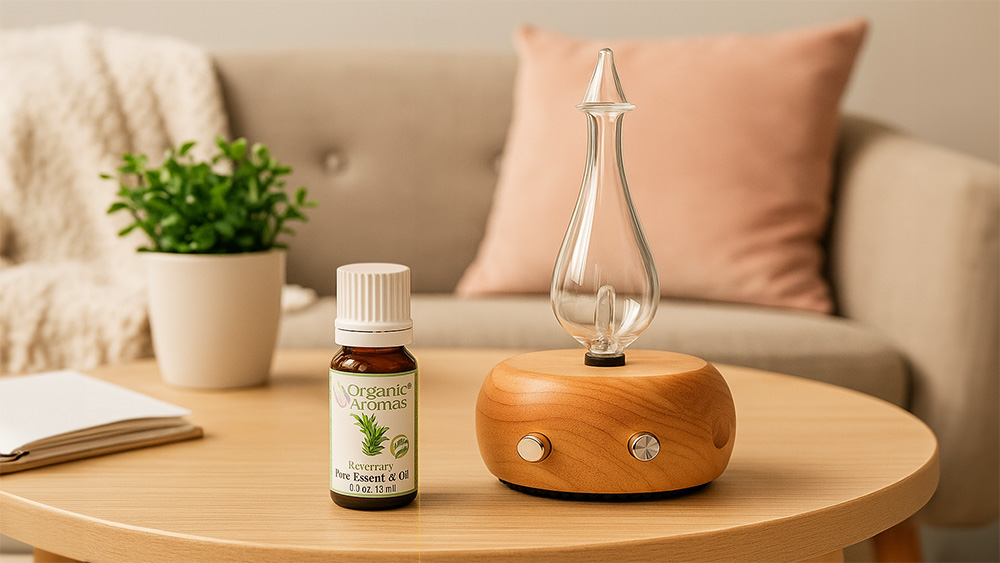
Nebulizing Diffuser Not Working? 7 Fixes for Clogs, No Mist & No Power
Few things are as quietly disappointing as reaching for your Nebulizing Diffuser® at the end of a long day and getting nothing back — no aroma, no soft hiss of moving air, no gentle plume of scent. If your nebulizing diffuser is not working, take a breath: in the overwhelming majority of cases the device is not broken at all. It is clogged, starved of airflow, or simply misunderstood.
Here is the single most important thing to know first. A nebulizing diffuser does not make water vapor or “mist” the way an ultrasonic unit does. It has no water tank and no heating element. It uses a stream of pressurized air to atomize pure essential oil into a dry cloud of microscopic droplets. So if you are waiting for a visible fog and seeing only a faint wisp, your diffuser may be working perfectly — you are just expecting the wrong thing. Understanding that distinction solves a surprising number of “it’s broken” panics before you touch a single part.
This guide walks through seven of the most common reasons a nebulizing diffuser is not working — from a blocked glass micro-tube to a silent motor to weak-smelling oil — with the exact fix for each, two step-by-step video demos, and a prevention routine so it does not happen again. Start with the quick-diagnosis table below, then jump to the section that matches your symptom.
| What you’re seeing | Most likely cause | Go to |
|---|---|---|
| No aroma, air is running | Clogged glass micro-tube | Fix #1 |
| No air / no hiss at all | Pump or motor issue | Fix #2 |
| Diffusing, but scent is faint | Oxidized oil or room airflow | Fix #3 |
| No light, no sound, dead | Power or battery fault | Fix #4 |
| Loud rattle, gurgle, or leak | Overfill, seating, or level | Fix #5 |
| Shuts off on its own | Auto-timer working as designed | Fix #6 |
| App won’t find or control the diffuser | Bluetooth/app pairing (Smart models) | Fix #7 |
Why a Nebulizing Diffuser® Stops Working (the 60-Second Mechanism)
Diagnosing any problem is far easier once you know how the device actually works. A Nebulizing Diffuser® is a cold-air atomizer built on Bernoulli’s Principle. A small pump pushes a fast jet of air across the top of a narrow glass micro-tube that sits in your oil. That fast-moving air lowers the pressure at the tube’s opening — the venturi effect — and the drop in pressure pulls oil up the tube, where the air stream shatters it into a fine aerosol of particles small enough to hang in the air. No water. No heat. Just pure, undiluted essential oil.
That elegant design has one consequence worth remembering: the entire system depends on a clear, precisely sized opening and a strong, unobstructed column of air. Anything that narrows the glass pathway — dried oil residue, a resinous film, a stray droplet in the air line — or anything that weakens the airflow will show up immediately as reduced or absent output. In our 12+ years of customer support, roughly two problems out of three trace back to one of those two things: a blocked tube or a starved pump. That is genuinely good news, because both are fixable at your kitchen counter. If you want the full picture, our deep-dive on how a nebulizing diffuser works breaks down the physics in more detail.
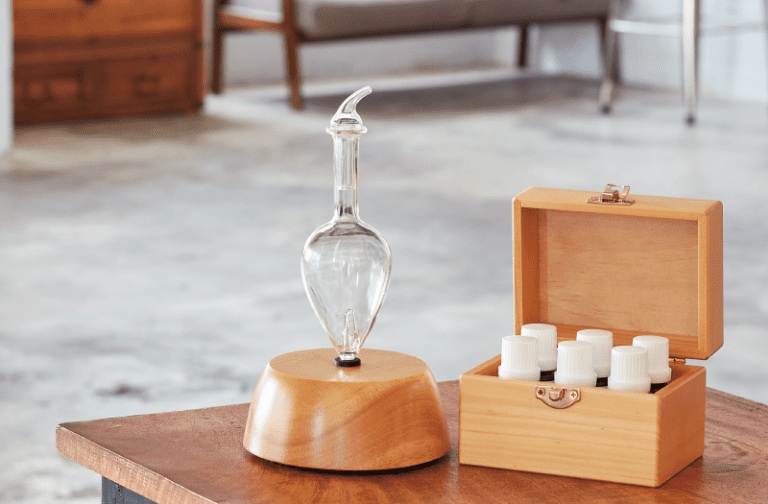
Fix #1: Clear a Clogged Glass Micro-Tube
This is the number-one reason a Nebulizing Diffuser® is not working. If the pump is clearly running — you can hear the air and feel a faint breeze — but almost no aroma reaches the room, the glass micro-tube is blocked.
Here is the jewel most troubleshooting pages miss: not all essential oils clog equally. The culprits are the heavy, high-viscosity oils rich in sesquiterpenes and resins — think myrrh, sandalwood, vetiver, patchouli, and vanilla-style absolutes. These oils oxidize and polymerize into a sticky, varnish-like film that narrows the micro-tube’s opening far faster than light oils like citrus, eucalyptus, or lavender. If you diffuse thick oils often, expect to clean more often. We break down exactly why in our guide on why sandalwood and vetiver barely nebulize.
How to clean the micro-tube
- Remove the glass reservoir from the base of the diffuser.
- Using the plastic cleaning pipette, add a few milliliters of high-percentage isopropyl (or ethyl) alcohol — 75–95% purity — into the glass reservoir. Higher purity works better because it carries less water to leave behind.
- Cover the top with your thumb, then swirl and gently shake so the alcohol reaches every internal surface.
- Discard the used alcohol safely.
- Add a few more milliliters of fresh alcohol, then use the pipette to blast the micro-tube with a firm stream — five or six times — to dislodge residue from inside the opening.
- Discard the excess and wipe the glass clean.
- Let it dry fully before reattaching. Alcohol left in the tube can momentarily thin your next batch of oil.
Prefer to watch? Here is a full demo — the key technique is at the 1:00 mark. For a written walk-through, see our step-by-step nebulizing diffuser cleaning guide.
Reattach the reservoir and test again. If the aroma returns, you are done. If it is still weak, move on to the pump test.

Join Now and Get a Coupon for 10% Off!
Fix #2: Run the Pump Test When There’s No Airflow
If cleaning does not help and you hear no air moving at all, the issue is likely the internal air pump or motor rather than the glass. A Nebulizing Diffuser® that is not working because the pump has failed will be silent or noticeably quieter than usual, with no breeze at the air outlet.
How to do the pump test
- Use the included Pump Test Device, or a small plastic tube.
- Remove the glass cap and place the tube at the air outlet on the base.
- Turn the diffuser on and feel for a steady stream of air.
Strong, steady airflow means the pump is healthy and your problem is upstream — recheck the tube or the oil. No airflow points to a motor or transformer fault. Record a short video of the test; our support team can diagnose far faster when they can see and hear the outlet. A related noise — bubbling or spitting rather than silence — usually is not a fault at all, as we explain in why a nebulizing diffuser gurgles or spits.
Fix #3: Diffusing but the Aroma Is Weak
Sometimes the machine is doing its job and the oil, or the room, is the real reason your Nebulizing Diffuser® seems not to be working. If a fine aerosol is clearly leaving the glass but the scent barely registers, look here first.
Common causes
- Oxidized or low-grade oil. Once opened, citrus and other monoterpene-rich oils can lose their brightness within 6–12 months as they oxidize. Old oil nebulizes but smells flat.
- Synthetic or diluted blends. “Fragrance oils” and pre-diluted products have less volatile aromatic content per drop, so the scent reads weaker and can gum up the tube.
- Room size and airflow. An open-plan space, a running fan, an AC vent, or a cracked window will sweep the aroma away as fast as it is produced.
Solutions
- Switch to a fresh, pure, single-origin essential oil. Not sure how to tell? Our guide on how to tell pure oil from a synthetic blend makes it simple.
- Run the diffuser in a smaller, enclosed room, and turn off fans and vents nearby.
- Give it a few minutes. Nebulized aroma builds gradually; it is meant to be experienced in pulses, not as a constant fog.
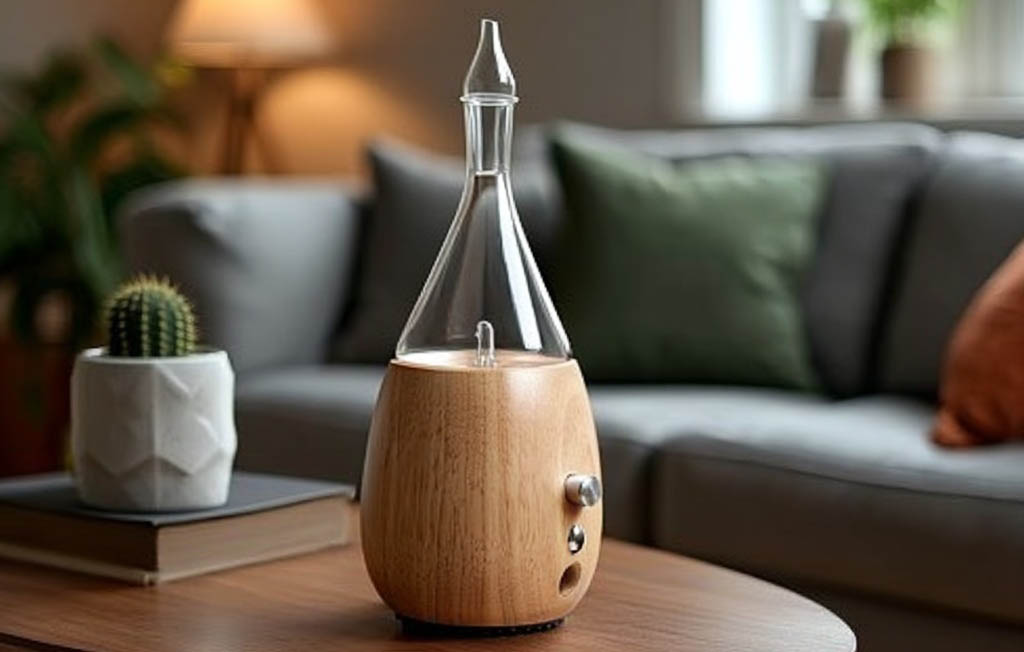
Fix #4: No Power, No Light, No Sound
If your Nebulizing Diffuser® is completely dead — no light, no sound, no air — the cause is almost always power delivery rather than the diffuser mechanism itself.
What to check
- Make sure the power adapter is fully and firmly seated at both ends.
- Try a different wall outlet you know is live.
- Plug directly into the wall — skip extension cords and power strips, which can under-deliver voltage.
- Press and hold the power button for 2–3 full seconds; some models require a long-press to start.
- Cordless and Smart models: the battery may simply be flat. Charge for a full hour before judging, and confirm the charging light comes on — a bad cable is a common false alarm.
If it still will not power on, the transformer or internal circuitry may need service. Contact the brand’s support team and mention your pump-test result for a faster resolution.
Fix #5: Loud Rattle, Gurgle, or Leaking Oil
Not every complaint is about silence — sometimes a Nebulizing Diffuser® that is not working “right” is actually noisy or messy. Here is how to read those symptoms.
- A louder-than-usual hum or rattle often means the glass reservoir is not seated squarely on the base, or the wooden base is resting on a hard, resonant surface. Reseat the glass and set the unit on a soft cloth or coaster.
- Gurgling or spitting droplets usually means you overfilled. Keep oil below the bottom of the internal glass tube — most units run best on 15–25 drops, not a full reservoir.
- Oil pooling at the base points to overfill or tilting during use. Wipe the base dry, reduce the oil level, and keep the diffuser on a flat surface.
Overfilling is the hidden cause behind most “leaking” and “gurgling” reports. Less oil, not more, gives a cleaner, stronger diffusion.
Fix #6: It Turns Off by Itself
If your Nebulizing Diffuser® runs for a while and then stops, it is almost certainly doing exactly what it was designed to do. Most models include an automatic shut-off timer — commonly a 2-hours-on cycle or an intermittent on/off rhythm — to conserve oil and let scent fade between bursts. That pulsing is a feature, not a fault: our sense of smell fatigues quickly, so short bursts actually keep the aroma more noticeable over an evening. Check your model’s timer setting before assuming failure, and see how long you should run a nebulizing diffuser for the full rationale.
Fix #7: Smart App Won’t Connect or Pair (Bluetooth Models)
If you own a Smart Nebulizing Diffuser® and the unit itself runs fine but the app cannot find it, schedule it, or control intensity, the problem is almost always Bluetooth pairing rather than the diffuser hardware.
What to check first
- Confirm Bluetooth is switched on for your phone or tablet, and that you are within the roughly 10-meter (30-foot) range of the diffuser.
- Power the diffuser on by pressing and holding the touch sensor for 3 seconds — the app can only discover a diffuser that is already powered on.
- Make sure the app is updated to its latest version from the Google Play or Apple App Store (search “Nebulizing Diffuser” by Organic Aromas).
- One-device rule. Each Smart diffuser holds a Bluetooth connection with only one phone or tablet at a time. If another device connected first, yours will not find it until that connection is released.
The reset sequence that clears most pairing failures
- Force-close and reopen the app, then tap the + icon to search for a new diffuser.
- Toggle your phone’s Bluetooth off, then back on.
- Restart your phone if the diffuser still does not appear in the search.
- If the diffuser was previously paired to a different phone, disconnect it there first — only one connection is allowed at a time.
Worth ruling out separately: if the diffuser connects fine but the battery seems to drain unusually fast, that is a distinct issue from a pairing failure. Lithium batteries in rechargeable models lose capacity gradually with age and charging habits, not from a Bluetooth fault — with normal care, expect 2,000+ hours of operation from a Smart unit.
Prevent Your Nebulizing Diffuser From Failing Again
Consistent, light maintenance is what keeps a Nebulizing Diffuser® working for years. Build these habits into your routine:
- Weekly: a quick alcohol rinse of the glass if you diffuse daily.
- After thick oils: clean the same day you diffuse sandalwood, myrrh, vetiver, or patchouli.
- Never add water or carrier oil to a nebulizing diffuser — it is built for neat essential oil only, and water can damage the mechanism.
- Don’t leave oil standing unused in the glass for weeks; it thickens and dries into the tube.
Deep clean for stubborn clogs. If a normal alcohol rinse will not clear a heavy blockage, give the glass reservoir a deep clean:
- Put on dishwashing gloves to protect your hands.
- Prepare a container of hot water (about 80–90°C / 170–190°F). Take care — it is hot.
- Add a small amount of mild dish soap and submerge the glass reservoir.
- The heat and soap loosen staining, oil residue, and blockages. Top up with hot water as needed.
- Soak for at least 30 minutes.
- Rinse with clean tap water and set the unit in a safe place to dry completely before use.
For the full routine, including what not to do, read how to clean an essential oil diffuser the waterless way.

Join Our Exclusive Member Club to get Big Discounts!

When to Contact Support (and What to Send)
If you have cleaned the tube, run the pump test, confirmed power, and your nebulizing diffuser is still not working, it is time to reach out. You will get help fastest if you send: a short video of the pump test showing airflow at the outlet, the model name, and roughly how old the unit is. That lets the team distinguish a clog from a genuine motor fault without guesswork. Considering an upgrade instead? The Smart Nebulizing Diffuser® adds app-based diagnostics and scheduling that flag many of these issues before you notice them.
Final Thoughts
When your nebulizing diffuser is not working, resist the urge to replace it. The vast majority of problems come down to six quick checks:
- Clean the glass micro-tube — the most common fix by far.
- Run the pump test to confirm the motor and airflow.
- Use fresh, pure essential oil for a fuller aroma.
- Adjust the room — smaller space, fewer drafts.
- Check power, seating, and the auto-timer.
- Smart model acting up? Confirm Bluetooth pairing and app updates before assuming a hardware fault.
Work through them in order and you will restore a clean, steady stream of pure aromatherapy in minutes. Need help with a specific model? Leave a comment or send us your cleaning or pump-test video — our team is glad to help.
Frequently Asked Questions
Why is my nebulizing diffuser not working even after cleaning?
If your nebulizing diffuser is not working after you clean the glass reservoir, the internal air pump is the next suspect. Run a simple pump test to check for airflow at the outlet. If there is no airflow, the motor may need service — contact the manufacturer with a short video of the test.
How often should I clean my nebulizing diffuser?
Clean it about once a week with 75–95% alcohol if you diffuse daily, and clean the same day whenever you use thick oils like sandalwood or myrrh. Regular cleaning is the single best way to prevent clogs and keep output strong.
Which essential oils should I avoid in a nebulizing diffuser?
Heavy, resinous oils — myrrh, sandalwood, vetiver, and patchouli — clog the glass micro-tube fastest because they are viscous and oxidize into a sticky film. You can still enjoy them; just clean more often, or blend them with a lighter oil.
Can I use water or carrier oil in my nebulizing diffuser?
No. Nebulizing diffusers are designed for pure, undiluted essential oil only. Adding water or carrier oil can damage the mechanism and is a common reason a nebulizing diffuser stops working properly.
Why is there vapor but no smell coming from my diffuser?
If your diffuser is producing a fine aerosol but little scent, the oil may be oxidized or low quality, or the room may be too large or drafty. Use fresh, pure oil in a smaller, enclosed space with fans and vents turned off.
Why is my nebulizing diffuser leaking or gurgling?
Both are usually signs of overfilling. Keep the oil below the bottom of the internal glass tube — around 15 to 25 drops — set the unit on a flat surface, and make sure the glass reservoir is seated squarely on the base.
Does a nebulizing diffuser make mist like an ultrasonic one?
No. A nebulizing diffuser uses no water and no heat, so it produces a dry aerosol of pure oil rather than a visible water mist. If you were expecting fog, a faint plume is normal — the diffuser may be working perfectly.