

Non Toxic Home Fragrance: The Honest Guide to Formats, Ozone and Dose
Search for non toxic home fragrance and you’ll find the same story again and again: synthetic air fresheners are bad, plant-based ones are good, here are the brands to buy. Part of that story is true. But it leaves out the chemistry of what happens to fragrance once it’s in the air of your home, and that part applies to plant-based scents too.
We make Nebulizing Diffusers® for pure essential oils, so you might expect us to skip that part. We’d rather tell you. Below you’ll find what “non-toxic” can and can’t mean on a label, the indoor-air reaction most brands never mention, an honest scorecard of every common home fragrance format, and a short set of rules for keeping your home’s fragrance load low. The short version: a non-toxic home fragrance routine depends on dose, ventilation and format, not just on where the ingredients came from.
What Non Toxic Home Fragrance Can (and Can’t) Mean

Start with the label. In the United States, “non-toxic” has no regulated definition on a candle, spray or air freshener. Neither do “clean,” “natural” or “green.” A brand can print them without meeting any shared standard. Ingredient disclosure has its own gap, because a whole fragrance blend can legally appear as the single word “fragrance.” We cover that loophole, and the phthalate question that comes with it, in our natural air freshener guide, so we won’t repeat it here.
What most guides do next is swap one ingredient list for another: avoid phthalates and synthetic musks, choose plant extracts and essential oils. That’s a sensible first step. Choosing genuinely pure oils is a skill of its own, and our guide to non-toxic essential oils walks through the purity signals worth checking.
But toxicity has never been a property of where an ingredient came from. It depends on what the molecule is, how much of it is in the air, for how long, and what it turns into. That last point is the one the “swap your products” articles leave out.
Three questions that matter more than “natural or synthetic”
How much goes into the air? A few minutes of scent in a room is a very different exposure from a product that emits all day, every day.
What else does the format add? Smoke and soot from a flame, solvents in a reed liquid, propellants in an aerosol, or water and tank residue in a humidifier-style device.
Where does it go? Fragrance doesn’t simply float until it fades. Some of it lands on surfaces, some leaves through open windows, and some reacts with other chemicals in the air.
The Part Most Brands Leave Out: Terpenes and Indoor Ozone
Almost every pleasant smell in a home, whether from a lemon, a pine needle, a bottle of lavender oil or a synthetic “fresh linen” plug-in, depends on a family of molecules called terpenes and their close relatives. Limonene gives citrus its brightness. Alpha-pinene is the smell of a conifer forest. Linalool and linalyl acetate define lavender.
Many of these molecules have carbon-carbon double bonds, and those double bonds react readily with ozone. Ozone isn’t only an outdoor smog problem. It drifts indoors through windows, doors and ventilation, so most homes have some. In a classic review in Indoor Air, chemist Charles Weschler noted that indoor ozone has a half-life of roughly 7 to 10 minutes and that most indoor pollutants react with it too slowly to matter. The exceptions are compounds with those unsaturated carbon-carbon bonds. They make up less than 10% of indoor pollutants, but their reactions with ozone can be a significant indoor source of free radicals and of new, often odorous compounds (Weschler, 2000).
What the chamber studies measured
Researchers at Lawrence Berkeley National Laboratory tested this in a 50-cubic-meter chamber set up like a furnished room. In one study, Brett Singer and colleagues ran a plug-in scented-oil air freshener for three days. It released d-limonene, dihydromyrcenol, linalool, linalyl acetate and beta-citronellol at 35 to 180 mg per day, and room concentrations averaged 30 to 160 µg/m³ (Singer et al., 2006, Indoor Air). Look at that list again: linalool and linalyl acetate are the signature molecules of lavender. Whether they come from a lab or a lavender field, they’re the same molecules and they react the same way.
A companion study then added ozone at levels typical of a warm-season day in a polluted area. With terpene-containing products in use, ozone was consumed and formaldehyde rose by around 10 parts per billion. Cleaning with an orange-oil degreaser and a pine-oil cleaner produced fine-particle concentrations above 100 µg/m³ in some tests, and the reactive chemistry continued for 10 to 12 hours after a brief cleaning session (Singer et al., 2006, Atmospheric Environment). Those particles are secondary organic aerosol, a fine haze formed in the air rather than emitted directly.
Nazaroff and Weschler’s earlier review reached the same conclusion: terpenes in cleaning products and air fresheners can react rapidly with indoor ozone to form formaldehyde and hydroxyl radicals, which go on to form other secondary pollutants (Nazaroff & Weschler, 2004). A 2020 critical review focused specifically on essential-oil-based household products came to a similar view. It found that these products are significant sources of terpenes indoors, and that their reactions can produce formaldehyde and secondary organic aerosol (PubMed 32162221).
What this does and doesn’t mean
It doesn’t mean essential oils are secretly dangerous, or that a few minutes of lavender in your bedroom is the same as a pine cleaner mopped across a whole floor. The amounts in these studies are the point: quantity and duration drive the outcome. A product that emits continuously for days keeps feeding the reaction. A short, small session gives it far less to work with, and ventilation clears what’s formed.
It does mean “plant-based” isn’t a free pass. If a brand tells you its fragrance is non-toxic simply because it’s natural, it’s leaving out the chemistry. We’d rather you know, because the fix is easy and it’s in your hands. We also look at this from the diffusion side in are essential oil diffusers safe?.
Join Now and Get a Coupon for 10% Off!
Home Fragrance Formats Scored: Candles, Plug-Ins, Reeds, Sprays, Simmer Pots and Diffusers
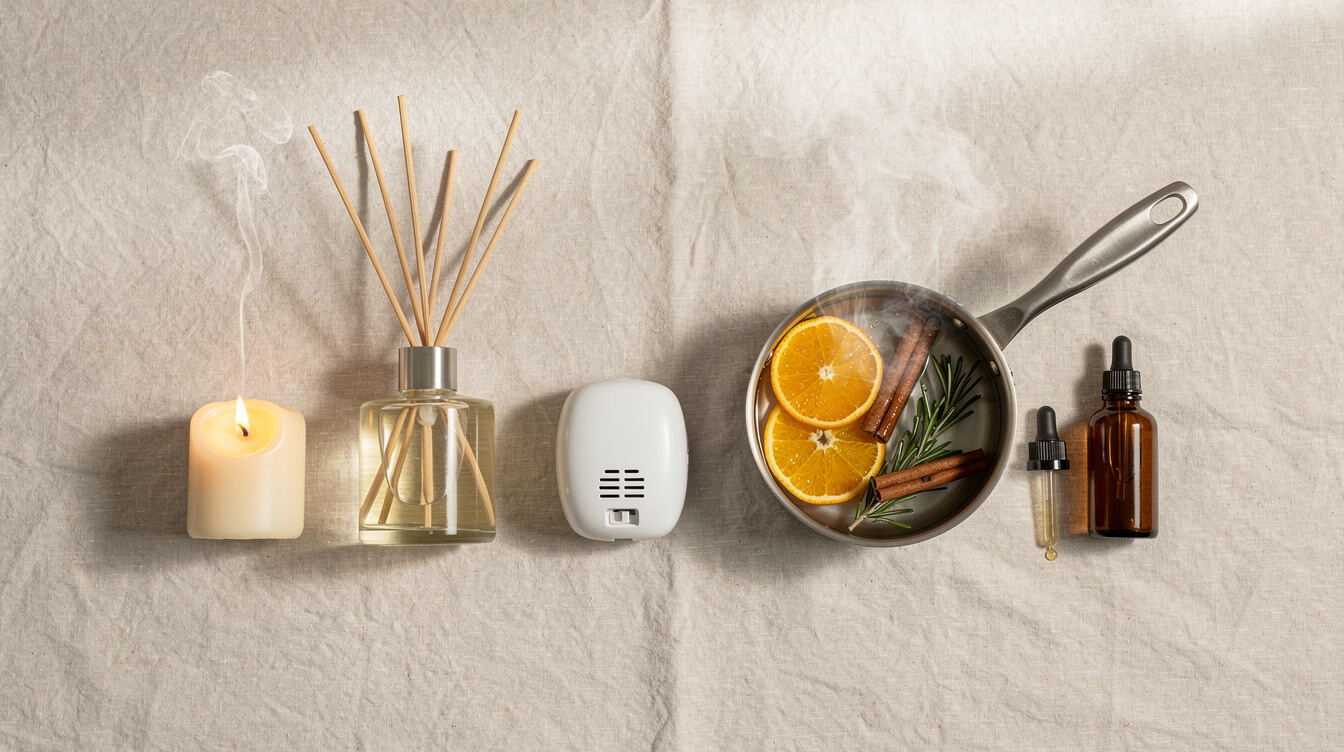
If dose and duration matter as much as ingredients, the format you choose becomes the biggest decision. We scored the common options on five questions: Does it burn anything? Does it add a carrier, solvent or propellant? Does heat change the scent chemistry? How much control do you have over dose and timing? Can you see exactly what’s in it?
Candles and wax melts
Combustion: yes for candles, which add soot and combustion byproducts to the air whatever the wax. Beeswax and well-made soy candles tend to burn cleaner than cheap paraffin, but no flame is emission-free. Heat: yes, which alters delicate top notes. Control: moderate, since you decide when to light and snuff. Transparency: depends entirely on the brand. Wax melts skip the flame but still heat the fragrance. Our diffuser vs candle comparison goes deeper on the combustion chemistry.
Plug-in air fresheners
Combustion: none. Heat: usually gentle warming. Control: the weakest of any format. Plug-ins emit continuously, day and night, which is exactly the long-duration pattern measured in the chamber study above. Transparency: often limited to “fragrance.”
Reed diffusers
Combustion and heat: none. Carrier: yes. Most reed liquids are a small amount of fragrance in a solvent base that helps it wick up the reeds, and that solvent evaporates into the room too. Control: low. Reeds emit around the clock, and you can only adjust them crudely by adding or removing sticks.
Aerosols and room sprays
Propellant or solvent: aerosols use propellants, and most pump sprays rely on alcohol or emulsifiers to carry the oil in water. Control: decent, because a spray is a short burst. The trade-off is that droplets settle onto floors, fabric and furniture.
Simmer pots
Combustion: only if you’re cooking on gas. Heat: yes, by design. Control and transparency: excellent, since you can see every orange slice and cinnamon stick. They’re a lovely, honest option for a supervised afternoon. They just can’t be left alone, and the scent is fairly faint.
Ultrasonic diffusers
Combustion and heat: none. Carrier: water. The oil is a small fraction of the mist, and anything in the tank, including minerals and microbial growth if it isn’t cleaned, is aerosolized along with it. We compare the water question in diffuser vs humidifier. Control: good when used with timers, but many units run for hours by default.
Nebulizing Diffusers®
Combustion, heat, carrier, solvent, propellant: none. A Nebulizing Diffuser® uses Bernoulli’s Principle: a stream of air passes over a thin glass tube, draws pure essential oil up, and breaks it into a fine mist inside a glass reservoir. Control: the highest of any format, with interval modes and timers so sessions start and stop on their own. Transparency: total, because the only thing in it is the oil you chose.
The honest caveat: because the oil is undiluted, a Nebulizing Diffuser® is also the strongest format per minute. It earns its top score only if you use that control. Run it nonstop in a closed room and you’ve recreated the plug-in problem with better oil.
The Low-Load Rules for a Non Toxic Home Fragrance Routine
Everything above comes down to keeping the total amount of reactive fragrance in your air modest, and letting fresh air carry away what forms. These are the habits we’d recommend, whatever format you use.
1. Scent in sessions, not all day
Emission over many hours is what keeps the reaction fed. Aim for short sessions, typically 30 to 60 minutes, at the moments you’ll enjoy them, such as when guests arrive, a morning reset or the wind-down hour. Your nose adapts to a constant scent anyway, so continuous fragrance gives you less pleasure for a much larger dose. Our guide to how long to diffuse essential oils covers timing in detail.
2. Use less than you think
On a Nebulizing Diffuser®, start with interval mode (around 2 minutes on, 1 minute off) and the lowest output that still lets you notice the scent when you walk into the room. If you notice the fragrance from the hallway, the dose is already generous.
3. Ventilate, and time it to the ozone
A cracked window or a running extractor fan clears both the fragrance and anything it forms. There’s one nuance almost no one mentions. Outdoor ozone usually peaks on hot, sunny afternoons, especially in cities, and an open window brings that ozone in. If you can, ventilate in the morning or evening, and on high-ozone days (your local air-quality index will tell you) keep heavy scenting for later in the day. In practice: lighter fragrance on a smoggy summer afternoon, more freedom on a cool, clean-air evening.
4. Never pair fragrance with an ozone generator
Some “air purifiers” and ionizers deliberately produce ozone. The U.S. EPA warns that ozone reacts with many indoor chemicals to form harmful or irritating byproducts and does not effectively remove contaminants like formaldehyde (EPA). Running one alongside any terpene-rich fragrance, natural or not, works against everything in this guide. A HEPA purifier with an activated carbon stage is the better partner. Our guide to cleaner air at home has more ideas.
5. Go easy on citrus and conifer oils in small, closed rooms
Citrus oils are mostly limonene, and pine, fir and other conifer oils are rich in alpha-pinene and related monoterpenes. Those are among the fastest ozone reactors in the home fragrance palette. They’re bright and wonderful, so we’re not suggesting you give them up. Just give them shorter sessions and better airflow, and don’t follow a citrus mop of the kitchen floor with an hour of orange oil in the same closed room.
6. Clean scent sources out of the air you breathe
Fragrance layered on top of an odor problem means more fragrance than you need. Fix the source first, such as a damp towel, the bin or a pet bedding wash, and you’ll find a light session does the job.
Sign Up to Get Your FREE
e-Book Here…
Building a Low-Load Fragrance Routine with Pure Essential Oils
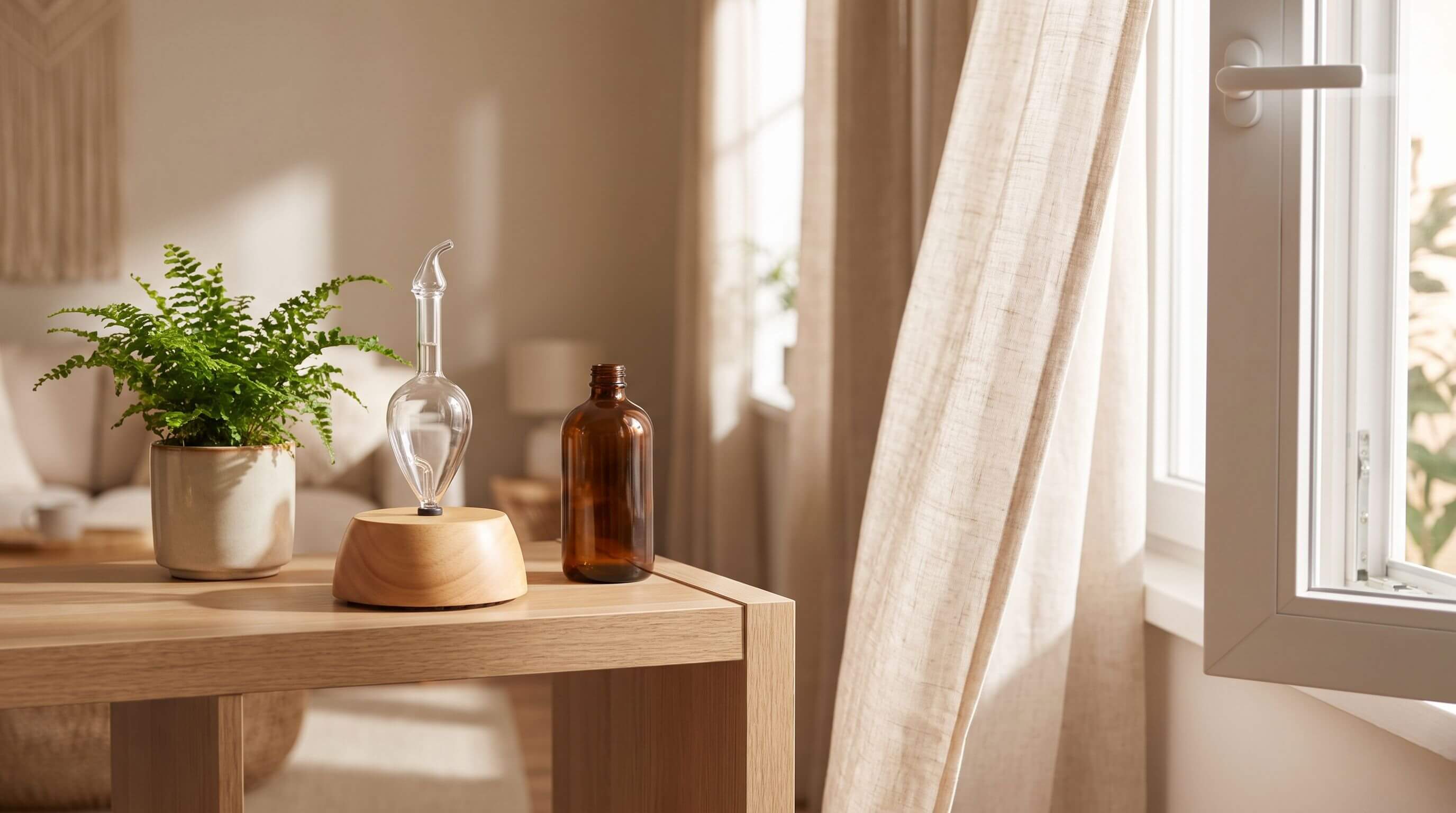
Here’s how a non toxic home fragrance routine looks in a real week, built around pure oils and a format you can control.
Choose oils you can verify. One botanical ingredient per bottle, with the Latin name on the label and no added carrier or “fragrance.” If you’re unsure how to judge purity, our guide to essential oils vs synthetic fragrance oils lays out the differences.
Pick one or two scent moments a day. For example, a 30-minute citrus-and-rosemary reset with the morning window open, and a softer lavender-and-cedarwood session in the evening. That’s an hour of fragrance a day instead of twenty-four.
Let the timer do the remembering. The Raindrop Smart Nebulizing Diffuser® is rechargeable and app-scheduled, so sessions switch off on their own, and it’s handcrafted from real wood and medical-grade Pyrex glass with no plastic reservoir. Every model is in our handcrafted Nebulizing Diffuser® collection.
Keep the glass clean and the oils capped. Oxidized oil smells flat and leaves residue. Store bottles cool, dark and tightly closed, and rinse the reservoir between oil families with our Nebulizing Diffuser® cleaning guide.
Think about everyone who shares the air. Babies, people who are sensitive to scent, birds, and cats in particular need a lighter touch and an easy way to leave the room. Our pet diffusion safety guide explains the extra precautions for animals, and anyone with a respiratory condition should check with their doctor before using fragrance at home.
Non Toxic Home Fragrance: Frequently Asked Questions
What is the healthiest way to fragrance your home?
The lowest-load approach is to remove odor sources, ventilate, and add small amounts of a pure, fully disclosed fragrance in short sessions you can switch off. Formats without flame, heat, solvents or propellants, used on a timer, give you the most control.
Do air fresheners contain phthalates?
Some do, often hidden under “fragrance” on the label, though many brands now advertise phthalate-free formulas. Look for full ingredient disclosure rather than relying on the claim alone.
Are essential oils non-toxic?
Pure essential oils avoid many synthetic additives, but they aren’t automatically harmless. They’re concentrated, and their terpenes can react with indoor ozone just like terpenes in synthetic fragrance. Used in small doses with good ventilation, they make a sensible low-load choice.
Are soy or beeswax candles non-toxic?
They generally burn cleaner than cheap paraffin, but every flame produces some soot and combustion byproducts. Trim the wick, burn in a ventilated room, and treat candles as an occasional pleasure rather than all-day fragrance.
Is a reed diffuser safer than a plug-in?
A reed diffuser avoids heat and electricity, but it still emits around the clock through a solvent carrier, and you can’t switch it off. Both formats give you less control over total exposure than a timed session.
What are eco-friendly air freshener options?
Open windows, houseplants for atmosphere, simmer pots, and pure essential oils in a refillable glass Nebulizing Diffuser® all avoid single-use plastic cartridges and aerosol cans.
Join Our Exclusive Member Club to get Big Discounts!
A truly non toxic home fragrance isn’t a product you can buy. It’s a way of using fragrance: pure ingredients, the most controllable format you can find, small doses, short sessions and fresh air. Do that, and your home can smell beautiful without loading its air, whichever oils you love most.