



Rosemary Aromatherapy Oil: The Chemotype Guide to Diffusing for Focus & Clarity
If you have ever crushed a fresh sprig between your fingers and felt your head clear a little, you already know why rosemary aromatherapy oil has been prized for centuries. The ancient Greeks wore rosemary garlands while they studied, convinced it sharpened memory. What they sensed by instinct, modern chemistry can now explain: the bright, camphoraceous aroma of Rosmarinus officinalis is carried by a handful of small, fast-moving molecules that reach the air — and your nose — almost the moment you release them.
Yet most guides to rosemary essential oil stop at a familiar list of benefits and never mention the two things that decide whether the oil actually delivers a bright, alert atmosphere in your room: which chemotype you bought, and how you diffuse it. This guide fixes that. You will learn the chemistry behind rosemary’s reputation for focus, the three chemotypes hiding behind identical-looking labels, what the research really shows about inhaling it, and the diffusion method that keeps its most volatile compounds intact all the way to your desk.
What Sets Rosemary Aromatherapy Oil Apart

Rosemary is a woody Mediterranean herb whose Latin name means “dew of the sea” — a nod to the coastal cliffs where it grows wild. Botanists reclassified it in 2017 from Rosmarinus officinalis to Salvia rosmarinus, formally folding it into the sage genus, though the older name still appears on most bottles. The essential oil is steam-distilled from the flowering tops and leaves, yielding a clear, mobile liquid with a fresh, herbaceous, faintly pine-and-camphor scent that reads as instantly “awake.”
That awakening quality is not marketing. Rosemary’s aroma is built mainly from small monoterpenes and oxides: 1,8-cineole (also called eucalyptol), camphor, alpha-pinene, camphene, limonene, and a touch of linalool. These are light, highly volatile molecules — they evaporate quickly and travel far, which is exactly why rosemary fills a room so readily and why the way you disperse it matters so much. If you are new to building a home scent library, our guide to choosing scents for your diffuser by mood is a helpful companion to this deep dive.
Rosemary also sits naturally in the same family of bracing, single-note oils worth learning one at a time. If you enjoy this style of chemistry-first profile, you may like our companion pieces on frankincense aromatherapy oil and patchouli.
The Chemotype Secret Most Labels Hide
Here is the jewel almost no retail listing tells you: rosemary is not one oil. Depending on where the plant grows and its genetics, the same species produces distinct chemotypes — batches with the same botanical name but meaningfully different chemistry. Buy a bottle simply labeled “rosemary essential oil” and you are, in effect, rolling dice on which one you get.
- Rosemary CT 1,8-cineole (commonly Moroccan or Tunisian): the crispest, most “heads-up” chemotype, often 40–55% cineole. This is the one to reach for when your goal is a bright, clear-headed atmosphere for work or study.
- Rosemary CT camphor (commonly Spanish): higher in camphor, warmer and more penetrating, traditionally favored in body and muscle blends. Its higher camphor content is also the reason for the extra safety cautions below.
- Rosemary CT verbenone (commonly French): the gentlest and most expensive, softer and slightly sweet, prized in fine skincare formulation.
Chemotype is not the only variable, either. Cineole content drifts with harvest season, altitude, and how long the plant flowered before distillation, which is why two “CT cineole” bottles from different suppliers can still smell noticeably different. This is where a Gas Chromatography–Mass Spectrometry (GC/MS) report earns its keep: it prints the actual percentage of each constituent in that specific batch, turning “trust us” into a number you can read. Reputable aromatherapy suppliers make these available on request, and the habit of asking for one is the single fastest way to stop overpaying for anonymous oil.
The practical takeaway: if you want rosemary aromatherapy oil for a focused, energizing room, look for a supplier who states the chemotype and, ideally, publishes a GC/MS report showing the cineole percentage. A pure, single-origin oil with its chemotype named is worth far more to your diffuser than a cheap, anonymous blend — and it stores better too, a point we cover in our note on whether essential oils expire.

Sign Up to Get Your FREE
e-Book Here…
Rosemary Aromatherapy Oil for Focus and Clarity: What the Research Shows

Competitors love to say rosemary “improves memory,” then move on. The more interesting story is why researchers keep testing it. In a well-cited 2012 study published in Therapeutic Advances in Psychopharmacology, Mark Moss and Lorraine Oliver had volunteers sit in a room scented with rosemary aroma while completing cognitive tasks. They measured blood-plasma levels of 1,8-cineole absorbed simply through breathing, and found that higher cineole concentrations tracked with better speed and accuracy on the tasks. In other words, the compound reached the bloodstream through inhalation, and more of it correlated with sharper performance.
Why does inhalation matter as a route at all? Because these are unusually small molecules. Compounds like 1,8-cineole are light enough to cross from the lungs into the bloodstream quickly, which is what let the researchers detect them in plasma at all. That is also why the aroma reaches you as a near-instant hit rather than a slow build — the same volatility that makes rosemary fill a room fast is what makes it a fitting choice for a quick reset between tasks.
It is worth being honest about the limits here: these are small studies, effects are modest, and aromatherapy is a supportive wellness practice, not a treatment for any condition. What the research does support is refreshingly practical — the airborne concentration of 1,8-cineole appears to matter. That single insight reframes the whole question. If the amount of intact cineole in your air is what counts, then your diffusion method is not a minor detail. It is the main event. For a ready-made blend to pair with rosemary, our bright-focus trio recipe is built for exactly these mid-morning moments.
Why Your Diffusion Method Decides the Result
Because 1,8-cineole is so volatile, it is also fragile in the wrong environment. Two of the most common home diffusion methods work against it. An ultrasonic diffuser disperses a mix of water and a few drops of oil as a cool micro-mist — convenient, but it dilutes the oil in water and delivers a thinner concentration of aroma molecules to the air. A heat-based diffuser or warmer is worse for a delicate oil like rosemary: heat drives off and alters the lightest, most desirable top notes first, so what you smell is a flattened, cooked version of the oil.
A Nebulizing Diffuser® takes the opposite approach. Using a principle from fluid dynamics — Bernoulli’s Principle — a stream of pressurized air passing over a glass tube draws pure, undiluted essential oil up and atomizes it into an ultra-fine mist of nothing but oil. No water, no heat. That means the full, intact spectrum of rosemary’s cineole and pinene reaches your air at the concentration the plant actually produced. If you want the mechanics in depth, we compare the two technologies head-to-head in Nebulizing Diffuser vs Ultrasonic Diffuser.
There is a quiet efficiency bonus, too. Because a nebulizing system atomizes neat oil in short bursts rather than misting continuously, many people find they use less oil per session than they expected — the concentration is high, so the run time is short. You are not paying to evaporate water; every drop goes into the air as aroma.
This is exactly why we build our diffusers the way we do. A handcrafted Organic Aromas Nebulizing Diffuser®, made of real wood and medical-grade Pyrex glass, is designed to deliver pure oil into the air with nothing added — the ideal way to experience a volatile, focus-forward oil like rosemary at full strength.

Join Now and Get a Coupon for 10% Off!
How to Diffuse Rosemary: Blends, Dose, and a Morning Ritual

Rosemary is bracing, so a little goes a long way. In a Nebulizing Diffuser®, which runs neat oil, start with short intervals — try a 2-minutes-on, 10-minutes-off cycle for the first session and adjust to your space. In a room-by-room sense, a small home office needs far less run time than an open-plan living area; our drops-by-room-size chart translates this to ultrasonic units too.
Rosemary rarely wants to work alone. A few pairings that keep the bright, clear-headed character while rounding off its sharp edge:
- Rosemary + lemon — the classic morning “clear desk” blend; citrus lifts the herbaceous base.
- Rosemary + peppermint — a cooling, high-alert pairing for the mid-afternoon slump.
- Rosemary + frankincense — grounding and steady, for long, focused work sessions.
Build it into a ritual and it becomes a cue, not a chore. A simple morning sequence: open a window for thirty seconds of fresh air, start your diffuser as you sit down, and let the first two-minute burst mark the official start of focused work. By the time the aroma settles, so have you.
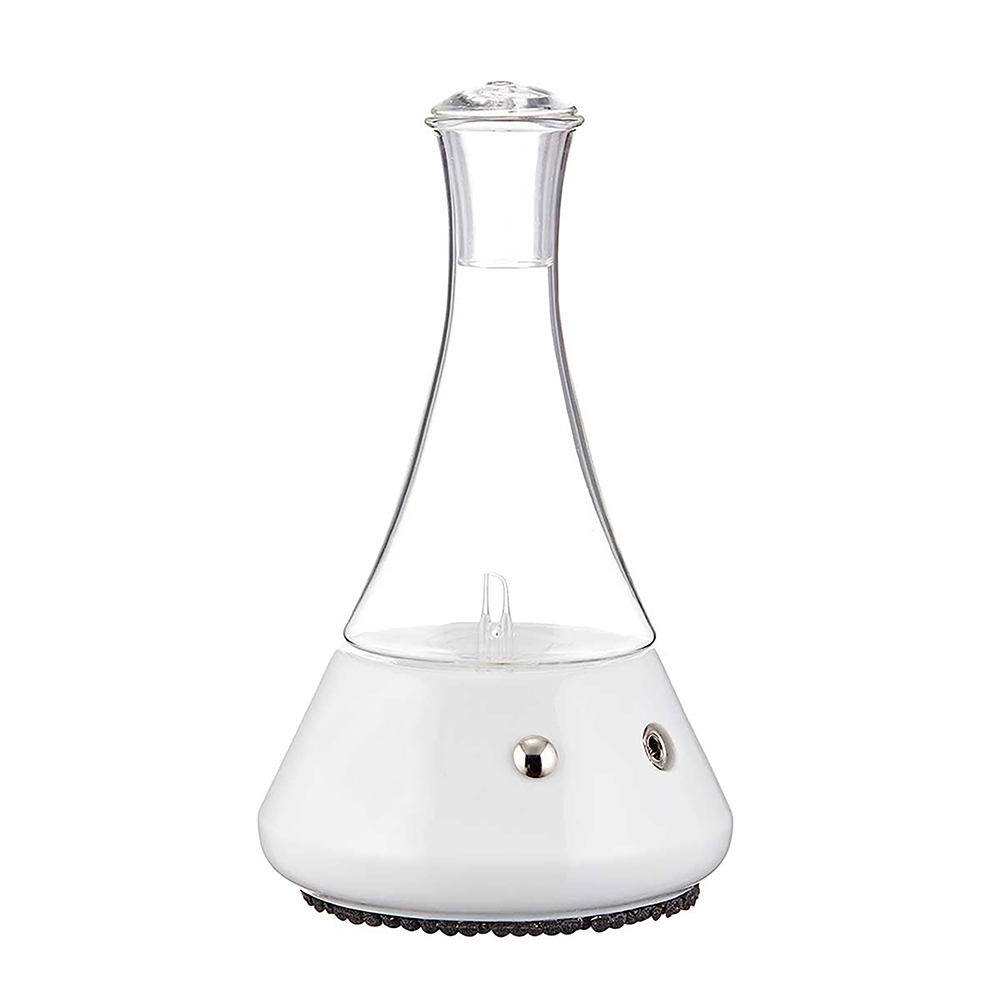
Diffuse Rosemary at Full Strength
Experience pure, undiluted rosemary the way the plant made it — no water, no heat. Our handcrafted Nebulizing Diffusers® deliver every bright molecule to your air.
Safety, Chemotype Cautions, and Rosemary FAQ
Rosemary is a robust oil, and a few sensible cautions keep it enjoyable. Because the camphor chemotype is stimulating, aromatherapy references generally advise avoiding rosemary during pregnancy and for anyone with epilepsy or seizure history, and keeping it well away from infants and young children. As with any essential oil, diffuse in a ventilated space, keep pets in mind, and consult a qualified healthcare professional if you have a specific health concern. This is wellness support for atmosphere and mood, not a substitute for medical care.
Which rosemary chemotype is best for focus?
For a bright, clear-headed atmosphere, choose the 1,8-cineole chemotype (often Moroccan or Tunisian). It carries the highest share of the compound most associated with an alert, awake feeling.
How much rosemary aromatherapy oil should I diffuse?
Less than you think. In a nebulizing diffuser, short cycles of neat oil are plenty; in an ultrasonic unit, a few drops in water. Rosemary’s aroma is assertive, so build up gradually rather than overwhelming the room.
Can I blend rosemary with other oils?
Absolutely. It pairs beautifully with citrus (lemon, bergamot), other herbs (peppermint, basil), and resins (frankincense). Start with a 2-to-1 ratio of the softer oil to rosemary and adjust to taste.

Sign Up to Get Your FREE Essential Oils e-Book Here
Final Thoughts
Rosemary aromatherapy oil earns its centuries-old reputation, but only when two things line up: a named, cineole-rich chemotype, and a diffusion method that carries those fragile molecules to your air intact. Get both right and you have one of the most reliable, uplifting scents for a focused morning — the ancient garland, reimagined as a clean stream of pure oil above your desk.