

Waterless Diffuser: How Bernoulli’s Principle Delivers Pure Essential Oils Without Heat or Water
A waterless diffuser is the only category of essential oil delivery that puts pure, undiluted oil into the air. No tank. No mist. No heat plate. Just oil, glass, and pressurized air. If you have ever paid premium prices for a therapeutic-grade essential oil and then watched it disappear into a foggy cloud of mostly water, you have already felt the gap this post exists to fill.
Almost every result on the first page of Google for the term “waterless diffuser” is a shopping page. Aroma360 wants to sell you a cartridge. HoMedics wants to sell you a rechargeable puck. Reddit threads debate which subscription model is least annoying. Nobody explains the actual science of how a waterless device delivers an essential oil intact, why that matters for the smell, the cost, and the room coverage, or how to evaluate one beyond price tag and reviews.
This is that explanation. By the end you will understand the airflow physics inside a nebulizing chamber, the trade offs between waterless, ultrasonic, and heat based diffusion, the real cost per ml of each method at an equivalent therapeutic dose, and why the materials your device is built from (wood, Pyrex, or plastic) decide whether your investment lasts five months or fifteen years. We make handcrafted Nebulizing Diffusers® for a living, so the lens is honest about the category: a waterless device is not automatically better, and not every “no water” product on the market is built the same way. The details are what separate a beautiful piece of working glass from a gimmick.
What a Waterless Diffuser Actually Does (Bernoulli’s Principle, Plain English)
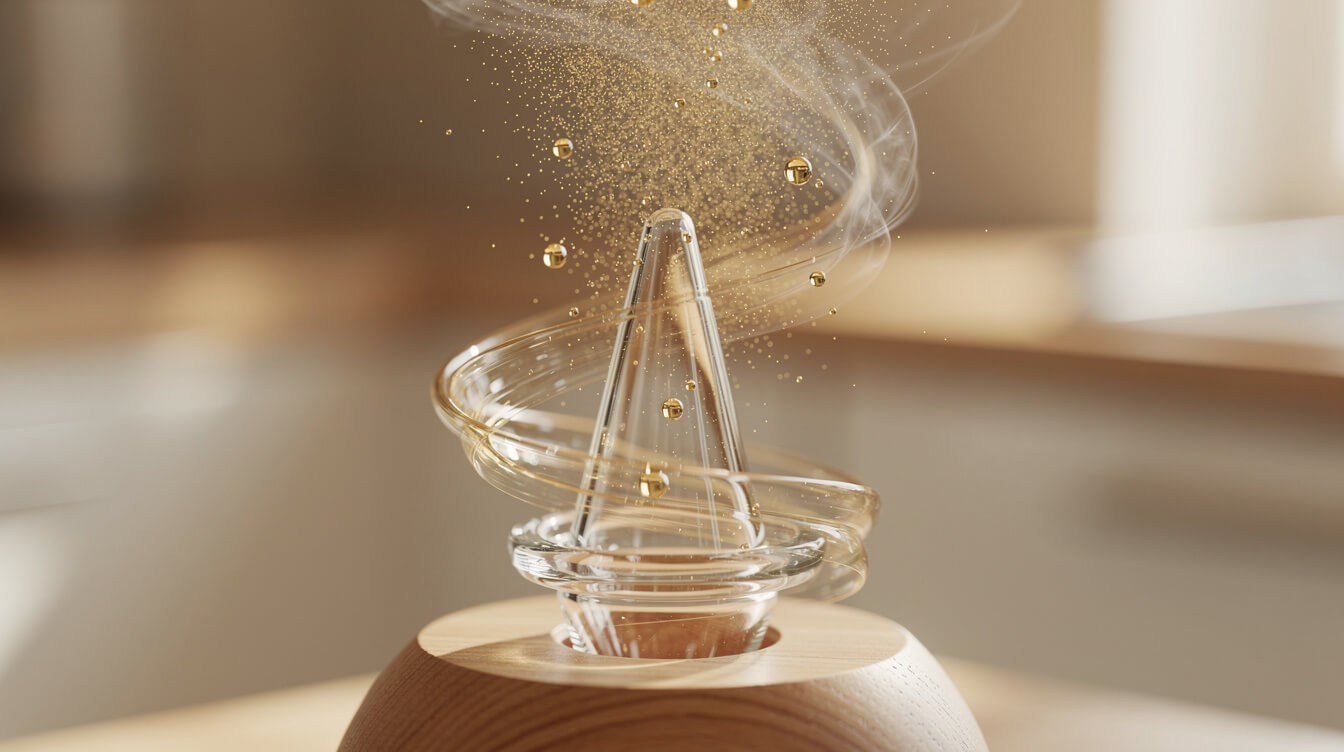
Strip away the marketing language and a true waterless diffuser is doing one thing: it is using airflow physics to break a liquid into an invisible mist. The technical term for the mechanism is Bernoulli’s Principle, named after the 18th century mathematician Daniel Bernoulli who first described it. The principle says that when a fluid (in our case, air) moves faster, its pressure drops. Push air through a narrow opening at high velocity and you create a tiny low-pressure zone at the tip. Anything sitting in that low-pressure zone gets pulled upward.
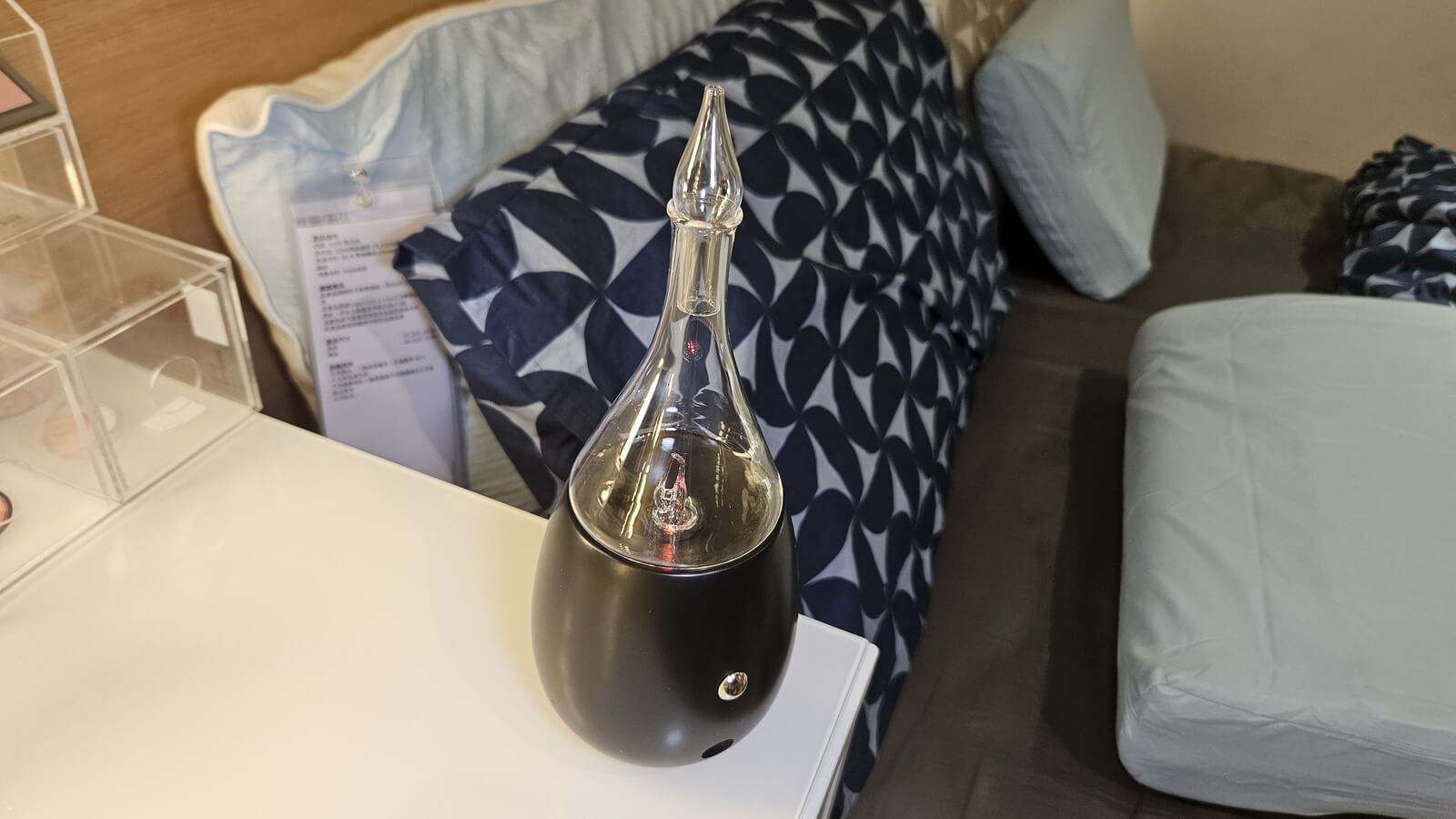
Inside a Nebulizing Diffuser®, a small pump sends a jet of air through a glass tube at roughly 8 to 12 meters per second. The tube terminates inside a sealed glass reservoir holding 5 to 10 ml of pure essential oil. As the high-velocity air exits the tube, a second, parallel glass channel sits in the oil pool. The pressure drop at the tip pulls oil up that channel and into the airstream, where the jet shears the oil into ultra-fine droplets. The result is an aerosol of pure essential oil suspended in moving air, with particles in the 1 to 3 micron range.
Why does the micron size matter? Because particles in that size band stay airborne. They drift on convection currents and saturate a room evenly instead of sinking to the floor like the heavier droplets a water-based device throws out. A 1 to 3 micron particle is also small enough that, when inhaled, it travels deeper into the respiratory tract than a 50 micron water droplet, which is why nebulized aromatherapy hits faster and at a lower dose than steam or mist. (For an in-depth look at the broader case for this mechanism, see our explainer on the 5 benefits of a Nebulizing Diffuser.)
The whole process is “cold-air.” No heat is applied to the oil. That is the second non-negotiable design rule and the reason we will keep coming back to it. Essential oils are volatile, meaning their aromatic molecules evaporate at relatively low temperatures, and many of those molecules degrade chemically when heated above 40 to 50 degrees Celsius. The Bernoulli mechanism uses kinetic energy, not thermal energy, to lift and aerosolize the oil. Chemistry stays intact.
Waterless vs Ultrasonic vs Heat: The Three Diffusion Mechanisms Compared
The category called “diffuser” is, confusingly, three completely different machines doing three different things. Understanding what each one is actually doing under the hood is how you decide which is right for your home, your oils, and your budget.
Ultrasonic mist diffusers
An ultrasonic device is a small ceramic disc vibrating at roughly 2 million times per second under a tank of water with a few drops of essential oil floating on top. The vibration breaks the surface tension of the water and tosses a cool mist into the air. What you see leaving the device is mostly water vapor with trace oil clinging to it. Useful as a humidifier in a dry room. Not, strictly speaking, an essential oil delivery system. The water dilutes the oil before it even leaves the tank.
Heat or candle diffusers
A heat-based diffuser, sometimes called a tealight oil burner or an electric warming dish, applies low heat to a small pool of oil and water to evaporate it. The smell fills a small space quickly because the warm vapor rises fast. The problem is exactly what we covered above: heat changes the chemistry. Citrus oils oxidize. Linalool isomerizes. The bright, alive note of a freshly distilled essential oil flattens into a stewed scent within minutes. Heat is the loudest “what you smell is not what you paid for” mechanism on the market.
Waterless nebulizing diffusion
A Nebulizing Diffuser® uses the Bernoulli airflow described in the previous section. The reservoir holds nothing but essential oil. The output is pure aerosolized oil at 1 to 3 microns. No carrier, no dilution, no heat-driven chemistry shift. Operating cost per ml of oil used is higher because the device dispenses faster (and that math is exactly what section seven below unpacks). What you trade for that higher per-hour oil cost is full intact chemistry, a much wider aroma profile, and therapeutic dosing at a fraction of the runtime of a water-based unit. Saying that the choice is “personal preference” understates the gap. These are not three flavors of the same machine. They are three different propositions about what aromatherapy is.
Join Now and Get a Coupon for 10% Off!
Why Water Dilutes the Therapeutic Compounds You Just Paid For
Here is the math nobody is doing for you in the SERP. A standard ultrasonic mist diffuser tank holds roughly 100 to 300 ml of water. The recommended oil dose is 3 to 10 drops per fill, which is roughly 0.15 to 0.5 ml of oil. Run the numbers and the output mist is approximately 95 percent water and 5 percent oil by volume, often less. Once you add the fact that most of the mist that leaves the device is water vapor (the oil molecules are heavier and tend to stick to the tank, the lid, and your countertop), the actual oil concentration reaching your nose drops further.
That dilution has three consequences worth understanding.
First, the therapeutic potency of an aromatic compound depends on getting enough of it into the air to register at the olfactory receptors. Linalool, the calming molecule in lavender, has an established detection threshold and effective dose range in inhalation studies. An ultrasonic device may not cross that threshold in a typical room within a typical session. A waterless device crosses it almost immediately, which is why nebulized aromatherapy “feels stronger” even when you use the same oil.
Second, water is not chemically neutral. Essential oils are hydrophobic by nature, which is why they bead up on the surface of water and resist mixing. The mechanical action of the ultrasonic disc forces a temporary emulsion, but the oil and water still want to separate. When they do, the more polar molecules in your oil (the esters, aldehydes, alcohols) stay associated with the water phase, while the less polar terpenes ride off in the mist. You end up smelling a chemically lopsided fraction of what you put in.
Third, the residue. If you have ever cleaned an ultrasonic diffuser and seen the brown film, that is partially polymerized essential oil and water mineral crud that accumulates with every cycle. Each cycle leaves a tiny amount of oil bound to the tank, never to be aerosolized. Your $40 bottle of frankincense is, partly, fertilizing the inside of your appliance. The Nebulizing Diffuser® has no tank to coat. Oil goes in, oil comes out, the glass reservoir cleans with a 10 second alcohol rinse. If you want a deeper dive on choosing oils that survive any diffusion method, our list of the best organic essential oils for your diffuser walks through the chemistry families and which behave best.
Materials Matter: Real Wood, Medical-Grade Pyrex Glass, and Why Plastic Is a Dealbreaker
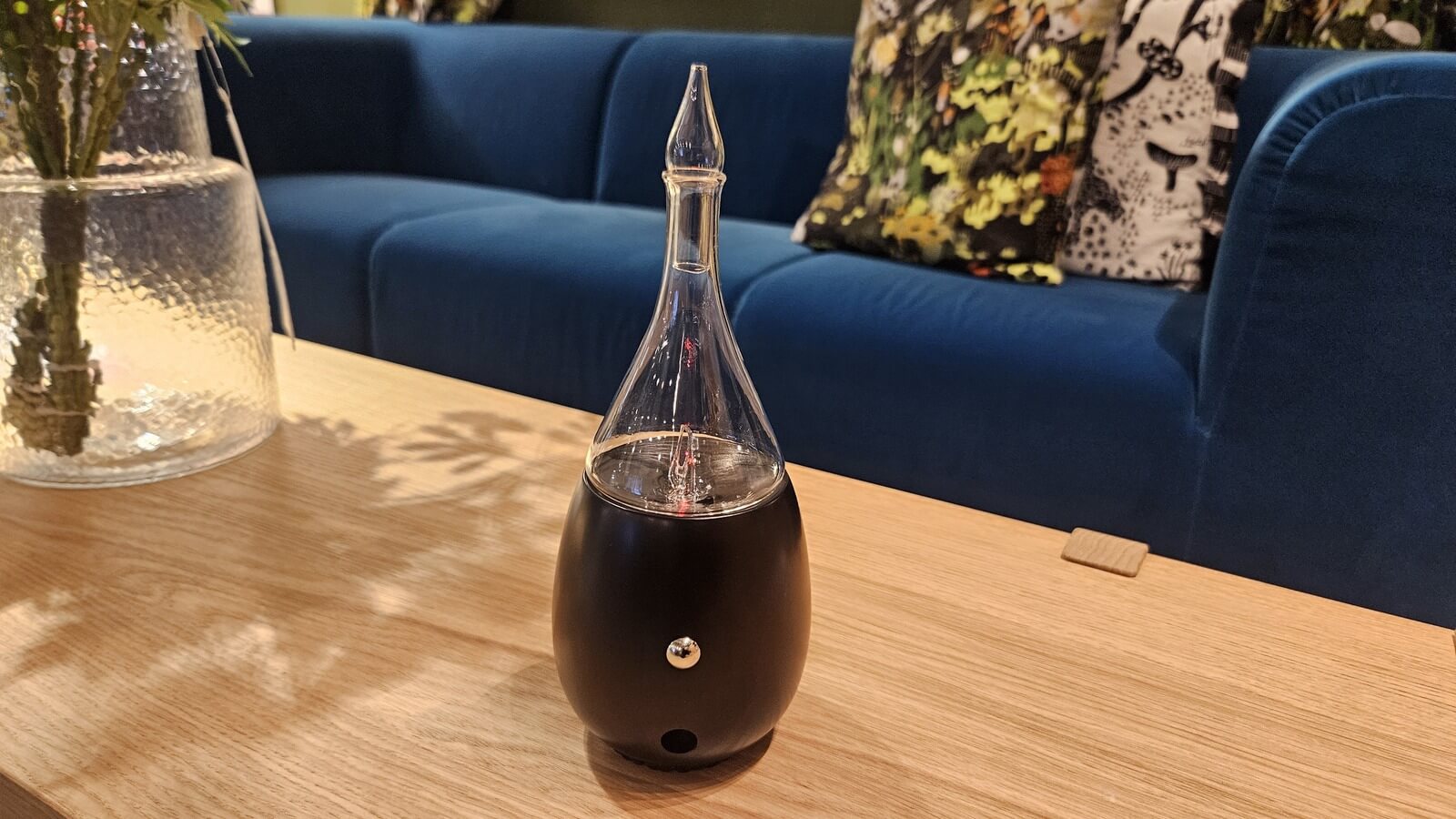
Once a device is using Bernoulli airflow, the next quality cliff is what the parts are made of. The Nebulizing Diffuser® form factor that we make at Organic Aromas, and that you will see across the better part of the premium waterless category, has three structural materials: hand-turned hardwood, hand-blown borosilicate (Pyrex) glass, and food-grade silicone for the small seals. Notice what is not on that list: plastic that contacts the oil.
Plastic is a dealbreaker for one chemical reason. Essential oils are powerful solvents. Citrus oils in particular, with their high d-limonene content, are aggressive enough to dissolve polystyrene, soften ABS, and leach plasticizers (the additives that make plastic flexible) into anything they touch over time. If your “waterless” device routes oil through plastic tubing or stores it against a plastic reservoir wall, you are slowly turning your essential oil into a plasticizer cocktail. You will not see it. You will smell it as a faint chemical off-note within a few weeks, and you will read about it later as one of the reasons cheaper cartridge systems develop a “burnt plastic” character after their first refill.
Borosilicate glass, the same glass family used in laboratory glassware and kitchen Pyrex, solves the contact problem. Borosilicate is rated for 1,000+ thermal cycles, is chemically inert to every essential oil chemistry family, and has a coefficient of thermal expansion roughly one-third that of standard soda-lime glass, so it does not crack from the small temperature swings of room air. Each hand-blown reservoir on our Nebulizing Diffusers® is shaped by a glassblower and quality-checked for wall thickness, neck symmetry, and inner nozzle alignment, because the airflow physics from section one only work when the geometry is precise.
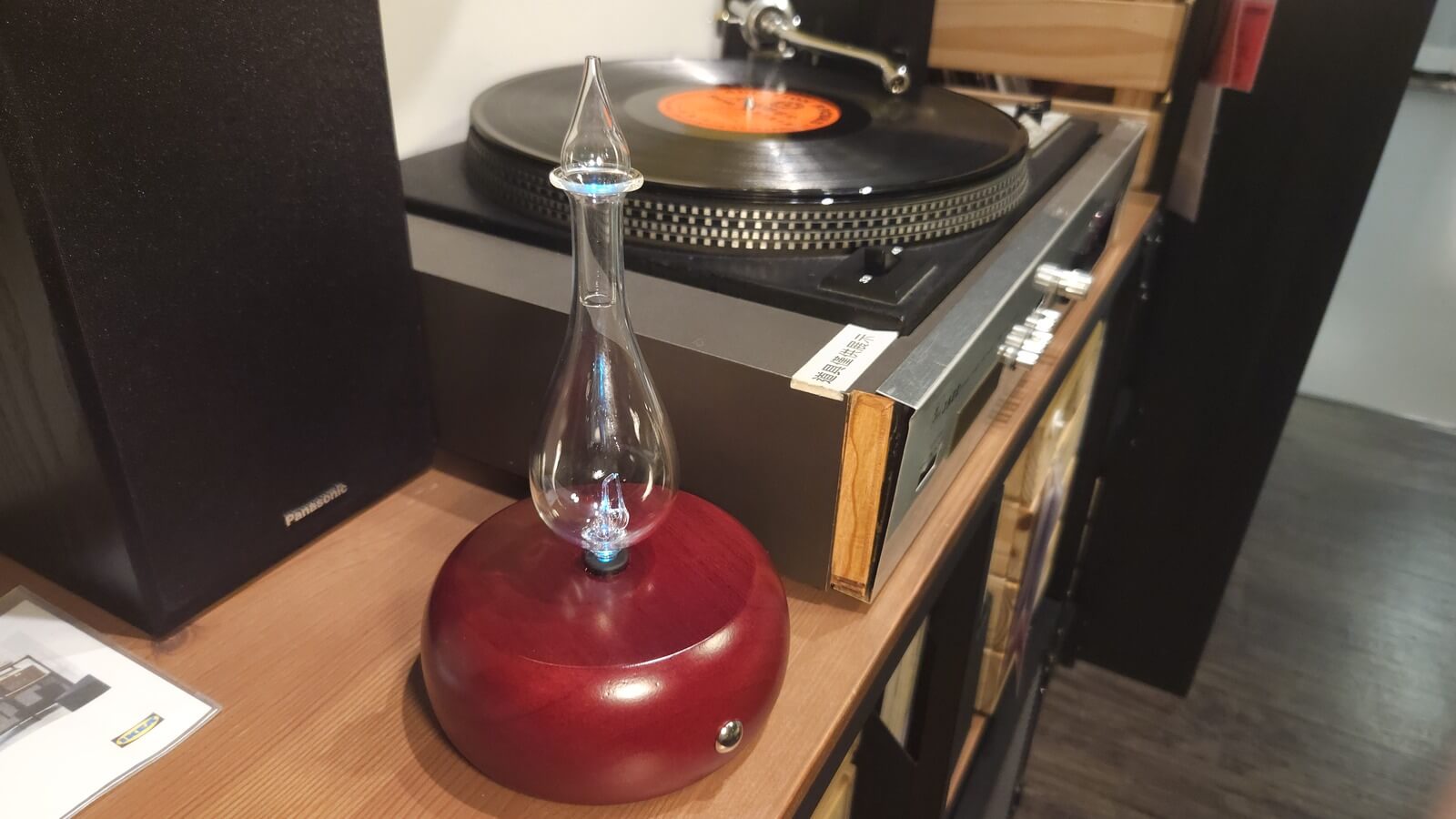
Wood, on the surface, is a finish choice. Underneath, it is also an engineering choice. A solid hardwood base (we use beech, oak, walnut, and rosewood, hand-turned in our shop) damps the vibration of the air pump, which is what makes the device quiet enough to leave running during sleep. Plastic-housed pumps echo. Wood-housed pumps absorb. If you are evaluating two waterless products and one feels notably heavier in the hand, that is the structural wood doing acoustic work. Our gallery of hand-carved Nebulizing Diffuser® designs walks through the wood species and the lathe process if you want to see the craft up close.
Sign Up to Get Your FREE
e-Book Here…
Particle Size, Dispersion Pattern, and Room Coverage
The number that decides how a diffuser “feels” in a room is the size of the particles it puts into the air, measured in microns. One micron is one-thousandth of a millimeter. A human hair is roughly 70 microns thick. Here is the lineup.
- Ultrasonic mist: approximately 50 to 80 microns. Heavy enough to fall under gravity within seconds. You see it as visible vapor. It coats the table next to the device with a faint film and saturates a 3 meter radius.
- Heat or candle diffuser: the smell rises with the warm air but the particle size is irregular and depends on temperature. Coverage is room-shaped (warm air rises, settles, descends) but qualitatively unstable.
- Nebulizing Diffuser®: 1 to 3 microns. Invisible to the eye. Light enough to stay suspended on indoor air currents for 30 to 60 minutes after the device stops. Saturates a 30 to 90 square meter open-plan space with a consistent aroma profile.
Two practical things follow from that. First, a nebulizing waterless device covers roughly 10 times the area of an equivalent ultrasonic unit, which is why it can sit in a living room and scent the kitchen, hallway, and entryway off the same fill. Second, because the dispersion is even (not a localized cloud) the scent does not “hit you” when you walk past the device the way a misting cloud does. It is ambient, the way a real spa space feels.
Programmability matters here. Because nebulizing output is strong, the better waterless designs include intermittent timing, typically 2 minutes on, 1 to 5 minutes off, so you can throttle the dose without losing the room coverage. A cheap waterless device with only on/off control will quickly saturate a small space. A good one gives you a knob or an app. (If you need a starting point on choosing a device with the right control, our short framework on how to choose a Nebulizing Diffuser sets it out cleanly.)
Sound Levels and the Whisper-Quiet Standard
A waterless device has a small air pump. That pump makes noise. How much noise depends almost entirely on how the pump is mounted, what surrounds it, and what surface it sits on. The benchmark you want to remember is under 30 decibels, which is the level of a quiet bedroom at night and the threshold below which most people stop noticing a continuous sound during sleep.
Three design factors get a waterless device under that 30 dB line.
One: the pump itself. A diaphragm pump (the common micro-pump in this category) needs vibration-isolating mounts, usually rubber grommets or silicone bushings, so the housing does not become a sound box.
Two: the housing. Solid hardwood absorbs higher-frequency vibration that plastic radiates. This is the same reason a wooden acoustic guitar sounds different from an injection-molded one. The wood itself is a damper.
Three: the airflow path. The air leaving the pump has to travel through tubing to the glass nozzle. If that tubing is straight and short, you get a faint, low-frequency hum. If it has a bend that allows the air to expand into a small chamber before exiting the nozzle, the hum is muffled further. The best designs add a quiet plenum without sacrificing the velocity needed to drive Bernoulli atomization, which is a real engineering trade off and the reason quality matters.
Practically, the test that matters is the bedroom test. Put the device on the nightstand. Switch it on intermittent. Lay down. If you can still hear it after two minutes, it is not whisper-quiet enough. The Nebulizing Diffusers® we ship are tested to 22 to 28 dB depending on model, which clears the bedroom test for the great majority of users. For a deeper read on the bedroom use case, our breakdown of quiet Nebulizing Diffusers for the bedroom covers placement, run-time, and oil pairings that work overnight.

Join Our Exclusive Member Club to get Big Discounts!
Cost Per ML: True Operating Cost of a Premium Nebulizing Diffuser vs Ultrasonic vs Cartridge
Here is the math that most reviews avoid, because it requires comparing apples to apples on a therapeutic-dose basis instead of a sticker price basis.
A nebulizing waterless device dispenses roughly 0.5 ml of pure essential oil per hour on continuous mode, less on intermittent. To deliver an equivalent aromatic dose at the room, an ultrasonic device must keep running for far longer because most of its mist is water. The effective oil throughput of an ultrasonic to match the scent intensity of a 30-minute nebulized session is roughly 0.04 ml of oil per hour for 4 to 6 hours, or about 0.16 to 0.24 ml total.
That looks like the ultrasonic wins on oil cost. It does, in a narrow sense. The ultrasonic uses less raw oil per session because its room saturation is lower. But two things flip the picture when you stretch the timeline.
First, replacement cycles. A typical $40 to $80 ultrasonic plastic-bodied diffuser has a service life of 12 to 24 months before the disc clouds or the seal fails. A handcrafted Nebulizing Diffuser® at $120 to $250 has a service life measured in decades because the working parts are glass and wood, not plastic and ceramic. Amortized over 10 years, the Nebulizing Diffuser® is the cheaper appliance even before you count oil.
Second, cartridge systems. The $79 Aroma360 or HoMedics-style cartridge waterless devices look attractive on day one. They get expensive on day 30, when the proprietary cartridge has to be replaced, and they get punishing on day 365 if you have used the device daily. Average cartridge cost is $25 to $45 for 100 to 200 ml of pre-blended fragrance oil, which is rarely a pure essential oil and is usually a synthetic fragrance carrier with essential oil notes added. You are paying for plastic and proprietary refill economics, not for therapeutic-grade oil. By contrast a 10 ml bottle of single-source therapeutic-grade essential oil at $15 to $40 runs a Nebulizing Diffuser® for roughly 20 hours of intermittent use. The cost per actual therapeutic hour is dramatically lower with the open-bottle architecture.
If you want to put it plainly: cartridge waterless is the printer-and-ink model. Open-bottle nebulizing waterless is the kettle-and-loose-leaf model. The kettle costs more on day one and it costs less every day after that.
Putting It All Together
A true waterless diffuser is not a marketing badge. It is a specific engineering choice with a specific physics signature: cold-air Bernoulli atomization, glass-to-glass oil contact, 1 to 3 micron output, 22 to 28 dB acoustics, and refill economics tied to the open-bottle market rather than a proprietary cartridge. When the four ingredients are present, you get an aromatherapy experience that lets the chemistry of a real essential oil reach you intact. When any one of them is missing (plastic in the oil path, audible pump noise, cartridge lock-in, ultrasonic mist masquerading as waterless), you get a compromise. Now you have the framework to tell the difference at a glance.
If you are ready to upgrade from a misting diffuser to a true waterless one, our handcrafted Nebulizing Diffuser® Collection brings together every design our glassblowers and woodworkers produce, from the elegant Raindrop on a single-piece hardwood base to the Smart Mobile Mini for travel. Every unit ships ready to receive your existing essential oil bottles, no cartridges, no refills, no proprietary anything. Just glass, wood, and the airflow physics that have powered premium aromatherapy since long before “waterless” became a category name.