


Which Essential Oils Are Safe for Dogs? Safe vs. Avoid List + Diffusing Rules
If you share your home with a dog and love aromatherapy, you have probably typed some version of which essential oils are safe for dogs into a search bar and come away more confused than when you started. One list calls bergamot safe while banning every citrus oil. Another calls lemongrass dog-friendly while a veterinary site puts it on the avoid list. This guide sorts it out: the oils that are generally better tolerated, the ones to keep out of the house, what the actual research on diffusing around dogs found, and the room-by-room rules that matter most when you diffuse pure oil.
One honest note before we start. “Safe” is never an absolute word with essential oils and pets. It depends on the oil, the amount, the route of exposure, the size and health of your dog, and how the oil reaches the air. The goal here is to help you make deliberate choices, not to replace your veterinarian.
Key Takeaways
Generally better tolerated (with care): lavender, chamomile, frankincense, myrrh and ginger, used in short, well-ventilated sessions.
Keep out of a dog home: tea tree, pennyroyal, wintergreen, sweet birch, pine, cinnamon, clove, hyssop, ylang-ylang, peppermint and most citrus oils.
The lists disagree because they mix up dose, route and plant chemistry. Bergamot is a citrus oil, and cornmint is as menthol-rich as peppermint.
Diffused lavender and chamomile were linked to more resting and less barking in a 55-dog shelter study. Rosemary and peppermint did the opposite.
Active diffusers settle fine droplets on fur, which a dog then licks off. Keep your dog’s bed out of the mist path and always leave an exit.
If you suspect exposure: fresh air first, then call your vet, the ASPCA Animal Poison Control Center (888-426-4435) or Pet Poison Helpline (855-764-7661). Do not induce vomiting.
Which Essential Oils Are Safe for Dogs? The Short, Honest Answer
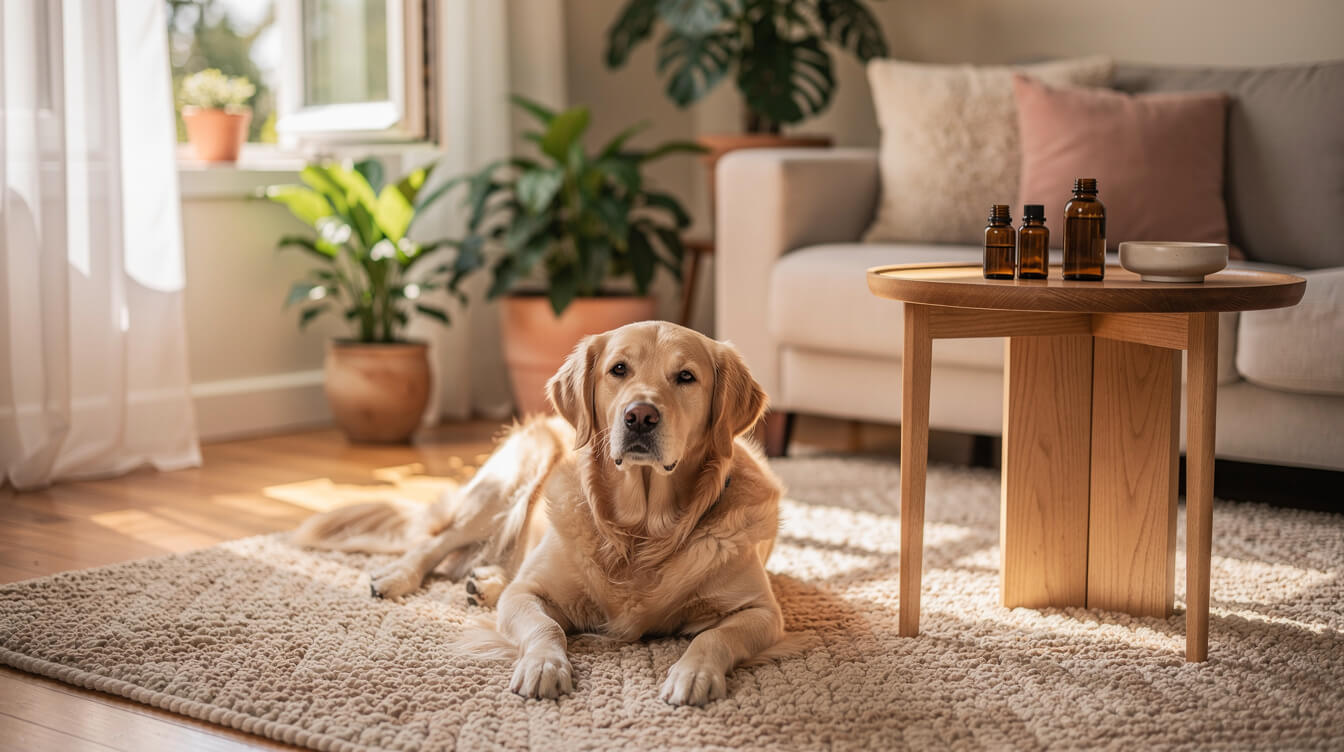
There is no oil that is safe for every dog in every amount. There is, however, a short list that veterinary sources keep coming back to as better tolerated when it is diffused lightly in an open room. There is also a longer list that every major veterinary source says to avoid. Here they are side by side.
Generally Better Tolerated
Lavender (the most studied oil around dogs)
Chamomile (Roman or German)
Frankincense
Myrrh
Ginger
Use short sessions, keep the room ventilated and the door open, and ask your vet first.
Avoid Around Dogs
Tea tree (melaleuca): the most common essential oil poisoning seen in pets
Pennyroyal: linked to liver damage
Wintergreen and sweet birch: rich in methyl salicylate, which acts like aspirin
Pine
Cinnamon, cassia and clove
Hyssop
Ylang-ylang
Peppermint
Citrus oils (d-limonene-rich peels)
Notice what the left column has in common. These oils are dominated by esters, gentle alcohols such as linalool, and resinous sesquiterpenes. The right column is full of phenols (clove, cinnamon), ketones such as pulegone (pennyroyal), salicylates (wintergreen, birch) and the terpene alcohol terpinen-4-ol at full strength (tea tree). Chemistry predicts the list far better than the folklore around each oil does.
If you also have a cat, plan around the cat. Cats process many of these compounds even more slowly than dogs do, and we explain why in our guide to what essential oils are safe for cats. For multi-pet homes, our broader pet diffusion safety guide covers the overlap.
Why “Safe for Dogs” Lists Contradict Each Other
Put the top-ranking lists next to each other and the contradictions jump out. They are not just differences of opinion. Several of them contradict themselves.
The bergamot paradox. A leading veterinary site lists bergamot as one of its safer oils while banning “citrus oils” in the same article. Bergamot is a citrus oil, cold-pressed from the peel of Citrus bergamia, and like other peel oils it carries limonene. It also contains bergapten, which makes skin react to sunlight. It may well be milder in practice, because its scent comes mostly from linalyl acetate and linalool, but “citrus is toxic, bergamot is fine” is not a rule you can apply without knowing that.
The lemongrass split. One popular dog-brand guide lists lemongrass among its 12 dog-safe oils. A veterinarian-reviewed guide ranking on the same results page lists lemongrass as toxic. Lemongrass is roughly 65–85% citral, a strong skin sensitizer. We side with caution.
The mint loophole. Peppermint is on nearly every avoid list, yet cornmint sometimes appears on safe lists. Cornmint (Mentha arvensis) is the plant commercial menthol is extracted from, so it is, if anything, more menthol-heavy than peppermint. Changing the common name doesn’t change the chemistry.
The rosemary question. Rosemary appears on several safer lists, yet its camphor and 1,8-cineole content puts it near oils such as eucalyptus and sage, which veterinary toxicology references group with oils that can trigger seizures at high exposure. A little in an airy room is not the same as a lot.
The pattern is that most lists answer “is a trace of this oil in the air likely to hurt a healthy adult dog?” while readers hear “can I use this oil around my dog however I like?” Dose and route matter more than the name on the label. A drop of lavender licked off a paw, a lavender-soaked bandana, and lavender misted for 30 minutes in a large open room are three very different exposures.
Purity matters too. A “lavender” fragrance oil cut with synthetic aroma chemicals or a cheaper carrier is not the oil any of these lists were written about. Our guide to choosing pure, non-toxic essential oils shows how to check what is actually in the bottle.

Sign Up to Get Your FREE Pets
e-Book Here…
What the Research Shows: Lavender, Chamomile, and Two Oils That Wind Dogs Up
Most “safe oils for dogs” articles stop at the list. Few mention that diffusion around dogs has been studied, and that the results line up with the chemistry.
The shelter study: 55 dogs, four oils, a control
In a study published in Applied Animal Behaviour Science (Graham, Wells and Hepper, 2005, vol. 91, pp. 143–153), researchers diffused four essential oils (lavender, chamomile, rosemary and peppermint) into the kennels of 55 rescue-shelter dogs, plus a no-odor control. Each scent ran for 4 hours a day for 5 days, with a 2-day break between conditions, and the dogs’ behavior was recorded on days 1, 3 and 5.
The results split cleanly. Under lavender and chamomile, dogs spent more time resting and less time moving, and they barked less than under any other condition. Under rosemary and peppermint, dogs spent significantly more time standing, moving and vocalizing. In other words, the two oils that show up on “safe” lists most often were also the two that encouraged settled behavior. One of the two that wound dogs up, peppermint, is the same oil most veterinary sources tell you to avoid.
The car study: lavender on the road
A year later, a follow-up in the Journal of the American Veterinary Medical Association (Wells, 2006, vol. 229, pp. 964–967) tested ambient lavender scent on 32 dogs whose owners described them as excitable during car travel. Each dog rode in its owner’s car for 3 days without scent and 3 days with lavender in the air. With lavender, the dogs spent significantly more time resting and sitting and less time moving and vocalizing.
Two caveats keep this honest. These were behavior studies of healthy dogs exposed to scent in the air. They did not test oil on the skin, oil in food, or hours of continuous diffusion in a closed room. And a car is a small space, so if you try lavender on the road, use a scented cloth placed out of reach rather than diffusing into the cabin. For the human side of lavender, including its own sensitivity profile, see our honest lavender side effects guide.
The practical lesson is simple: if you want a scent your dog is most likely to settle around, lavender or chamomile is the evidence-backed starting point, and bright, minty or camphor-heavy oils are better saved for rooms your dog isn’t in. Our Lavender Essential Oil 100% Pure Organic is the one we reach for in our own dog-friendly living rooms.
Essential Oils to Avoid Around Dogs, and Why Each Is on the List
Knowing why an oil is on the avoid list helps you judge the oils that aren’t on any list yet. Veterinary toxicology references, including the Merck Veterinary Manual, sort the problem oils into a few clear groups.
Oils that strain the liver: tea tree (melaleuca), cinnamon, cassia bark, pennyroyal and birch tar. Many essential oil compounds are absorbed quickly through the mouth or skin and then processed by the liver, so puppies and dogs with liver problems are the most vulnerable.
Oils that can trigger seizures: wintergreen, birch, cedar, eucalyptus, hyssop, pennyroyal, sage and wormwood. These are mostly ketone-rich oils, plus the salicylate oils.
Aspirin-like oils: wintergreen and sweet birch are almost entirely methyl salicylate, the same family of compound as aspirin, which is why a small amount can be a large dose for a small dog.
Hot, irritating oils: clove and cinnamon are phenol-rich and can burn the lips, gums and skin.
Tea tree: the case study every dog owner should know
Tea tree deserves its own warning because of how dogs get exposed. A review of the ASPCA Animal Poison Control Center’s records, published in JAVMA in 2014, covered 443 cases of concentrated tea tree oil poisoning in dogs and cats between 2002 and 2012. In most of them, the owner had deliberately applied the oil to the animal’s skin, usually for fleas or skin complaints. The dog did not knock over a bottle. Signs such as drooling, lethargy, wobbliness, weakness and tremors appeared in as little as 2 hours, sometimes not until 12 hours later, and lasted up to 3 days. That delay is why “he seems fine right now” is not reassurance. We cover the oil’s chemistry in our tea tree essential oil guide, and if pests are the reason you’re reaching for oils, our tick-repellent guide explains the pet-safe rules first.
One clarification: “avoid” refers to the concentrated essential oil. A sprinkle of cinnamon in your baking or a dog sniffing an orange peel is a very different exposure from a few drops of neat oil.

Sign Up to Get Your FREE
e-Book Here…
How Nebulizing Diffusion Changes the Safety Math

Here is the part most diffuser brands won’t tell you, including the ones that sell diffusers. The Merck Veterinary Manual separates passive diffusers (reed sticks, pads), which mostly create respiratory irritation, from active diffusers, both ultrasonic and nebulizing. Active diffusers release microdroplets of oil that can settle on a pet’s fur. The dog then licks them off while grooming, so an inhalation exposure quietly becomes a skin and ingestion exposure.
A Nebulizing Diffuser® is an active diffuser, and a very efficient one. Using Bernoulli’s Principle, it breaks pure, undiluted oil into a fine aromatic mist with no water and no heat. For people, that is exactly the point: you get the oil’s full chemistry, not a few drops lost in a water tank. In a dog household, it means the oil choice and the room setup matter more, not less. These are the rules we follow in our own homes:
1. Keep the dog’s bed and bowls out of the mist path. Droplets settle downwind and below the device. Place the device high, across the room from where your dog sleeps, eats or drinks, so the mist mixes into room air before anything lands.
2. Always leave an exit. Diffuse only in rooms with an open door your dog can use. A dog that leaves the room is giving you information, so respect it.
3. Diffuse in short, intermittent sessions. With pure oil, 30–60 minutes on a low setting is usually enough to scent a room for hours. On classic models, use interval mode (2 minutes on, 1 minute off). On Smart models, schedule sessions for when your dog is out walking or in another room.
4. Size the space honestly. Never diffuse in a crate, a car, a small bathroom or any closed room with your dog inside. The smaller the room, the faster droplets build up.
5. Ventilate. Open a window or run the HVAC fan. Moving air dilutes the scent and gives droplets somewhere to go other than your dog’s coat.
6. Keep the device and bottles out of reach. Neat oil from a spill or a knocked-over bottle is far more dangerous than anything in the air.
7. Wipe, don’t wonder. If your dog has been lying near the device and its coat smells of the oil, wash the area with a mild liquid dish soap, which lifts oil better than water alone.
The upside of a waterless design is control. A Nebulizing Diffuser® starts and stops instantly, has no tank of scented water left sitting out, and a Smart model can be scheduled around your dog’s day. For the bigger picture on airborne safety, read our research review, are essential oil diffusers safe?. If odor is the real problem, our pet-safe air freshener guide explains why pet smells keep coming back on humid days.
Warning Signs and What to Do If Your Dog Is Exposed
Dogs can’t tell you a scent is bothering them, so watch the body. According to Pet Poison Helpline, signs of essential oil exposure include:
A fragrance or scent on the coat, skin, breath or vomit (often the first clue)
Drooling, or pawing at the mouth or face
Difficulty breathing, or fast or labored breathing
Wobbliness, stumbling or difficulty walking
Lethargy, weakness or unusual sleepiness
Muscle tremors
Redness or burns on the lips, gums, tongue or skin
Vomiting
Remember the tea tree data: signs can appear hours after exposure. If you suspect exposure, follow this sequence.
1. Fresh air first. Switch off the device and move your dog to a ventilated room or outside.
2. Call for expert help right away. Phone your veterinarian, an emergency clinic, the ASPCA Animal Poison Control Center (888-426-4435) or Pet Poison Helpline (855-764-7661). Both lines run 24/7, and a consultation fee may apply.
3. Do not induce vomiting or give activated charcoal unless a veterinary professional tells you to. Concentrated oils can irritate the throat and airway on the way back up.
4. Wash oil off the skin or coat with a mild liquid dish soap and lukewarm water.
5. Bring the bottle. Take the bottle, or a photo of the label, to the clinic so the vet knows exactly what your dog was exposed to.
For a veterinarian’s perspective on pets and aromatherapy, our Q&A with Dr. Emily Hoppmann, DVM is worth a read.

Join Our Exclusive Member Club to get Big Discounts!
Frequently Asked Questions
Which essential oils are safe for dogs to smell?
In a well-ventilated room with an open door, lavender and chamomile have the best evidence behind them. In shelter and car-travel studies, diffused lavender was linked to more resting and less barking. Frankincense, myrrh and ginger are also generally better tolerated when used lightly. Check with your vet first, especially for puppies, seniors, pregnant dogs or dogs with liver or breathing problems.
Is it safe to diffuse essential oils if I have a dog?
It can be, if you choose better-tolerated oils, keep sessions short, ventilate, keep your dog’s bed out of the mist path, and always leave an exit. Never diffuse in a small closed space with your dog inside.
Which essential oil is most toxic to dogs?
Tea tree (melaleuca) is the essential oil most often involved in pet poisonings, usually because it was applied to the coat. Pennyroyal, wintergreen and sweet birch are also high-risk because of their effects on the liver and their aspirin-like salicylate content.
Is lavender oil safe for dogs?
Lavender is the most widely studied oil around dogs and is generally considered one of the better-tolerated options for light diffusion. That does not make it safe to apply to the skin or let your dog lick. Never apply undiluted oil to a dog’s coat.
Are citrus oils like bergamot safe for dogs?
Most veterinary sources list citrus oils as ones to avoid, and bergamot is a citrus peel oil. Some lists still call bergamot safer, but the safest choice is to keep citrus oils out of shared rooms and pick lavender or chamomile instead.
What should I do first if my dog licks essential oil?
Move your dog to fresh air, then call your veterinarian, the ASPCA Animal Poison Control Center (888-426-4435) or Pet Poison Helpline (855-764-7661). Do not induce vomiting, and bring the bottle with you.
Final Thoughts: Choosing Essential Oils That Are Safe for Dogs
The question of which essential oils are safe for dogs has a calmer answer than the internet suggests. Start with the oils that have both chemistry and evidence on their side, lavender and chamomile. Keep the known problem oils out of shared rooms, including tea tree, pennyroyal, wintergreen, birch, the hot phenol oils, mint and citrus. Then make the room do the safety work: a high placement away from your dog’s bed, an open door, short sessions and fresh air.
Do that, and pure aromatherapy and a happy, relaxed dog can share the same living room.

Diffuse Pure Essential Oils, On Your Terms
Handcrafted from real wood and medical-grade Pyrex glass, the Nebulizing Diffuser® delivers pure, undiluted aromatherapy with no water and no heat. It starts and stops instantly, and Smart models can be scheduled around your dog’s day.






Should you tell, that you are not right.
Very interesting.
I was putting patchouli essential oil and lavender essential oil on last night and my dogs accidentally got some on them one threw up the other 3 are just acting kinda lazy this morning should I be worried
Please give me a recipe for flea and tick prevention using eucalyptus oil. This seems to be the best one for this snd should I use organic? Is the Latin name the one to look for?
Young Living is one of the worst essential oil brands on the market. They refuse to publish the chemical analysis of their trash oils so someone else did it independently. Guess what? They are full of synthetic chemicals and poisonous “fragrance”. Don’t believe me? Use your stupid, propaganda spewing phone to actually look something up. So is DoTerra. People need to stop being so dumb and employ critical thinking methods into their every day lives.
It’s 2022…. Now, isn’t this true for our entire nation right? Critical thought? You are censored if you have enough critique in your thoughts….
Do be careful defusing essential oils around pets. When I first got into oils, I happen to work with a Young Living distributor, so that is what I chose.
I set up my diffuser in my bedroom and excitedly started diffusing. My dog sleeps in my bedroom with me at night, with the door closed. It never occurred to me that I was trapping him overnight with these oils. I noticed a change in his behaviour almost immediately. He started having accidents in the house and getting into things… Two things that he has never done.
I stopped diffusing the oils in my bedroom, and his behaviour went back to normal. Coincidence? Possibly.
I should mention that I was not diffusing any of the oils that are mentioned in this article as being potentially dangerous. I was mostly using JuvaFlex or citrus.
When I brought this up to my distributor, she laughed it off, telling me that if animals were getting sick from essential oils, it is probably because people were using lower quality oils. But wouldn’t it make sense that a better quality oil would be more potent, and therefore potentially more dangerous to an animal?
Needless to say… Do not rely on a distributor who is trying to sell you a product for good advice. Do your own research and watch your own animal.
What essential oil can I spray around to kill germs fthat won’t harm my small dog
I’ve never quite understood a website leaving a question area but never choosing to answer people’s questions ask! Why waste people’s time? These poor people are worried about their furbabys! Too start I use peppermint on myself & in my super hot bath water I have 2 chihuahua’s & they’ve never had a reaction once to peppermint oil the smallest of the 2 is 10lbs. I also put a couple drops of tea tree in my water sometimes which also has never effected my dogs, that being said I read a story of a woman that defused tea tree not knowing it was a danger to dogs, her dogs became delirious & didn’t even recognize her, if she’d not caught the issue & stopped informed by her vet it would have caused irreversible damage or death! Also before taking advice from a site trying to sell oils your better off to join an essential oils group online & talk to other pet owners! I’ve learned more from my local pet supply store than my vet about my dog chicken allergy! Sad people questions weren’t answered! I hope this helps the woman with the chihuahua question!
When I put coconut oil on dog rash he just licks it off. How do I apply tick repellent essential oils without him licking it?
I use a diffuser at night it helps me sleep but I have a 12 week old puppy she sleeps in my room now I’m worried I use lavender on guard and frankincense All by doeterra
All you people asking for health advice without being a patient, you won’t get an answer from Organic Armoas. They are not vets. Discuss this with an Eastern/Western vet in your area.
Some of you guys are either not worried by spelling or not smart enough to spell words correctly. Definitely not trusting anyone who looks like they are dumb. :/
I am not using essential oils on my dog. Was wondering if inhaling the fumes from the breathe easy mixture my husband is using for his cold
i have a shih zue and maltese- i have COPD, emphsema and on oxyegn- i have a chronic sinus infection and wanted to boil some water and add a couple drops of thyme and breathe in to help my sinus’s- will this harm my pups- please rely ASAP thank you for your kindness
I put out drops of peppermint oil on cottonballs to deter mice from staying in my house. Will it hurt my small chihuahuas to breathe this. Plz answer back promptly.
Can I give my dog Oregano Oil Capsules & Thyme Oil capsules to kill bad bacteria in gut & small bowel, Helicobacter & SIBO?
I love clove and have used it in my diffuser. With 3 dogs, I did not see Amy negative reaction. I also did not know it was not safe for them until today! TY for the great info.
Hi I have a Yorkshire terriers mother always gets stressed especially when she seee her lead for walks then sets other dogs of barking plz can you help
I have Ravintsara and would like to diffuse it in my bedroom during this flu season. I didn’t see it on the list for dogs however I want to make sure because they sleep in the bedroom. They are 20 lbs and 25 lbs. mini aussies.!
What essential oil will help dogs with flease
What essential oil it will be good for my puppy to stop i scratching and biting
I have a blind dog that keeps running into to the walls what essential oil can I use on my walls that will help her not run into the walls. Please help I love my little dog
Tea tree can kill you dog and do can clove Wintergreen.. slim..thyme is not good there’s few more …. Pepmint is good lavender is good for your dog farkin is good… For dogs long grass is ok….. There’s a list … Be careful… Good luck
Is peppermint oil bad for dogs if I use it in my diffuser ?
I ordered some oils and diffuser, I have an 80 lb American Bulldog, anything I shouldn’t use or is it just trial and error with what he approves of?
A child that I care for 3 days a week always has a concoction of essential oils on and my dog hides for a good couple of hours when she comes in. What smell could be bothering him?
Is peppermint oil bad for my dog if I use it in aromatherapy
What essential oils should I not use in my Diffuser around my dogs? They are both over 60 lbs.
Staffie 13 yrs old..
What oils are not safe to diffuse around small dog eight pounds
I used Tea Tree Oil in my diffuser the other day with other oils not realizing Tea Tree Oil was not good for dogs. The next morning when one of my dogs woke up she went down the stairs ever so slightly, she took one step at a time when she normally runs down. The night before I had a diffuser going with tea tree oil, grapefruit and lemon. Today I read that tea tree oil is not good for dogs even if it is in a diffuser. Lesson learned.
What essential oils are safe to use in a diffuser around small breed dogs?
Can I safely use tea tree oil in my home without harming my dog? E.g., in cleaners or in my nebuliser?
Thank you for this information. Is it safe to diffuse these oils around my dog? I usually only use 1-4 drops of an essential oil in my diffuser? I sometimes diffuse thyme and/or oregano when I’m feeling sick and am wondering if it’s okay to do so with my new doggie family member.
Thank you for the information about using Essential Oils safely around pets. I have 2 dogs and this will help me know which oils to use and not to around them. I appreciate you sharing this information with us because when it comes to our furbabies this information is so necessary to know.
What would be a good essenial oil for joint pain in a dog?