


Essential Oil Diffuser for a Large Room: The Coverage Math Most Guides Skip
You buy a well-reviewed essential oil diffuser, set it on the console table in your open-plan living room, add your favorite blend, and switch it on. Stand next to it and the scent is lovely. Walk to the sofa fifteen feet away and it is gone. This is the single most common disappointment with an essential oil diffuser for a large room, and it is almost never the oil’s fault. It is a mismatch between how the device disperses scent and how much air a big space actually holds. A 400 square foot great room holds roughly 3,200 cubic feet of air. A compact mister was engineered to perfume a bathroom or a nightstand, not to fill a volume that size evenly.
Most buyer’s guides answer “what is the best diffuser for a large room” with a list of bigger water tanks. That misses the mechanism entirely. The question that actually decides whether your whole room smells like cedar and bergamot, or just the three feet around the unit, is how concentrated the scent output is and how long those scent particles stay airborne. This guide walks through the real coverage math, why water-based units quietly struggle at scale, and how to size a Nebulizing Diffuser® to a space that a small mister will never reach.
Why a Standard Diffuser Disappears in a Large Room

The “covers up to 300 square feet” claim printed on most ultrasonic diffuser boxes is not measuring what you think it measures. It is describing how far a visible plume of water vapor can drift before it dissipates, under ideal still-air lab conditions. Scent coverage and mist coverage are not the same number. The water carries only a trace of oil, and the moment that mist evaporates a few feet from the unit, the aroma it was carrying is already diluted into a much larger pocket of air.
There is also basic physics working against you. Scent intensity falls off sharply with distance from the source, because the same fixed amount of aroma molecules is spreading through an ever-larger volume of air. Double the distance and you are not halving the strength, you are spreading those molecules through roughly four times the space. In a small bedroom the source is never far away, so this barely registers. In a 20 by 20 foot living room with nine foot ceilings, the far corners sit in a volume of air so large that a low-output device simply cannot saturate it. The oil runs out long before the scent ever arrives.
This is why people end up buying two or three small units and scattering them around one room. It works, sort of, but it means three tanks to refill, three units to clean, and three times the chance of a spill. The smarter fix is not more devices. It is a single device with genuinely concentrated output. If you want the underlying engineering, our explainer on how a nebulizing diffuser works breaks down the airflow in detail.
The Coverage Math: Output, Not Tank Size, Scents a Big Space
Here is the part the SERP skips. What scents a large room is not the size of the water reservoir. It is the mass of pure aromatic compound you put into the air per minute, and how long those particles stay suspended. On both counts, the diffusion method matters more than any spec on the box.
An ultrasonic unit vibrates a plate roughly 2.4 million times per second to shatter water into mist. Crucially, the oil is floating on top of that water, so each puff of mist is mostly water with a faint oil load. A Nebulizing Diffuser® works on an entirely different principle. It uses Bernoulli’s Principle: a fast stream of air passing over a small tube creates a pressure drop that draws neat, undiluted essential oil up and shears it into an aerosol of roughly 1 to 3 micron droplets. No water, no dilution. Every particle leaving the glass is 100% essential oil. Drop for drop, you are putting far more actual aroma compound into the air per minute, which is exactly what a large volume of air demands.
Particle size is the second lever, and it is the one almost no competitor explains. Smaller droplets have less mass relative to their surface area, so they resist gravity longer and stay airborne for minutes rather than seconds. A 1 to 3 micron nebulized particle drifts on the room’s natural air currents and travels across the space before it ever settles. A heavier water-laden droplet falls out of the air much faster, often landing on the table around the unit, which is why water-based diffusers leave a damp ring and a tight scent radius. The same particle-size principle governs how aroma reaches you at all, something we cover in our piece on why particle size matters for the olfactory pathway. For a large room, fine particles plus concentrated output is the combination that actually fills the space.

Sign Up to Get Your FREE
e-Book Here…
The Hidden Cost of Water-Based Diffusers in Big Rooms

Scaling an ultrasonic diffuser up to a large room introduces a problem that the marketing never mentions: you are also scaling up the water you release into the air. A large-tank ultrasonic unit can disperse 200 to 500 milliliters of water over a full evening. In a small room run briefly, that is harmless. In a large room run for hours, day after day, it is a meaningful and continuous moisture load.
If you live somewhere already humid, or you are running the unit through a tropical summer, that added moisture is not neutral. Sustained indoor humidity above roughly 60% creates conditions where mildew and dust mites are happier, particularly in the still air of corners and behind furniture in a big room. You bought the device to make the space feel fresher, and a water-based system can quietly work against that goal. A waterless approach sidesteps the trade-off entirely, which is one reason the wellness industry leans on it. We compare the two formats head to head in our breakdown of the nebulizing diffuser versus ultrasonic diffuser question.
Then there is the refill treadmill. To keep a large room scented, a water-based unit needs the tank topped up and the oil replenished on every cycle, because most of what it disperses is water that needs replacing. There is also the residue: oils and minerals build up on the ultrasonic plate, so the unit needs frequent cleaning to keep performing, and a neglected one loses output fast. A waterless Nebulizing Diffuser® has no tank to refill and no plate to scale over. You add oil directly to the glass reservoir, and a few milliliters of pure oil goes a long way because none of it is wasted carrying water. If the format is new to you, our guide to choosing a waterless diffuser for essential oils is a good companion to this one.
How to Choose an Essential Oil Diffuser for a Large Room
Sizing a diffuser to a big space is less about one magic number and more about matching output, timing, and placement to the volume of air you are trying to scent. Here is the practical framework we give customers furnishing open-plan homes and studios.
Lead with output, not tank size. Ignore the water-reservoir capacity entirely and look for concentrated, waterless dispersion. A nebulizing unit’s strength is measured by how much neat oil it atomizes per cycle, not by how many milliliters of water it holds. This single shift in what you shop for filters out most of the underpowered options immediately.
Use intermittent timing instead of constant run. A common mistake is running a powerful diffuser non-stop and overwhelming the room. Pure nebulized oil is potent, so the proven pattern for a large space is cycling: roughly two minutes on, then a rest interval of fifteen to thirty minutes, repeated. The lingering 1 to 3 micron particles keep the whole room scented during the off interval, while the rest period prevents both scent fatigue and oil waste. A larger room can take a slightly longer on-cycle or a shorter rest gap; a smaller open area needs less. Our app-controlled Smart Nebulizing Diffuser® line was built around exactly this kind of programmable cycling, and the smart diffuser buyer’s guide explains what app control actually changes.
Place it high and near gentle airflow. Position the unit on a shelf or console rather than the floor, and ideally near a natural air current, the path of a ceiling fan, an HVAC vent, or a doorway people move through. Those fine particles ride the room’s air movement, so giving them a current to travel on is how you reach the far corners of a large room without cranking the output. Elevating the device also lets the aerosol settle downward through the whole volume rather than pooling at floor level.

Join Now and Get a Coupon for 10% Off!
A Room-by-Room Coverage Playbook

Across twelve years and more than 200,000 customers, a few large-space patterns come up again and again. Here is how to think about the most common big rooms.
The open-plan living and kitchen great room. This is the hardest case, because it is really two zones sharing one volume of air, often with cooking odors competing. Place a single high-output nebulizing unit centrally, elevated, on a two-minutes-on, twenty-minutes-off cycle, and let the kitchen’s natural airflow distribute it. Bright, diffusive oils like bergamot, grapefruit, and lemongrass carry across open space better than heavy base notes, which tend to settle near the source.
The large primary bedroom. Here the goal is even, gentle scent through the night rather than a strong hit. A shorter on-cycle with longer rest intervals keeps a tall-ceilinged bedroom softly scented without becoming overwhelming. If quiet operation matters at night, our notes on quiet nebulizing diffusers for the bedroom are worth a read before you buy.
The studio, loft, or home gym. High ceilings and hard surfaces mean fast air mixing but also fast dissipation. Lean toward a slightly longer on-cycle, central placement, and oils with good projection. The big advantage of the waterless approach in these spaces is that you are not adding humidity to a room where damp would be unwelcome.
Whatever the room, the principle holds: concentrated waterless output plus smart timing beats a bigger water tank every time. If you want the wider case for the format, our overview of the benefits of a nebulizing diffuser covers the rest.
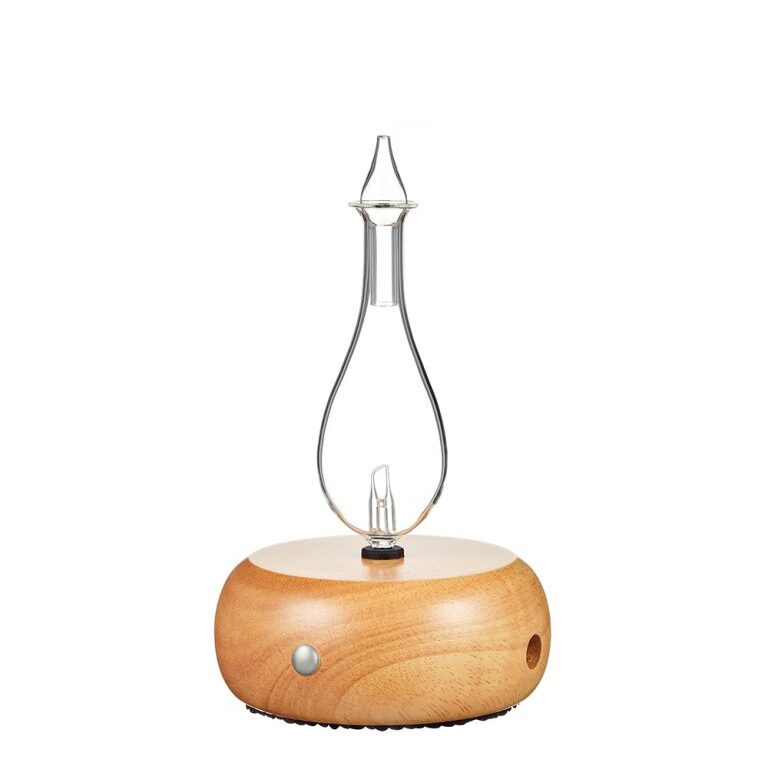
Built to Scent the Whole Room
The Magnificent Smart Nebulizing Diffuser® atomizes 100% pure essential oil into a fine, waterless aerosol and lets you program the on-off cycling that large spaces need. No water, no heat, no refill treadmill.
Frequently Asked Questions: Large-Room Diffusing
What size diffuser do I need for a large room? Stop thinking in tank size and start thinking in output. For a room above roughly 300 to 400 square feet, you want a concentrated, waterless nebulizing unit running on an intermittent timer, not the biggest water reservoir you can find. A single high-output nebulizer placed centrally will out-scent two or three small misters.
Can one diffuser cover an open-plan living and kitchen area? Usually yes, if it is a high-output nebulizing unit placed centrally and elevated, set to a two-minutes-on, twenty-minutes-off cycle. The fine, long-lingering particles and the room’s natural airflow do the distribution between cycles. A single underpowered mister will not manage it.
Will a diffuser make my large room humid? A water-based ultrasonic unit will, because it disperses water along with a trace of oil, and over hours in a big room that adds up. A waterless Nebulizing Diffuser® adds no moisture at all, since it atomizes pure oil with no water involved. In humid climates that difference matters.
How many drops of oil should I use in a large room? With a nebulizing diffuser you are working in milliliters of neat oil rather than drops, and because none of it is wasted carrying water, a small amount lasts. Start modest, run an on-off cycle, and judge by the scent at the far side of the room rather than next to the unit. It is easier to add than to clear out an overdone room.
Is a cold air diffuser better than ultrasonic for big spaces? For coverage, yes, because cold air nebulizing delivers concentrated, undiluted oil in fine particles that travel. Our full cold air diffuser buyer’s guide covers the format in depth.

Join Our Exclusive Member Club to get Big Discounts!
Final Thoughts: Scent the Whole Room, Not Just the Corner
The reason a large room defeats so many diffusers has nothing to do with the oils and everything to do with physics. A small water-based mister was built to perfume a small pocket of air, and no amount of premium oil changes the volume it can reach. Scenting a big space evenly comes down to two things the marketing rarely mentions: concentrated, waterless output, and fine particles that stay airborne long enough to travel.
Match a nebulizing diffuser to your room, lead with output instead of tank size, run it on an intermittent cycle, and place it high near gentle airflow, and the far sofa smells as good as the spot right beside the unit. That is the whole goal of an essential oil diffuser for a large room: a clean, even wave of pure botanical scent that fills the space and never announces the machine making it.