

Friday Mini-FAQ: Can I Use Fragrance Oils in a Nebulizing Diffuser® (or Only Pure Essential Oils)?
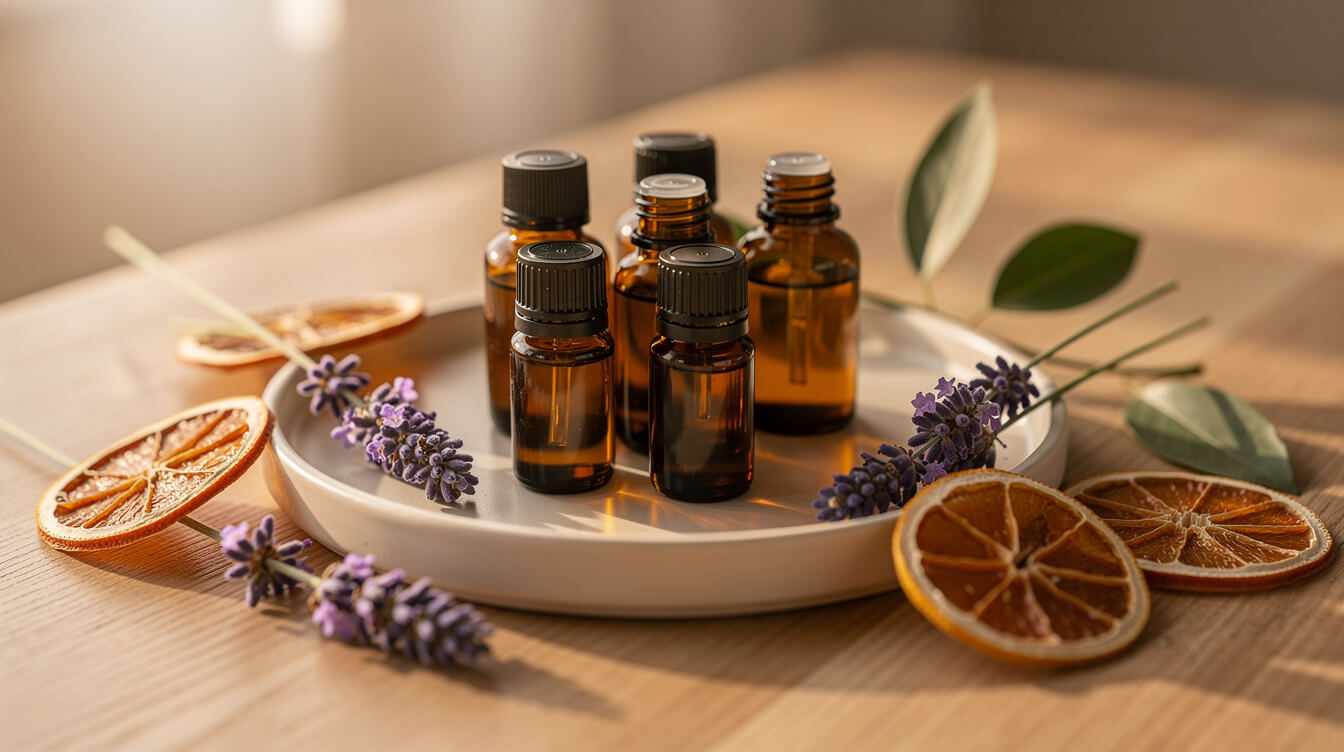
There is a moment, standing over a fragrant drawer of little amber bottles left from a candle-making phase, when it seems almost wasteful not to pour one into your new diffuser — they smell lovely, after all. Hold that pour for thirty seconds; the reason to keep them separate is quietly fascinating.
Reader question: “I have a drawer full of fragrance oils left over from candle-making. Can I just pour those into my Nebulizing Diffuser®, or does it really have to be pure essential oil?”
Pure essential oil only — and this one isn’t brand snobbery, it’s physics. A Nebulizing Diffuser® has no water and no heat to lean on. A jet of air shears past the base of the glass tube, and the oil is atomized entirely by that air stream and by its own volatility — how readily it wants to leap into vapor on its own. Pure essential oils are built for exactly this: they’re mostly light, volatile terpenes and alcohols. The limonene in a citrus oil boils around 176°C; linalool, the soft heart of lavender, around 198°C. Nudge them and they flash into a cold, dry mist.
Fragrance oils are engineered for the opposite job. They’re aroma compounds dissolved into a carrier-and-fixative base — dipropylene glycol (DPG), benzyl benzoate, sometimes phthalates — whose whole purpose is to slow the scent down so a candle or reed diffuser releases it for hours. Those solvents are heavy and stubbornly non-volatile: DPG boils near 232°C, and benzyl benzoate not until roughly 323°C. Ask a cool air jet to atomize that, with no heat to help, and it simply can’t. The light aroma molecules escape; the heavy base is left behind.
What you get in practice is a weak, oddly “flat” scent, a gurgle, and — the real cost — a sticky, varnish-like film drying onto the borosilicate glass airway. That residue narrows the very channel the mist travels through, so the diffuser fades a little more each session until it needs a proper waterless clean to breathe again. Reed diffusers and wax warmers are designed around those carriers; a waterless, heatless nebulizer is designed to refuse them.
So if a particular scent from that drawer is one you truly love, the kind move is to find it as a pure single oil or a 100% essential-oil blend. Your Nebulizing Diffuser® will thank you with a mist that’s brighter, truer, and mercifully easy to keep clean.
Sign Up to Get Your FREE
e-Book Here…
Keep the candle-making oils for candles, and give your diffuser the pure, volatile stuff it was born to atomize — the difference in the air is unmistakable.
Warm regards,
Chad
Organic Aromas