

What Does Ylang Ylang Smell Like? Why Some Noses Call It Heavenly and Others Call It Horrible
What does ylang ylang smell like? Sweet, creamy and intensely floral, somewhere between jasmine and tuberose, with a ripe, almost banana-custard softness, a faint clove-like spice and a sharp, medicinal edge on top that some people love and others can’t stand. As it dries down it turns warmer, softer and slightly woody-balsamic. It is one of the richest and most polarizing scents in aromatherapy.
That polarizing part is worth taking seriously. One of the most-read pages on this exact question is a forum thread titled, more or less, “Ylang ylang? Smells horrible.” Nobody in the top search results really explains why. We will. Below we name the two molecules behind the “horrible” reaction (and why they’re concentrated in the most expensive grade), show you how to tell true ylang ylang from its cheaper cousin cananga by reading one line on the label, answer whether ylang is masculine or feminine (the answer involves Victorian men’s hair oil), and finish with three blends that turn ylang’s sharp edge into something beautiful.
What Does Ylang Ylang Smell Like? The Short Answer
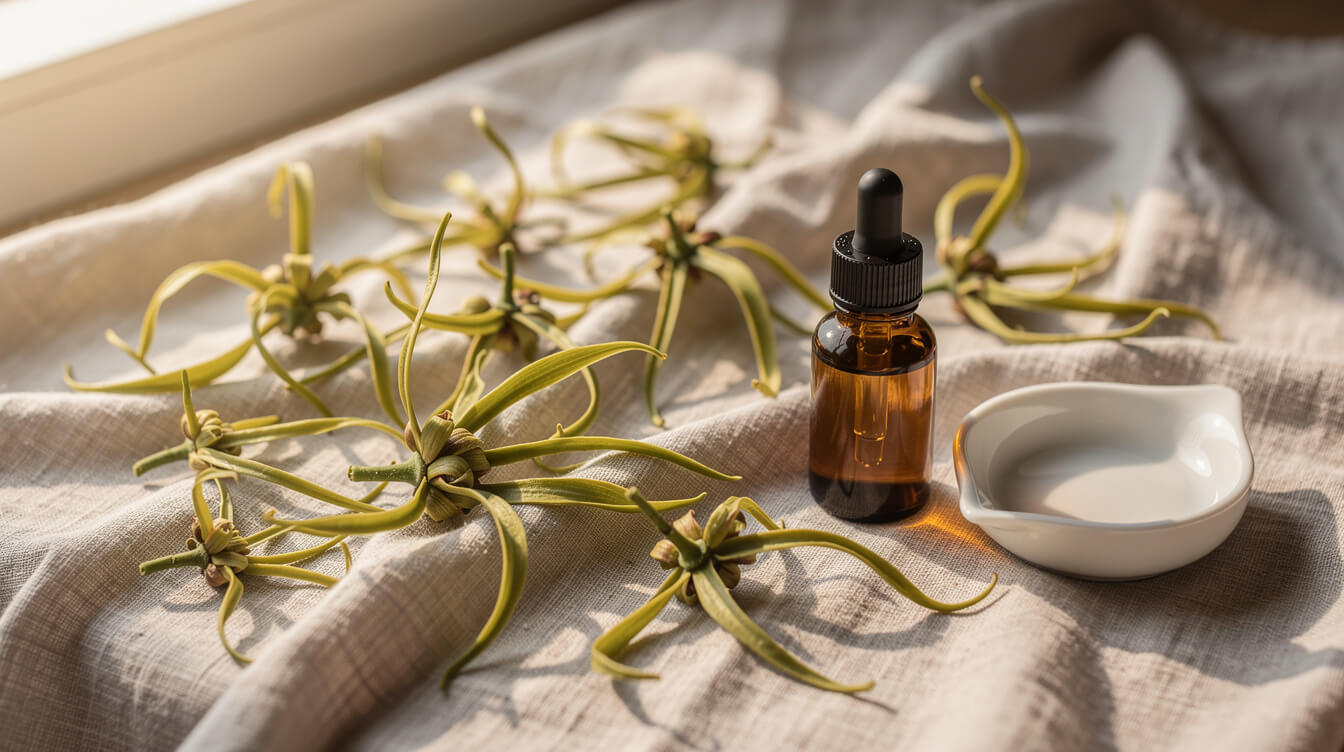
Ylang ylang oil is steam-distilled from the flowers of Cananga odorata, a fast-growing tropical tree whose long, twisted petals turn from green to golden yellow as they ripen. Most of the world’s supply comes from the Comoros islands (Anjouan above all) and from Nosy Be, off Madagascar’s northwest coast. Ask perfumers and experienced users to describe it and the same notes come up again and again:
Sweet and creamy-floral. The heart of the scent: lush, heady and petal-soft, often compared to jasmine, gardenia and tuberose.
Fruity, almost banana-like. A ripe, custardy sweetness underneath, which our Oil of the Day on ylang ylang describes beautifully.
Sharp and medicinal. A piercing, slightly phenolic top note, sometimes described as nail-salon, mothball-like or “like an old pharmacy.” This is the note that divides people.
Gently spicy. A faint clove warmth from trace amounts of eugenol.
Woody and balsamic. The dry-down: softer, warmer, a little powdery and more relaxed than the opening.
Why the bottle and the room smell different
Ylang ylang is a concentrated oil. Sniffed straight from the bottle, the sharp top notes rush at you all at once and can overwhelm the floral heart. Diffused into a room, or diluted in a blend, the same oil reads as soft, sweet and enveloping. If your first impression came from the bottle neck, it’s worth smelling it again on a paper strip held at arm’s length, or in a room a few minutes after diffusing, before you decide you don’t like it.
“Ylang Ylang Smells Horrible”: The Two Molecules Behind the Complaint
If ylang ylang smells harsh, medicinal or even a little “chemical” to you, you aren’t imagining it, and your oil isn’t necessarily bad. Two small, light molecules are responsible, and both are powerful.
1. p-Cresyl methyl ether: the mothball-and-pharmacy note
Also called para-methylanisole, p-cresyl methyl ether is a simple phenolic ether. Perfumery databases such as The Good Scents Company describe its odor with words like “naphthyl” (mothball-like), “cresol” (medicinal, tarry), ylang, powdery and nutty. On its own it’s pungent. Inside ylang ylang it supplies much of the bright, piercing lift that makes the flower smell so loud.
2. Methyl benzoate: the phenolic, wintergreen-like edge
Methyl benzoate is the second. Its odor is usually described as phenolic, wintergreen-like and almond-sweet, with a floral, cananga-like facet. It also turns up in tuberose and in many night-scented flowers. In small amounts it’s sweet and exotic. In a big hit, straight from a bottle, it reads as sharp and solvent-like, which is probably where the “nail polish” comparisons come from.
Why the most prized grade can smell the harshest
Here’s the twist. Ylang ylang is usually distilled in stages, and the first and most expensive fraction, called Extra, is the one richest in these light, punchy molecules. (Our complete guide to ylang ylang explains the Extra, I, II, III and Complete grades.) Published analyses put p-cresyl methyl ether at roughly 5 to 16% of Extra-grade oil and methyl benzoate at roughly 4 to 9%, alongside large amounts of linalool and benzyl acetate. One Comoros producer gives typical Extra figures of about 10% p-cresyl methyl ether and 6% methyl benzoate.
So the grade perfumers prize most for its radiance is also the one most likely to smell “horrible” to a new nose at full strength. Later fractions and Complete oil contain far less of these two molecules and far more of the heavier, softer sesquiterpenes, which is why they smell rounder, woodier and gentler. The fix is rarely a different bottle. It’s dilution and ratio: at low concentrations, the same sharp molecules stop reading as medicinal and start reading as a bright, glowing lift over the florals. That’s exactly how perfumers use them.
Other reasons ylang can smell off to you
Old or oxidized oil. Ylang’s light esters fade first as an opened bottle ages, which can leave a flatter, heavier, slightly sour smell.
It isn’t ylang at all. Cananga oil, a cheaper relative, is sometimes sold or blended as ylang. More on that next.
Your own nose. People really do perceive heavy white florals differently. Some find them luxurious, while others find them cloying even at low doses. Both reactions are normal.
Sign Up to Get Your FREE
e-Book Here…
Ylang Ylang vs Cananga: Read the Botanical Name on the Bottle
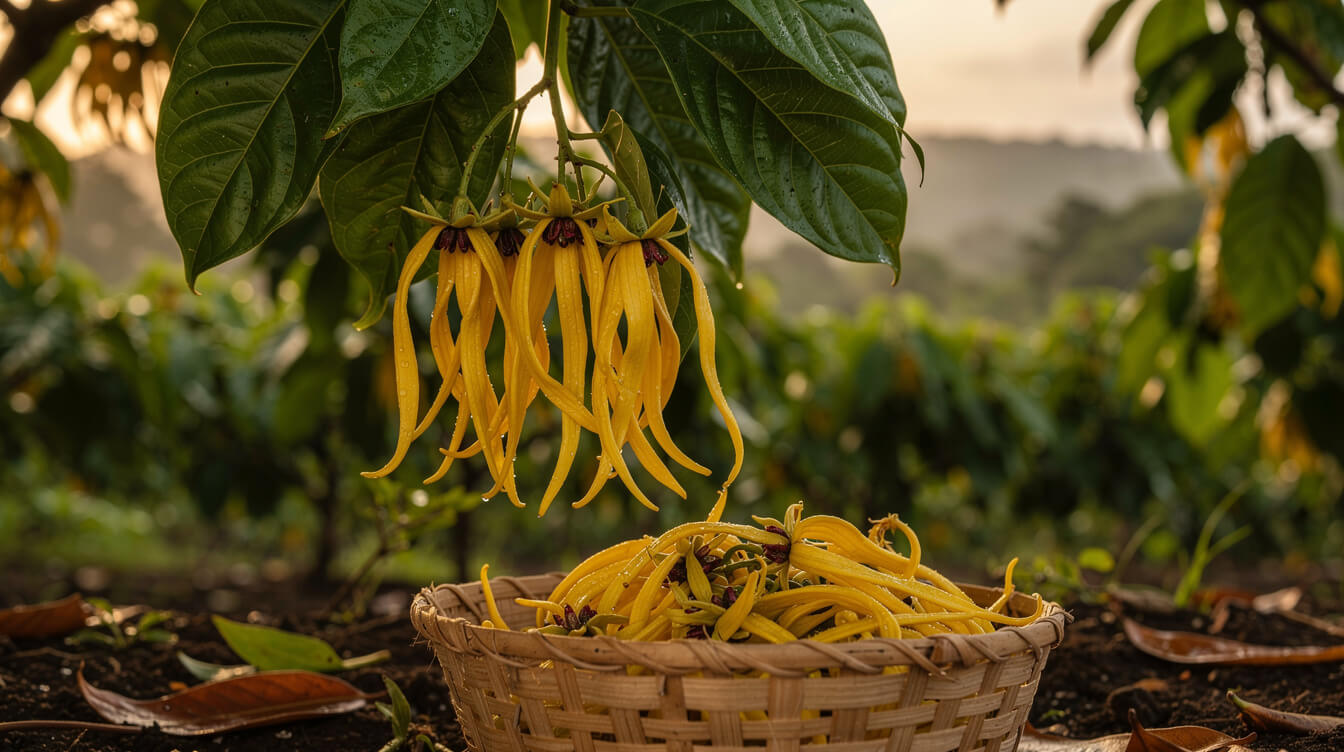
Ylang ylang and cananga come from the same species, Cananga odorata, but from two different forms of the tree, and the international standards treat them as two different oils:
Ylang ylang oil comes from Cananga odorata forma genuina, grown mainly in the Comoros, Mayotte and Madagascar. It’s covered by ISO 3063 and is usually fractionated into grades.
Cananga oil comes from Cananga odorata forma macrophylla, traditionally produced in Java. It’s covered by ISO 3523 and is distilled in one run, without grades.
What the standard says cananga smells like
ISO 3523 describes cananga’s odor in four words: “floral, woody and balsamic.” Its chemical profile shows why. The standard requires cananga oil to contain 30 to 40% β-caryophyllene, the dry, woody-spicy molecule also found in black pepper and clove, and only 0.5 to 2% p-cresyl methyl ether and 1 to 3% linalool. Compare that with the 5 to 16% p-cresyl methyl ether and 7 to 24% linalool reported for ylang Extra. Cananga has roughly a tenth of the bright, piercing top note and several times the woody sesquiterpene base.
In the bottle, that means cananga smells greener, woodier and more leathery, with less sparkle and less sweetness. Some producers also describe faint milky or sour off-notes in cananga that come from its single long distillation. It’s a lovely, inexpensive and long-lasting oil in its own right, popular in soaps and men’s grooming products. It just isn’t ylang ylang.
How to read the label
Look for the botanical name, not just the common name. “Cananga odorata forma (or var.) genuina“ means true ylang ylang. “macrophylla“ or the words “cananga oil” mean cananga. A label that gives only Cananga odorata with no form, and a price well below other ylang oils, deserves a question to the seller. Our Ylang Ylang Essential Oil is Cananga odorata var. genuina from Madagascar, and its independent gas chromatography reports are linked on the product page.
What Does Ylang Ylang Smell Similar To?
Ylang ylang shares molecules with a surprising number of familiar smells, which is why people reach for so many different comparisons. If you’ve never smelled it, these are the closest reference points:
Jasmine. The closest floral cousin. Both are rich in benzyl acetate and linalool, so they share a sweet, fruity-floral core. Jasmine is more animalic and narcotic, while ylang is creamier and more tropical. Our guide to jasmine covers what makes jasmine itself so strange.
Tuberose and gardenia. The same creamy, heady, white-flower richness. Tuberose shares ylang’s methyl benzoate edge.
Ripe banana and custard. Fruity esters give ylang a dessert-like softness. One of them, prenyl acetate, smells distinctly of sweet banana even though it’s present only in trace amounts.
Clove. A whisper of eugenol, the main molecule in clove bud oil, adds a warm spice in the heart.
Wintergreen and almond. That’s methyl benzoate again, most noticeable in the first few seconds.
Black pepper and dry wood. In the dry-down, β-caryophyllene and related sesquiterpenes give a soft, peppery woodiness, much stronger in Complete grades and in cananga.
What ylang ylang smells good with
Because ylang is so dense, it pairs best with oils that add air and structure rather than more sweetness:
Citrus (Sweet Orange, Bergamot): the classic partner. Citrus lifts ylang’s heaviness and softens its medicinal edge.
Woods (Cedarwood, Amyris): ground the florals and turn ylang warm and sophisticated. (OA doesn’t sell a single-note sandalwood. Amyris is our soft, woody stand-in; see what sandalwood smells like for why.)
Herbal florals (Lavender): lavender’s clean linalool freshness keeps ylang from tipping into perfume-counter territory.
Spice (Clove Bud): a single drop echoes ylang’s eugenol note and makes a blend feel cozy. Use it sparingly.
For the ratios behind good pairings, our essential oil blending chart explains top, middle and base notes.
Sign Up to Get Your FREE Essential Oils e-Book Here
Is Ylang Ylang Masculine or Feminine?
Today, ylang ylang is coded as feminine, mostly because of where people meet it: in rich floral perfumes. Its most famous appearance is in Chanel No. 5, created by Ernest Beaux in 1921, where ylang sits in the floral heart alongside rose and jasmine. Many of the classic white-floral perfumes that followed lean on it too.
The men’s hair oil that gave us the antimacassar
History says otherwise. In the 1790s, a London barber named Alexander Rowland began selling Rowland’s Macassar Oil, a men’s hair dressing that became one of the best-known grooming products of the 19th century. Macassar oil was typically made from a vegetable oil such as coconut, palm or kusum oil, perfumed with fragrant oils including ylang ylang. So many gentlemen slicked their hair with it that households began draping small cloths over the backs of armchairs to protect the upholstery from greasy heads. Those cloths are still called antimacassars. For much of the Victorian era, then, ylang ylang was a scent many people would have associated with men’s hair.
Unisex in a blend
In practice, ylang is about as gendered as you make it. Paired with citrus and other florals, it reads soft, sunny and feminine. Paired with cedarwood, amyris, vetiver or a touch of spice, its woody-peppery dry-down comes forward and it reads warm, smooth and unisex. If you diffuse at home for a household with mixed tastes, a woods-forward ylang blend is a lovely middle ground.
How to Make Ylang Ylang Smell Good: Three Blends and How to Diffuse Them
Everything above points to one practical rule: treat ylang ylang as a seasoning, not the main course. Used as one part of a blend, it adds a creamy glow and depth that nothing else quite matches. Used alone at full strength, its sharp top notes can dominate. Our ylang ylang guide covers how much to use. Here we focus on the ratios.
Three blends that tame ylang’s edge
Each recipe is in parts, so you can scale it to your bottle. Mix in a clean glass vial and let it rest for a day so the notes settle together.
Sunlit Bloom: 4 parts Sweet Orange, 2 parts Bergamot, 1 part Ylang Ylang. Bright, cheerful and tropical. The citrus carries the ylang so you notice its creamy sweetness and almost none of its sharpness. Perfect for a living room on a gray afternoon.
Evening Woods: 3 parts Bergamot, 2 parts Cedarwood, 1 part Lavender, 1 part Ylang Ylang. The unisex version. Cedarwood pulls ylang’s dry-down forward, and lavender keeps it clean. A soft, grown-up scent for the end of the day.
Golden Hour: 3 parts Sweet Orange, 2 parts Amyris, 1 part Ylang Ylang, a single drop of Clove Bud per 10 ml. Warm, creamy and lightly spiced, built on ylang’s eugenol note. Cozy for cooler evenings.
Prefer a ready-made blend? Our Passion Blend and Serenity Blend both include ylang ylang, already balanced with other oils. For ylang on the go, the Ylang Ylang Roll-on is pre-diluted for easy use.
Why a Nebulizing Diffuser® suits ylang
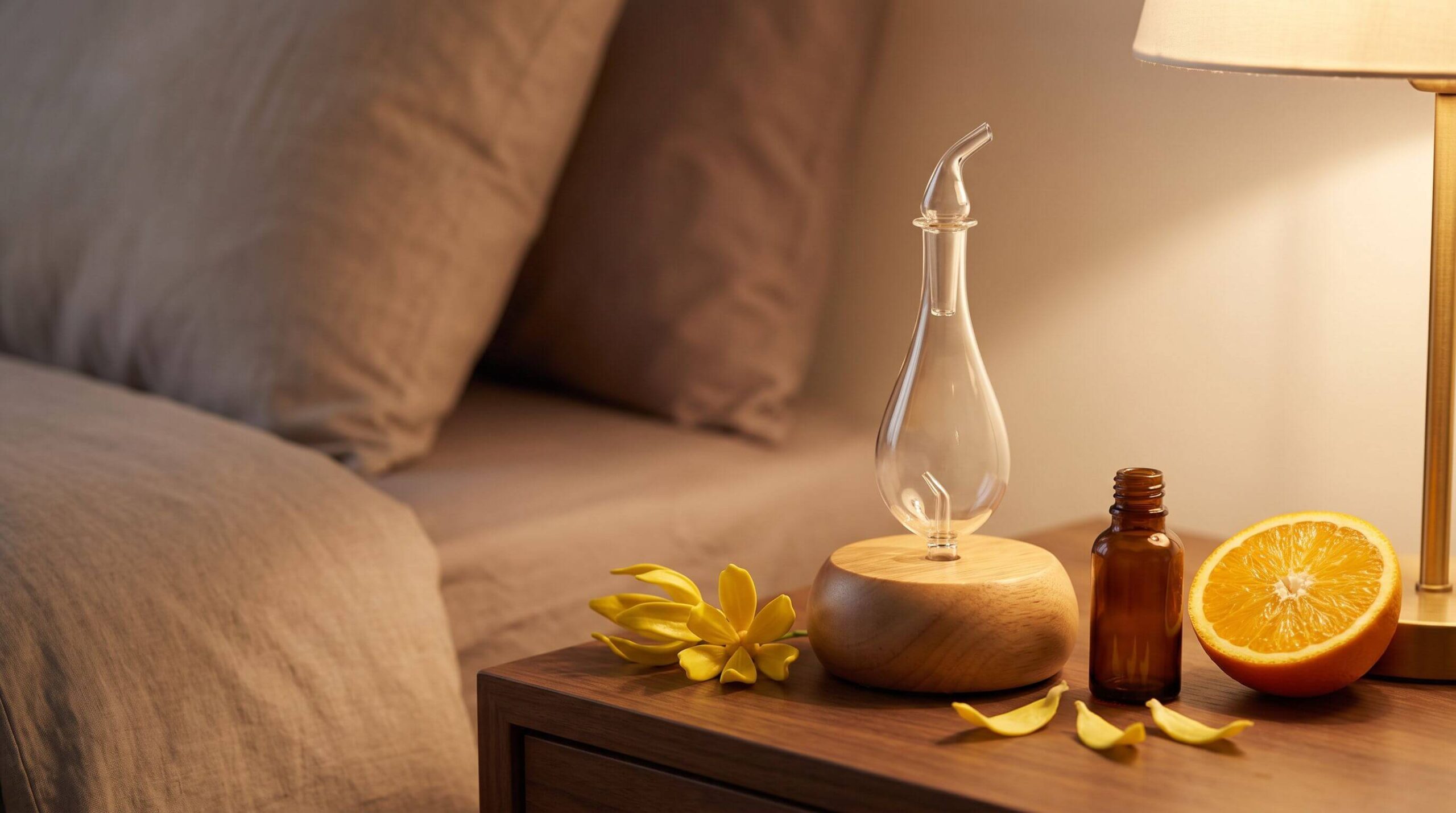
A Nebulizing Diffuser® works on Bernoulli’s Principle. A fast stream of air passing over a fine glass tube draws pure oil up and breaks it into a microscopic mist, with no water and no heat. For an oil as layered as ylang ylang, that matters. Heat-based methods and evaporating pads release the lightest molecules first, so you get a blast of the sharp top notes followed later by the heavier woody ones. Nebulizing turns whole droplets of oil into mist, so the bright, creamy and woody parts of ylang reach the room together, the way the blend was built. (Over a long session a blend can still drift a little. Our mini-FAQ on scent drift explains why.)
Ylang ylang is thicker than citrus but isn’t one of the heavy resin or root oils that tend to leave residue in the glass tubes, so blending it with a lighter oil, as in the recipes above, keeps things flowing smoothly. Run short, intermittent cycles rather than a constant stream. A little ylang fills a room fast, and your nose adapts to heavy florals quickly. Our guide on how to use a Nebulizing Diffuser® covers filling, settings and care, or browse the full handcrafted Nebulizing Diffuser® collection.

Join Our Exclusive Member Club to get Big Discounts!
What Does Ylang Ylang Smell Like? FAQs
How would you describe the smell of ylang ylang?
Sweet, creamy and intensely floral, similar to jasmine and tuberose, with a ripe banana-custard softness, a faint clove-like spice and a sharp, slightly medicinal top note. As it dries down, it becomes warmer, softer and gently woody.
Why does ylang ylang smell bad to some people?
Two powerful molecules, p-cresyl methyl ether and methyl benzoate, give ylang a sharp, phenolic, almost mothball- or solvent-like edge at full strength. They’re most concentrated in the prized Extra grade. Diluted in a blend or diffused into a room, the same molecules read as a bright floral lift. Old oil and cananga sold as ylang can also smell off.
Is ylang ylang a nice scent?
Most people find it beautiful when it’s diluted or blended, and many find it overwhelming straight from the bottle. Try it in a citrus blend such as 4 parts sweet orange to 1 part ylang before deciding.
What’s the difference between ylang ylang and cananga?
They come from two forms of the same tree. Ylang ylang (forma genuina) is brighter, sweeter and more floral. Cananga (forma macrophylla) contains far more woody β-caryophyllene and far less of ylang’s bright top notes, so it smells greener, woodier and more leathery. Check the botanical name on the label.
Is ylang ylang masculine or feminine?
It’s usually coded as feminine today because of perfumes like Chanel No. 5, but it was a key scent in Rowland’s Macassar Oil, a 19th-century men’s hair dressing. Blended with woods, it reads warm and unisex.
Is ylang ylang safe to diffuse around pets?
Cats in particular process some essential oil compounds poorly, so be cautious. Diffuse in a well-ventilated room for short, intermittent sessions, keep a door open so pets can leave, and never apply oils to pets. Ask your veterinarian if your pet has a health condition. Our guides to oils and cats and dogs go into more detail.
Who should avoid ylang ylang oil?
Ylang ylang can irritate or sensitize skin if it’s used undiluted, so always dilute it well for topical use and patch-test first. If you’re pregnant, nursing, managing a health condition or taking medication, ask your clinician before using any essential oil. Keep oils away from children, and never ingest them.
So what does ylang ylang smell like? A creamy, golden white flower with a banana-soft heart, a clove-warm middle and a sharp, glowing top note that’s thrilling to some noses and too much for others. Once you know which molecules make that edge, and that a little dilution turns it from harsh to radiant, ylang becomes one of the most rewarding oils to blend. Start with our pure Ylang Ylang Essential Oil, a squeeze of citrus and a short, intermittent diffusing cycle. Curious about other scents? Explore what bergamot smells like and what vetiver smells like next.