


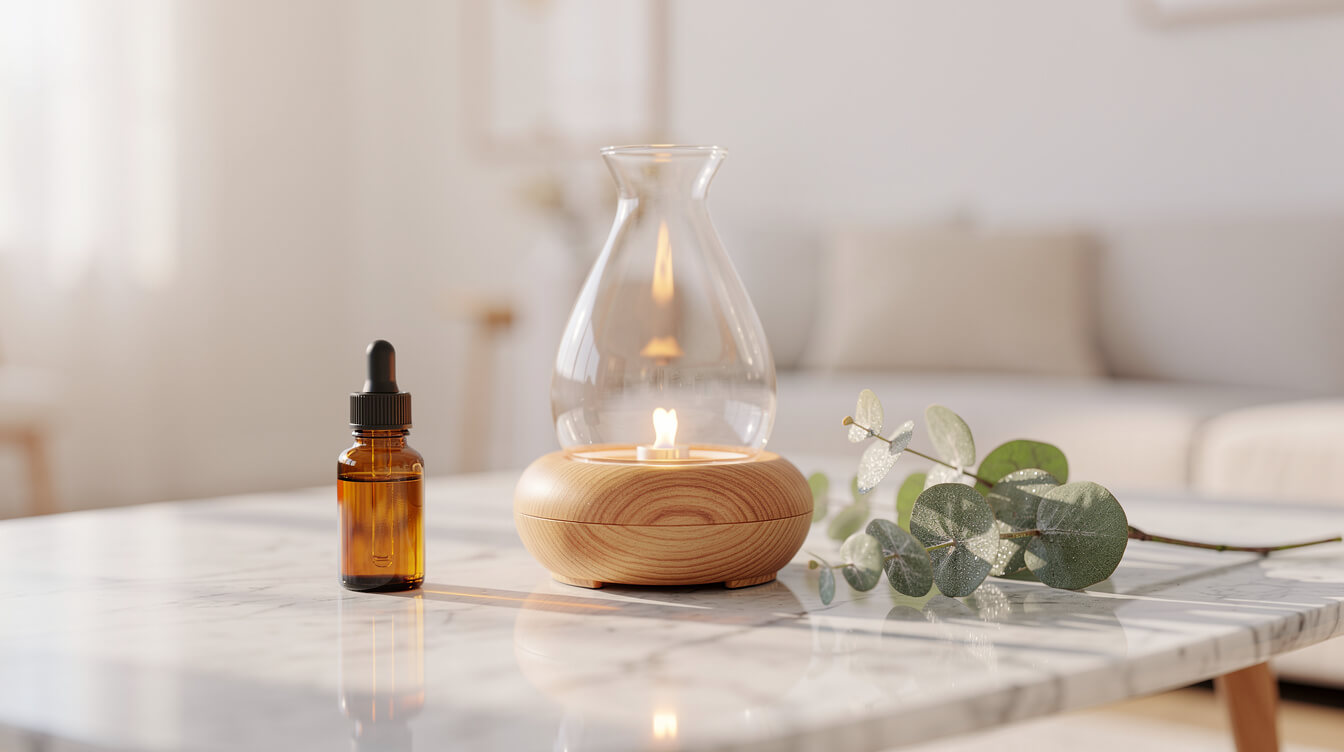
The Best BPA-Free Essential Oil Diffuser: A 2026 Guide
Type bpa free essential oil diffuser into any search bar and you will drown in product listings wearing a reassuring little “BPA-free” badge. It feels like the finish line. It isn’t. That badge answers exactly one narrow question — whether a single chemical, bisphenol A, was used in the housing — and it stays conspicuously quiet about everything your essential oils actually touch on the way into the air you breathe.
This guide goes deeper than the SERP. We’ll unpack why “BPA-free” is a low bar and not a finish line, why concentrated essential oils are unusually hard on plastic in the first place, and how a waterless Nebulizing Diffuser® sidesteps the whole problem by keeping your oils in contact with nothing but glass and wood. By the end you’ll know precisely what to check before you buy — and why the honest answer to “what is the best BPA-free essential oil diffuser?” is often “the one that has no plastic in the oil path at all.”
Why a “BPA-Free” Label Isn’t the Same as Plastic-Free
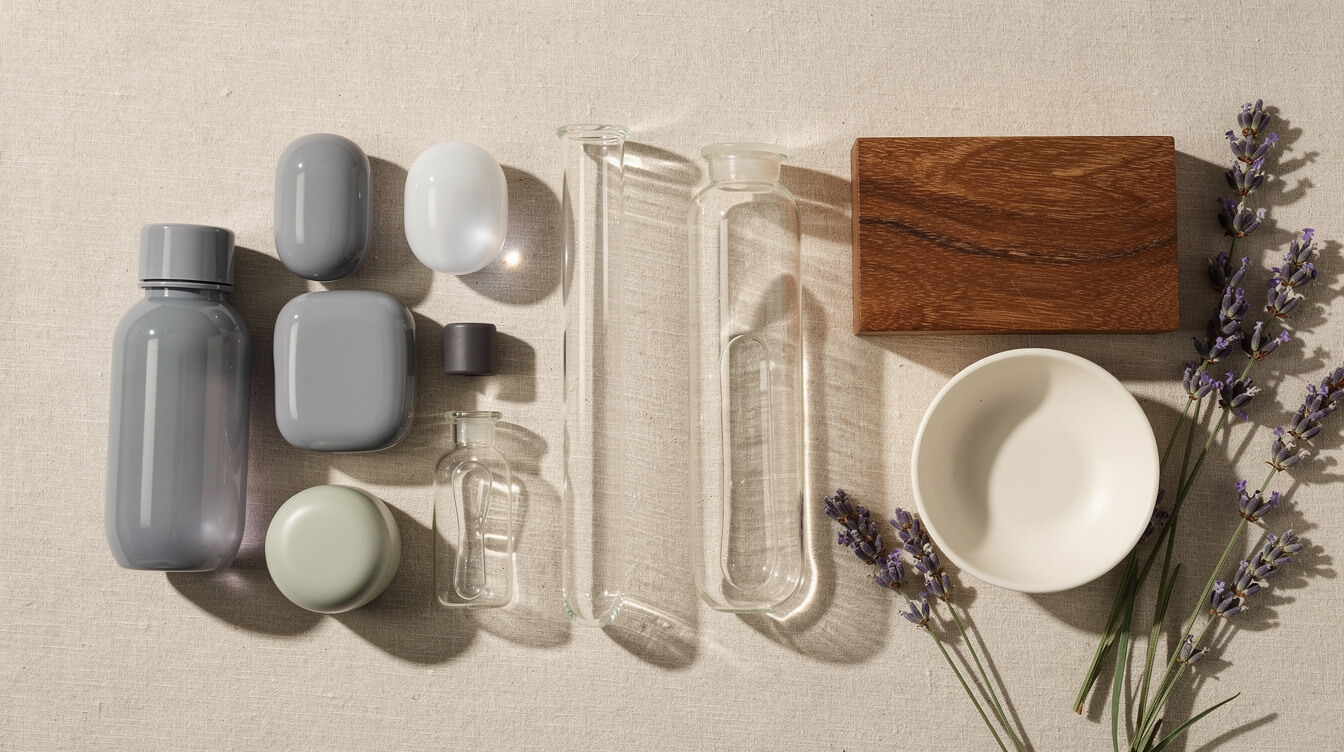
Here is the sentence that reframes the entire search. In one widely-cited 2026 roundup of “nontoxic” diffusers, the editors’ own materials note for a top pick reads: “Matte ceramic outer, BPA-free plastic.” Read that twice. The unit is marketed as nontoxic and BPA-free — and it is still built around plastic. The ceramic is a shell; the reservoir and vapor path underneath are polymer.
“BPA-free” only means bisphenol A specifically was left out. It says nothing about the replacement bisphenols — BPS and BPF — that manufacturers swapped in, which are structurally similar and far less studied. It says nothing about the phthalate plasticizers blended into flexible plastics to keep them pliable. And it says nothing about the most important variable of all: whether your undiluted essential oil ever meets that plastic.
So when you’re comparing a BPA-free essential oil diffuser against the alternatives, the useful question isn’t “is the label there?” It’s “trace the oil path — what does the oil physically touch?” In most ultrasonic and evaporative units, the answer is: a plastic reservoir, a plastic well, and a plastic mist chamber. BPA-free or not, that’s plastic in the one place it matters most. For a fuller breakdown of how the two technologies differ, our honest nebulizing vs ultrasonic comparison walks through it side by side.
What BPA Actually Is — and Why Essential Oils Make Plastic Worse
Bisphenol A is an industrial chemical that has been used since the 1960s to make polycarbonate plastics and epoxy resins — the hard, clear plastics in some bottles and the resin linings inside cans and caps. Regulatory agencies including the U.S. Food and Drug Administration continue to study it, and consumer demand has driven a sweeping shift toward BPA-free products across the market. That demand is exactly why the badge exists. Fair enough — but the badge was designed for water bottles and food containers, not for a device that aerosolizes concentrated botanical solvents all day.
And that is the part almost every competing article skips. Pure essential oils are natural solvents. Their aroma molecules — monoterpenes like limonene and pinene, and phenols like carvacrol — are the same class of compounds industry uses to dissolve and degrease. Citrus oils are practically a byword for cutting through grease. Put that against a plastic wall day after day and the plastic doesn’t stay inert: it can soften, cloud, micro-crack, and slowly surrender its plasticizers. Over twelve years of customer feedback, we’ve seen the pattern first-hand — people arrive having watched a cheap plastic unit go milky and brittle within months of running neat oils through it.
Now add the two accelerants most plastic diffusers bake in: heat and water. Ultrasonic units sit the oil in a warm water bath and vibrate it inside a plastic chamber; warmth speeds up any chemical migration, and the oil-water-plastic sandwich is the exact condition under which leaching is most likely. “BPA-free” does nothing to change that chemistry. If your goal is to inhale the oil and only the oil, the material the oil touches matters more than any single molecule left off an ingredient list.
Sign Up to Get Your FREE
e-Book Here…
How a Nebulizing Diffuser® Takes Plastic Out of the Equation
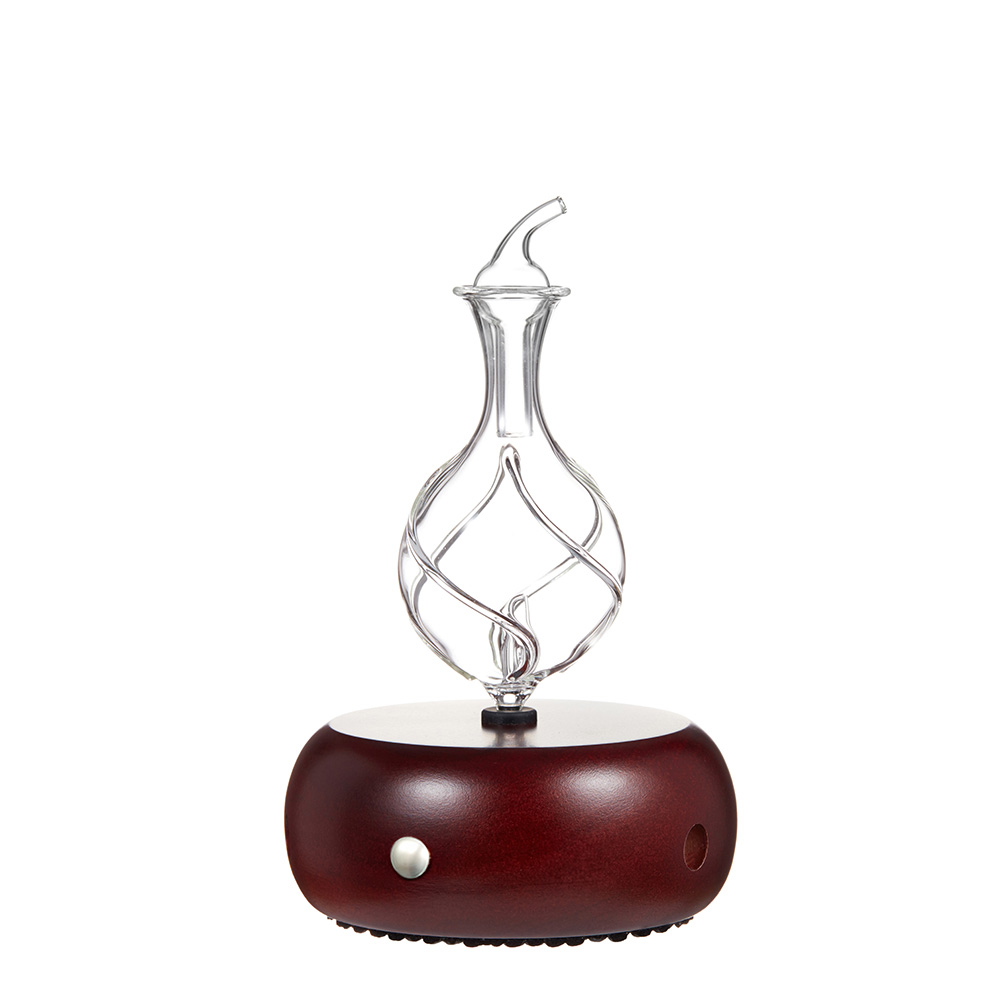
The cleanest way to win the plastic argument is to remove plastic from the oil path entirely — and that is precisely what nebulizing diffusion does. A Nebulizing Diffuser® uses no water, no heat, and no plastic reservoir. Instead it runs on Bernoulli’s Principle: a small air pump pushes a fast stream of air across the top of a medical-grade Pyrex glass tube. That fast-moving air creates a drop in pressure that draws neat essential oil up the glass and shears it into an ultra-fine, dry aroma — pure oil, atomized straight into the room.
Follow the oil path and you’ll see why this matters for anyone shopping a BPA-free essential oil diffuser: the oil rests in a hand-blown glass reservoir, climbs a glass tube, and exits as vapor. The only other material in the build is real hardwood for the base. No plastic. No water to bake it in. No heating element to accelerate anything. Glass is chemically inert against terpenes — it won’t cloud, soften, or leach the way a polymer does — which is exactly why laboratories store aggressive solvents in glass, not Tupperware.
You also get a scent benefit competitors rarely mention. Because nothing is diluting the oil in water, you smell the full, undiminished aroma profile of the botanical — top notes intact. Our deep dives on the physics of waterless diffusion and how to choose a waterless diffuser go further if you want the full mechanism.
How to Choose the Best BPA-Free Essential Oil Diffuser: 5 Checks
Ready to compare units like a materials scientist instead of a badge-reader? Run every candidate — the best BPA-free essential oil diffuser will pass all five — through this checklist:
1. Trace the oil path, not the label
Ask one question: from bottle to air, what does the oil touch? If the answer includes a plastic reservoir or a plastic mist well, “BPA-free” is decorating a compromise. Glass-and-wood construction with a glass oil path is the gold standard.
2. Prefer glass over “BPA-free plastic” for the reservoir
A glass reservoir is inert against the solvent action of neat oils; a polymer one is not, however it’s labeled. Medical-grade Pyrex is the same material trusted for laboratory glassware.
3. Treat heat and water as red flags
Warmth and a water bath are the two conditions that most accelerate any migration from plastic. A waterless, heatless design removes both at once — and preserves the oil’s delicate top notes as a bonus.
4. Insist on genuine natural materials
Real hardwood and glass aren’t just aesthetic. They’re a signal that the maker chose durable, inert materials over the cheapest possible mold-injected shell.
5. Confirm it’s easy to clean with alcohol
Because glass tolerates a high-proof alcohol rinse, a nebulizing unit stays genuinely clean between oils — no biofilm, no water scale. Our step-by-step cleaning guide covers the two-minute routine.
If you’d rather skip the audit and start with a unit engineered to pass all five, the Raindrop — Smart Nebulizing Diffuser® pairs a hand-blown glass reservoir with a hardwood base and app control, so your oils only ever meet glass and wood.
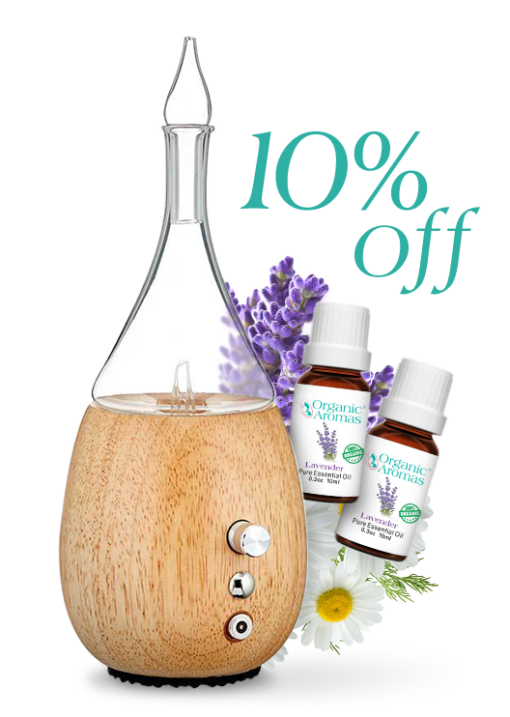
Join Now and Get a Coupon for 10% Off!
The Organic Aromas BPA-Free Lineup
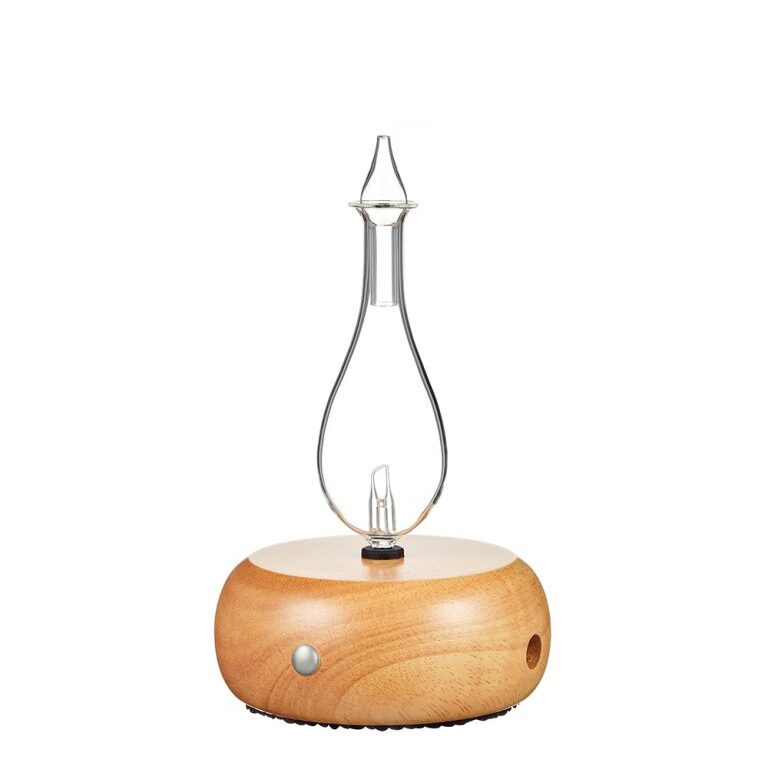
Every Organic Aromas Nebulizing Diffuser® is built to the same rule: a medical-grade Pyrex glass oil path and a real hardwood base — no plastic where your oils travel, no water, no heat. A few favorites to start with:
- Raindrop — the bestseller. A rounded hardwood base and a conical glass reservoir with a candle-wick-style top; effective, versatile, and whisper-quiet.
- Radiance — a swirling custom-glass reservoir on a smooth hardwood base, with an optional warm LED light ring for evening ambiance.
- Magnificent — an hourglass-shaped glass reservoir on a rounded wooden base; a sculptural centerpiece as much as a diffuser.
- Exquisite — a contemporary silhouette offered in several finishes, for those who want the unit to disappear into modern decor.
Prefer to browse the full range side by side? The complete Nebulizing Diffuser® collection lists every model, and the newer Smart editions add rechargeable, app-controlled scheduling on top of the same plastic-free glass core. If you travel, our portable nebulizing guide covers the compact options.
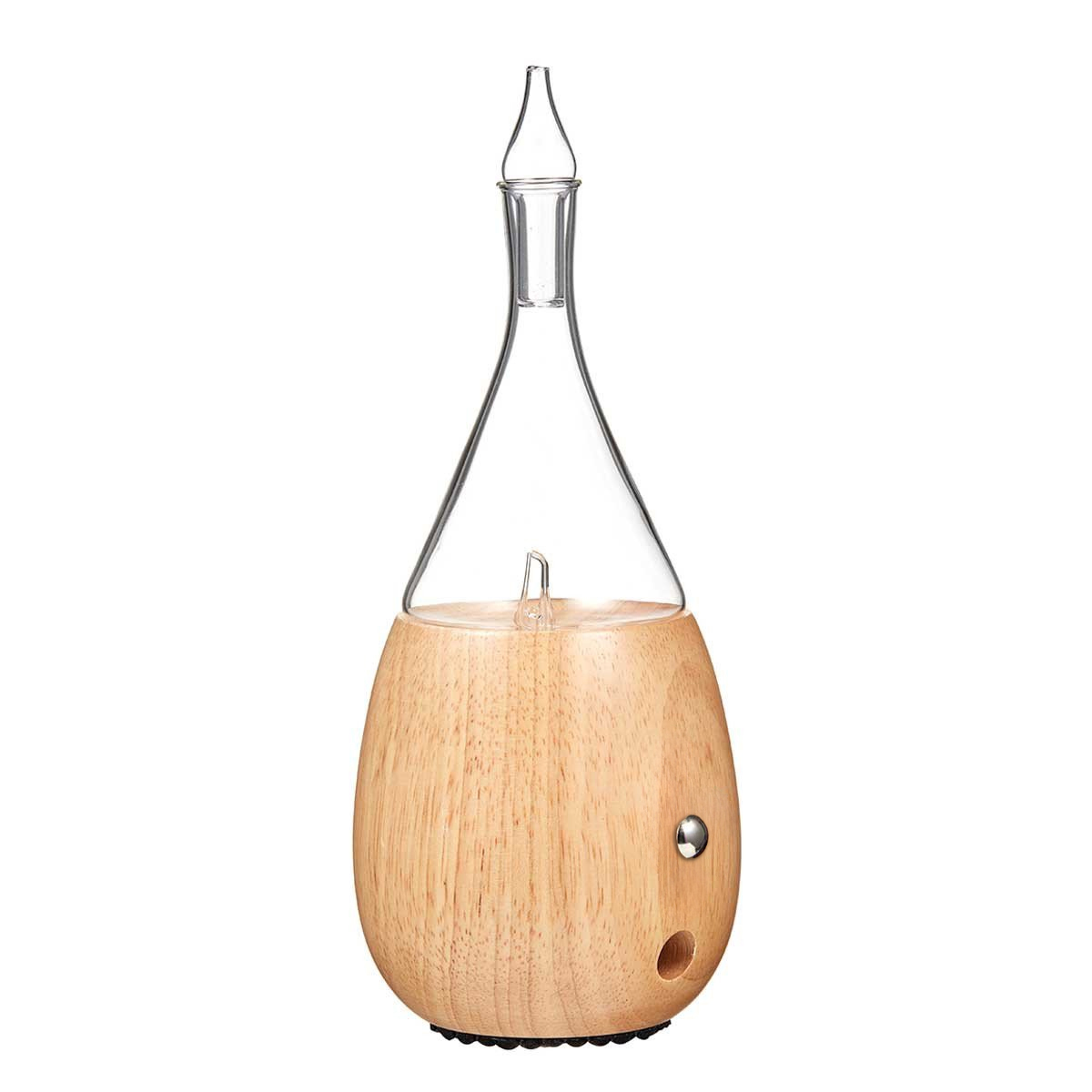
Pure Oils, Zero Plastic in the Path
Handcrafted from real wood and medical-grade Pyrex glass — no water, no heat, no plastic reservoir. Diffuse pure, undiluted essential oils the way they were meant to be enjoyed.
Care, Honest Limitations & FAQ
No honest buying guide pretends its favorite has zero trade-offs. A glass Nebulizing Diffuser® is the cleanest option for keeping plastic away from your oils — and it asks a little more of you in return:
- Thick, resinous oils need a workaround. Heavy oils like sandalwood, vetiver, myrrh, and patchouli can be slow to atomize and may gum up the glass tube. The fix is easy: blend them with thinner citrus or conifer oils, and rinse the tube with high-proof alcohol. Our thick-oils FAQ has the full method.
- It uses oil a touch faster. You’re diffusing pure, undiluted oil rather than a few drops in a tank of water, so intermittent timing (for example, 15 minutes on, 30 off) keeps a room beautifully scented while stretching your bottle.
- It costs more than a plastic unit up front. Handcrafted glass and wood aren’t injection-molded plastic — and they’re built to last for years rather than months.
Is a “BPA-free” plastic diffuser safe for essential oils?
“BPA-free” only removes one molecule. The larger issue is that concentrated essential oils act as solvents against plastic generally, and heat plus water accelerate any migration. A glass oil path avoids that concern entirely, which is why many aromatherapy enthusiasts prefer it.
Do glass nebulizing diffusers need water?
No. A Nebulizing Diffuser® is completely waterless. It atomizes neat oil using air pressure, so there’s no tank to refill, no water scale, and no diluted, watered-down scent.
How do I keep a glass diffuser clean?
Because glass tolerates it, a periodic rinse with high-proof (90%+) alcohol dissolves any oil residue and leaves the tube clear. It’s a two-minute routine — see our full cleaning walkthrough.
Glass or BPA-free plastic — which is genuinely better?
For a device that aerosolizes solvent-like botanicals all day, inert glass is the more future-proof choice. “BPA-free plastic” is an improvement over old polycarbonate, but it’s still plastic in the oil path. Glass simply removes the question.
The Bottom Line
The best BPA-free essential oil diffuser isn’t the one with the most reassuring sticker — it’s the one that keeps plastic out of the oil path altogether. Trace where your oil travels, favor inert glass and real wood over any labeled polymer, and treat heat and water as the accelerants they are. Do that, and “BPA-free” stops being a marketing promise and becomes a design guarantee — pure aroma, delivered by nothing but glass, wood, and air.



hello everyone
good to know
They all look appealing but I would go with the simplicity of the raindrop.
Great information! I didn’t know that about diffusers made out of plastic are not recommended! Thanks for sharing!
The Radiance Nebulizing Diffuser is the most appealing to me. Thanks for your contest
This is good to know.
All of them, Radiance is a good choice
I love mine Raindrop Nebulizing Diffuser®!
I love the look of these the 2nd one Radiance didn’t know about the plastic thank you.
Thanks for the chance to win, they are absolutely gorgeous. I learned so much that I didn’t know before so thank you. My choice would be the Exquisite or the Radiance.
Surprised there is BPA in these diffusers. Thanks for the awareness and the giveaways
Radiance definitely with its look like Aladdin lamp 🙂
We enjoy a world of benefits when we learn about the best essential BPA-free diffuser! 😀
The raindrop-nebulizing diffuser. Thanks for the chance
great for a zero-waste life
these defusers are fantastick
So important to have this information. Thank you.
thanks great info learned something new today The raindrop – Nebulizing Diffuser® would be best
This are the best diffusers ever! When you buy one of these you never want to go back to a plastic one you have to use with water. Scent of the oils is so much better. Stronger, but you only have to diffuse for 10 or 15 minutes to have the benefits. I bought my second one already!
wow i guess i never really thought of that before, thanks for pointing it out
Your products are the best !!.
Love your products !
Thanks
thanks for the info
Wow! Thanks for sharing this very informative article! I always knew a little bit of BPA is in water bottles, which is why I always try to bring a water bottle instead. I had no idea it was in so much other stuff, too! Gross! Makes you really rethink products and reading product labels carefully. Thanks again for sharing!
A good report as always, thanks.
I’d never heard of the BPA in the plastic diffusers before. Thanks for the article.
oh my…. it is time to ditch that plastic one I got last Christmas
Very information, thanks.
thanks for sharing
wonderful information
this is very reassuring ty
i always learn so much ty
Very informative article on BPA free diffusers. My favorite BPA free diffuser is the raindrop design.
The best BPA free diffuser is the Raindrop – Nebulizing Diffuser 🙂 It would make a great addition to any home!
I will never go back to the common but cheap plastic diffusers. Thank you for this article and your BPA information. This is yet another reason (among many) why the plastic diffusers are definitely not the way to go.
This makes me even happier I bought the raindrop lol
Glad to know organic aromas makes BPA free diffusers. Yet another reason I will be buying one from them!