

Jasmine Essential Oil Benefits: The Indole Paradox, Sambac vs. Grandiflorum, and How to Diffuse It
Most lists of jasmine essential oil benefits read like a perfume ad: romantic, relaxing, good for sleep, good for skin. The science tells a more interesting story. Jasmine is one of the few florals that has been tested on people breathing it, and the results point to a scent that wakes you up rather than winding you down. Its most important molecule smells like a barnyard at full strength and like heaven at a trace. And the way most people buy it is the one way that will clog a Nebulizing Diffuser®.
This guide starts where the other guides stop. We’ll look at what’s actually in a bottle of jasmine, the indole paradox that explains why a little jasmine goes so much further than a lot, the real differences between sambac and grandiflorum, what the human studies found, and how to diffuse this precious, sticky oil without wasting a drop or gumming up your glass.
Jasmine Essential Oil Benefits Start With What’s in the Bottle
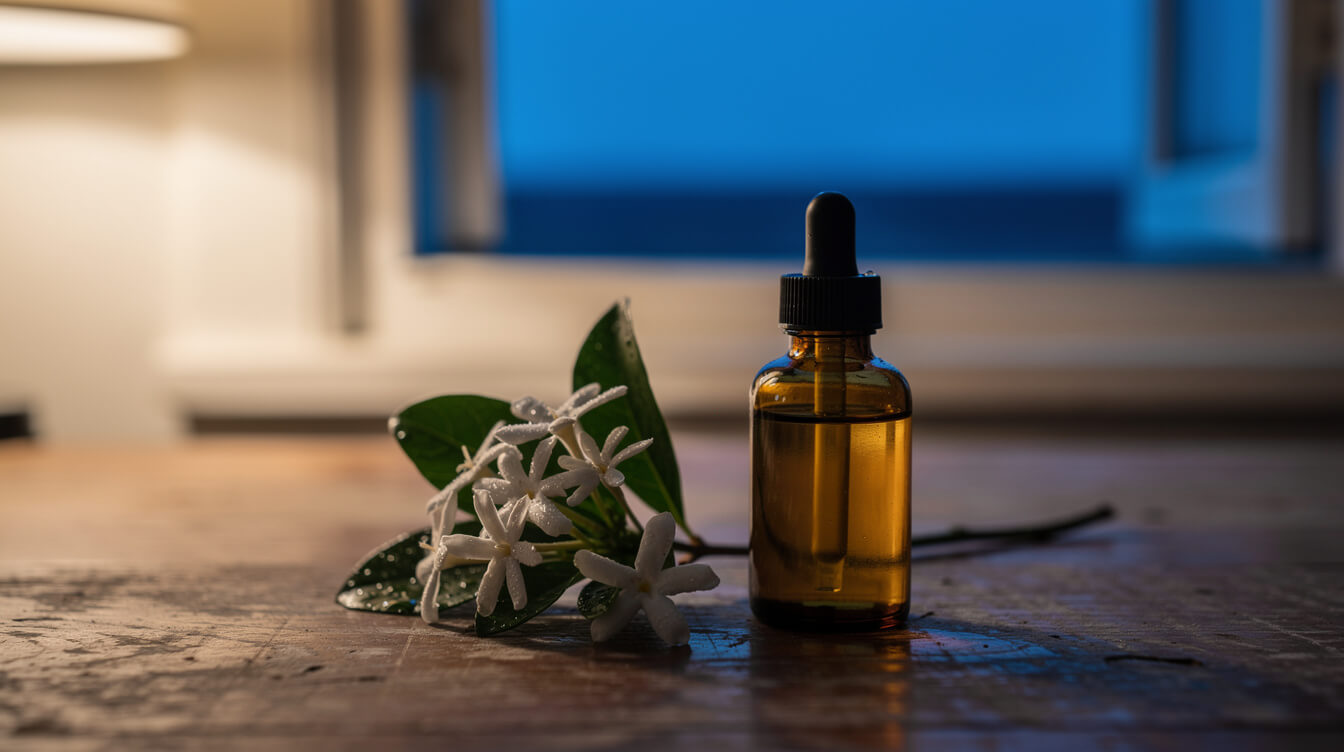
First, a small correction to the name. True jasmine “essential oil” is almost always a jasmine absolute. The flowers are too delicate for steam distillation, so the fragrance is drawn out with a solvent, and the solvent is then removed. We explain the process, and how it compares with distillation for rose and osmanthus, in our guide to absolutes vs. essential oils. What matters here is the result: a thick, honey-colored liquid with a scent far closer to the living flower than any distillate could be.
The four molecules that make jasmine smell like jasmine
Gas chromatography (GC-MS) breaks a jasmine absolute into hundreds of compounds, but a handful do most of the work. Published analyses of Jasminum grandiflorum absolutes from India, Egypt and Italy show a consistent pattern:
Benzyl acetate, about 23 to 27%. The sweet, fruity, slightly pear-like top of jasmine. It’s the most abundant single molecule and the part you smell first.
Benzyl benzoate, about 12 to 21%. A heavy, faintly balsamic ester that barely evaporates at room temperature. It acts as jasmine’s built-in fixative, and it’s a big reason the absolute is so thick.
Linalool, about 6 to 8%. The soft floral alcohol you also know from lavender and bergamot. It gives jasmine its airy, fresh lift.
Indole, about 1.5 to 2.7%. A small number with a huge effect. Indole is jasmine’s “animalic” heart, and it’s the reason jasmine can smell creamy and intoxicating in one room and slightly too much in another. The next section is all about it.
Add traces of methyl jasmonate, cis-jasmone and phytol, and you have the profile perfumers have chased for centuries. Exact numbers vary with origin, harvest and extraction, which is why two genuine jasmine absolutes can smell noticeably different.
The molecule perfumers copied
In the late 1950s, Firmenich chemist Edouard Demole isolated methyl jasmonate, a molecule present in jasmine absolute at well under 1%, yet essential to its radiance. He then made a close synthetic cousin, methyl dihydrojasmonate, published in 1962 and later sold as Hedione. It smells like a transparent, glowing jasmine with none of the indole, and Dior’s Eau Sauvage (1966) made it famous.
Why does that matter to you? Because a great deal of inexpensive “jasmine” scent, in candles, plug-ins and many “jasmine oils” online, is built on Hedione and benzyl acetate rather than flowers. It can smell pretty, but it’s thin and airy, without the warm, slightly animal depth of the real absolute. If a “pure jasmine essential oil” costs about the same as a bottle of sweet orange, it’s worth asking what’s actually inside. Our guide to judging real essential oil purity covers the questions to ask, and our mini-FAQ on fragrance oils explains why synthetic fragrance oils don’t belong in a Nebulizing Diffuser®.
The Indole Paradox: Why a Little Jasmine Goes Further Than a Lot
Indole is one of the strangest molecules in perfumery. Smelled neat, it’s sharp, mothball-like and frankly fecal. It is, in fact, one of the compounds that gives feces its smell. Diluted to well below 0.1%, it turns into the narcotic, creamy warmth that makes jasmine, orange blossom and tuberose unforgettable. The molecule doesn’t change. Your nose does: at high concentration, indole triggers a wider range of odor receptors than it does at a trace, and the brain reads that crowd of signals very differently.
Jasmine absolute carries indole at roughly 1.5 to 2.7%, so the oil in the bottle is already well above the level where indole reads as purely floral. That’s why some people sniff an open bottle of real jasmine and wrinkle their nose, then fall in love with the same oil in a blend or drifting through a room. It’s also why the most beautiful jasmine experiences almost always involve less jasmine, not more.
What this means for your blends
Perfumers treat jasmine as a heart note and a modifier, rarely as a solo. A small share of jasmine lends warmth, roundness and a “living flower” quality to brighter oils, and the indole sits low enough to read as floral. That’s exactly how we use it. Jasmine is one of six to nine oils in four of our blends: Morning Bloom, Butterflies Breath, Jubilation and Welcome Home. In each, it’s a supporting voice under citrus, pine or geranium, not the lead singer.
For your own blends, a good starting point is 1 part jasmine to 9 or 10 parts lighter oils. Go up slowly if you want more of its character. Our essential oil blending chart shows how heart notes like jasmine sit between bright top notes and grounding base notes.
What this means in the room
The same rule applies to the air. If your room smells “too much” of jasmine, or slightly stale and heavy after an hour, you’re not imagining it. Indole builds up, and as it does, the scent moves along that line from floral toward animal. Short, intermittent sessions keep it on the floral side. We suggest a low intensity setting and a cycle of a few minutes on and several minutes off, rather than running jasmine continuously in a small room.
Sign Up to Get Your FREE
e-Book Here…
Sambac vs. Grandiflorum: Two Jasmines, Two Different Characters
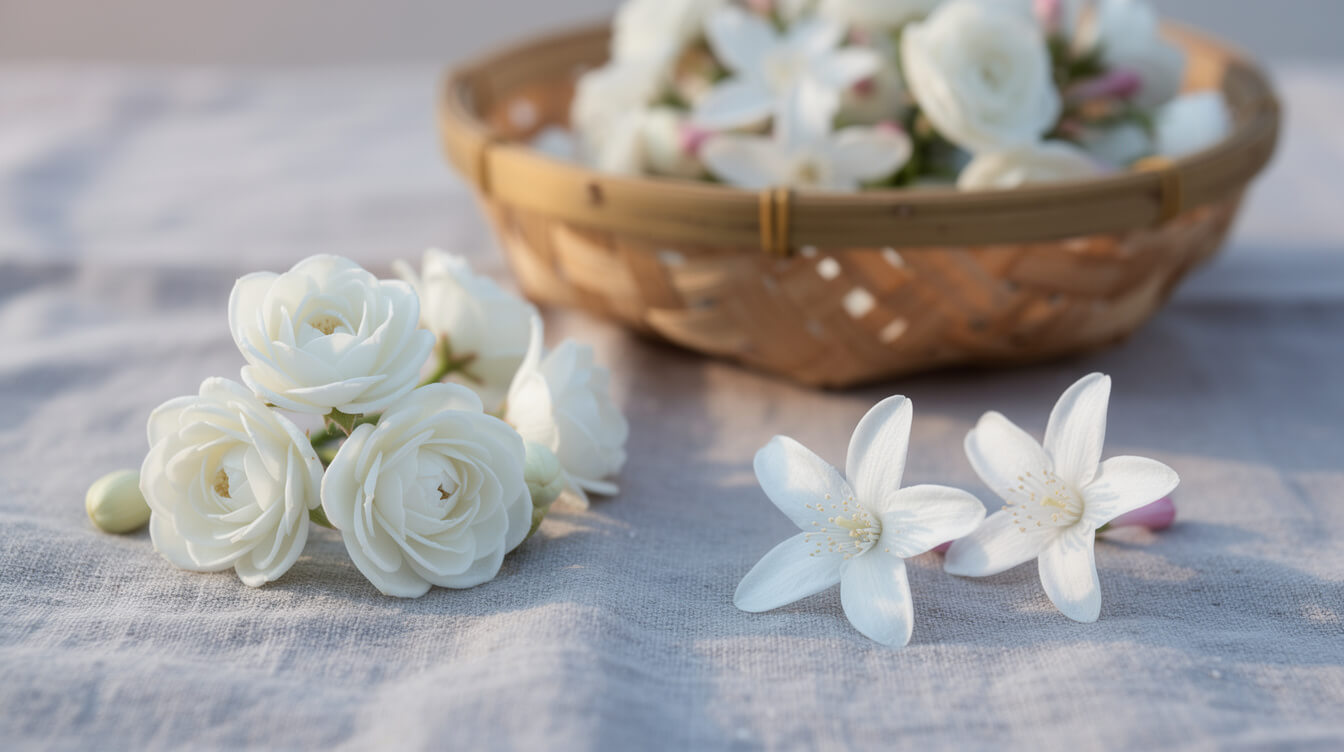
“Jasmine” on a label can mean two quite different plants, and it’s worth knowing which one you’re buying.
Jasminum grandiflorum: the classic perfume jasmine
Also called Spanish or royal jasmine, grandiflorum has small, five-petaled, star-shaped flowers, often blushed pink underneath. It’s the jasmine of the Grasse perfume tradition and today grows mostly in Egypt and India. Its absolute is rich in benzyl acetate and benzyl benzoate, with a deeper, more indolic, almost leathery warmth. If you want the jasmine of classic French perfume, this is it.
Jasminum sambac: the night jasmine
Sambac, or Arabian jasmine, has rounder, often doubled, many-petaled blossoms. It’s the flower in jasmine tea and Hawaiian pikake leis, and the national flower of the Philippines and Indonesia. Its scent is greener, fruitier and more tea-like. Compared with grandiflorum, sambac is typically higher in linalool and carries methyl anthranilate, a grape-like note, plus the soft green terpene α-farnesene.
Why jasmine is picked in the dark
Sambac is a night bloomer that evolved to attract moths. A 2016 study in Frontiers in Plant Science tracked its scent production hour by hour and found the key enzyme for one of its main aroma esters peaks about four hours after the flower opens, around midnight, with methyl benzoate emission peaking near 2 a.m.. The flowers are at their most fragrant in the small hours, which is why jasmine is traditionally harvested at night or before dawn, before the day’s heat drives off the volatile compounds the flower has been building all night.
For diffusing, the difference is mostly about mood. Grandiflorum is warmer and more sensual, lovely in the evening and paired with woods. Sambac is fresher and brighter, and pairs beautifully with citrus for daytime. If you enjoy other exotic florals, our guide to ylang ylang essential oil benefits covers another night-scented flower with a similar heady side.
The Real Benefits of Jasmine Essential Oil: Brighter, Not Sleepier
Here’s the jewel most jasmine guides miss. Much of the internet files jasmine under “relaxing” and “sleep.” But the two best-known human studies on jasmine’s scent found the opposite: jasmine is an uplifting, activating oil.
What the studies found
In a 2010 study in Natural Product Communications, researcher Tapanee Hongratanaworakit gave volunteers an aromatherapy massage with diluted jasmine oil or a plain placebo oil. Compared with placebo, the jasmine group showed higher breathing rate, blood-oxygen saturation and blood pressure, all markers of increased arousal, the body shifting toward alertness. Just as telling, the jasmine group rated themselves more alert, more vigorous and less relaxed.
Because massage involves the skin as well as the nose, a 2013 study in the Journal of Health Research (Sayowan and colleagues) looked at inhalation alone. Volunteers who breathed jasmine oil showed more beta-wave brain activity, the pattern linked with an alert, attentive state. They also reported more positive feelings, describing themselves as more “well,” “active,” “fresh” and “romantic,” and they felt significantly less drowsy.
These are small studies, and they measure mood and alertness, not health outcomes. But they point in the same direction, and they match what many people notice in practice: jasmine lifts a room. It’s a better companion for a slow Sunday morning, a creative afternoon or an evening with friends than for the last ten minutes before sleep. For bedtime, softer oils like lavender are the better choice.
Where jasmine shines
Morning and creative time. Jasmine with citrus is bright and optimistic. Our guide to essential oils for focus covers other oils that suit a working day.
Evenings with company. Its warmth and “romantic” reputation make it a natural for dinner, conversation and candlelit (or lamplit) evenings.
Personal scent. Jasmine is the heart of countless perfumes. If you like making your own, our guide to building a natural scent note by note shows where it fits.
4 jasmine blends for your Nebulizing Diffuser®
Each recipe is in parts, so you can scale it to your bottle. Mix in a clean glass vial, cap it, and let it rest for a day so the oils settle together.
Morning Garden: 5 parts Sweet Orange, 3 parts Bergamot, 1 part jasmine. Bright, juicy and softly floral, with the jasmine adding warmth under the citrus. Our post on orange essential oil explains why fresh citrus matters.
White Floral Study: 5 parts Sweet Orange, 2 parts Magnolia, 1 part jasmine. Two white florals over citrus: creamy, airy and luminous.
Evening Glow: 4 parts Bergamot, 2 parts Rose Geranium, 2 parts Cedarwood, 1 part jasmine. Rosy, woody and warm for a slow evening with friends.
Tropical Night: 5 parts Sweet Orange, 1 part Ylang Ylang, 1 part jasmine, 1 part Patchouli. Heady and lush. Ylang ylang, jasmine and patchouli are all heavy, so keep the citrus share high, and clean the glass afterward (see below).
Sign Up to Get Your FREE Essential Oils e-Book Here
How to Diffuse Jasmine in a Nebulizing Diffuser® Without Clogging It
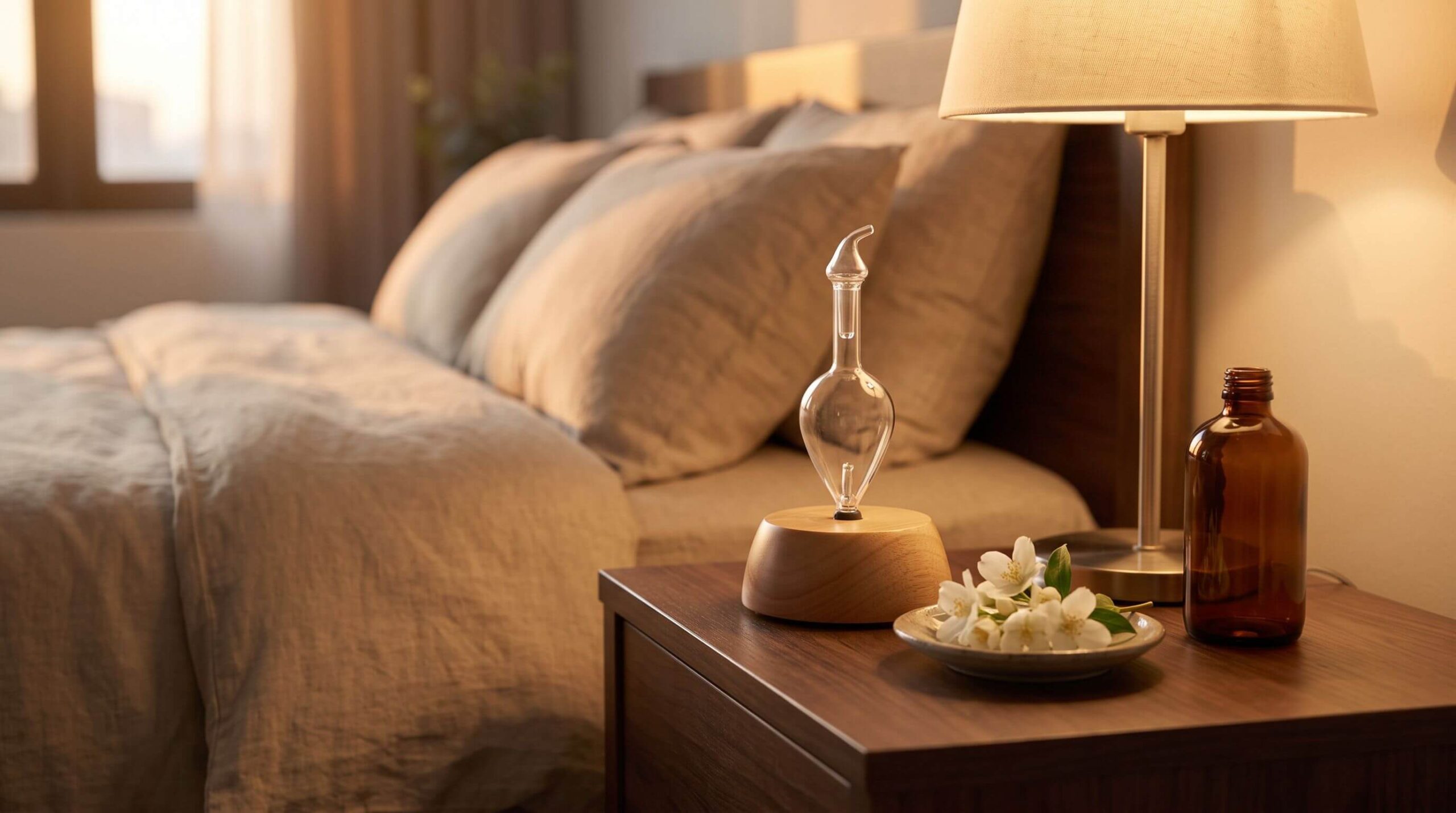
A Nebulizing Diffuser® is the most faithful way to enjoy jasmine in a room, because of how it works. It uses Bernoulli’s Principle: a stream of air across a fine glass tube draws pure oil up and breaks it into a fine mist. There’s no water and no heat. That matters for jasmine in particular. The flowers are made into an absolute precisely because heat destroys their scent, and a heat-based burner undoes that care. An ultrasonic diffuser dilutes the oil in a tank of water and sends the lighter molecules off first. Cold atomization delivers jasmine’s sweet benzyl acetate top and its heavy benzyl benzoate base together, as the blend was made. Our explainer on the Bernoulli’s Principle in waterless diffusion goes deeper.
But jasmine needs a little care, for two reasons.
1. Check the label: many “jasmine oils” are diluted in jojoba
Because genuine jasmine absolute is so costly, it’s very often sold pre-diluted, typically 3 to 10% jasmine in jojoba or another carrier oil, sometimes labeled “jasmine dilute” or in small print on the back. That’s convenient for skin, but carrier oils are the one thing a Nebulizing Diffuser® can’t handle. Jojoba doesn’t atomize like essential oil. It coats the glass and clogs the fine tubes. Never put a carrier-diluted jasmine in a Nebulizing Diffuser®. If the label lists jojoba, fractionated coconut, grapeseed or any carrier, keep it for your skin.
2. Pure jasmine is thick, so always blend it
Undiluted absolute is the opposite problem. With up to a fifth of the oil made of slow-evaporating benzyl benzoate, it’s viscous and sticky, similar to the thicker oils we already flag for extra care, such as vetiver, patchouli, sandalwood and benzoin. Run alone, it can slow the flow and leave residue in the glass.
The fix is simple and fits the indole paradox perfectly: blend jasmine into thinner oils at about 10% or less, as in the recipes above. Citrus oils are ideal partners because they’re thin, bright and help carry the heavier molecules. Or simply use one of our jasmine-containing blends, which are already balanced for nebulizing.
3. Clean after heavy floral sessions
After running jasmine, ylang ylang or patchouli blends, rinse the glass with 70% or stronger isopropyl alcohol so residue doesn’t build up. Our step-by-step guide on how to clean a Nebulizing Diffuser® shows the method, and if the mist ever weakens, our troubleshooting guide walks through the fixes.
The Raindrop Smart Nebulizing Diffuser® is a lovely match for jasmine: you can set short, low-intensity sessions from your phone, so the room stays on the floral side of the indole line. Browse every model in our handcrafted Nebulizing Diffuser® collection.
Jasmine safety, honestly
Jasmine is gentle in the air but deserves respect on the skin. In Essential Oil Safety (2nd edition), Robert Tisserand and Rodney Young class jasmine absolute as a moderate-risk skin sensitizer and suggest a maximum skin concentration of 0.7%, noting that 0 to 1.2% of people with dermatitis reacted when patch tested at 2 to 3%. IFRA, the fragrance industry’s safety body, also sets limits on jasmine because several of its constituents can sensitize. So for skin, keep it well diluted and patch test first. Avoid jasmine during pregnancy unless a qualified practitioner advises otherwise. With pets, diffuse in a well-ventilated room and leave them a way out. Our guide to essential oils around dogs has more.
Jasmine Essential Oil Benefits: Frequently Asked Questions
What are the main benefits of jasmine essential oil?
Jasmine’s best-studied benefit is mood. In human studies, inhaling jasmine raised self-reported alertness, well-being and positive feelings and reduced drowsiness. It also brings a warm, luxurious floral note to blends, and in a Nebulizing Diffuser® it can make a room feel bright and welcoming.
Is jasmine essential oil relaxing or energizing?
The research points to energizing. A 2010 study found jasmine increased markers of arousal and made people feel more alert and vigorous, and a 2013 inhalation study found more alert brain-wave activity and less drowsiness. It’s better suited to mornings, creative time and social evenings than to bedtime.
Why does jasmine sometimes smell unpleasant?
Indole. Jasmine contains roughly 1.5 to 2.7% indole, a molecule that smells floral at a trace and animal or fecal at higher concentrations. Using less jasmine in a blend, and diffusing in short sessions, keeps it on the floral side.
What is the difference between jasmine sambac and grandiflorum?
Grandiflorum is the classic perfume jasmine, warmer and more indolic, rich in benzyl acetate and benzyl benzoate. Sambac is the night-blooming jasmine of jasmine tea, fresher, greener and fruitier, with more linalool and a grape-like methyl anthranilate note.
Can I put jasmine oil in a Nebulizing Diffuser®?
Yes, if it’s pure and blended. Never use jasmine diluted in jojoba or any carrier oil, which will clog the glass. Pure jasmine absolute is thick, so blend it at about 10% or less into thinner oils like sweet orange or bergamot, and clean the glass with isopropyl alcohol afterward.
Why is real jasmine oil so expensive?
The flowers are picked by hand, at night or before dawn, and the yield is tiny, so it takes a great many blossoms to make a small amount of absolute. That cost is also why cheaper “jasmine” products often rely on synthetic Hedione and benzyl acetate instead.