

The Metallic Smell on Your Hands After Polishing Silver Isn’t the Metal
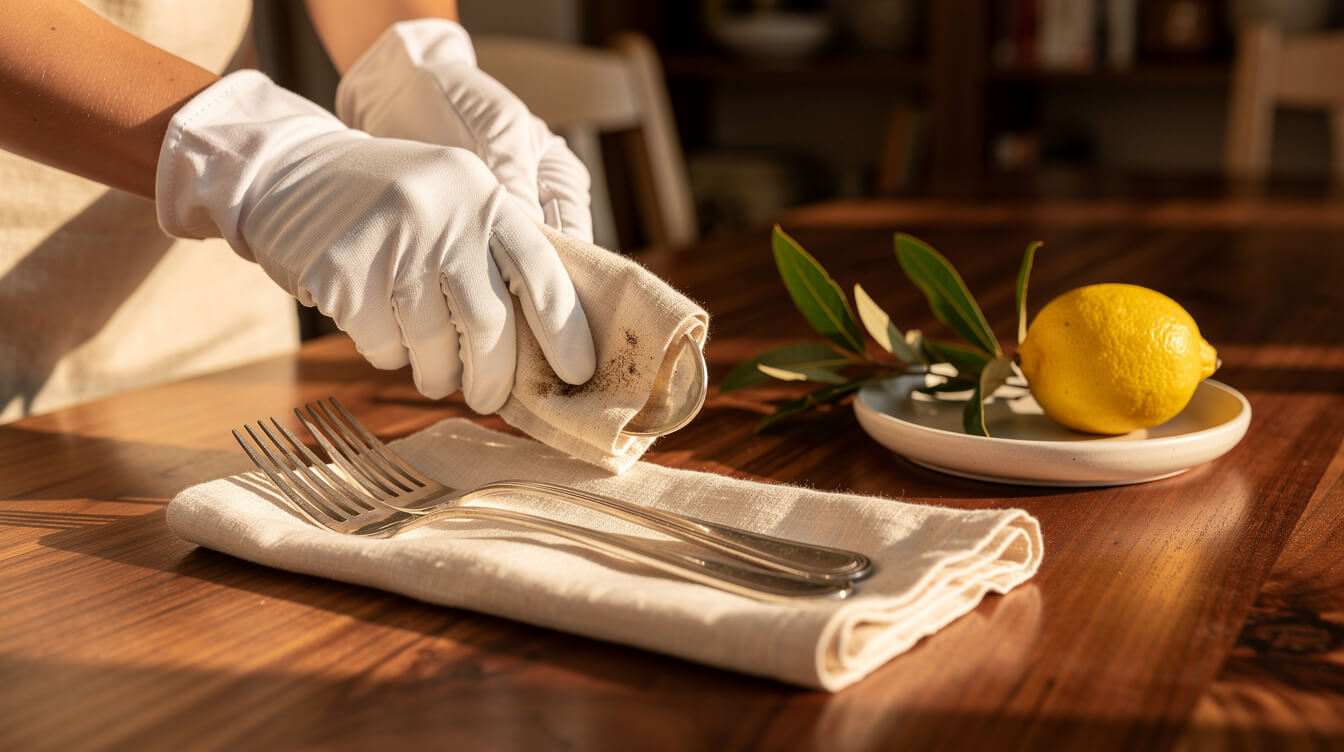
The week before Thanksgiving, the flatware box comes down from the top shelf. You sit at the dining table with a soft cloth and the good spoons, and by the time the last fork shines your fingertips carry a smell you’d swear was the silver itself: sharp, coppery, a little like a handful of coins.
The Smell Isn’t the Metal. It’s Your Skin
Metals don’t give off scent molecules at room temperature, so a spoon has no smell of its own. In 2006 a Virginia Tech team led by Dietmar Glindemann and Andrea Dietrich published the explanation in Angewandte Chemie. Seven volunteers handled iron, and the researchers captured the air just above their skin. When iron touches skin, it rapidly breaks down the oxidized oils sitting on its surface. One of the fragments is 1-octen-3-one, a molecule people can smell even in very small amounts. It reads as mushroomy and metallic. In other words, the “metal” smell is your own skin, rearranged in an instant. The team’s press materials say copper triggers the same reaction, and sterling silver is 7.5% copper. That’s also why a scraped knee smells metallic: blood carries iron, and it produces the same molecules.
Tarnish Has a Smell Story Too
The black film on your silver doesn’t come from age. It’s silver sulfide, formed when silver meets sulfur gases in the air. The Canadian Conservation Institute notes that a freshly cooked hard-boiled egg can tarnish silver within minutes, not months. Rubber bands, wool and felt add sulfur too. So polish on Wednesday, and keep the deviled eggs well away from the serving spoons. The conservators’ other tip helps your nose as much as your silver: wear plain cotton gloves. Your fingerprints stay off the silver, and the metallic smell stays off your hands.
The Polishing Hour: 3 Drops Lemon, 2 Drops Cedarwood, 1 Drop Bay Laurel
Lemon is the brightness every well-kept dining room seems to smell of. Cedarwood brings in the sideboard and the old wooden drawer the flatware lives in. A single drop of Bay Laurel adds a green, faintly spiced note, the leaf that will soon go into Thursday’s stuffing.
- Add the drops pure and undiluted to your Nebulizing Diffuser®: 3 of Lemon, 2 of Cedarwood and 1 of Bay Laurel.
- Run it on a low, intermittent setting for the length of the polishing session.
- Set it across the room from the table, not beside it. Citrus oils can leave a faint film on polished wood up close (here is why the holiday table needs a little distance).

Sign Up to Get Your FREE Essential Oils e-Book ($9.99 Value)
Here’s to shining spoons, a bright room and hands that smell of nothing but lemon and wood by the time the guests arrive.
Warmly,
Chad