



Bernoulli’s Principle Explained: The Equation, Real Numbers and the Myths
Bernoulli’s principle says that when a fluid speeds up, its pressure drops. That one sentence explains why a perfume atomizer sprays, why a carburetor pulls fuel, why a hurricane can lift a roof, and why a small glass Nebulizing Diffuser® can turn pure essential oil into a fine, fragrant mist without water or heat.
Most explanations stop at that sentence, or jump straight to airplane wings and get the wing part wrong. In this guide we do the arithmetic instead. You’ll see the equation in plain English, how big the pressure drop really is at everyday speeds, the family feud behind the name, what Bernoulli does and doesn’t explain about flight, and exactly how fast air has to move to lift essential oil up a glass tube. We sell Nebulizing Diffusers®, so we think about this physics every day. Here’s what we’ve learned.
What Is Bernoulli’s Principle?

Picture air or water flowing along a path. Bernoulli’s principle says that along that path, a fluid’s speed and its pressure trade off against each other. Where the flow speeds up, its pressure falls. Where it slows down, its pressure rises. Nothing mysterious is happening. It’s conservation of energy, applied to a moving fluid.
Think of each small parcel of fluid as carrying an energy budget. Some of that budget is pressure, some is motion and some is height. The total stays fixed, so if the parcel spends more of it on speed, less is left over as pressure. When air rushes through a narrow gap, it has to speed up to get through, and the pressure in that gap drops below the pressure of the still air around it.
The Bernoulli equation, term by term
Written out, the equation looks like this:
p + ½ρv² + ρgh = constant (along a streamline)
p is the static pressure, the pressure you’d feel if you moved along with the flow.
½ρv² is the dynamic pressure, the energy of motion. ρ (rho) is the fluid’s density and v is its speed.
ρgh is the energy of height. g is gravity and h is how high the fluid sits.
Notice that speed is squared. Double the speed and the dynamic pressure goes up four times. That squared term is why small changes in airflow make such a big difference, from wind on a roof to the dial on a Nebulizing Diffuser®.
The fine print: when the equation holds
The simple form works when the flow is steady (not gusting), the fluid is effectively incompressible, friction inside the fluid is small, and you compare points along the same streamline. Air counts as incompressible for this purpose up to roughly 100 m/s, about a third of the speed of sound, which covers almost everything in a home. Break those conditions and you need fuller tools, which is where many of the popular myths come from.
How Big Is the Pressure Drop? Bernoulli’s Principle in Real Numbers
Every competitor page says “faster air means lower pressure.” Almost none says how much lower. Here’s the dynamic pressure, ½ρv², for air at sea level (density about 1.2 kg/m³). It’s the most pressure that speed can “spend”. For comparison, normal atmospheric pressure is about 101,325 pascals (Pa).
5 m/s (11 mph), a gentle breeze: about 15 Pa
10 m/s (22 mph), a fresh wind: about 60 Pa
28 m/s (62 mph), a hand out a car window at highway speed: about 460 Pa
50 m/s (112 mph), a major hurricane: about 1,500 Pa
Even the hurricane figure is only around 1.5% of atmospheric pressure. That sounds tiny until you multiply it by area. Spread 1,500 Pa across a 100 m² roof and you get about 150,000 newtons of force, roughly the weight of 15 tonnes. Real roof loads depend on shape, gusts and where the flow separates, which is why engineers work from building codes rather than one formula. But the order of magnitude explains why storms peel roofs upward: the fast wind above lowers the pressure outside while the still air in the attic pushes up.
The Venturi effect: squeeze the pipe, speed the flow
The other half of the story is the continuity rule. In a pipe, the same amount of fluid has to pass every point each second, so area times speed stays constant. Halve the cross-section and the flow goes twice as fast. Because speed is squared in Bernoulli’s equation, that throat now carries four times the dynamic pressure, and its static pressure drops accordingly. This narrowing trick is called the Venturi effect, after the Italian physicist Giovanni Battista Venturi, who studied it in 1797. It’s the engine inside carburetors, flow meters, perfume atomizers and every nebulizer, including the one we explain in our guide to how a Nebulizing Diffuser® works.
Try it at home with two drinking straws and a glass of water. Stand one straw upright in the water. Hold the second straw level, with its open end just above, and just short of, the top of the upright straw. Blow hard. The fast air skimming over the upright straw lowers the pressure at its tip, water climbs the straw, and your breath shreds it into a spray. You’ve just built the simplest atomizer there is.

Sign Up to Get Your FREE
e-Book ($9.99 Value)
Who Discovered It? Daniel Bernoulli, a Backdated Book and Euler’s Equation

The principle is named after Daniel Bernoulli (1700 to 1782), a Swiss mathematician and physician from one of the most gifted, and most quarrelsome, families in the history of science. He did most of the work while teaching in St Petersburg and published it in 1738 in his book Hydrodynamica. The title gave us the word “hydrodynamics”.
According to the MacTutor history of mathematics archive, the book contained the first correct analysis of water flowing out of a hole in a container, built on the conservation of energy he had studied with his father. Chapter 10 also sketched the basis of the kinetic theory of gases, a century before it became mainstream physics.
A father who backdated his book
Here’s the part most histories leave out. Daniel’s father, the celebrated mathematician Johann Bernoulli, then published his own book on the subject, Hydraulica. MacTutor describes it as largely based on his son’s work. Johann dated it 1732, though it actually appeared around 1739, which made it look as if Daniel had borrowed from him. The historians call it a disgraceful attempt to take credit for his son’s work. Daniel, for his part, had signed the title page of Hydrodynamica as “son of Johann,” apparently trying to make peace.
Euler wrote the equation
One more twist. Daniel showed that pressure drops as flow speeds up, but the tidy equation above isn’t his. His friend and former St Petersburg colleague Leonhard Euler derived the equation in its familiar form in 1752. Euler had a gift for turning Daniel’s physical insights into rigorous mathematics, and the two corresponded for years.
The idea spread into instruments quickly. In 1732 the French engineer Henri Pitot described a bent tube for measuring the speed of the river Seine, the ancestor of the airspeed probe on every airliner. Venturi’s experiments followed in 1797. Then came the medical nebulizers and perfume atomizers of the 1800s, a lineage we trace in our history of aromatherapy.
Bernoulli’s Principle and Airplane Wings: What’s True and What’s a Myth
Most people meet Bernoulli’s principle in a diagram of a wing, usually with the explanation the old version of this page also gave. The curved top is longer than the flat bottom, it says, so air going over the top must travel faster to “meet up” with the air underneath at the back edge. That faster air has lower pressure, and the wing is lifted.
The physics in the last sentence is right. The reason given for the faster air is wrong. NASA’s Glenn Research Center calls this the “equal transit time” theory and lists it among the most widely circulated incorrect explanations of lift. Three facts sink it:
Nothing makes the air meet up. No law of physics says two neighboring parcels of air must reach the back of the wing at the same moment.
The real air is much faster than the myth predicts. In a 2003 paper in Physics Education, Cambridge engineer Holger Babinsky released pulses of smoke in a wind tunnel. The pulse over the top of a lifting wing reached the trailing edge well before the pulse underneath. The air never meets up.
Flat and upside-down wings fly. A paper airplane’s wing is a flat sheet with equal top and bottom lengths, and aerobatic planes fly inverted, with the “longer” surface underneath.
So what does create lift?
A wing set at a slight angle, often with some curve, turns the airflow downward. Bending the flow like that requires a pressure difference: lower pressure above the wing, higher pressure below. Bernoulli’s equation describes how speed and pressure relate within that bent flow. Newton’s third law describes the same event from the other side: the wing pushes air down, so the air pushes the wing up. They aren’t rival theories. They’re two accounts of one pressure field.
Where pilots really use Bernoulli’s equation
The clearest aviation application is the pitot tube, Henri Pitot’s idea in miniature. A forward-facing probe senses total pressure, a side port senses static pressure, and Bernoulli’s equation turns the difference into airspeed. When ice crystals temporarily blocked the pitot probes on Air France Flight 447 in June 2009, the crew lost reliable airspeed readings. France’s air accident bureau (BEA) named that obstruction as the event that began the accident sequence. It’s a sobering reminder of how much modern flight relies on this 18th-century equation.

Join Now and Get a Coupon for 10% Off!
Inside a Nebulizing Diffuser®: Bernoulli’s Principle You Can Smell
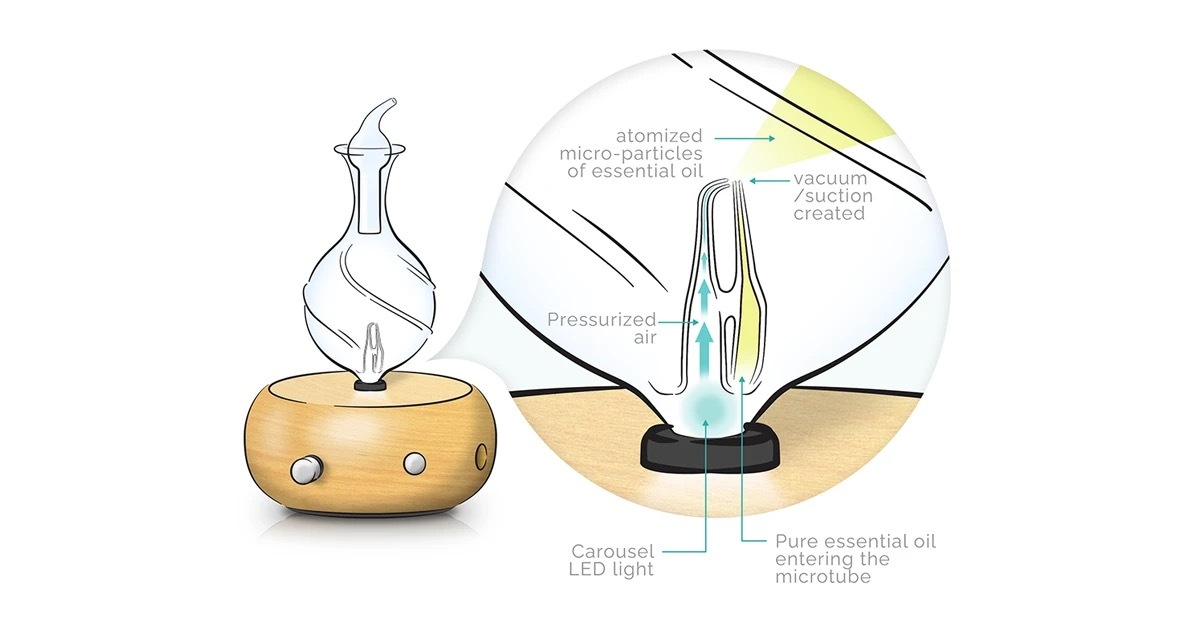
A Nebulizing Diffuser® is the Venturi effect built in glass. The diagram above shows our Radiance. A small pump in the wooden base pushes pressurized air up one fine glass microtube. A second microtube sits right beside it, its lower end in the essential oil. As the air jet leaves its tube, it races across the tip of the oil tube and creates the low-pressure zone Bernoulli predicted. Atmospheric pressure on the oil’s surface then pushes oil up the second tube, and the same fast jet tears it into a cloud of micro-particles. There’s no water to dilute it, no heat to change it and no plastic in the oil path. Our waterless guide covers why that matters for the oil itself.
How fast does the air have to move?
Here’s a calculation we haven’t seen anywhere else. To lift a liquid a height h, the suction at the tube tip has to beat the weight of the column, which equals ρgh. Essential oils weigh about 0.9 g/ml. Setting that equal to the air’s dynamic pressure gives the minimum jet speed in a perfect, frictionless world:
Lift oil 1 cm: about 88 Pa of suction, which needs air at about 12 m/s (27 mph)
Lift oil 3 cm: about 265 Pa, which needs about 21 m/s (47 mph)
Lift oil 5 cm: about 441 Pa, which needs about 27 m/s (61 mph)
Real devices need more than these idealized figures, because a jet never turns all of its speed into suction at the tip, and breaking oil into fine droplets takes extra energy. Even so, the numbers explain two things owners notice. First, the air leaving that tiny glass tube is moving at a gale’s pace, which is why you can feel a crisp stream at the top of the glass. Second, the required suction rises in a straight line with lift height. That’s one reason output can change as the oil level falls, and why the fill guidance in our guide to using a Nebulizing Diffuser® matters.
Why a slightly clogged tube fails so dramatically
Once the oil is moving, a second law takes over. Flow through a narrow tube follows the Hagen-Poiseuille equation: the flow rate rises with the pressure difference, falls with the oil’s viscosity, and scales with the fourth power of the tube’s radius. That fourth power is brutal. A film of residue that narrows the bore by 20% cuts the flow by about 59% (0.8 to the fourth power is 0.41). Halve the radius and the flow drops to one-sixteenth.
That’s why a Nebulizing Diffuser® can go from a healthy mist to almost nothing over a few weeks of thick oils, and why a short alcohol rinse brings it right back. Our step-by-step guide to cleaning a Nebulizing Diffuser® covers the routine, and our troubleshooting guide covers the other causes. It’s also why carrier oils, which are many times thicker than essential oils, never belong in a nebulizer, as we explain in our guide to carrier oils.
If you’d like to see the principle at work on your own shelf, the Radiance Nebulizing Diffuser® is the unit in the diagram, hand-blown Pyrex glass on a real wood base with a soft carousel light. For a broader comparison with water-based units, see nebulizing vs ultrasonic.

An 18th-Century Equation, Handcrafted in Glass and Wood
Our Nebulizing Diffusers® of real wood and medical-grade Pyrex glass use Bernoulli’s principle to release pure, undiluted essential oil. No water, no heat, no plastic in the oil path.
Everyday Examples of Bernoulli’s Principle (and Three Things It Gets Blamed For)
Once you know what to look for, you’ll find the principle all over your home and town:
Perfume atomizers and spray guns. A squeeze bulb or compressor blows air across a dip tube, and the pressure drop lifts and shreds the liquid, the same way your straws did.
Carburetors. Older engines narrow the intake into a Venturi throat. The fast air there has low pressure, which draws fuel from a jet and mixes it into the airflow.
Chimneys and roof vents. Wind blowing across the top of a chimney lowers the pressure at its mouth and helps pull smoke up and out. That’s one reason fireplaces often draw better on a breezy day.
Flow meters and pitot tubes. Water utilities, HVAC technicians and aircraft all measure flow by reading the pressure difference that speed creates.
Roofs in a storm. As the numbers above show, fast wind over a roof lowers the pressure outside, and the calmer air inside pushes up.
Three things Bernoulli usually gets blamed for
The shower curtain that clings to your legs. The textbook answer is that the fast-moving spray lowers the pressure inside the shower. In 2001, University of Massachusetts engineer David Schmidt modeled the shower on a computer and found something more interesting: the spray sets up a sideways vortex, like a small hurricane on its side, and the low pressure at its center pulls the curtain in. The work won him the 2001 Ig Nobel Prize in Physics. It happens with a cold shower too, so warm air rising can’t be the whole answer either. For more on the bathroom, see our guide to essential oils in the shower.
The paper strip that rises when you blow over it. This classroom demo is often credited to Bernoulli, but air leaving your mouth is already at roughly room pressure. The strip rises mainly because the airflow follows the paper’s curve, and bending a flow requires lower pressure on the inside of the bend. It’s related physics, just not “faster air, lower pressure” in the simple sense.
The equal-transit wing. As we saw above, the faster air over a wing is real, but the “air has to meet up” reason is not.
None of this makes Bernoulli’s principle wrong. It means the equation is a precise tool with conditions attached, not a slogan to stick on anything that moves. Used properly, it’s one of the most practical ideas in physics, and one of the few you can smell.

Join Our Exclusive Member Club to get Big Discounts!
Bernoulli’s Principle: FAQ
What is Bernoulli’s principle in simple terms?
Bernoulli’s principle says that when a fluid such as air or water speeds up, its pressure drops, and when it slows down, its pressure rises. It’s conservation of energy for a moving fluid: the energy spent on speed comes out of the energy stored as pressure.
What is the Bernoulli equation?
Along a streamline in steady, incompressible, low-friction flow, p + ½ρv² + ρgh stays constant. Here p is pressure, ρ is density, v is speed, g is gravity and h is height. Because speed is squared, doubling the speed quadruples the dynamic pressure.
Is Bernoulli’s principle why airplanes fly?
Partly. A wing turns the airflow downward, which creates lower pressure above the wing and higher pressure below it. Bernoulli’s equation describes that pressure difference and Newton’s third law describes the same event as a push on the air. The popular equal-transit-time explanation, where air must meet up at the trailing edge, is a myth.
What are examples of Bernoulli’s principle in everyday life?
Perfume atomizers, spray guns, carburetors, pitot tubes that measure airspeed, Venturi flow meters, chimney draft on a windy day, storm winds lifting roofs, and Nebulizing Diffusers®, which use a fast air jet to draw essential oil up a glass tube and turn it into a fine mist.
Who discovered Bernoulli’s principle?
The Swiss mathematician Daniel Bernoulli published the idea in Hydrodynamica in 1738. Leonhard Euler derived the equation in its usual modern form in 1752. Daniel’s father Johann published a similar book, Hydraulica, and dated it 1732, even though it appeared around 1739.
How does a Nebulizing Diffuser® use Bernoulli’s principle?
A small pump pushes air through one glass microtube. The fast jet passes over the tip of a second tube that sits in essential oil, and the pressure drop draws the oil up and breaks it into micro-particles. No water or heat is involved. In an idealized calculation, lifting oil 3 cm takes an air jet of about 21 m/s (47 mph).
Bernoulli’s principle started as a doctor’s insight about water pouring from a hole in a tank and became one of the most useful ideas in engineering. It measures the speed of airliners, lifts fuel into engines, and in a Nebulizing Diffuser® it lifts a few drops of lavender or cedarwood into the air of your living room, using nothing but moving air and a little glass.