

Roman Chamomile Essential Oil: Why Its Delicate Esters Don’t Survive Most Diffusers
Roman chamomile essential oil smells like a green apple sliced open in a warm hayloft: soft, fruity, a little honeyed, and quietly calming. Most guides stop there and move straight to a list of uses. But what makes this oil smell the way it does is an unusually fragile group of molecules, and how you diffuse it decides whether you actually smell them or a flatter, duller version of the oil you paid for.
Roman chamomile is mostly esters, the same family of compounds that gives ripe fruit its aroma. Esters react to heat and water in ways most aromatherapy content never mentions. In this guide we’ll explain what that ester profile is, how Roman chamomile differs from its inky-blue German cousin, what heat and water do to it in a diffuser, and how to get the most from it in a Nebulizing Diffuser®. We finish with four blends, a buying checklist, and answers to the most common questions.
What Is Roman Chamomile Essential Oil?
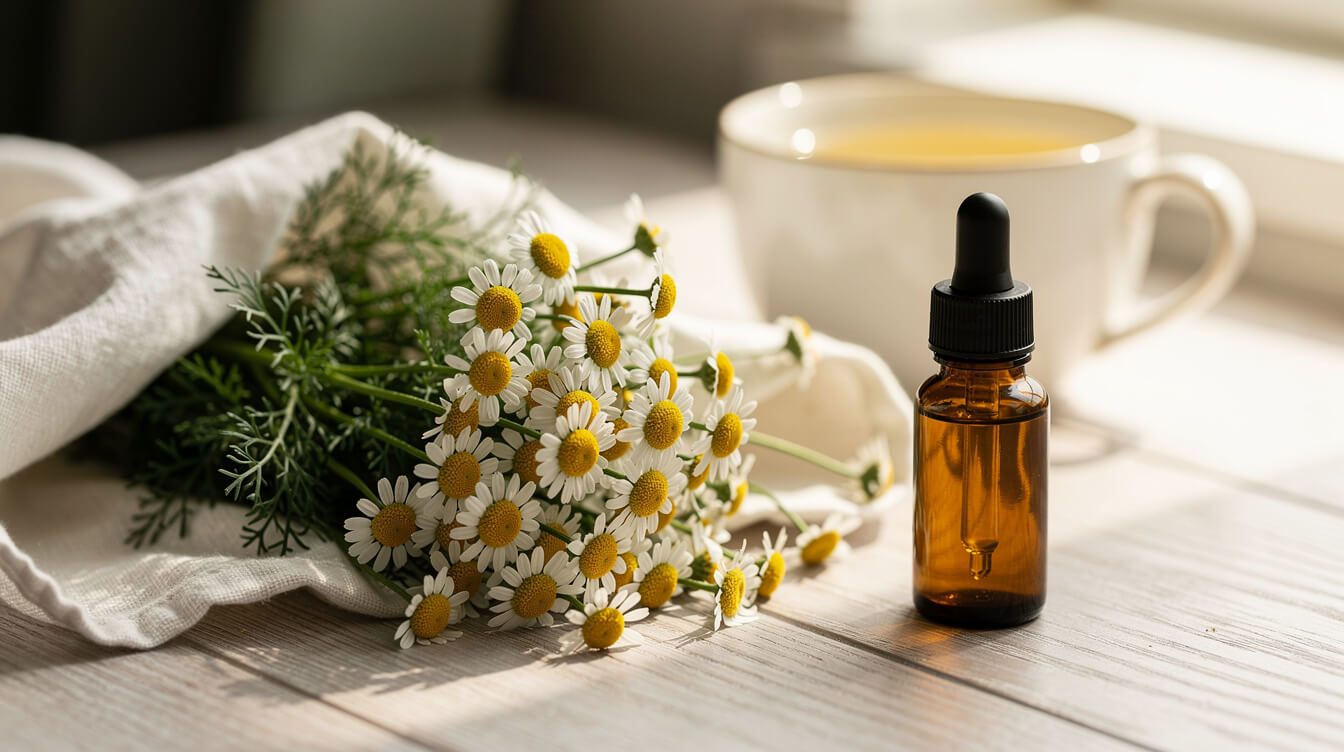
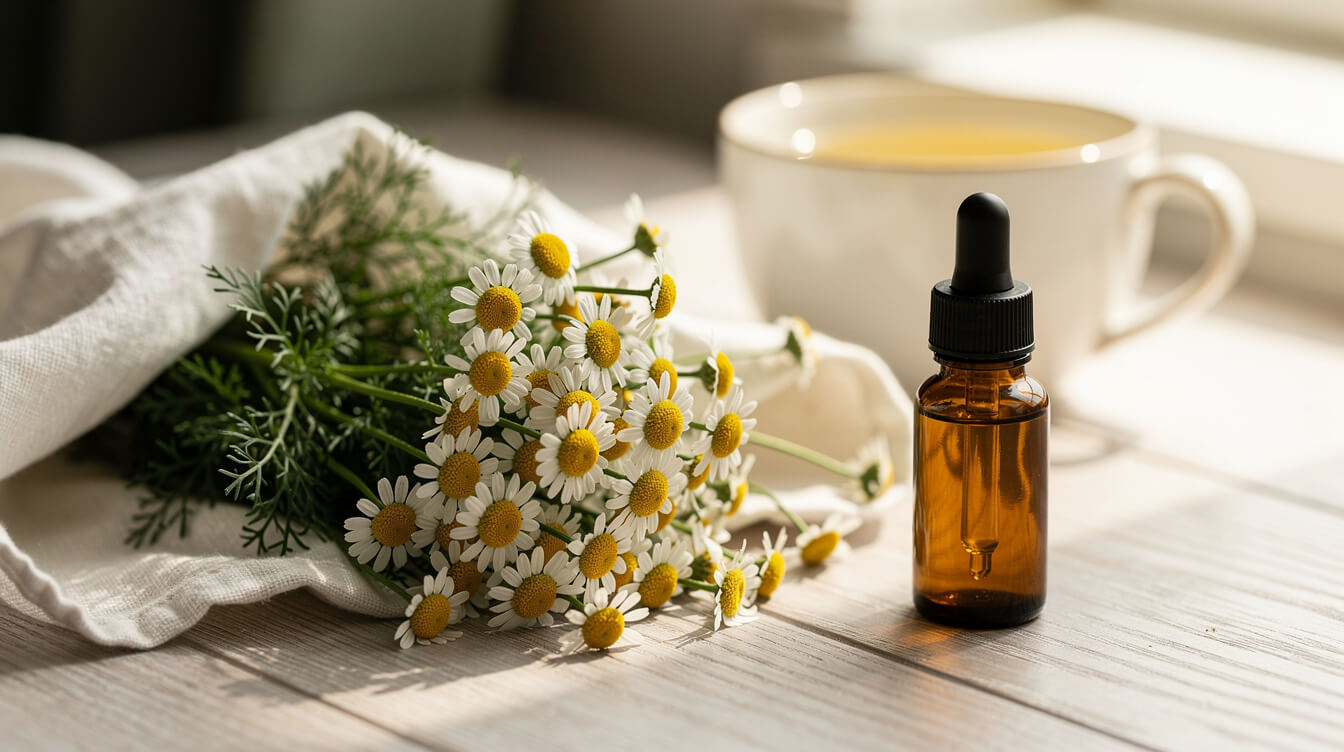
Roman chamomile (Chamaemelum nobile, still often labelled by its older name Anthemis nobilis) is a low, creeping perennial in the daisy family. It has feathery leaves and small white flowers with solid, domed yellow centers. It grows so close to the ground that English gardeners have planted it as a lawn for centuries. A non-flowering variety called ‘Treneague’ is still sold for exactly that purpose, and a chamomile lawn releases its scent every time someone walks across it.
That scent is where the name comes from. “Chamomile” traces back to the Greek khamaimēlon: khamai, “on the ground,” and mēlon, “apple.” The ancient Greeks named this plant “earth apple” more than two thousand years before anyone could explain the chemistry behind the smell. Today we can: the apple note comes from esters, and Roman chamomile is one of the most ester-rich essential oils in aromatherapy.
The oil is steam-distilled from the flowering tops. It’s typically pale straw-yellow, sometimes with a faint blue or green tint when freshly distilled that fades with time. Supplier Eden Botanicals describes it as “powerfully diffusive” with green-apple-peel and pear notes and a “strong odor intensity,” and advises using it sparingly. Remember that last point. It matters when we get to diffusing.
The Ester Story: What 75–80% Esters Means for the Way It Smells
Most essential oils are dominated by terpenes: the limonene in citrus peels, the pinene in conifers. Roman chamomile is different. In the French aromatherapy reference L’Aromathérapie Exactement, Pierre Franchomme and Dr. Daniel Pénoël put esters at up to 80% of the oil. The two leading compounds are isobutyl angelate and 2-methylbutyl angelate, which together often make up roughly 35–45% of the oil. The rest is a long tail of related angelates, tiglates, butyrates and methacrylates.
Why esters smell like fruit
An ester forms when an acid and an alcohol join and give off a molecule of water. Many of these combinations smell fruity. Isoamyl acetate is the smell of bananas, ethyl butyrate is pineapple, and methyl anthranilate is grape. Roman chamomile’s angelate esters fall in the same family, which is why the oil reads as apple, pear and warm hay rather than as “herbal” in the sharp, camphoraceous way many green oils do. It’s also why perfumers prize it for soft, tea-like fruit accords.
The “angelic” acid
The acid half of those angelate esters has a lovely history. Angelic acid was first isolated in 1842 by the German pharmacist Ludwig Andreas Buchner from the root of garden angelica (Angelica archangelica), the “herb of the angels,” and it was named after that plant. Angelic acid has a twin called tiglic acid, named after the croton plant Croton tiglium. They contain exactly the same atoms arranged in a slightly different shape (chemists call them geometric isomers), and they don’t smell the same. Angelic acid is the less stable of the two. Given enough heat, or contact with acids, it tends to flip into the tiglic form. Remember that for the next sections.
The practical takeaway: Roman chamomile’s character lives in its esters. Keep them intact and you get the full apple-and-honey softness. Change them, and the oil drifts toward sour, flat, or simply “hay.” It’s the same principle behind the linalool-to-linalyl-acetate balance we explored in our lavender for sleep guide. Lavender’s calming softness is also largely an ester, linalyl acetate.
Sign Up to Get Your FREE
e-Book Here…
Roman vs. German Chamomile: Why One Oil Is Blue
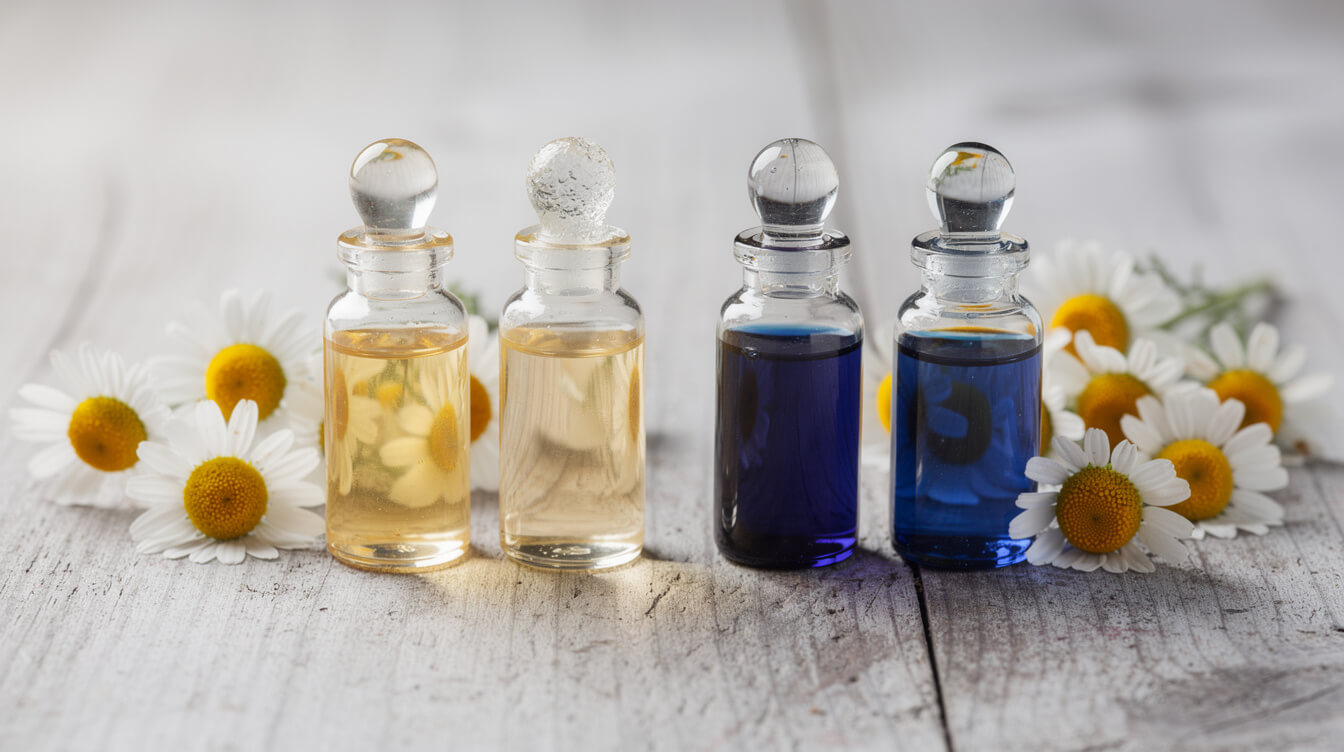
“Chamomile” on a label can mean two different plants with almost opposite chemistry, and the difference is visible in the bottle.
Roman chamomile (Chamaemelum nobile) is a perennial ground cover with solid flower centers. Its oil is pale yellow, ester-dominant, and fruity-sweet. It’s the one people describe as “apple-like.”
German chamomile (Matricaria chamomilla, also sold as M. recutita) is an upright annual with hollow, cone-shaped centers. It’s the chamomile in most tea bags. Its oil contains very few esters. It’s dominated by sesquiterpenes such as α-bisabolol, its oxides, and chamazulene, which gives the oil a striking ink-blue color and a heavier, herbaceous, slightly medicinal aroma.
The blue is made in the still
This is the detail that tells you the most about chamomile chemistry. Fresh German chamomile flowers contain no chamazulene at all. They contain a colorless precursor called matricin. Only during steam distillation do heat, water and the slightly acidic conditions in the still break matricin down and convert it into blue chamazulene. That famous blue is a product of heat and water acting on fragile molecules. Chamazulene itself keeps changing afterwards: exposed to air and light, it oxidizes, and old German chamomile oil drifts from blue to green to brown.
Roman chamomile doesn’t turn blue, but it’s sensitive in its own way. The same conditions that create German chamomile’s color, heat plus water, are exactly the ones that put Roman chamomile’s esters at risk. Distillers handle that carefully once. A badly chosen diffuser can undo it every evening.
If you want a deeper look at how different extraction methods shape an oil’s chemistry, our guide to absolutes versus steam-distilled essential oils covers the floral side of the story.
Why Heat and Water Change Chamomile’s Delicate Profile
Three different things can happen to an ester-rich oil inside a diffuser. It helps to separate them, because they work on different timescales, and honesty matters here.
1. Hydrolysis: the ester comes apart
Making an ester releases water, and adding water back can reverse it. In hydrolysis, water splits an ester into its original acid and alcohol. For isobutyl angelate, that means angelic acid (sharp and sour-smelling) plus isobutanol (a solvent-like, fusel note). At room temperature and neutral pH this is slow, and a single evening in water won’t wreck your oil. Heat speeds it up considerably, though: as a rough chemistry rule of thumb, reaction rates about double for every 10°C (18°F) rise. A warm water bath is the worst combination: plenty of water, plus heat.
2. Isomerization: angelate becomes tiglate
As mentioned above, angelic acid is the less stable twin, and heat nudges angelate structures toward the tiglate form. Tiglates are pleasant molecules, but they aren’t the same smell. A heat-based diffuser that runs for hours is gently pushing the oil in a direction the plant didn’t choose.
3. Fractionation: the light notes leave first
This is the effect you’re most likely to notice within a single session, and it has nothing to do with chemistry breaking down. It’s about evaporation. Any diffuser that relies on evaporating oil, such as a tealight burner, an electric heat diffuser, a reed stick, or a fan pad, releases the most volatile molecules first. Roman chamomile’s light, fruity esters go first, and the heavier sesquiterpenes and waxy compounds stay behind. The first ten minutes smell bright and apple-like, and the last hour smells like dry hay. What’s left on the pad or dish isn’t the oil you started with.
Ultrasonic diffusers avoid heat, but they bring water into the picture. Essential oil doesn’t dissolve in water, so it floats as a thin film on the tank. The vibrating plate produces a mist that’s mostly water vapor carrying oil unevenly, a few drops spread across several hundred milliliters. The ester-rich top notes reach you diluted and fragmented, and the oil sits in a water bath for the whole session. We unpack the volatility side of this in our essential oil blending chart, which explains why heat-based methods break up carefully balanced blends.

Join Now and Get a Coupon for 10% Off!
Diffusing Roman Chamomile Essential Oil: How Nebulizing Preserves the Esters
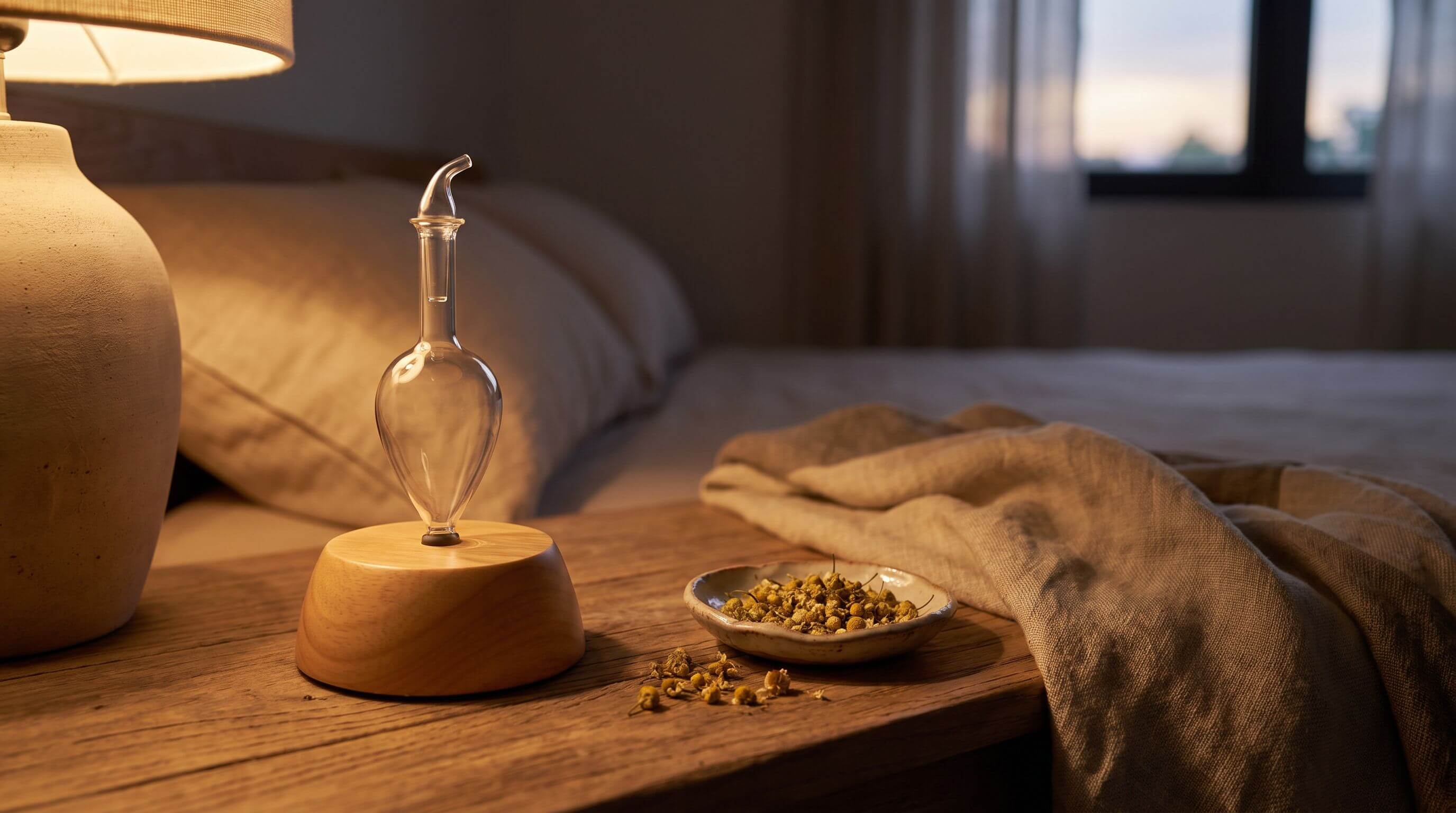
A Nebulizing Diffuser® takes the opposite approach to evaporation. It uses Bernoulli’s Principle: a fast stream of air passes over the top of a fine glass tube, lowering the pressure enough to draw pure oil upward, where the airflow shears it into a micro-fine mist inside the glass reservoir. There’s no water, no heat, and no plastic in the oil path. (Our explainer on waterless diffusion walks through the physics.)
For Roman chamomile, this solves all three problems above. With no water, there’s nothing to hydrolyze the esters. With no heat, nothing pushes angelate toward tiglate or accelerates other reactions. And because the oil leaves as whole liquid microdroplets rather than evaporating molecule by molecule, the light esters and the heavier base notes enter the room together, in the same proportions as in the bottle. The tenth minute smells like the first.
Settings that suit Roman chamomile
Use less than you think. Roman chamomile has a strong odor intensity. Undiluted and nebulized, it can tip from soft apple to overwhelming hay in a small room. Start on the lowest output setting and use interval mode, about 2 minutes on and 1 minute off on classic models, or a gentle schedule in the app on a Smart Nebulizing Diffuser®.
Run it before you need it. For an evening wind-down, run 20–30 minutes in the bedroom while you get ready, then switch it off when you settle in. The scent lingers gently, and you avoid saturating the room overnight.
Easy on the glass. Roman chamomile is a thin, mobile oil, so unlike vetiver, patchouli or sandalwood it isn’t one that clogs micro-tubes. Fresh oil stays fluid. Old, oxidized oil gets thicker, which is one more reason to buy small and use it up. Our guide to cleaning a Nebulizing Diffuser® covers routine care.
Our own Chamomile Essential Oil carries the classic Roman angelate profile (isobutyl and methyl angelate lead its listed constituents) and is ready to go straight into any piece from our handcrafted Nebulizing Diffuser® collection.
Best Times and Pairings for Diffusing Roman Chamomile
Roman chamomile is a soft-spoken oil, which makes it wonderful for transitions: the end of a workday, a slow weekend morning, the half hour before lights out. Our Sunday Reset chamomile ritual and the reading-hour chamomile and sandalwood pause are two of the simplest ways to make it a habit.
When blending, a useful trick is to pair esters with esters. Lavender, bergamot and clary sage are all rich in linalyl acetate, another soft, fruity-floral ester. Blends built on these oils hold together seamlessly, because no single sharp terpene dominates. Ratios below are in parts. Multiply them into a small amber bottle (for example, 3 : 1 : 2 becomes 15 : 5 : 10 drops).
1. Ester Hour: lavender, Roman chamomile, bergamot (3 : 1 : 2)
The classic evening blend, made more cohesive by its shared ester chemistry. Lavender carries the floral body, chamomile adds the apple-and-honey warmth, and bergamot lifts the top so it never feels heavy.
2. Clary Calm: clary sage, lavender, Roman chamomile (2 : 2 : 1)
Earthier and more grounding, with clary sage’s musky, tea-like depth. A lovely choice for a long bath evening or a quiet reading chair.
3. Apple Orchard Hush: sweet orange, Roman chamomile, cedarwood (2 : 1 : 1)
An October blend: bright orange peel, chamomile’s orchard fruit, and a woody cedar floor beneath. It smells like a farm stand at the end of the day.
4. Soft Rose Morning: bergamot, Roman chamomile, geranium (3 : 1 : 1)
Fresh and gently floral, for slow weekend mornings. Geranium adds a rosy note, and its citronellol-geraniol chemistry (see our geranium guide) plays nicely with chamomile’s fruit. For more mood-based combinations, browse our guide to the best scents for your Nebulizing Diffuser®.

Join Our Exclusive Member Club to get Big Discounts!
Buying and Storing Roman Chamomile: A Short Checklist
Roman chamomile is one of the more expensive oils on any shelf, often four or more times the price of lavender or citrus. That price is exactly why it’s a target for substitution and dilution. Before you buy, check:
1. The Latin name. Look for Chamaemelum nobile or Anthemis nobilis. “Moroccan chamomile” (Cladanthus mixtus, formerly Ormenis multicaulis) is a different, cheaper plant with a different scent profile. It’s a pleasant oil in its own right, but it isn’t Roman chamomile. Unnamed “chamomile oil” at a bargain price deserves a question.
2. The chemistry. A reputable supplier can share a GC/MS report. You want to see angelate esters, chiefly isobutyl angelate and 2-methylbutyl angelate, at the top of the list. If the leading compounds are chamazulene and bisabolol oxides, it’s German chamomile. If esters are oddly low, ask why. Our guide to telling pure oil from synthetic blends covers the wider red flags.
3. The price. A 10 mL bottle of genuine Roman chamomile priced like sweet orange is too good to be true. Pre-diluted “chamomile” in jojoba is fine for skin roll-ons, but it doesn’t belong in a Nebulizing Diffuser®, which is designed for pure, undiluted oil.
4. The bottle and the cap. Dark amber or cobalt glass, a tight cap, and ideally a distillation or batch date.
Storing it so the esters last
Esters are sensitive to moisture as well as heat, so keep the cap tight. Every time humid air gets in, it brings a little water with it. Store the bottle somewhere cool and dark, away from steamy bathrooms and sunny windowsills, and decant a small working bottle if you have a larger one, so the main stock isn’t opened every day. Stored well, Roman chamomile keeps its character for a few years. Our guide to essential oil shelf life explains how to tell when an oil has turned.
A few sensible cautions
Roman chamomile is considered one of the gentler essential oils, but “gentle” isn’t the same as “no rules.” If you’re sensitive to plants in the daisy family, such as ragweed, chrysanthemums or marigolds, take care with any chamomile. Diffuse in a ventilated room, keep sessions intermittent, and always leave a door open so pets can step away; our pet-safe diffusion guide covers cats and dogs in detail. If you’re pregnant or nursing, check with your healthcare provider before using any essential oil. Never ingest essential oils, whatever a label or blog suggests.
Roman Chamomile Essential Oil: Frequently Asked Questions
What does Roman chamomile essential oil smell like?
Sweet, fruity and herbaceous, most often described as green apple, pear and warm hay with a honeyed softness. The fruitiness comes from angelate esters, which make up the majority of the oil.
What is the difference between Roman and German chamomile oil?
They come from different plants with different chemistry. Roman chamomile (Chamaemelum nobile) is pale yellow and ester-rich, with a sweet, apple-like aroma. German chamomile (Matricaria chamomilla) is deep blue from chamazulene, which forms during distillation, and smells heavier and more herbaceous.
Can you put Roman chamomile essential oil in a diffuser?
Yes. A Nebulizing Diffuser® suits it especially well because it atomizes the pure oil without water or heat, so the delicate esters reach the room intact. Because the oil is very aromatic, use a low setting and interval mode.
How much Roman chamomile should I diffuse?
Less than most oils. Start on the lowest output with an on/off interval (about 2 minutes on, 1 minute off) and run for 20–30 minutes. In blends, keep chamomile to about one part in four to six so it softens the blend rather than dominating it.
Why is Roman chamomile oil so expensive?
The plant is small, the oil comes only from the flowering tops, and demand from both aromatherapy and perfumery is high. That price makes it a common target for substitution, so check the Latin name and ask for a GC/MS report.
Is Roman chamomile essential oil safe to diffuse around pets?
It’s generally considered one of the milder oils, but pets, especially cats, process aromatic compounds differently from people. Diffuse intermittently in a ventilated room, never in a closed space with an animal, and make sure pets can always leave the room.
The ancient Greeks called it the earth apple, and that’s still the best description of what this oil can do: fill a room with soft fruit, warm hay and quiet calm. Keep the esters intact by keeping the cap tight, the heat off and the water out. A Nebulizing Diffuser® will deliver Roman chamomile essential oil the way the flowers made it.