


Best Aroma Oil for a Diffuser: How to Tell Pure Oil From Synthetic Blend
Search for the best aroma oil for a diffuser and you get a shopping mall, not an answer. The top results are Amazon starter sets, “fragrance oil best sellers,” and brand roundups that rank bottles by vibe and packaging. Not one of them stops to define what an “aroma oil” actually is — which matters enormously, because that friendly little phrase hides three very different products, and some of them will quietly underperform (or gum up) the machine you bought them for.
Here is the short version, and the through-line of this whole guide: the best aroma oil for a diffuser is not a brand at all. It is a purity standard, matched to the right machine. Get those two things right — a genuinely pure oil, running in a diffuser designed to atomize it — and cheap-looking bottles suddenly outperform glossy “luxury” sets. Below we decode what “aroma oil” really means, how to read a label like a lab tech, the purity checklist smart buyers use, why a nebulizing diffuser is so unforgiving of diluted oils, the best pure single oils to start with, and the cost-per-drop math that flips the price argument on its head.
What “Aroma Oil” Really Means (and the 3 Things It Can Be)
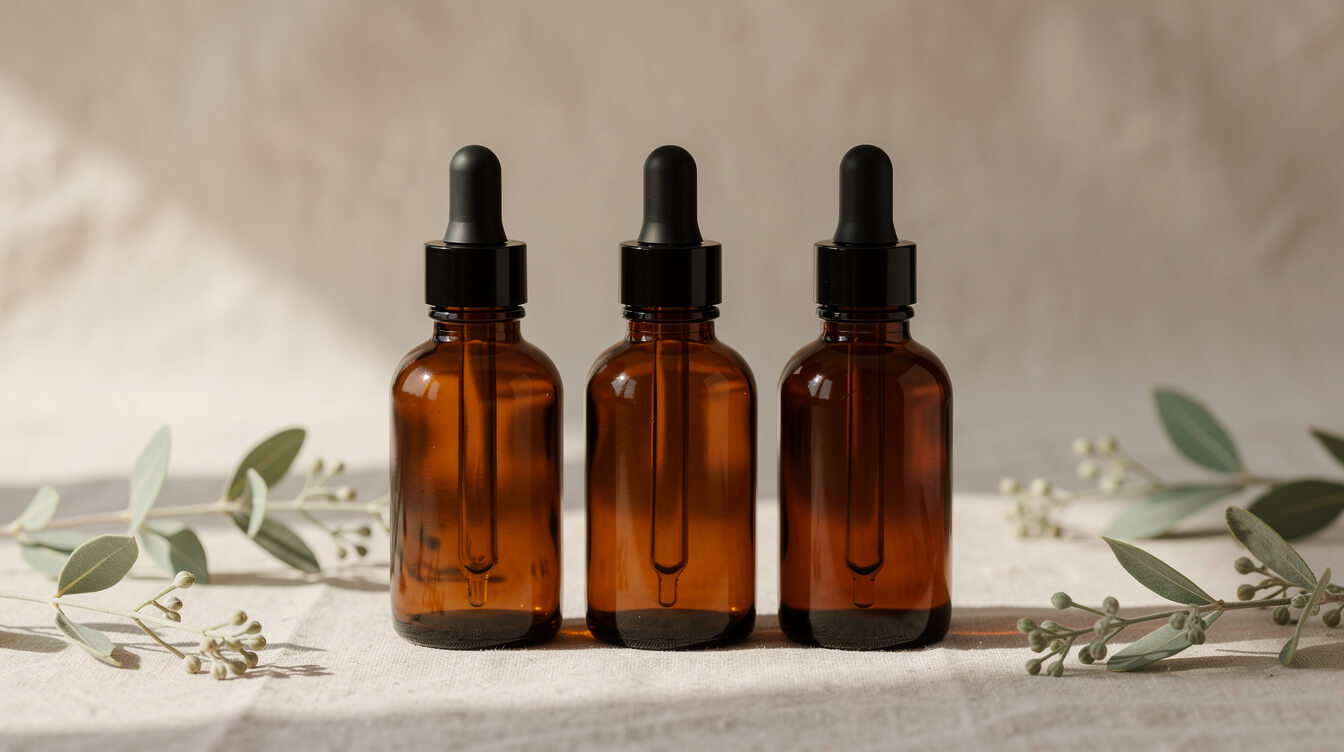
“Aroma oil” is a marketing umbrella, not a regulated term. When a listing uses it, the bottle inside is almost always one of three things — and telling them apart is the single most valuable skill a diffuser owner can have.
1. A pure essential oil
This is the plant, and nothing else: the volatile aromatic compounds steam-distilled or cold-pressed from lavender flowers, peppermint leaves, or lemon peel. A pure essential oil is undiluted and highly concentrated — a single drop of peppermint carries the aromatic punch of a large handful of leaves. It is the only category that belongs, neat, inside a nebulizing diffuser.
2. A synthetic fragrance oil (often sold as “aroma oil”)
This is a lab-built scent — aroma molecules blended in a solvent or carrier to mimic “vanilla,” “ocean,” or “clean cotton,” scents that no plant produces. Hotel-lobby scent brands and many “premium diffuser oil” sets fall here. There is nothing evil about a good synthetic fragrance in a wax melt or a reed set, but it is not an essential oil, it will not deliver the botanical constituents you may be diffusing for, and it can leave a sticky residue in precision hardware. If a “best aroma oil for diffuser” listing never once says essential oil, assume it is fragrance. We dig into exactly this question in our guide to whether you can use fragrance oils in a Nebulizing Diffuser®.
3. A pre-diluted blend
This is a real essential oil already thinned in a carrier — fractionated coconut (MCT), jojoba, or a neutral base — usually to somewhere between 2% and 20% strength. Roll-ons and “ready to use” bottles live here. Pre-dilution is genuinely useful for topical products and for gentler settings, but it is the wrong fuel for a waterless diffuser, where the carrier does not atomize and simply coats the glass. Hold onto that distinction; it decides half your buying choices.
Synthetic Fragrance Oil vs Pure Essential Oil: Spot the Difference on the Label
You rarely need a lab to separate the two. The label usually confesses everything — if you know the tells. Turn the bottle over before you buy.
Red flags that scream “synthetic” or “diluted”
- The words fragrance, parfum, perfume oil, aroma, or nature-identical in the ingredients. In cosmetic labeling, “fragrance/parfum” is a legal catch-all that can hide dozens of undisclosed synthetics.
- A scent no plant makes — “fresh linen,” “birthday cake,” “ocean breeze,” “unicorn.” Botany does not grow those.
- No Latin (botanical) name anywhere on the bottle.
- No country of origin and no extraction method.
- Suspiciously cheap and suspiciously uniform — a six-bottle “essential oil” set for the price of one real bottle of rose or sandalwood is telling you something.
Green flags that signal a genuine essential oil
- A single Latin binomial as the ingredient — Lavandula angustifolia, Mentha piperita, Citrus limon — and nothing else.
- Country of origin (Bulgarian vs French lavender genuinely smell different) and extraction method (steam-distilled, CO2, or cold-pressed).
- A batch or lot number you can trace — and, ideally, a matching GC/MS report.
- Honest language: “100% pure essential oil,” not “made with essential oils” or “essential-oil-infused,” both of which usually mean mostly-something-else.
One quick at-home test settles most doubts: place a single drop on plain printer paper and let it sit for an hour or two. A pure essential oil (with the exception of naturally heavy, resinous oils like sandalwood or patchouli) evaporates and leaves little to no greasy ring. A carrier-diluted or fragrance blend usually leaves an oily halo behind. It is not laboratory-grade, but it is a fast, free gut-check.
Sign Up to Get Your FREE
e-Book Here…
The Purity Checklist Smart Buyers Use (GC/MS, Latin Name, Origin)
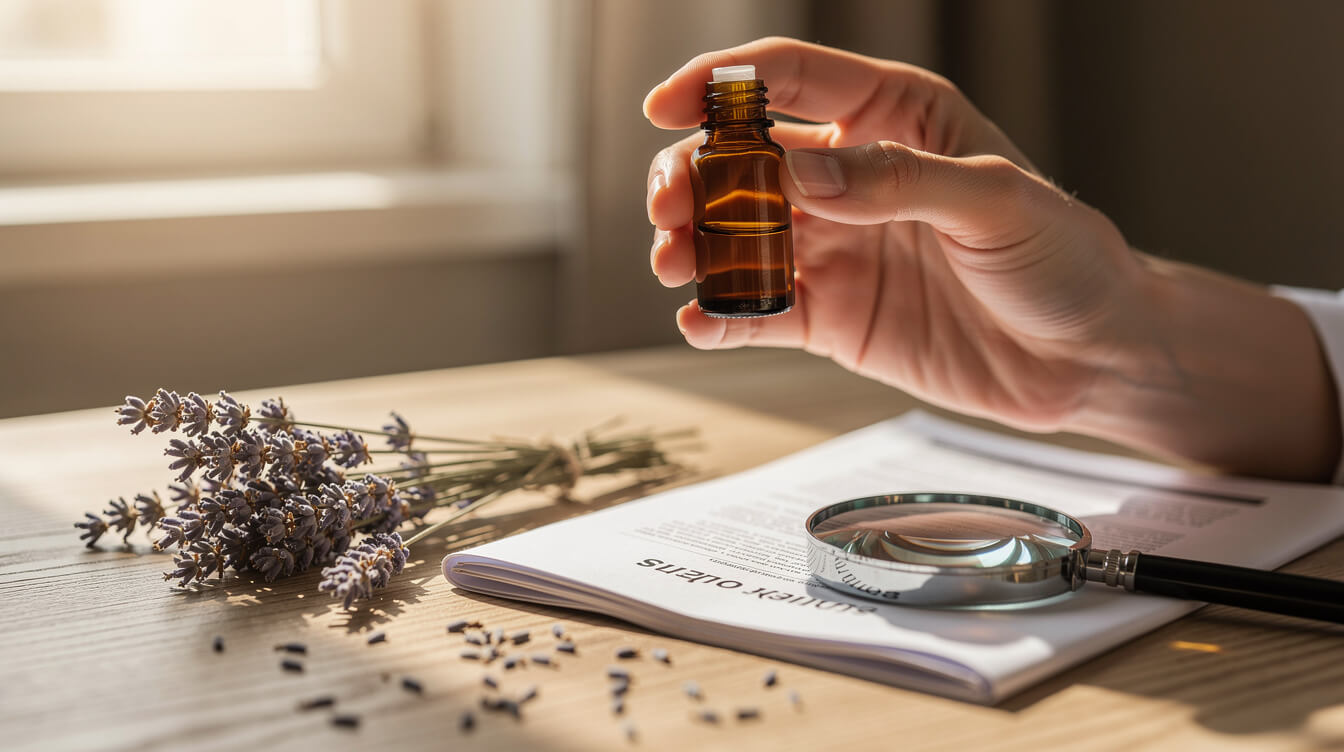
Here is the exact sequence experienced buyers run before they trust a bottle. Treat it as a five-point pass/fail, not a wish list.
- Botanical name. One plant, named in Latin. No binomial, no sale.
- Origin and extraction. Where it grew and how it was pulled from the plant. Reputable sellers publish both.
- A GC/MS report you can actually see. This is the document nearly every roundup skips.
- Batch traceability. The report should tie to the lot number on your bottle, not a generic “typical results” sheet.
- Sensible packaging. Amber or cobalt glass, never clear plastic — light and certain plastics degrade the oil.
How to read a GC/MS report without a chemistry degree
Gas Chromatography–Mass Spectrometry (GC/MS) is the industry’s fingerprinting test. Gas chromatography separates the oil into its individual chemical constituents; mass spectrometry then identifies and measures each one. What you get is a percentage breakdown — and you only need to know the marker compounds for each oil to sanity-check it:
- Lavender (Lavandula angustifolia): roughly 25–45% linalool and 25–45% linalyl acetate. That near-balanced pair is what gives true lavender its soft, rounded calm. A “lavender” oil that is 60% linalool and almost no linalyl acetate is likely spike lavender, lavandin, or synthetically stretched.
- Peppermint (Mentha piperita): typically 30–55% menthol with meaningful menthone. Too little menthol and it is probably cornmint sold as peppermint.
- Lemon (Citrus limon): usually 60–70% limonene, cold-pressed. A “lemon” that is nearly pure limonene with no supporting terpenes may be a reconstruction.
The report also exposes adulteration the nose can miss: added synthetic linalool, phthalate carriers used to “stretch” volume, or a cheaper oil blended in to pad the weight. For a deeper walk through certifications and brand-level transparency, our guide to the best essential oil brands and how to judge real purity pairs perfectly with this checklist.
Match the Oil to Your Diffuser: Why Nebulizing Wants Pure, Undiluted Oil
This is the part almost every “best aroma oil for diffuser” article ignores, and it is the one that saves you money and heartache: the machine decides which oil is actually best. Not every diffuser wants the same fuel.
A Nebulizing Diffuser® uses no water and no heat. It works on Bernoulli’s Principle: a fast stream of air passes over the top of a small glass tube, and the resulting pressure drop pulls neat oil up the tube and shatters it into an ultra-fine, dry mist of pure essential oil. Because there is no water to hide behind and no carrier to atomize, the device is exquisitely sensitive to what you feed it:
- Pure essential oil: atomizes beautifully into a dry aromatic mist. This is what the hardware is built for.
- Pre-diluted blend: the carrier oil is heavier and does not aerosolize cleanly. It coats the glass, dulls the output, and leaves a film you have to clean out.
- Synthetic fragrance oil: can leave a tacky residue, throw off-notes as it breaks down, and shorten the life of the glass condenser.
In other words, a nebulizing diffuser rewards purity and punishes dilution. The exact opposite is true of an ultrasonic unit, which needs oil dispersed in a reservoir of water and is happy with lighter blends — a real trade-off we cover in our complete ultrasonic diffuser guide. There is also a scent-quality payoff: because nebulizing delivers concentrated, unheated oil, it preserves the delicate top notes — that balanced linalool/linalyl-acetate signature in lavender, for instance — instead of watering them down. If you want the mechanics of the waterless approach, see our overview of the waterless diffuser, and if you are still choosing hardware, our buyer’s framework for the best diffuser for essential oils ranks by mechanism, not price.
The practical takeaway: if you own or are eyeing a nebulizing diffuser, your shopping list is short and simple — single-origin, 100% pure essential oils in amber glass. You can shop the Nebulizing Diffuser® collection and pair it with pure oils that let the technology do what it was designed to do.
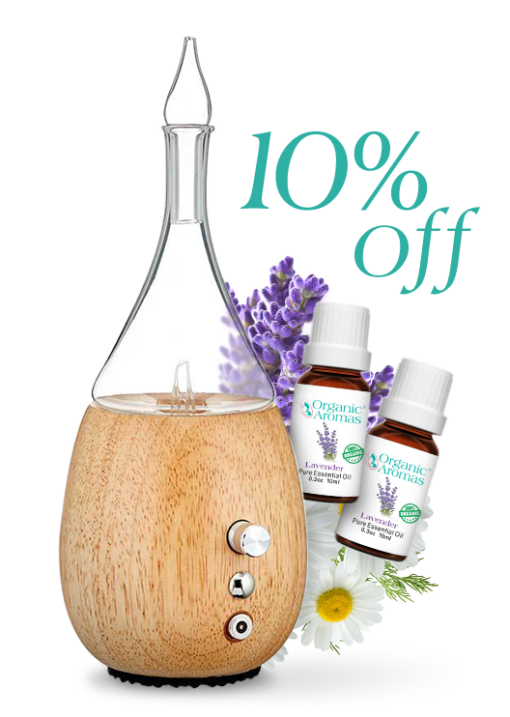
Join Now and Get a Coupon for 10% Off!
Best Pure Single Oils to Start With, by Use

Skip the 12-bottle bargain set. A handful of excellent single oils will out-scent it and teach you far more about what you actually enjoy. Start with pure singles, grouped by the atmosphere you want to create. (These are ambiance and scent suggestions, not health treatments.)
For a calm, wind-down atmosphere
Lavender (Lavandula angustifolia) is the classic for a reason — soft, floral, and grounding. Roman chamomile adds a gentle, apple-sweet warmth, and bergamot (try the bergaptene-free version for evening use) brings a bright citrus lift that keeps lavender from feeling heavy. A drop each of lavender and bergamot is one of the most beloved evening pairings there is.
For a fresh, clean-smelling room
Lemon (Citrus limon) is crisp and instantly brightening; eucalyptus (Eucalyptus globulus) reads clean and open; and a whisper of peppermint makes the whole room feel like a window just opened. This trio is a favorite for kitchens and bathrooms.
For a focused, uplifting workspace
Rosemary (Rosmarinus officinalis) is herbaceous and alert, peppermint is cooling and sharpening, and sweet orange keeps the mood warm and cheerful. Run any of these in short bursts while you work rather than continuously — a few minutes on, a stretch off, is how a nebulizing diffuser is meant to be used.
Once you have a few singles you love, blending is where the fun begins. Our essential oil blending chart shows how top, middle, and base notes fit together, and our reference list of essential oils and their uses is a handy map when you want to branch out.

Join Our Exclusive Member Club to get Big Discounts!
When a Pre-Diluted Blend Makes Sense (and When It Wastes Money)
Pre-diluted “aroma oils” are not a scam — they are simply built for a different job. Knowing which job keeps you from overpaying.
A pre-diluted blend makes sense when you want a roll-on for your wrists or temples, when you are scenting a young child’s or a pet-shared room and want a gentler concentration, when you are traveling and don’t want to handle neat oils, or when your device is an ultrasonic or reed setup that tolerates carriers. In those cases the dilution is doing real work.
A pre-diluted blend wastes money when you are buying it to run neat in a waterless nebulizing diffuser. You are paying essential-oil prices for a bottle that may be 80–95% carrier, the carrier will not atomize, and you will clean gummed glass for your trouble. If the fine print says “in fractionated coconut oil” or “ready to use,” it is a dilution — wonderful for skin, wrong for a nebulizer.
Price vs Value: Why Cheap “Aroma Oil” Sets Cost More Per Usable Drop
The sticker price is the most misleading number on the shelf. What actually matters is cost per usable drop of scent throw — and by that measure, the bargain set is often the expensive one.
Run the math. A $12 set of six 10 ml “aroma oils” looks like a steal next to a $24 bottle of a single pure oil. But if those set bottles are mostly fragrance and carrier, you have to use far more product to get the same scent into the air — and in a nebulizing diffuser, the carrier never truly aerosolizes, so a chunk of every bottle is unusable. The pure oil, by contrast, is concentrated: a nebulizing diffuser sips just a few drops per short session, and because there is no water diluting the output, each drop carries its full aromatic weight. Divide the price by the number of genuinely scent-producing sessions and the “expensive” pure bottle routinely wins.
There is a longevity dividend too. Pure oils used in short bursts last surprisingly long, while synthetic fragrance residue can foul precision glass and shorten hardware life. Buying one excellent oil beats buying six mediocre ones almost every time — your nose, your machine, and your wallet all agree.
Frequently Asked Questions About Aroma Oils and Diffusers
What is the difference between an aroma oil and an essential oil?
“Essential oil” is a specific thing: the pure, volatile aromatic extract of a single plant, with nothing added. “Aroma oil” is a loose marketing term that can mean a pure essential oil, a synthetic fragrance oil, or a pre-diluted blend. Every essential oil can be called an aroma oil, but plenty of “aroma oils” are not essential oils at all. When in doubt, read the ingredient list for a single Latin plant name.
Can you put any aroma oil in a nebulizing diffuser?
No — and this is where most people go wrong. A nebulizing diffuser is designed for neat, 100% pure essential oil. Pre-diluted blends and synthetic fragrance oils contain carriers or solvents that will not atomize, so they coat the glass, weaken the scent output, and leave residue you have to clean. If a bottle lists a carrier oil or the word “fragrance,” keep it for your ultrasonic diffuser, reed set, or roll-on instead.
How many drops does a nebulizing diffuser actually use?
Because it aerosolizes concentrated oil directly, a nebulizing diffuser needs very little — often just 10 to 20 drops per bottle-load, running in short bursts of a few minutes rather than continuously. That efficiency is a big part of why pure oils are more economical than they first appear, and why cheap diluted sets end up costing more per genuinely scented session.
Are pure essential oils safe to diffuse around children and pets?
Diffuse in a well-ventilated room, use short intervals rather than all-day running, and keep the concentration light in shared spaces. Some oils are not appropriate around young children or certain pets, so it is worth checking each oil individually and giving animals the freedom to leave the room. When in doubt, less is more — a nebulizing diffuser’s short-burst design naturally supports that gentler approach.
Are single oils or blends better for a diffuser?
Start with pure single oils. They are easier to judge for quality, they teach your nose what each botanical really smells like, and they let you build your own combinations. Once you know your favorites, mixing your own blend of pure oils gives you far more control (and better value) than buying a pre-made “blend” that may be mostly carrier. A blending chart is the perfect next step.
Final Thoughts: Buy a Standard, Not a Brand
The best aroma oil for a diffuser was never going to be a single product you could add to a cart and forget. It is a way of shopping: read the label for a Latin name and an origin, insist on a GC/MS report, refuse anything that hides behind “fragrance,” and — above all — match the oil to your machine. Feed a Nebulizing Diffuser® the pure, undiluted single oils it was engineered to atomize, run it in gentle bursts, and you will get a cleaner, truer, more economical scent than any “premium” fragrance set can offer. Choose the standard, and the right bottle chooses itself.