


5 Reasons to Switch to a Plastic Free Essential Oil Diffuser (2026 Update)
A plastic free essential oil diffuser is one of those upgrades that sounds like a lifestyle preference until you look at the chemistry. Essential oils are concentrated plant solvents, and most diffusers are built from the very plastics that solvents attack. When we first wrote this guide in 2019, the case was mostly common sense. Today we can put numbers on it.
Below are five reasons to make the switch, each one checked against materials science, recycling data and our own sales records. We’ll also be honest about what “plastic-free” can and can’t mean for any electric device, including ours, so you know exactly what to look for before you buy.
What a Plastic Free Essential Oil Diffuser Should Mean (Follow the Oil)
Let’s start with a truth most product pages skip. No electric diffuser is 100% free of plastic. Every one of them has a power cord, a switch or circuit board, and some kind of motor, pump or vibrating disc. Ours included. Anyone promising a diffuser with zero plastic in it is talking about the outside, not the whole machine.
What you can control is the oil path: every surface the essential oil touches from the moment you pour it until it leaves as mist. That’s where plastic matters, because that’s where oil sits against it for hours, day after day. A useful plastic-free claim means the reservoir, the tubes and the outlet are glass, ceramic or another inert material. A decorative glass shell over a plastic tank doesn’t count.
In a Nebulizing Diffuser® from Organic Aromas, the oil sits in a hand-blown glass reservoir, climbs glass micro-tubes, is atomized inside the glass and exits through a glass cap. The air pump and electronics live in the wood base below, where the oil never goes. A small rubber grommet holds the glass in place, and the cleaning pipette in the box is plastic. We’d rather you hear that from us.
We walk through the three designs that get sold as “glass diffusers” in our guide to what the oil actually touches in a glass diffuser, and our BPA-free diffuser guide explains why a “BPA-free” sticker still means plastic. This post is about why the switch is worth making.
Reason 1: Essential Oils Are Solvents, and Diffuser Plastics Crack Under Them
You’ve probably seen the warnings. Many ultrasonic diffuser makers tell you to avoid citrus oils or undiluted oils, and some say doing so can void the warranty. That isn’t fussiness. It’s a failure mode engineers have a name for: environmental stress cracking, or ESC.
ESC happens when a plastic part that is under even slight stress meets a chemical that can soak into it. The chemical loosens the polymer chains, tiny cracks start, and the part fails long before it should. According to failure analyst Jeffrey Jansen, ESC is involved in some 25% of all plastic part failures. a Curbell Plastics white paper puts the range at 15 to 25%, and at 40% or higher for glassy plastics such as polycarbonate, acrylic (PMMA), ABS and polystyrene. Those are the clear, glossy, rigid plastics often used for diffuser lids, covers and shells.
Why essential oils are such good stress-crackers
Jansen’s paper lists the chemical families that cause the most severe stress cracking: esters, ketones, aldehydes and aromatic hydrocarbons, with smaller molecules being more aggressive than larger ones. Now look at what’s in your oil cabinet. Lavender is rich in an ester, linalyl acetate. Lemongrass is mostly aldehydes (citral). Peppermint carries a ketone, menthone, and rosemary carries camphor, another ketone. Citrus oils are mostly limonene, a small terpene so good at dissolving things that it’s sold as an industrial degreaser.
Chemical-resistance charts tell the same story. One chemical-resistance chart for limonene rates polypropylene as “good”, while polycarbonate, acrylic and PET are only “limited”, and PVC, nylon and common rubbers like nitrile and EPDM are “not recommended”. A polycarbonate compatibility chart lists turpentine, a pine-derived terpene solvent, as a “severe effect” on polycarbonate.
Two details make this worse in a diffuser than in, say, a shampoo bottle. First, molded parts carry stress that’s “frozen in” during manufacturing, and Curbell notes that this alone can be enough to start ESC with no extra load. Second, a diffuser’s seals, lids and clips are clamped, pressed and flexed every time you refill it. Add a solvent and time, and you get the hazing, crazing and hairline cracks that show up on older plastic diffusers. Our Friday FAQ on citrus oils shows the same effect with a piece of foam.
Glass has no polymer chains to loosen. Limonene, citral and camphor can sit in it for years and leave it exactly as it was. That’s why your essential oils come in glass bottles in the first place.

Sign Up to Get Your FREE
e-Book ($9.99 Value)
Reason 2: Glass Gives the Scent Back Exactly as It Went In

Cracking is what plastic does to itself. The other half of the story is what plastic does to the scent. Aroma molecules don’t just sit against soft plastics like polyethylene and polypropylene. Some of them dissolve into the walls. Food scientists call this flavor scalping, and we’ve covered the measured losses in our glass diffuser guide, so we won’t repeat the numbers here.
What matters day to day is what you smell. A plastic tank that has absorbed last week’s peppermint can release a faint trace of it into this week’s lavender. Bright top notes like limonene and linalool are often the first to fade from the air, which flattens a blend you chose for its sparkle.
Most ultrasonic diffusers also dilute the oil heavily. A few drops in a 200 ml tank of water comes to around 0.1% oil, so nearly everything in the mist is water. A Nebulizing Diffuser® works the other way. It uses Bernoulli’s Principle to turn pure, undiluted oil into a fine, dry mist with no water and no heat. The aroma you get is the oil you poured, not a watered-down version of it. If you want the full comparison, see our honest nebulizing vs ultrasonic breakdown.
Glass is also easy to reset. A quick swirl of isopropyl alcohol returns it to neutral, so switching from a citrus morning blend to a woody evening one doesn’t leave a ghost behind. Our waterless cleaning method shows each step.
Reason 3: No Water Tank Means Nothing to Grow
The old version of this post said plastic diffusers can smell “moldy”. That’s still true, but it’s the water causing it, not the plastic. Any device that holds standing water at room temperature gives microbes a place to live. Plastic just makes it worse, because soft, slightly scratched surfaces are easier for a slimy film to cling to than smooth glass.
Ultrasonic diffusers need a rinse and dry after every use and a proper clean every few days to stay fresh. Skip that, and the musty note you smell is coming from the tank, not your oil. We explain the mold and white-dust side of water-based machines in our guide to diffusers vs humidifiers, and if your whole home has started to smell musty, our guide to finding the source of a mildew smell can help.
A waterless, plastic-free design removes the problem entirely. There’s no tank to empty and nothing damp left sitting overnight. Oil goes into glass, mist comes out, and the only upkeep is an occasional alcohol rinse. It also means you never add moisture to a room that’s already humid, which matters in bathrooms, basements and coastal homes. For a deeper look at the waterless category, read our waterless diffuser guide.

Join Now and Get a Coupon for 10% Off!
Reason 4: A Plastic Free Essential Oil Diffuser Is Built to Be Repaired

This is the reason almost nobody talks about, and it may be the biggest. Small electronics are among the least recycled things we own.
The UN Global E-waste Monitor 2024 found that the world generated a record 62 million tonnes of e-waste in 2022, and only 22.3% was documented as properly collected and recycled. Small devices, the category that includes things like toasters, toys and vacuum cleaners, made up 20.4 million tonnes of that, and only about 12% of them were recycled. The same report counts 17 million tonnes of plastics inside that year’s e-waste. Plastic on its own fares no better: the OECD Global Plastics Outlook found that just 9% of plastic waste is successfully recycled.
So the most sustainable diffuser is the one you don’t throw away. When a sealed plastic unit cracks, clouds or stops misting, the usual fix is a new one. A Nebulizing Diffuser® is built in separate, replaceable parts. If the glass chips or a micro-tube clogs past cleaning, our Replacement Glass Reservoir Set costs $22 and fits back onto the same wood base. As of this update, customers have bought 1,369 of them, which is 1,369 diffusers that stayed in use instead of going to a landfill.
It works the other way too. If you’d like app control, or a base ever needs replacing, the Smart Nebulizing Diffuser® base is sold on its own so your glass carries on. Every unit also comes with a one-year parts and service warranty. One honest note: our Smart models run on a rechargeable battery, so when that base finally retires, take it to a battery or e-waste drop-off rather than the trash.
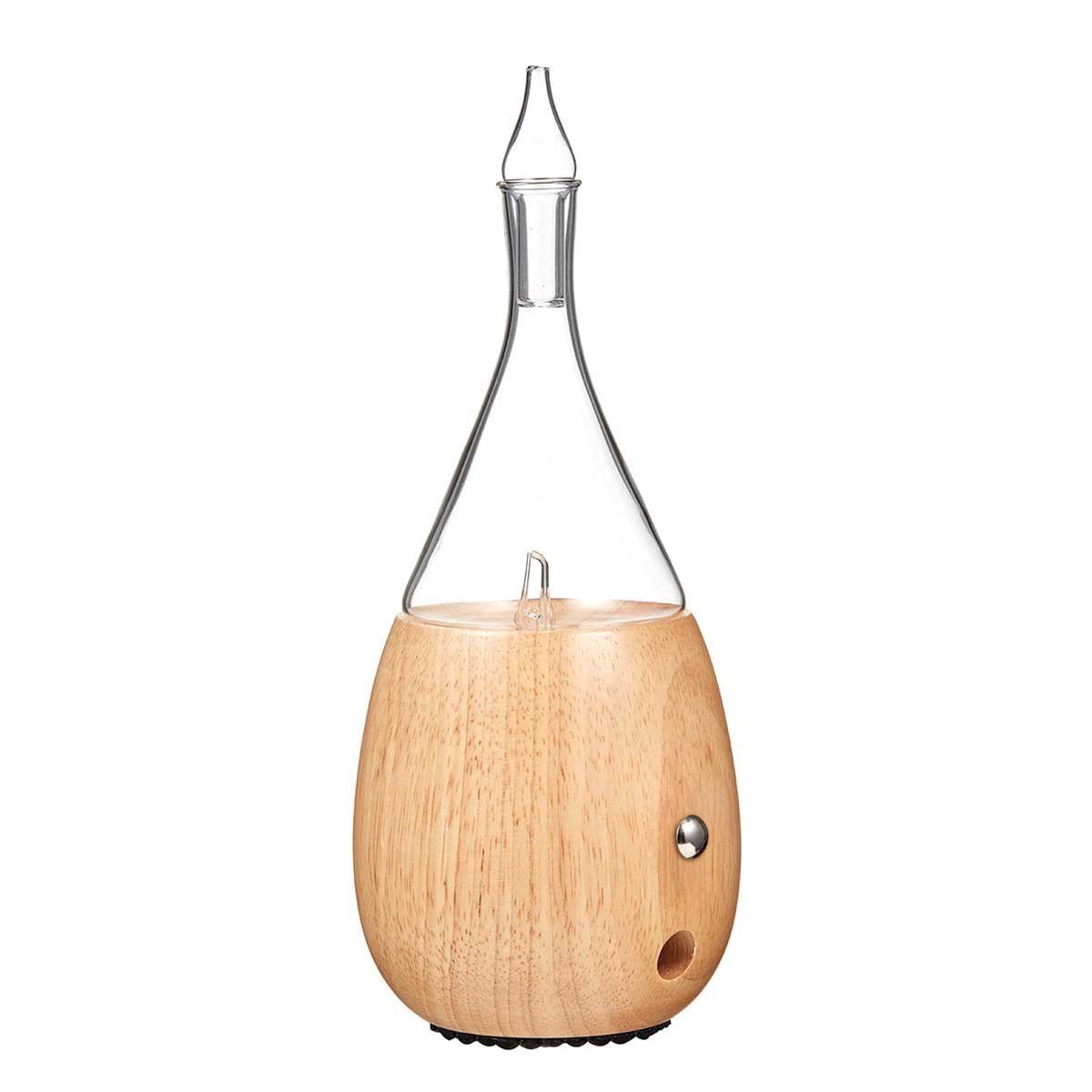
Glass Where Your Oil Lives, Wood Where It Sits
Handcrafted from real wood and medical-grade Pyrex glass, the Nebulizing Diffuser® keeps pure essential oil in glass from reservoir to mist, with no water and no heat. Every part can be replaced, so it is made to stay.
Reason 5: Wood and Glass Age Into a Room Instead of Out of It
Plastic looks its best on the day you unbox it. After that, it yellows in sunlight, scuffs, and picks up a dull film where oil has touched it. Wood and glass go the other way. A solid wood base deepens in color with time and handling, and clear glass stays clear as long as you rinse it now and then.
That’s why a Nebulizing Diffuser® tends to end up somewhere visible: on a nightstand, a bookshelf or the corner of a desk, rather than hidden behind a plant. Each glass reservoir is hand-blown, so no two are quite the same, and the shapes range from the classic teardrop of the Raindrop Smart Nebulizing Diffuser® to seasonal designs like our Christmas Tree Nebulizing Diffuser®, which puts a small glass tree on your mantel.
A few simple habits keep both materials looking their best:
Keep oil off the wood. Fill the glass with it lifted off the base, and wipe any drips right away. Concentrated oil can mark a wood finish just as it marks plastic. Our guide to using a Nebulizing Diffuser® covers filling and placement in detail.
Rinse the glass weekly. Old oil, especially citrus, can turn sticky as it oxidizes. A small splash of 70% or stronger isopropyl alcohol keeps it bright.
Handle it like stemware. Lift the reservoir straight up rather than twisting it, and it will last for years.
Pure oil deserves a vessel that respects it. Pair your Nebulizing Diffuser® with high-quality, unadulterated oils and you’ll notice the difference the first time you switch it on.

Join Our Exclusive Member Club to get Big Discounts!
Plastic Free Essential Oil Diffuser: FAQ
Is any essential oil diffuser completely plastic-free?
Not entirely. Every electric diffuser has a cord, electronics and a pump or motor, and those use some plastic. The part that matters is the oil path. In a glass Nebulizing Diffuser®, the reservoir, micro-tubes and cap that touch the oil are all glass, while the pump and electronics sit in the wood base below.
Why do some diffuser brands say not to use citrus oils?
Citrus oils are rich in limonene, a strong natural solvent. Combined with the stress in molded parts, solvents like this can haze or crack rigid plastics such as polycarbonate and acrylic over time, a failure mode called environmental stress cracking. Glass is unaffected, so citrus oils are fine in a glass Nebulizing Diffuser®.
Do plastic diffusers release microplastics into the air?
We haven’t found a published study that measured plastic particles coming out of an essential oil diffuser, so we can’t give you a number. What is well documented is that essential oils can soften, haze and crack many plastics, and that some aroma compounds absorb into plastic walls. Choosing a glass oil path avoids both questions.
Is a BPA-free diffuser the same as a plastic-free diffuser?
No. BPA-free only means one chemical, bisphenol A, was left out. The tank is still plastic, and it can still absorb scent or crack. A plastic-free oil path means glass or another inert material where the oil sits.
What happens if the glass on my Nebulizing Diffuser breaks?
You don’t need a new unit. Our Replacement Glass Reservoir Set fits back onto your existing wood base and costs $22. Smart models can also replace the base on its own, so either part can be swapped without throwing the other away.
Are glass diffusers fragile?
Hand-blown glass needs the same care as a wine glass. Lift it straight up and down when removing or replacing it, don’t twist it in the base, and keep it away from the edge of a busy surface. Treated that way, the glass lasts for years.
Switching to a plastic free essential oil diffuser comes down to one idea. Keep your oil in glass from bottle to mist, and choose a machine you can repair rather than replace. Your blends will smell the way they should, and the diffuser will still be on your shelf years from now.






Wish was more phone friendly.
Trouble finding shop button but I’ll find it 🙂
We’ve learned the hard way plastic are JUNK! We went through 2 before we got fed up with the melting problem AND they rapidly started producing less and less vapor. Purchased a Lilypur ceramic. It’s a beautiful vase styled unit but doesn’t release nearly enough vapor. We don’t know what to buy that will run for hours and release enough meet our needs.
This would be a great product to use in my home.
Another great product for our world, way to much plastic in our water and on our lands. Thanks for the information and keeping is more informed.
Wonderful post with much information and facts I didn’t know.Thanks for sharing and happy holidays !
Thanks I will now consider using a plastic-free diffuser
Great information here, thanks for sharing.
The world is over flowing with plastic so we need to do away with plastic containers
Good to know. Didn’t think about mold on a diffuser with oil.
Great to know that they do’nt dilute oils, allows strong essential oils, energy efficient, no moldy smell, and ofcoarse looks great. Thanks you learn something everyday.
Had no idea and there are so many plastic ones on the market!
All these are super great reasons to switch to a plastic free essential oil diffuser!! But you forgot the most important one, it’s better for the planet! Plastic diffusers really do hurt the environment because they are not biodegradable! That is reason enough for me to switch! But being able to use stronger essential oils is also a great reason to switch!
We have enough toxins in our environment, we need to eliminate plastics whenever we can.
Como siempre, un buen reportaje con muy buenas ideas. Muchas gracias amigos.
If youu haven’t tried this, it really worths it. After trying a nebulazer all the other ways for aromatherapy will seem “fake”. Apart from its exquisite aesthetics and its non toxic materials, it is also consuming very little quantities of essential oil in relation to all other diffussers, enhancing at the same time their qualities
I didn’t know that the essential oils can break down the plastic diffusers.
I tried to eliminate as much plastic as I can from my life. I am so grateful to find these plastic free essential oil diffusers. Great for me and great for the planet
I have been thinking of buying a diffuser and before reading this article never thought about the dangers of using plastics. Thank you for this info.
thanks for the info
Most important to me is that glass is not corroded by essential oils while plastic may be and can release harmful plastic particles into the air.
All every excellent points. Plastic also has a higher environmental impact in its production and cannot actually be recycled. Only about 10% of plastic is downcycled, meaning that it cannot be recycled back to what it was but rather is melted down to form different products such as plastic chairs.
less plastic is a good idea
yes the less plastic in the world the better we will be
Very interesting, thanks for the info
I feel that using glass allows an uncontaminated scent to diffuse. But plastic is surely a lot better than aerosol sprays!
Harmful plastic particles may be released into the air while diffusing – not really sure about this, I own ultrasonic diffuser for 5 years already and no plastic has been dissolved from it, it looks like new, you just need to clean it from time to time. Even I am very satisfied with it, I decided to give a shot to a Radiance nebulizing diffuser, because of all other 4 reasons from this article. Can’t wait for it to arrive!
I love my Raindrop – Nebulizing Diffuser®
Very interesting. I’m hoping to get one of these real soon. (Santa, I’ve been a very good girl 😉)
I have a total of 4 nebulizing diffusers in my home from Organic Aromas, and I absolutely will never go back to plastic diffusers. There is NO comparison!
I only recently found out about the dangers of plastic in a support group for PCOS. I’m excited to take more control of my body and health by avoiding using plastics and it started today when I ordered my glass diffuser. Not to mention REAL potent aromatherapy… Can’t wait.
I love using a glass diffuser because I know that it’s not contaminated by plastic chemicals