

How to Dilute Essential Oils: 2026 Chart, Ratios, and Safety Guide
Learning how to dilute essential oils is the single safety habit that separates a soothing aromatherapy routine from a stinging, red-skin surprise. Pure plant extracts are stunningly concentrated. A single teaspoon of lavender oil holds the aromatic essence of roughly 250 pounds of lavender flowers, which is exactly why a drop applied neat can overwhelm the skin and the senses at the same time.
At Organic Aromas, we have spent more than twelve years watching customers blend, mist, and diffuse oils inside two hundred thousand homes. Two patterns stand out. First, most dilution mistakes come from copying a generic recipe instead of matching the ratio to the use. Second, almost no one is told that topical aromatherapy needs dilution while inhalation aromatherapy through a true Nebulizing Diffuser® does not. We will fix both today.
This 2026 refresh walks through every method for diluting essential oils safely: the chart, the carrier oils, the step-by-step process, the use-case ratios, and the special rules for kids, seniors, and sensitive skin. By the end you will know exactly how to dilute essential oils for any setting in your home.
Why You Need to Dilute Essential Oils (And When You Do Not)
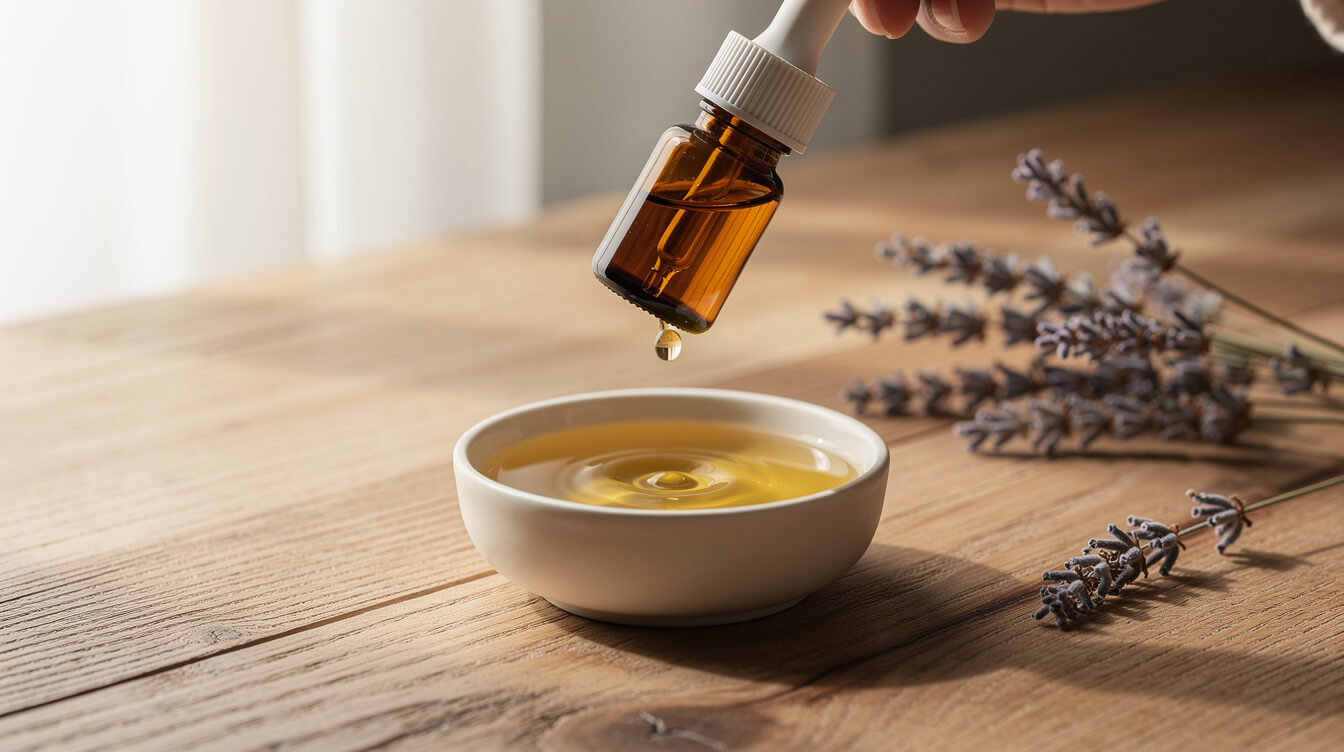
Essential oils are lipophilic, which means they slip into skin lipids and then into the bloodstream within minutes. That is the gift of aromatherapy. It is also the reason undiluted oils can sensitize you over time. Once a person becomes sensitized to a constituent like cinnamaldehyde in cinnamon bark or citral in lemongrass, the reaction is usually permanent.
Dilution with a carrier oil does three jobs at once. It slows skin absorption so the oil delivers its aroma without flooding the system. It buffers strong constituents like phenols, aldehydes, and oxidized monoterpenes. And it spreads a tiny volume of oil across a larger surface, which is how a single drop turns into a usable massage blend.
Here is the part most articles miss. You dilute essential oils for topical use. You do not dilute them for inhalation through a nebulizing diffuser. A nebulizing diffuser uses Bernoulli’s Principle to atomize undiluted oil into a fine cold mist, and any water or carrier added to that reservoir will clog the glass and dull the scent. If you want the full story on why pure-oil diffusion works without dilution, our waterless diffuser and Bernoulli’s Principle guide walks through the physics.
So the rule is simple. Touching skin? Dilute. Filling a bath or a roll-on? Dilute. Adding to lotion, soap, or laundry rinse? Dilute. Diffusing pure aroma into the air for inhalation through a nebulizer? No dilution needed. Adding to an ultrasonic or steam diffuser? Drops go straight into water, but that is suspension, not topical dilution.
Essential Oil Dilution Chart: Ratios at a Glance
Almost every dilution conversation comes back to one number: percentage. A 2% dilution means two parts essential oil to ninety-eight parts carrier oil by volume. The trick is converting that into drops, because most home aromatherapy uses a drop count rather than a precise volume.
Use this conversion as your anchor: one milliliter of essential oil equals roughly twenty drops from a standard orifice reducer. From there the math becomes friendly.
| Dilution | Per 1 tsp (5 mL) carrier | Per 1 oz (30 mL) carrier | Best for |
|---|---|---|---|
| 0.5% | 1 drop | 3 drops | Babies (older than 3 months), elderly, facial care |
| 1% | 2 drops | 6 drops | Children, sensitive skin, full-body daily use |
| 2% | 4 drops | 12 drops | Healthy adult skin, daily massage, body oil |
| 3% | 6 drops | 18 drops | Short-term blends, sore-muscle rubs, targeted spots |
| 5% | 10 drops | 30 drops | Acute relief, single-application bug bites or bruises |
| 10% | 20 drops | 60 drops | Perfume blends only, never full-body |
The 2% rule from aromatherapy authority Wendy Robbins of AromaWeb is the working default for healthy adult skin. The Tisserand Institute recommends staying at or below this for daily use, with brief excursions to 3% for short-term blends like a single massage or a sore-back rub. Going above 5% for general topical use is a sensitization risk, not a benefit. More oil does not equal more aroma absorption. It equals more constituents pushed through the skin barrier than the body can metabolize cleanly.
A second number worth remembering: hot oils stay at half-strength. Cassia, cinnamon bark, clove, oregano, thyme, and lemongrass should be diluted at half the percentage you would use for lavender or chamomile, because their phenol and aldehyde content is far more skin-active. A 1% blend of cinnamon is plenty.
Sign Up to Get Your FREE
e-Book Here…
Choosing the Right Carrier Oil for Diluting Essential Oils
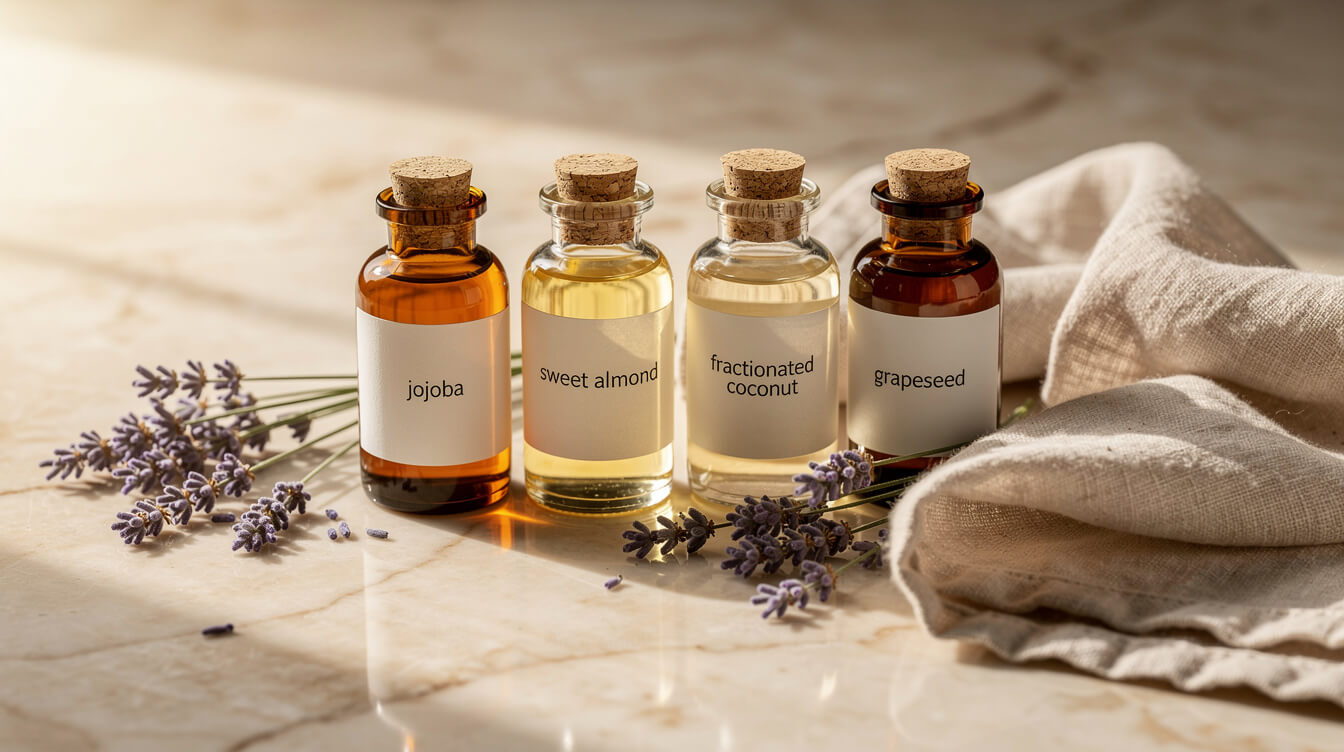
A carrier oil is a neutral plant oil that thins out an essential oil so it can be applied safely. Cold-pressed nut, seed, or fruit-stone oils are the standard. The shelf life, absorption speed, and skin feel vary widely, so the choice matters more than most blog posts admit.
- Jojoba oil is technically a liquid wax. It mirrors the skin’s own sebum, absorbs cleanly, and resists oxidation for two to three years. Best for facial blends and roll-ons.
- Fractionated coconut oil stays liquid year-round, has almost no scent of its own, and lasts up to four years. The best all-purpose carrier for beginners.
- Sweet almond oil is light, mildly nourishing, and slightly nutty. Holds for one year. Excellent for full-body massage.
- Grapeseed oil is the lightest of the common carriers and absorbs fast, but it oxidizes within six months. Reach for it when speed matters more than shelf life.
- Argan oil is rich and slow-absorbing. Reserve it for facial serums and dry-skin spot treatments.
- Avocado oil is heavy and deeply moisturizing. Best blended with a lighter carrier for body work.
If you are building your first kit, two carriers cover ninety percent of home aromatherapy: a bottle of fractionated coconut for body work and a smaller bottle of jojoba for facial blends. Our deep-dive on the best carrier oil for essential oils and the companion piece on types of carrier oils compare every common option side by side.
What about water, alcohol, witch hazel, and aloe gel? Those are dispersants, not carriers. They distribute essential oils through a spray or mist but do not buffer skin absorption the way a fatty oil does. Use them for room sprays and pillow mists, not for direct skin application.
How to Dilute Essential Oils Step by Step (5 Reliable Methods)
Here are five repeatable methods covering nearly every home aromatherapy need. Pick the one that matches your use case and follow the ratio.
Method 1: The Single-Application Drop
Pour about half a teaspoon of carrier oil into your palm. Add one drop of essential oil and rub your palms together. This gives you roughly a 2% blend for one application. Perfect for a quick neck rub, a temple massage, or testing a new oil before committing to a larger batch.
Method 2: The 10 mL Roll-On
Fill an empty 10 mL roller bottle with carrier oil to about two-thirds full. Add four drops of essential oil for a 2% blend, or two drops for a 1% blend safe for kids over six. Cap with the roller fitment and top up. Shake gently. Apply to pulse points, the back of the neck, or the soles of the feet.
Method 3: The 1 oz Massage Bottle
Combine 30 mL of carrier oil with twelve drops of essential oil for a 2% full-body massage blend. For an evening blend, try eight drops of lavender plus four drops of sweet orange. For sore muscles, try six drops of peppermint plus six drops of black pepper, then reduce to a 1% blend if the skin tingles.
Method 4: The Bath Blend
Never drop essential oils directly into bath water. They float on the surface and concentrate on the first skin they touch, which is rarely the spot you intended. Instead, pre-dilute six to ten drops of essential oil into one tablespoon of carrier oil, then swirl the carrier-oil blend into the running water. The fatty carrier disperses the aroma evenly.
Method 5: The Room Spray
Combine 60 mL of distilled water, 10 mL of high-proof witch hazel or unflavored vodka, and twenty to thirty drops of essential oil in a glass spray bottle. Shake well before each use. This is a dispersant blend, not a topical dilution, so the ratios run higher because the spray hits the air rather than the skin.
Sign Up to Get Your FREE Essential Oils e-Book Here
Dilution by Use Case: Massage, Skincare, Sprays, and Diffusion
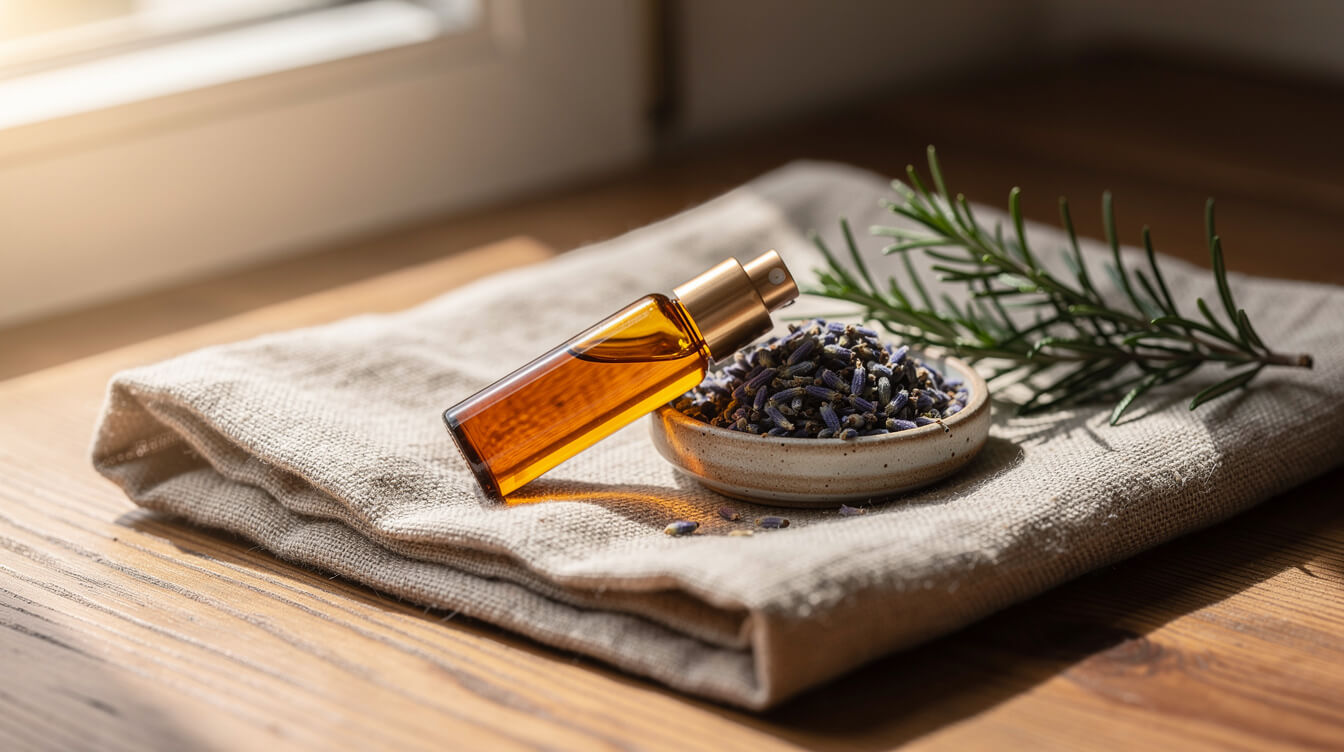
The right dilution depends on where the blend lands. Skin needs lower percentages. Hair and feet tolerate more. The air takes pure oil with no dilution at all when delivered through a true nebulizing diffuser.
- Daily body lotion: 1% to 2% in your unscented lotion (six to twelve drops per ounce). Build the blend in a small jar, not the whole bottle, so you can adjust.
- Facial serum: 0.5% to 1% in jojoba (three to six drops per ounce). The face is more reactive than the body, so start at 0.5%.
- Massage oil: 2% for full-body, 3% for a single targeted session on a specific muscle group.
- Hair and scalp blend: 1% to 2% in coconut or sweet almond. Apply, leave for thirty minutes, then shampoo out.
- Foot soak: Pre-dilute five drops into one tablespoon of jojoba, then add to a basin of warm water with Epsom salts.
- Linen and pillow spray: Dispersant blend at roughly 1% to 2% concentration, never sprayed directly on skin.
- Ultrasonic diffuser: Drops go into the water reservoir at three to five drops per 100 mL. The water is the dispersant, not a carrier.
- Nebulizing Diffuser®: Pure oil, no dilution, no water. The Nebulizing Diffuser®’s glass reservoir atomizes the oil directly. Adding carrier oil here will gum up the venturi tube. For a side-by-side of nebulizing versus ultrasonic, see our waterless diffuser for essential oils guide.
One reason customers come back to nebulizing diffusion after trying ultrasonic units is that ultrasonic dilution wastes oil. Roughly half of the dispersed droplets settle as wet film rather than airborne aroma. A true Nebulizing Diffuser® converts every drop into breathable mist, which is why a few drops scent an entire room. The complete picture lives in our nebulizing diffuser complete guide.
Safe Dilution for Children, Seniors, and Sensitive Skin
Children, older adults, and anyone with reactive skin need lower dilutions and a shorter list of safe oils. Their skin barriers are thinner, their metabolic clearance is slower, and the same drop that feels lovely on a healthy adult forearm can sting a six-year-old’s wrist.
- Babies under three months: No topical essential oils. The skin barrier is still maturing. Hydrosols and aromatic herbs only.
- Three months to two years: 0.25% to 0.5% with safe oils only (lavender, chamomile, mandarin, dill). Avoid peppermint, eucalyptus, and rosemary near the face.
- Two to six years: 0.5% to 1% with a broader but still selective oil list. Patch test every new oil.
- Six to twelve years: 1% to 2% with most general oils. Keep hot oils out of the mix.
- Sensitive adult skin: Start at 0.5% to 1% even for body work. Our guide to the best essential oils for sensitive skin shortlists the gentlest options.
- Older adults: 1% for daily use is plenty. Their skin holds less moisture, so a richer carrier like jojoba or argan feels better than a light grapeseed.
- Pregnancy: A short list of oils is considered safe at 1% from the second trimester onward. Our essential oils safe for pregnant women guide walks through every trimester.
One often-overlooked rule applies to everyone: patch test before you commit a batch. Apply a single 1% drop to the inner forearm, cover lightly, and wait twenty-four hours. Redness, itching, or warmth means the oil or the dilution is not right for you, regardless of what a chart says. Skin chemistry varies, and a good blend respects that.
Citrus oils carry a separate flag. Cold-pressed bergamot, lemon, lime, and grapefruit can be phototoxic, meaning the blend reacts with UV light and causes hyperpigmentation on exposed skin. Keep cold-pressed citrus blends to 0.4% (about two drops per ounce) if you will be in the sun within twelve hours, or switch to steam-distilled citrus, which is non-phototoxic. The same principle is covered in our lavender essential oil side effects guide, which translates well to citrus.
Join Our Exclusive Member Club to get Big Discounts!
Storing Diluted Essential Oils for Maximum Shelf Life
Once an essential oil meets a carrier, the clock starts ticking. The carrier oil’s shelf life now caps the blend, not the essential oil’s. A 2% lavender blend in grapeseed will go rancid in six months even though the lavender itself is still bright. A 2% lavender blend in jojoba can last two years.
- Use dark glass bottles, amber or cobalt. Light degrades essential oil constituents within weeks.
- Keep blends cool and away from heat sources. The cabinet next to the stove is the worst spot in any kitchen.
- Label every bottle with the blend, the dilution percentage, and the date mixed. Memory is unreliable; masking tape is not.
- Mix small batches. A 10 mL roll-on you finish in four weeks beats a 100 mL bottle that sits half-used for a year.
- For citrus-heavy blends, store in the refrigerator. D-limonene oxidizes faster at room temperature and oxidized citrus is more skin-sensitizing than fresh.
One last tip from twelve years of customer feedback: write the dilution percentage on the bottle, not just the drop count. Six months from now, “2% lavender in jojoba” tells you exactly how to refresh the blend. “Eight drops in something” tells you nothing.
How to Dilute Essential Oils: Frequently Asked Questions
Can you use water to dilute essential oils?
Not for topical application. Water and essential oils do not mix; the oil floats on top, and the first patch of skin contact gets the full undiluted hit. Water works only as a dispersant for sprays and ultrasonic diffusers, paired with an emulsifier like witch hazel, solubol, or vodka. For anything touching skin, use a fatty plant-based carrier oil.
What is the strongest dilution that is still safe?
For healthy adult skin, a 3% to 5% blend is considered safe for short-term, targeted use such as a sore-muscle rub or a one-off bug-bite treatment. For daily full-body use, 1% to 2% is the cap. Going above 5% for general topical use is not more effective, just more sensitizing.
How many drops are in 1 mL of essential oil?
Roughly twenty drops, assuming a standard orifice reducer. Thicker oils like sandalwood or vetiver drop a bit slower, so the count can dip to fifteen. Always measure by drop count from your own bottle when the dilution math matters, like a child’s blend.
Do I need to dilute essential oils for a diffuser?
It depends on the diffuser. A Nebulizing Diffuser® uses pure undiluted essential oil; do not add water or carrier oil, since both will clog the glass mechanism. An ultrasonic diffuser uses water as a dispersant and you add three to five drops per 100 mL. A steam or candle-warmer diffuser also uses water. Reed diffusers and personal inhalers use the oil neat, soaked into reeds or a wick.
Can I dilute essential oils with coconut oil straight from the jar?
Yes, but solid (virgin) coconut oil melts and re-solidifies with temperature, which makes drop ratios inconsistent. Fractionated coconut oil stays liquid and is easier to measure, mix, and pour into roll-ons. Both work; fractionated is simply more convenient.
How long do diluted essential oil blends last?
The carrier oil sets the ceiling. Jojoba-based blends last up to two years. Sweet almond about one year. Grapeseed six months. Store in dark glass, in a cool dark cabinet, with the date written on the label.
Diluting Essential Oils Safely: Your Next Step
The point of learning how to dilute essential oils is not to memorize a chart. It is to build a habit of matching the ratio to the use, so that every blend you make feels good on the skin and works the way the plant intended. Start with the 2% default, drop to 1% for sensitive skin, climb to 3% only when you need short-term targeted relief, and keep pure undiluted oils for the nebulizing diffuser that delivers aroma without the carrier.
If you have been diluting drops into a water-based diffuser and wondering why the scent fades after twenty minutes, the answer is the dispersion method, not the oil. A handcrafted Nebulizing Diffuser® built from real wood and medical-grade Pyrex glass turns four to six drops of pure essential oil into a room-filling cold mist for hours, with no dilution, no water, and no heat. That is the original aromatherapy method, and twelve years of customer feedback says the difference is immediate.
Two patterns hold across every safe-dilution practice we have seen. Start lower than you think you need, and write down what you mixed. Everything else is detail.