

What Does Frankincense Smell Like? The Oil, the Smoke and the “Old Church” Molecule
What does frankincense smell like? Fresh and resinous at first: pine needles, lemon peel and a pinch of cracked pepper. Then it settles into something warm, balsamic and faintly woody, with a cool, mineral calm underneath that many people simply call “church.” It’s bright rather than sweet, clean rather than heavy, and more green than most people expect from the oil.
That’s the short answer. The longer one is more interesting, because there isn’t one frankincense smell. There are three: the oil in the bottle, the smoke from resin on hot charcoal, and the “church smell” you remember from a candlelit service. Each is made of different molecules, and two of them are partly made by fire. Below we name the trace compounds that chemists have found behind frankincense’s pepper and “old church” notes, share what our own lab report says about the frankincense we bottle (and why it may smell different from yours), and finish with three holiday blends and how to diffuse a resin oil without trouble.
What Does Frankincense Smell Like? The Short Answer
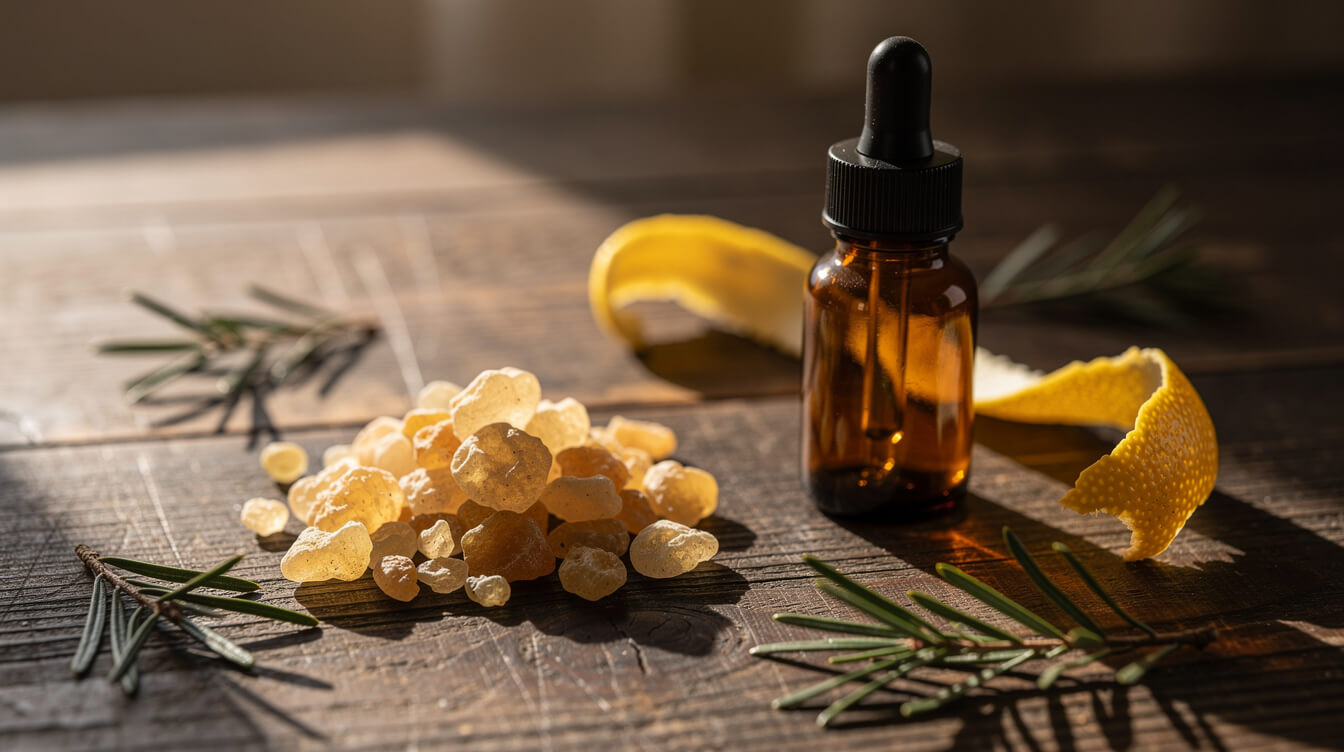
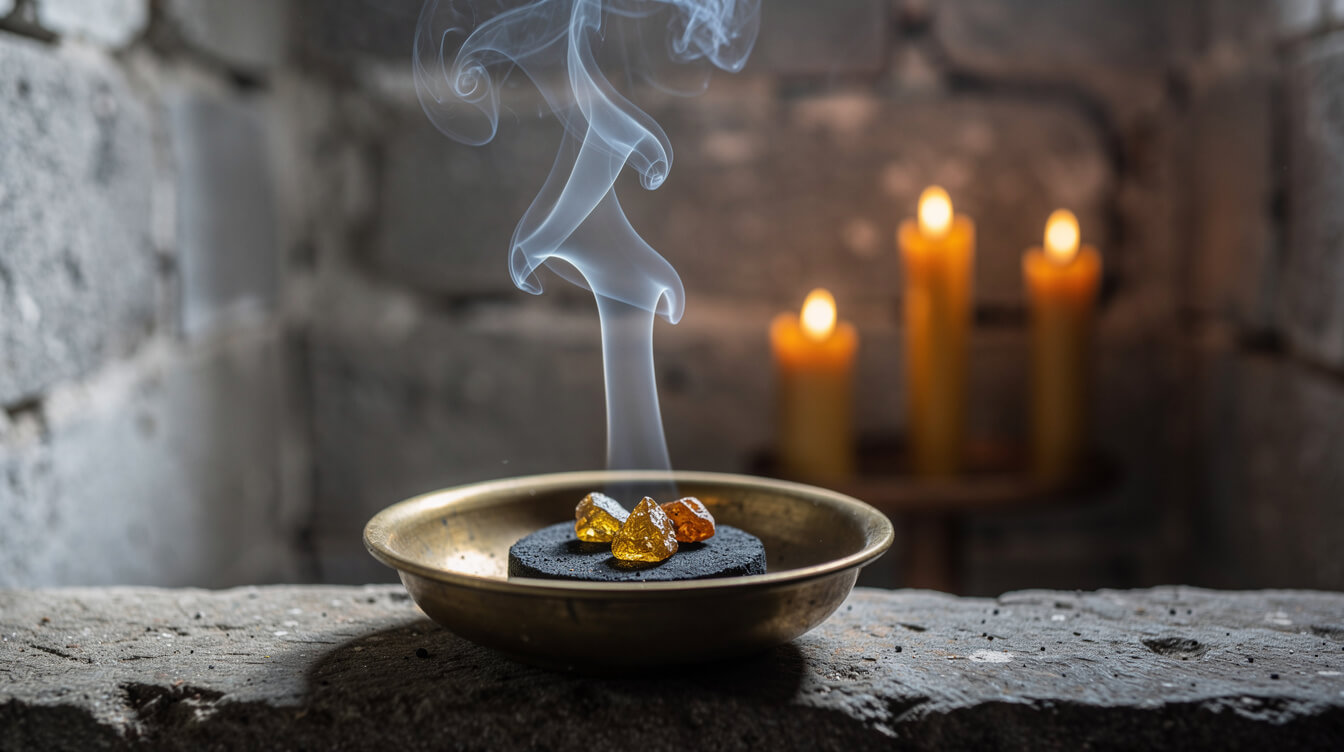
Frankincense is the hardened resin of Boswellia trees, tapped from the bark in Oman, Yemen, the Horn of Africa and India. The essential oil is steam-distilled from those golden “tears.” Ask perfumers to describe the oil and you’ll hear the same words again and again:
Piney and resinous. The opening note, sharp and clean like a snapped conifer twig. This is mostly α-pinene, the same molecule in pine forests.
Lemony and bright. A citrus-peel sparkle, stronger in some species than others.
Peppery and spicy. A dry, slightly hot edge, as if someone cracked black pepper nearby. (A trace molecule explains this, and we’ll get to it.)
Balsamic and warm. After a few minutes the brightness softens into a gentle, resin-sweet warmth.
Cool and mineral. The note people struggle to name. It’s often described as clean stone, cold air or the inside of an old church.
How frankincense changes over an hour
Put a drop on a paper strip and smell it three times. In the first minute it’s sharp: pine, citrus, green. At twenty minutes the pepper and balsamic warmth come forward. After an hour or two the strip smells of soft, dry resin with a faint woody sweetness. Frankincense oil fades much faster than myrrh, vetiver or sandalwood because most of it is made of light, quick-evaporating molecules, which is why perfumers use it as a bright top-to-heart note rather than a base.
What frankincense oil does not smell like
It isn’t smoky. That surprises almost everyone the first time they open a bottle. The smoke you associate with frankincense comes from burning the resin, which is a very different thing, as the next section explains. The oil also isn’t sweet or vanilla-like. If a “frankincense” candle smells sugary and powdery, you’re smelling a perfume accord, usually with benzoin, vanilla or amber notes, built around a small amount of real frankincense or none at all.
Three Frankincenses: The Oil, the Burning Resin and the “Church Smell”
One of the most-asked frankincense questions on Reddit goes like this: why does my frankincense oil smell so different from the frankincense I burned? The answer is that you’re smelling three different materials.
1. The oil: only the part that rides the steam
Steam distillation only captures molecules light enough to travel with steam. In frankincense, that’s a small fraction of the resin. Published distillations of Omani Boswellia sacra report oil yields ranging from roughly 2.5% to just over 14% of the resin’s weight, depending on the grade and how long it’s distilled, with 5.5% typical for one botanically certified sample. Everything else, the gum and the heavy resin acids, stays behind in the still. That’s why the oil smells bright, green and citrusy, not dark and smoky. (Our Oil of the Day on frankincense chemistry covers why the famous boswellic acids never make it into the bottle.)
2. The smoke: a smell partly made by fire
When you drop resin tears on glowing charcoal, you aren’t just evaporating them. You’re cooking them. In 2015, Johannes Niebler and Andrea Buettner, flavor chemists at the University of Erlangen-Nuremberg, set out to study exactly this. They built a new instrument setup (pyrolysis-GC-MS with olfactometry, where a trained nose sniffs each compound as it leaves the machine) to mimic what happens in a censer. Their finding, published in the Journal of Analytical and Applied Pyrolysis: heating frankincense resin produces a range of odorants that are absent from the raw material. New smells are literally formed in the heat.
So the smoky, toasty, slightly sweet-burnt smell of incense isn’t hiding in the oil waiting to be released. It’s created on the coal. Burning anything also produces ordinary combustion byproducts, which is one practical reason many people prefer to enjoy frankincense without smoke at home.
3. The “church smell”: a molecule plus a room
Here’s the most surprising part. For a long time, nobody could name the molecule responsible for frankincense’s characteristic “old church” note. In 2016, a team led by Nicolas Baldovini at the Institut de Chimie de Nice (CNRS and Université Côte d’Azur) finally found it. Writing in Angewandte Chemie, they identified two molecules never before found in nature, which they named olibanic acids: (+)-trans- and (+)-cis-2-octylcyclopropyl-1-carboxylic acid.
The numbers show why they were so hard to find. The olibanic acids make up only a few hundred parts per million of frankincense oil. The team started with three kilograms of Somali frankincense oil and, after rounds of distillation, extraction and chromatography, isolated about one milligram of the two compounds. A trained panel of human noses had to guide every step, because instruments alone couldn’t pick these traces out of the mix. The researchers then synthesized both molecules to confirm the match. They found them in every frankincense sample they analyzed, even samples with very different overall chemistry.
That’s the molecule. The rest of the “church smell” is the room. Historically, church incense was rarely pure frankincense. The Odeuropa Encyclopedia of Smell History notes that many 19th-century European churches blended it with benzoin, storax and sometimes cinnamon and cloves, and that 12th- to 14th-century censers excavated in present-day Belgium contained frankincense alongside juniper and pine tar. Add beeswax candles, old wood and cold stone that has absorbed centuries of smoke, and you have an accord no single bottle can fully reproduce. A visitor to a Spanish cathedral in 1895 put it well: the fumes seemed to have “impregnated the very stones.”
Sign Up to Get Your FREE
e-Book Here…
The Trace Molecules Behind Frankincense’s Pepper and Spice
Frankincense oil is dominated by a handful of big, simple molecules: α-pinene, limonene, α-thujene, sabinene and myrcene. They give the pine-and-citrus opening. But the most characterful notes come from compounds present in such small amounts that a standard lab report can miss them entirely.
In a 2014 study in Phytochemistry, Niebler and Buettner ran an aroma extract dilution analysis on Boswellia sacra resin from Somalia and Oman. In this method the extract is diluted again and again, and trained panelists sniff each dilution as it comes off the instrument. The odorants still detectable at the highest dilutions are the ones that matter most to the smell. They detected 23 odorants. Alongside α-pinene (the “rosiny” head note), β-myrcene and linalool, they found p-cresol, a phenolic, faintly leathery-animalic note, and two powerful molecules they couldn’t yet identify.
Rotundone: the black pepper molecule
In 2016, the same group (now with Katharina Zhuravlova and Mirjana Minceva) isolated those two unknowns and reported them in the Journal of Natural Products. The first was rotundone, a sesquiterpene ketone described as coniferous, woody and peppery. It’s the same molecule that gives black pepper its peppery smell and gives some Shiraz wines their famous cracked-pepper note. That’s where frankincense’s peppery edge comes from.
Rotundone comes with a twist. Wine researchers (Wood and colleagues, 2008) found that roughly one in five people can’t smell it at all, even at concentrations hundreds of times above the normal threshold of about 8 nanograms per liter of water. If a friend insists frankincense smells peppery and you get only pine and lemon, you may both be right.
Mustakone: the note that vanishes in seconds
The second molecule was mustakone, which the team described as a potent odorant for the first time. Panelists described it as spicy, woody, slightly fatty, balsamic and even meat-broth-like. For the most sensitive panelists, its odor threshold was in the same range as some of the most powerful food aromas known. And the panel reported very fast adaptation: after one to three seconds of sniffing they could no longer perceive it.
That’s a useful thing to know. The warm, spicy richness you notice in the first breath over a frankincense bottle may fade from your perception almost immediately, even though the molecule is still there. Step away, breathe fresh air and come back, and it returns. It’s one reason frankincense can seem to “change” every time you smell it.
One more finding from Niebler’s doctoral research: frankincense resin tears stored for more than ten years showed no notable loss of their monoterpene odorants. The hard resin is a natural time capsule, which helps explain how frankincense survived ancient trade routes so well. Distilled oil is different: once it’s out of the resin and exposed to air, its light molecules slowly oxidize, which brings us to your bottle.
Why Does My Frankincense Oil Smell Different?
If your frankincense smells greener, sharper or more herbal than a friend’s, there are three usual reasons: species, age and your nose.
Species: four trees, four personalities
“Frankincense” comes from several Boswellia species, and each has its own chemistry. Here’s the quick version, by smell:
B. sacra (Oman, Yemen): bright, lemony and refined, with a clean pine opening.
B. carterii (Somalia): classic pine-and-citrus frankincense, balanced and familiar.
B. serrata (India): greener, more herbal and peppery, with less lemon. Often dominated by α-thujene rather than α-pinene.
B. frereana (Somalia): fresh, green and light, with very little “incense” depth.
Our guide to frankincense aromatherapy oil tours each species in depth, and Myrrh vs Frankincense explains how frankincense differs from its ancient partner.
What our lab report says about our frankincense
We send our oils out for independent testing and link the reports on each product page. The most recent report on our Frankincense Essential Oil is from PhytoChemia, a lab in Québec accredited to ISO 17025. It analyzed the oil by gas chromatography and identified the source as Boswellia serrata from India. Its top components:
α-Thujene: 60.94%, a woody, green, slightly herbal-peppery monoterpene
α-Pinene: 16.58%, the pine and resin note
Sabinene: 4.76%, a warm, woody-spicy note also found in black pepper and nutmeg
Δ3-Carene: 4.08%, sharp and piney
p-Cymene: 1.67% and limonene: 1.62%, the citrus-fresh lift
Methyl chavicol: 1.06%, a faint anise-basil sweetness
Serratol: 0.05%, a diterpene alcohol named after B. serrata and used as a marker for the species
The lab’s conclusion: no adulterant, contaminant or diluent detected. So if you’ve smelled Omani or Somali frankincense and ours reads greener and more peppery, that’s the serrata chemistry: about four times more α-thujene than α-pinene. Published analyses of serrata oil vary widely, from about 20% to nearly 70% α-thujene depending on where and how the resin was harvested. Ours sits at the high end. In a blend it gives a crisp, herbal brightness that works beautifully with citrus and spice.
Age and your own nose
Frankincense oil is mostly light monoterpenes, and those oxidize once a bottle has been opened many times. Older oil loses its sparkle, smells flatter or more turpentine-like, and can turn slightly sticky. Our customer care team suggests using resin oils within two to three years and keeping the cap tight and the bottle out of sun and heat. Then there’s your nose: given rotundone anosmia and mustakone’s two-second fade, two people can honestly smell the same drop differently.

Sign Up to Get Your FREE Essential Oils e-Book Here
What Does Frankincense Smell Good With? Three Holiday Blends

Frankincense is one of the easiest oils to pair because it sits in the middle of so many families. It picks up the pine in conifers, the peel in citrus, the warmth in spice and the depth in woods and resins. These pairings work especially well:
Citrus (Sweet Orange, Bergamot, Grapefruit): lifts frankincense’s lemon facet and softens its sharpness.
Warm spice (Clove Bud, Cinnamon, Black Pepper): black pepper echoes the rotundone note, and clove and cinnamon add holiday warmth.
Woods (Cedarwood): adds a dry, structured base and makes the blend last longer.
Other resins (Myrrh, Benzoin): myrrh adds bitter depth and benzoin adds vanilla-like sweetness. Use both sparingly, because they’re thick.
Three blends to try this season
Each recipe is in parts, so you can scale it to your bottle. Mix in a clean glass vial and let it rest for a day so the notes settle together.
Winter Window: 4 parts Sweet Orange, 2 parts Frankincense, 1 part Clove Bud. The classic: bright orange, clean resin and a warm clove glow, like a pomander by a frosted window.
Peppered Resin: 3 parts Bergamot, 2 parts Frankincense, 1 part Cedarwood, 1 part Black Pepper. Built around the pepper molecule frankincense shares with black pepper. Crisp, dry and elegant, good for an evening with guests.
Candlelit Chapel: 3 parts Frankincense, 3 parts Sweet Orange, 2 parts Cedarwood, 1 part Benzoin. Our home take on the church accord: resin, wood and a soft vanilla-balsamic sweetness from benzoin, standing in for the beeswax candles. The citrus keeps it light enough to diffuse.
For more seasonal ideas, see our guide to Christmas essential oils, which explains which holiday scents an essential oil can truly make, and our cinnamon pine cones method for a no-heat table centerpiece.
Diffusing Frankincense in a Nebulizing Diffuser®
A Nebulizing Diffuser® works on Bernoulli’s Principle: a fast stream of air passing over a fine glass tube draws pure oil up and breaks it into a microscopic mist. There’s no water, no heat and no flame. For frankincense, that means you get the oil exactly as it was distilled. The bright pine-and-lemon top arrives together with the warmer, peppery heart instead of being driven off first by heat, and nothing is pyrolyzed, so there’s no smoke and none of the fire-made odorants or combustion byproducts that come with burning resin. You smell the oil, not the coal.
Blend it rather than running it alone
Steam-distilled frankincense is thinner than myrrh or benzoin, but it’s still a resin oil, and our customer care team lists it among the oils that can leave sticky residue in the fine glass tube when run on its own for long sessions. The simple habit: use frankincense as part of a blend with a thinner oil such as citrus, as in the recipes above, and wipe the glass with a little isopropyl alcohol after resin-heavy sessions once it’s cool. Our guide on how to use a Nebulizing Diffuser® covers filling, settings and care step by step.
Run it in short cycles and walk back in
Remember mustakone’s two-second fade. If you sit right next to the glass, your nose adapts quickly and the scent seems to disappear. Run a short, intermittent cycle, leave the room for ten minutes and come back in. That first breath at the doorway is when frankincense reads the way it should: clean resin, citrus, a hint of pepper and that cool, quiet calm. For the season, our Christmas Tree Nebulizing Diffuser® pairs especially well with the Winter Window blend, or browse the full handcrafted Nebulizing Diffuser® collection.

Join Our Exclusive Member Club to get Big Discounts!
What Does Frankincense Smell Like? FAQs
How would you describe the smell of frankincense?
Fresh, piney and lemony at first, with a peppery edge, then warm, balsamic and softly woody, with a cool, clean, mineral calm that many people associate with old churches. The oil is bright and green rather than smoky or sweet.
Why doesn’t my frankincense oil smell like incense?
Because incense smoke is partly made by fire. Heating the resin on charcoal creates new odorants that aren’t in the raw material, while steam-distilled oil contains only the lighter molecules that travel with steam. The oil smells brighter and greener. The smoke smells toastier and darker.
Does frankincense smell like church?
Partly. Chemists have identified trace molecules called olibanic acids, present at a few hundred parts per million, as the source of frankincense’s “old church” note. The full church smell is a room accord: frankincense smoke, often blended with benzoin, storax or spices, plus beeswax candles, wood and stone.
Why does frankincense smell peppery?
It contains trace amounts of rotundone, the same molecule behind the peppery note in black pepper and some Shiraz wines. Roughly one in five people can’t smell rotundone at all, so not everyone notices it.
What smells similar to frankincense?
Pine and fir share its resinous opening, lemon and bergamot share its citrus lift, and black pepper shares its peppery edge. Elemi and myrrh are the closest resin relatives, though myrrh is darker and more bitter.
Is frankincense safe to diffuse around cats and dogs?
Cats in particular process some essential oil compounds poorly, so be cautious. Diffuse in a well-ventilated room for short, intermittent sessions, keep the door open so pets can leave, and never apply oils to pets. Ask your veterinarian if your pet has a health condition. Our guides to oils and cats and dogs go into more detail.
Who should avoid frankincense oil?
If you’re pregnant, nursing, managing a health condition or taking medication, ask your clinician before using any essential oil. Keep oils away from children, and never ingest them.
So what does frankincense smell like? In the bottle: pine, lemon peel and pepper over a warm, balsamic heart. On the coal: something new, made by fire. In a church: a few hundred parts per million of olibanic acids, plus candles and centuries-old stone. Once you know which frankincense you’re smelling, each one makes more sense. To bring the clean, bright version home this season, start with our pure Frankincense Essential Oil, one of the blends above and a short, intermittent setting. Curious about other scents? Explore what sandalwood smells like and what vetiver smells like next.