

What Does Eucalyptus Smell Like? (Hint: It Isn’t Vicks)
What does eucalyptus smell like? Fresh, cool and sharply clean, with a green, camphor-like bite up front, a faint resinous sweetness like pine needles in the middle, and a soft, slightly woody, honeyed dry-down. Crush a fresh leaf and it smells brighter and greener still, almost like cut grass mixed with cold mountain air.
Ask most people to describe it, though, and they’ll say one word: Vicks. That’s the problem. The smell nearly everyone files under “eucalyptus” is mostly something else, and the real thing is greener, softer and more interesting than the medicine-cabinet memory. Below we take the Vicks smell apart ingredient by ingredient, explain why the eucalyptus bundle hanging in your shower went quiet after a week (and how to wake it up in ten seconds), compare fresh, dried and preserved stems, introduce the “eucalyptus” trees that smell like lemon or peppermint, and finish with the pairings that make eucalyptus smell its best in your home.
What Does Eucalyptus Smell Like? The Short Answer
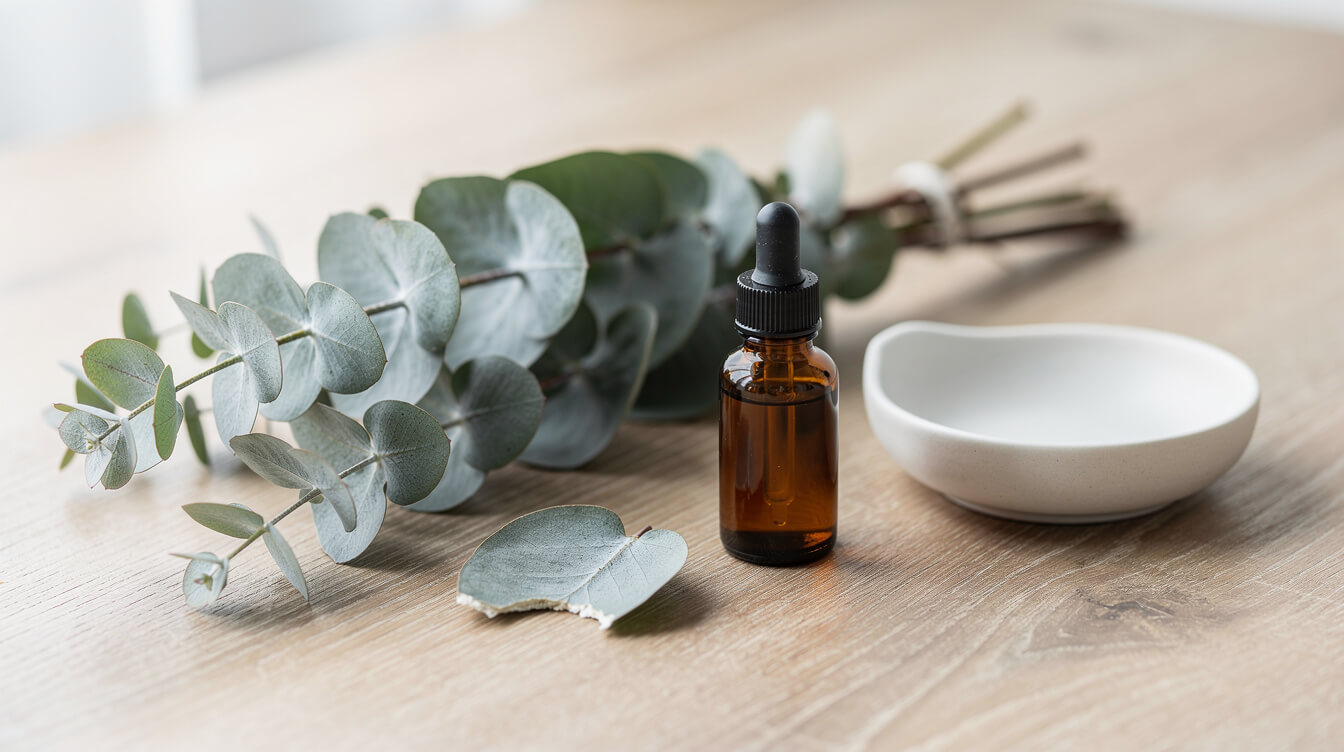
Eucalyptus oil is steam-distilled from the leaves of a handful of the 700-plus Eucalyptus species native to Australia. The classic medicinal-type oils are dominated by one molecule, 1,8-cineole (also called eucalyptol), which is also found in rosemary, bay laurel and cardamom. Cineole is what gives eucalyptus its signature clean, cool, camphoraceous character. Around it sit smaller amounts of pine-scented α-pinene, citrusy limonene and woody sesquiterpenes, and those supporting notes are what make a good eucalyptus oil smell like a forest instead of a cough drop.
Put into words, this is what people describe:
Fresh and cool. The first impression. Eucalyptus reads as cold, the way the air feels on a clear winter morning, even though the oil isn’t actually cold.
Camphoraceous. A sharp, clean, slightly medicinal edge, the note it shares with camphor and rosemary.
Green and leafy. Especially in a freshly crushed leaf: sappy, grassy and alive.
Resinous and piney. A soft pine-needle sweetness from the pinenes, stronger in some species than others.
Woody and faintly honeyed. The dry-down, after the bright top notes fade. Subtle, warm and a little sweet.
Why the bottle smells harsher than the leaf
Straight from the bottle, eucalyptus is concentrated and can feel almost stinging to the nose. There’s also a quieter reason: crude, freshly distilled eucalyptus oil contains small amounts of sharp, sour-smelling aldehydes, including isovaleraldehyde, which some sources compare to cat urine. Commercial oils are often rectified, meaning re-distilled, partly to strip those aldehydes out and raise the cineole content. A rectified oil smells cleaner and simpler. An unrectified oil can smell rougher but greener and more complex. Neither is wrong; they’re just different. If a bottle smells sour or “off” rather than fresh, though, it’s worth smelling it again on a paper strip at arm’s length before you judge it.
It Isn’t Vicks: What’s Really in the Smell You Remember
For millions of people, eucalyptus smells like the blue jar from childhood. So here’s the jewel most articles skip: eucalyptus is the smallest active ingredient in Vicks VapoRub.
According to the US Drug Facts label, VapoRub’s three active ingredients are camphor 4.8%, menthol 2.6% and eucalyptus oil 1.2%. There’s four times as much camphor as eucalyptus oil, and twice as much menthol. Then come the inactive ingredients, several of which are fragrant in their own right: cedarleaf oil, nutmeg oil, thymol and turpentine oil, all in a petrolatum base.
Taking the Vicks smell apart
Each of those ingredients adds its own piece to the famous smell:
Camphor: the dominant note. Cold, sharp, mothball-like and unmistakably “medicine cabinet.”
Menthol: the icy, minty chill that makes your eyes water a little. This is peppermint’s main molecule, and pure eucalyptus doesn’t contain it.
Turpentine oil: a solvent-like pine note, distilled from pine resin.
Cedarleaf oil: a sharp, herbaceous, woody green note from Thuja leaves.
Thymol: the warm, phenolic, herbal note of thyme.
Nutmeg oil: a soft, warm spice underneath.
Eucalyptus oil: fresh, cool and camphoraceous, and outnumbered.
Camphor and cineole share a cool, camphoraceous character, which is exactly why the two get confused. But pure eucalyptus oil, smelled next to that jar, comes across as greener, softer and more woody-sweet, with far less of the icy menthol bite and none of the warm spice. Try it: put a drop of Eucalyptus Essential Oil on a paper strip and smell it beside a peppermint strip. You’ll find the “Vicks” sensation is mostly the mint and camphor, not the eucalyptus.
If you love that cool, camphoraceous family of smells, our Oil of the Day on ravintsara and niaouli cover two cineole-rich cousins that smell different again.
Sign Up to Get Your FREE
e-Book Here…
Why Your Eucalyptus Shower Bundle Stopped Smelling (and How to Wake It Up)
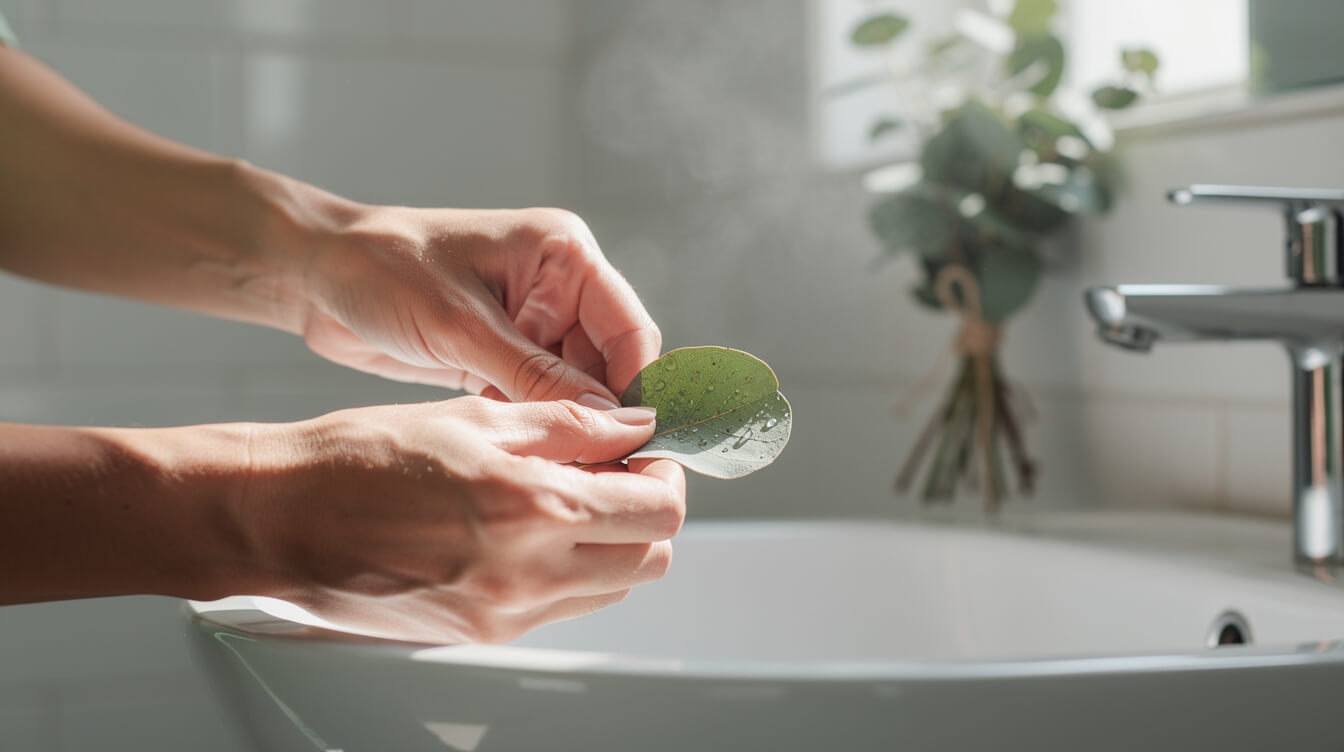
It’s one of the most-asked questions on this topic: you hang a beautiful eucalyptus bundle from the shower head, it smells wonderful for a few days, and then it goes quiet. Is the plant fake? Is it the wrong kind? Usually, neither. The answer is in the leaf itself.
The oil is sealed inside the leaf
Eucalyptus doesn’t wear its oil on the surface. It stores it in tiny secretory cavities, or oil glands, embedded inside the leaf tissue. You can see them for yourself: hold a fresh leaf up to a bright window and look for dozens of tiny translucent dots, like pinpricks of light. Each dot is a sealed pocket of oil, mostly cineole in the common types. The plant evolved them as a chemical defense against animals that eat leaves, so they’re built to stay closed until something breaks them open.
That’s why an intact eucalyptus leaf smells surprisingly faint, and why a crushed one smells so strong. Shower steam warms the leaves and releases some oil from glands near the surface, which is the wonderful first-week burst. Once those are spent, the rest of the oil stays locked inside unbroken glands, while the leaves slowly dry out.
Wake it up in ten seconds
Bruise the leaves. Before your shower, roll the bundle firmly between your palms or gently crush a few leaves with your fingers. You’re rupturing fresh oil glands, and the scent comes right back.
Let steam reach it, not spray. Hang it near the shower head but out of the direct stream, so warm steam drifts over it without soaking it.
Check the leaves are actually fresh. Fresh stems are flexible and cool to the touch. Stiff, papery, uniformly colored leaves have probably been dried or preserved (more on that next).
Replace it. Even a well-cared-for fresh bundle usually lasts a couple of weeks, sometimes up to four, before it’s simply spent.
If you love the steam-and-eucalyptus combination, our guide to essential oils for shower steamers explains how heat changes a scent over a single shower, and what to do about it.
Fresh vs Dried vs Preserved Eucalyptus: Which Smells Strongest?
If you’re buying stems for their scent rather than their looks, how they’ve been processed matters as much as which kind you buy. Florists mostly sell a few ornamental species, often silver dollar eucalyptus (Eucalyptus cinerea), with its round, coin-like leaves, baby blue eucalyptus (Eucalyptus pulverulenta ‘Baby Blue’), and “seeded” eucalyptus, sold for its clusters of seed pods. They’re chosen for color and shape first, so their scent varies from stem to stem. Here’s how the three main formats compare:
Fresh eucalyptus
Strongest and greenest. Fresh leaves have intact, oil-filled glands and enough moisture that warmth and handling release scent easily. They smell bright, green and cool, with a sappy note you won’t get from a bottle. Fresh stems last one to four weeks.
Dried eucalyptus
Milder, woodier and longer-lasting. Air-dried leaves keep many of their oil glands, but the lightest, freshest-smelling molecules slowly escape over time, so the scent becomes softer, drier and more herbal. Crushing a leaf still releases a surprising amount. Dried eucalyptus is a good choice for decor, but it’s a slow, gentle scent source.
Preserved eucalyptus
Longest-lasting, but usually the faintest. Preserved stems have been soaked in a glycerin solution that replaces the leaf’s water and keeps it supple for months or years. The process bleaches the natural color, so preserved eucalyptus is often dyed, which is why some stems leave a green tint on wet surfaces. Most of the leaf’s own volatile oil is lost or diluted along the way. Preserved stems usually smell much milder than fresh, and some are sold with added fragrance, so if a preserved bundle smells strong, check the listing.
The bottom line: for scent, fresh beats dried, and dried usually beats preserved. For a stronger, steadier eucalyptus scent in a room, a pure essential oil does what no stem can, which is where the next section comes in.
Sign Up to Get Your FREE Essential Oils e-Book Here
What Scents Go Well With Eucalyptus?
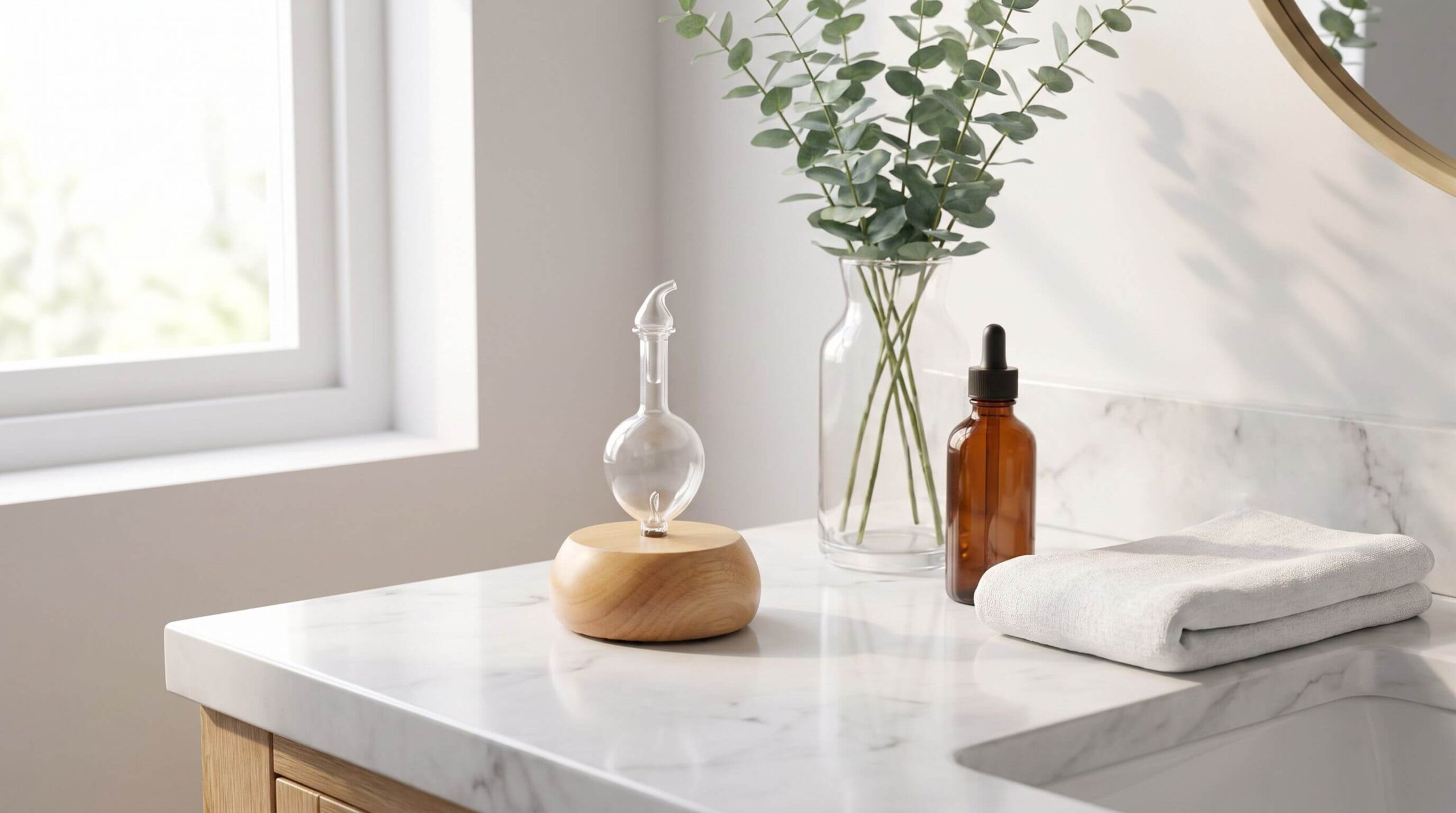
Eucalyptus is bright and assertive, so it pairs best with oils that either round off its sharp edge or lean into its freshness. These are the pairings we come back to:
Lemon: the easiest partner. Citrus softens eucalyptus’s medicinal edge and turns it sunny and clean, like a freshly washed kitchen.
Lavender: lavender’s floral, herbal linalool rounds eucalyptus out, making it softer and more spa-like.
Rosemary: a close chemical cousin that also contains cineole, so the two blend seamlessly into something herbal and green.
Spearmint: a gentler, sweeter mint than peppermint. It adds coolness without pushing the blend toward that Vicks smell.
Cedarwood: grounds eucalyptus’s bright top note and draws out its woody dry-down, so the blend smells like a forest after rain.
Three eucalyptus blends to try
Each recipe is in parts, so you can scale it to your bottle. Mix in a clean glass vial and let it rest for a day.
Clean Kitchen: 3 parts Lemon, 2 parts Eucalyptus, 1 part Rosemary. Bright, fresh and herbal. Lovely after cooking.
Spa Morning: 3 parts Lavender, 2 parts Eucalyptus, 1 part Spearmint. Soft, cool and calming, built for a bathroom or bedroom in the morning.
Forest After Rain: 3 parts Cedarwood, 2 parts Eucalyptus, 1 part Lemon. Green, woody and grounded. A good choice for a living room on a gray afternoon.
For more on why these ratios work, our essential oil blending chart explains top, middle and base notes.
Why a Nebulizing Diffuser® suits eucalyptus
A Nebulizing Diffuser® uses Bernoulli’s Principle: a fast stream of air passes over a fine glass tube, draws up pure oil and breaks it into a microscopic mist, with no water and no heat. Eucalyptus is a thin, fast-moving oil that nebulizes beautifully, and because the whole droplet is atomized at once, the fresh top notes and the woody dry-down reach the room together instead of the sharpest notes arriving first. Our guide on how to use a Nebulizing Diffuser® covers filling and settings, and what the oil actually touches explains why an all-glass oil path keeps a fresh oil smelling fresh.
Use short, intermittent cycles. Eucalyptus is strong, and your nose adapts to it quickly, so a few minutes on and a longer pause off keeps the scent noticeable. Our post on making your house smell good and keeping it noticeable explains why pulsing beats running a scent constantly. You can browse the full handcrafted Nebulizing Diffuser® collection when you’re ready.
The “Eucalyptus” That Smells Like Lemon or Peppermint
Here’s something that surprises most people: “eucalyptus” is a common name for hundreds of trees, and they don’t all smell alike. Most eucalyptus essential oil is cineole-type, but at least two well-known “eucalyptus” oils smell nothing like the classic:
Lemon eucalyptus: smells like citronella
Lemon eucalyptus, or lemon-scented gum, is now classified as Corymbia citriodora, a close relative that was moved out of the Eucalyptus genus. Its leaf oil is dominated by citronellal, often 65 to 80% or more, the same lemony-green aldehyde behind citronella grass. Crush a leaf and you’d never guess it was a “eucalyptus”: it smells sharply lemony, waxy and green, with almost no camphoraceous note at all. (It’s also the source of a different, chemically processed ingredient used in some insect repellents, which isn’t the same thing as the essential oil.)
Broad-leaved peppermint: smells like mint
Eucalyptus dives, known in Australia as broad-leaved peppermint, makes an oil rich in piperitone, typically around 40 to 55%. Piperitone has a distinctly minty, herbal, slightly camphoraceous smell, which is where the tree gets its common name. It’s mostly used commercially as a source material for making other aroma chemicals, and it smells more like a cross between peppermint and eucalyptus than either one.
So when someone says eucalyptus smells “lemony” or “minty,” they may well have smelled a different tree. If you’re choosing between the classic cineole-type eucalyptus oils, our complete guide to eucalyptus essential oil compares the common types. And for another oil whose name hides surprising chemistry, see why tea tree oil turns harsh in the bottle.
Why Australia’s Blue Mountains look blue (it isn’t the smell)
You may have heard that eucalyptus forests release so much oil that they tint the air blue. The famous blue haze over Sydney’s Blue Mountains is real, but the popular “oil droplets” story is a simplification. Australia’s CSIRO explains that the haze comes from a chemical reaction in the atmosphere driven by isoprene, a compound trees emit, and that eucalypts are among the highest emitters of these biogenic volatile compounds of any trees. Isoprene isn’t what you smell in a eucalyptus leaf, so the haze and the scent come from different chemistry. The smell of a warm eucalyptus forest after rain, though, is very much the leaf oil.

Join Our Exclusive Member Club to get Big Discounts!
What Does Eucalyptus Smell Like? FAQs
How would you describe the smell of eucalyptus?
Fresh, cool, clean and camphoraceous, with a green, leafy brightness, a soft pine-like sweetness and a gently woody dry-down. A freshly crushed leaf smells greener and more alive than the bottled oil.
Does eucalyptus smell like Vicks?
Only partly. Vicks VapoRub lists camphor 4.8%, menthol 2.6% and eucalyptus oil 1.2% as its active ingredients, plus cedarleaf, nutmeg, thymol and turpentine. The familiar “Vicks” smell is mostly camphor and menthol. Pure eucalyptus is greener and softer, with less icy mint.
Why doesn’t my eucalyptus plant smell?
Eucalyptus stores its oil in sealed glands inside the leaf, so an intact leaf smells faint. Crush or bruise a few leaves to release the scent. Dried and especially glycerin-preserved stems also lose much of their natural oil, so they smell milder than fresh ones.
Which smells stronger, fresh or dried eucalyptus?
Fresh eucalyptus smells stronger and greener. Dried eucalyptus is milder and woodier but lasts much longer, and preserved eucalyptus is usually the faintest of the three.
What scents go well with eucalyptus?
Lemon, lavender, rosemary, spearmint and cedarwood are all excellent partners. Citrus softens eucalyptus’s sharp edge, lavender makes it more spa-like, and cedarwood draws out its woody side.
Is eucalyptus safe to diffuse around pets?
Eucalyptus is one of the oils to be cautious with around cats, which process some essential oil compounds poorly, and dogs can be sensitive too. Diffuse only in a well-ventilated room for short, intermittent sessions, keep a door open so pets can leave, and never apply oils to pets. Our guides to oils and cats and dogs go into more detail, and ask your veterinarian if you’re unsure.
Who should be careful with eucalyptus oil?
Eucalyptus oil is potent. Keep it well away from young children’s faces, never ingest it, and dilute it well and patch-test before any skin use. If you’re pregnant, nursing, managing a health condition or taking medication, ask your clinician before using any essential oil.
So what does eucalyptus smell like? Not quite the blue jar you remember: it’s greener, cooler and more forest-like, with a soft woody sweetness under that clean, camphoraceous lift. Crush a leaf to smell it at its freshest, pair it with lemon or lavender to soften its edge, and diffuse it in short bursts to keep it bright. Start with our pure Eucalyptus Essential Oil (or the pre-diluted Eucalyptus Roll-on for on the go), and if you enjoy exploring scent, read what bergamot smells like and what ylang ylang smells like next.