

How to Make Your House Smell Good (and Keep Noticing It): The Odor Math Most Tips Miss
If you’ve searched for how to make your house smell good, you’ve probably seen the same list everywhere: simmer a pot of citrus, light a candle, sprinkle baking soda, buy a plug-in. Those tips aren’t wrong, but they skip two questions. Why does a bad smell keep winning no matter how much scent you add? And why does your own home seem to smell of nothing at all, even when guests say it smells lovely?
This guide answers both with some odor science, then gives you a simple order of operations: find the source, move the air, choose a clean scent, and pulse it so you keep noticing it. Most lists skip the first and last steps, and those two make the biggest difference.
How to Make Your House Smell Good: Why Covering Up Doesn’t Work
Every smell has a detection threshold, the lowest concentration in the air that a typical nose can pick up. Between 1976 and 1988, Yoshio Nagata of the Japan Environmental Sanitation Center measured those thresholds for 223 compounds using the same panel method, the triangle odor bag test that Japan later wrote into its odor-control law. Because every compound went through the same procedure, the results can be compared directly. They’re among the most widely cited odor-threshold measurements published by Japan’s Ministry of the Environment.
Set the classic household bad smells next to the main molecules in a fresh citrus or pine scent, and you can see why covering a smell up so often fails:
Limonene (the main molecule in lemon and sweet orange oil): 0.038 ppm, or about 38 parts per billion.
α-Pinene (the fresh note in pine, rosemary and eucalyptus): 0.018 ppm, about 18 parts per billion.
Hydrogen sulfide (rotten egg, sewer gas): 0.00041 ppm. About 90 times easier to detect than limonene.
Isovaleric acid (sweaty socks, gym bags): 0.000078 ppm. About 490 times easier.
Methyl mercaptan (rotting food, drains, cabbage water): 0.000070 ppm. About 540 times easier.
Trimethylamine (fishy bins and fridges): 0.000032 ppm. About 1,200 times easier.
Geosmin (musty, damp, earthy): 0.0000065 ppm. Nearly 6,000 times easier.
Skatole (fecal): 0.0000056 ppm. Close to 7,000 times easier.
Put simply, your nose is tuned to catch rot, damp and waste at concentrations hundreds or thousands of times lower than the ones where it registers a pleasant scent. A drain or bin putting out a tiny trickle of sulfur compounds is a loud signal. To shout over it with lemon, you’d need a huge amount of oil in the air, which is how rooms end up smelling like “drain with a hint of citrus.”
More oil isn’t the answer either
Smell intensity doesn’t rise in step with concentration. Psychophysicists who measure this have found that, for most odors, perceived strength grows much more slowly than the amount in the air, so doubling the oil makes a room smell stronger, but nowhere near twice as strong. When two smells mix, the nose also tends to perceive each as weaker, but the one with the lower threshold usually stays identifiable underneath. That’s why heavy fragrance over a real source tends to read as “someone is hiding something” rather than as clean.
One more exception is useful to know. Ammonia’s threshold is 1.5 ppm, roughly 40 times higher than limonene’s, so a sharp cleaning-product or ammonia edge is relatively easy for a fresh scent to soften. The “catty” part of pet urine odor is different, because it comes from sulfur compounds. Our guide to pet-safe air freshening explains why that one keeps coming back on humid days.
And then there’s nose-blindness
The second reason your home doesn’t seem to smell of anything is olfactory adaptation. With steady exposure, your nose and brain turn down the volume on a constant smell within minutes. That’s why guests notice your home’s scent the moment they walk in and you don’t, and why a plug-in that runs all day seems to “stop working” while it keeps on emitting. We covered the basics in how long to diffuse essential oils. Step 4 below shows how to use adaptation to your advantage.
Step 1: Find and Remove the Source
Given those thresholds, the most effective thing you can do to make a home smell good costs nothing: find whatever is putting out the low-threshold molecules and deal with it. Here are the eight places to check, roughly in order of how often they’re the culprit.
1. Dry drain traps (the hidden sewer smell)
Every sink, shower, tub and floor drain has a U-shaped bend, the P-trap, that holds a small plug of water. That water is the only thing stopping sewer gas, which is rich in hydrogen sulfide and mercaptans, from drifting back into the room. In a guest bathroom, a basement floor drain or a shower nobody uses, the water slowly evaporates, especially in dry, heated winter air, and the seal is gone.
The fix: run water down every rarely used drain for a few seconds once or twice a month. For drains that dry out quickly, plumbers often suggest adding a spoonful of mineral oil after the water. It floats on top and slows evaporation. If a sewer smell comes back soon after you refill a trap, call a plumber, because a blocked vent or failed seal needs a real repair, not fragrance.
2. Garbage disposal and sink strainer
Food scraps trapped under the rubber splash guard are a classic mercaptan source. Lift the guard and scrub its underside with a brush and dish soap, then flush with plenty of cold water.
3. Dishwasher filter
Most modern dishwashers have a removable filter at the bottom that many people never clean. Twist it out, rinse off the trapped food, and scrub it gently once a month.
4. Bins, fridge and freezer seals
Wash the bin itself, not just the bag, since liquid collects in the bottom. In the fridge, check the drip pan, the crisper drawers and the rubber door seals, where spills hide and trimethylamine-type fishy smells build up.
5. Washing machine gasket and drawer
Front-loaders hold water in the folds of the door gasket and the detergent drawer, which is perfect for musty, geosmin-type smells. Wipe the gasket dry after the last load, leave the door ajar, and run the manufacturer’s cleaning cycle.
6. Soft furnishings
Sofas, rugs, curtains and bedding soak up cooking, smoke and body odors and release them slowly. Wash what you can, vacuum upholstery, and air cushions outside on a dry day. For lingering smoke specifically, our guide to removing cigarette smoke smell goes step by step.
7. HVAC and vacuum filters
A clogged furnace or air conditioning filter recirculates the same stale air through every room. Check it monthly in heating season and change it on schedule. A vacuum with a full bag or dirty filter can also blow a dusty smell around the room every time you clean.
8. Damp corners and pet zones
Geosmin is the reason damp has such a distinctive earthy smell, the same molecule behind the scent of rain we explored in the science of petrichor. Outside it smells lovely. Inside, it’s a sign of moisture. Look under sinks, behind furniture on outside walls, and in closets. Wash pet bedding often and clean litter areas daily. For bathrooms specifically, see how to remove bathroom odors.
Sign Up to Get Your FREE
e-Book Here…
Step 2: Move and Refresh the Air

Once the source is gone, the leftover odor molecules still need somewhere to go. Moving air is the one thing that removes them rather than covering them.
Ventilate in short, sharp bursts
Open windows on opposite sides of the house for 5 to 10 minutes. A cross-breeze changes the air in a room far faster than one window open a crack all day, and in cold weather a short burst loses less heat. The best times are first thing in the morning, after cooking, and after showers. Run kitchen and bathroom extractor fans for a while after you finish, not just while you’re cooking or showering.
Watch the humidity
Damp air holds on to smells and feeds the musty ones. Indoor humidity in the middle range feels and smells fresher. Our comparison of waterless diffusion and humidifiers explains the target range and why water-based devices can tip a room toward damp if you overdo it.
Houseplants: lovely, but not air filters
You’ll often read that houseplants purify the air, usually citing a 1989 NASA chamber study. Real homes are very different from small sealed test chambers. When researchers Bryan Cummings and Michael Waring reviewed decades of these studies in 2019, they found that ordinary ventilation dilutes airborne compounds far faster than plants can absorb them. By their calculation, you would need 100 to 1,000 plants per square meter of floor to match a couple of open windows. Keep plants because they’re beautiful and calming to look at, and some, like flowering jasmine or a pot of rosemary on a sunny sill, add a gentle scent of their own. Just don’t count on them to clear odors.
Be cautious with gadgets too. Ozone generators and some “ionizing” air fresheners create ozone, which reacts with scented molecules in the air. We explain the chemistry in our guide to non-toxic home fragrance, including why skipping these devices is the simplest choice.
Step 3: Choose a Scent Method That Doesn’t Create New Problems
With a clean, well-aired home, now a little scent goes a long way. The method you choose matters, because some popular options trade one problem for another.
Simmer pots. Citrus peel, cinnamon and cloves in water on the stove smell wonderful and cost almost nothing. They add humidity, though, and they need watching. Never leave one unattended.
Candles. Beautiful for atmosphere, but burning wax creates soot and combustion byproducts, and many scented candles use synthetic fragrance. Our comparison of candles and pure-oil diffusion covers the trade-offs in detail.
Plug-ins and sprays. Convenient, but most run on fragrance oils, and plug-ins emit continuously, the exact pattern that makes your nose tune them out. Our guide to natural air fresheners explains what a “natural” label does and doesn’t promise. If you like sprays, make your own with our room spray recipes, which actually stay mixed.
Ultrasonic diffusers. These vibrate a mix of water and a few drops of oil into a mist. The oil is diluted, they add moisture, and the water tank needs regular cleaning so it doesn’t turn musty itself.
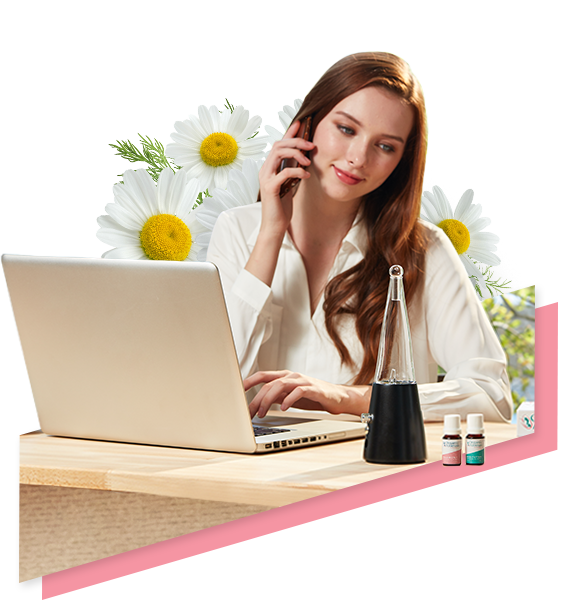
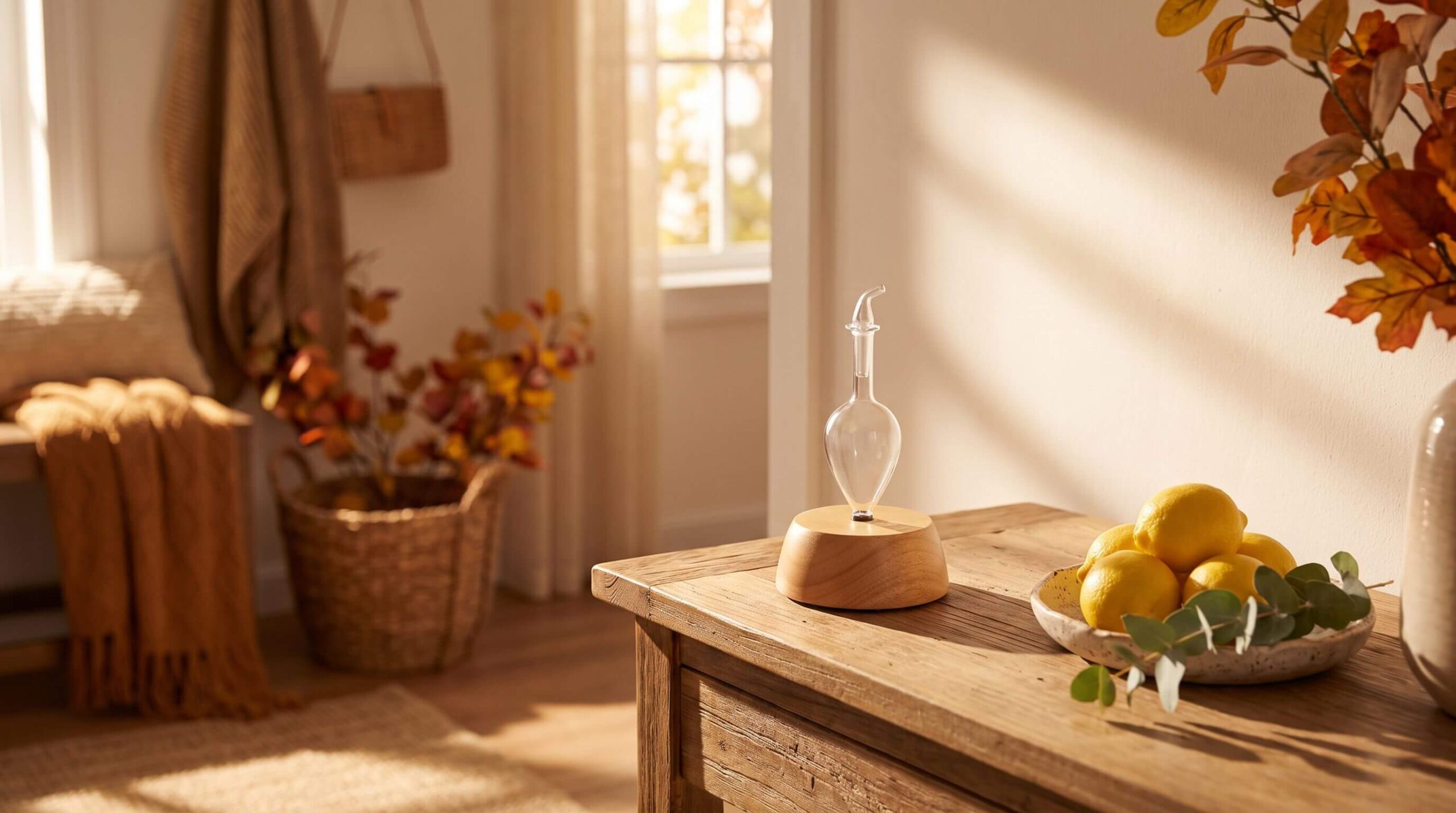
A Nebulizing Diffuser®. This uses Bernoulli’s Principle: a stream of air across a fine glass tube draws up pure essential oil and breaks it into a fine mist. There’s no water, no heat and no flame, so you get the whole oil as it was bottled, and you can switch it on and off in short sessions, which matters a lot in Step 4.
Signature scents, room by room
Mix these in parts so you can scale them to any bottle. Each one is a starting point, so adjust it to your nose.
Entryway, the first impression: Welcome Home, our ready-made blend of pine, cedarwood, lemon, eucalyptus, petitgrain and a touch of jasmine. It’s crisp at the door and warm a minute later.
Kitchen, after cooking: 3 parts Lemon, 2 parts Rosemary, 1 part Peppermint. Bright and herbal. Air the room first, then run a short session.
Living room, for gatherings: 3 parts Sweet Orange, 2 parts Bergamot, 1 part Cedarwood. Warm, sunny and easy for almost everyone to like.
Bathroom: 2 parts Eucalyptus, 2 parts Lemon. Clean and fresh, once the drain trap is full and the fan has run.
Bedroom, winding down: 3 parts Lavender, 1 part Cedarwood. Soft and calming, for the last half hour before bed.
For more combinations, including blends for the laundry room and home office, see our room-by-room air freshener recipes and our picks of the best essential oils for home.

Sign Up to Get Your FREE Essential Oils e-Book Here
Step 4: Pulse the Scent So You Keep Noticing It
This is the step almost nobody mentions, and it’s the answer to the most common complaint on cleaning forums: “How do I keep my house smelling good for longer?” Often the scent hasn’t faded. Your nose has adapted to it.
Adaptation responds to a constant signal. Give your nose a break, even a few minutes without the scent, and it begins to recover its sensitivity. That means intermittent scent comes across as fresher and stronger than continuous scent, while using less oil. A home that’s lightly scented in waves smells better to the people who live in it than one that’s heavily scented all day.
How to pulse with a Nebulizing Diffuser®
Use interval mode. On our classic models, interval mode runs about 2 minutes on and 1 minute off. That rhythm builds the scent in the room without letting it flatten into the background.
Keep sessions short. 30 to 60 minutes is plenty for most rooms. Then switch it off and let the room, and your nose, reset.
Time it to moments. Run a session before guests arrive, after you’ve aired the kitchen, while you tidy on a Sunday morning, or in the half hour before bed. Come back into the room after a break and you’ll notice the scent again, just as a guest would.
Rotate blends. Switching between two or three signature scents through the week keeps your home from settling into one background note you stop noticing.
The Raindrop Smart Nebulizing Diffuser® makes this effortless, because you can schedule short sessions from your phone. Set a session for 20 minutes before you usually get home and the house greets you with a fresh scent at the door. For larger open-plan spaces, our guide to scenting a large room helps match the model to the space. Browse every model in our handcrafted Nebulizing Diffuser® collection.
Keep it simple to maintain, too. A quick rinse of the glass with isopropyl alcohol, as shown in our guide on how to clean your Nebulizing Diffuser®, keeps every blend smelling true.
How to Make Your House Smell Good: Frequently Asked Questions
How do I make my house smell good all the time?
Start by removing odor sources, especially dry drain traps, the garbage disposal, the dishwasher filter, bins and soft furnishings. Air the house in short cross-breezes each day. Then add scent in short sessions rather than nonstop. Scent in waves stays noticeable, while a constant scent fades into the background for the people who live there.
Why can’t I smell my own house?
It’s olfactory adaptation, often called nose-blindness. Your nose and brain turn down the volume on any smell that stays constant, usually within minutes. Guests arriving from outside haven’t adapted yet, so they notice your home’s scent, good or bad, right away.
Why does my house smell bad even after I spray air freshener?
Most household bad smells, such as sewer gas, rotting food, musty damp and fishy bins, can be detected at concentrations hundreds to thousands of times lower than fresh scents like lemon. A small source easily outshouts a lot of fragrance. Find and remove the source first, then add scent.
What houseplants make a house smell good?
Scented plants such as jasmine, gardenia, rosemary, mint, lavender and scented geraniums add a gentle fragrance, especially in bloom or when you brush their leaves. They’re lovely, but they don’t clear odors from the air. Ventilation does far more.
How do I make a natural air freshener at home?
The simplest option is to diffuse pure essential oils in short sessions in a Nebulizing Diffuser®. You can also make a room spray, but water and oil don’t mix on their own, so follow a recipe that uses a proper solubilizer or high-proof alcohol.
What is the fastest way to make a house smell good before guests arrive?
Take out the trash, run water down any unused drains, open windows on opposite sides for 5 to 10 minutes, then close them and run a 20 to 30 minute session of a bright blend in the main rooms. Switch it off just before guests arrive, so the scent is noticeable but not heavy.