



Glass Diffuser for Essential Oils: What the Oil Actually Touches (2026 Guide)
Search for a glass diffuser for essential oils, or simply a glass oil diffuser, and you’ll get pages of beautiful products, but they aren’t all the same kind of machine. Some are plastic water tanks under a decorative glass dome. Some hold water in a real glass bowl but still make mist with a vibrating plate in a plastic base. Only one design keeps the oil in contact with nothing but glass from the moment you pour it until it leaves as mist.
That difference matters for more than looks. Food scientists have spent forty years measuring what happens when citrus and floral aroma compounds sit against plastic. They call it flavor scalping, and the numbers are bigger than most people expect. This guide sorts out the three designs sold as “glass diffusers”, shows what the oil actually touches in each, walks through the research, and gives you a five-point check for reading a product listing. Then we’ll cover shapes, oils and how to care for the glass so it lasts for years.
What Is a Glass Oil Diffuser? Three Designs, One Name
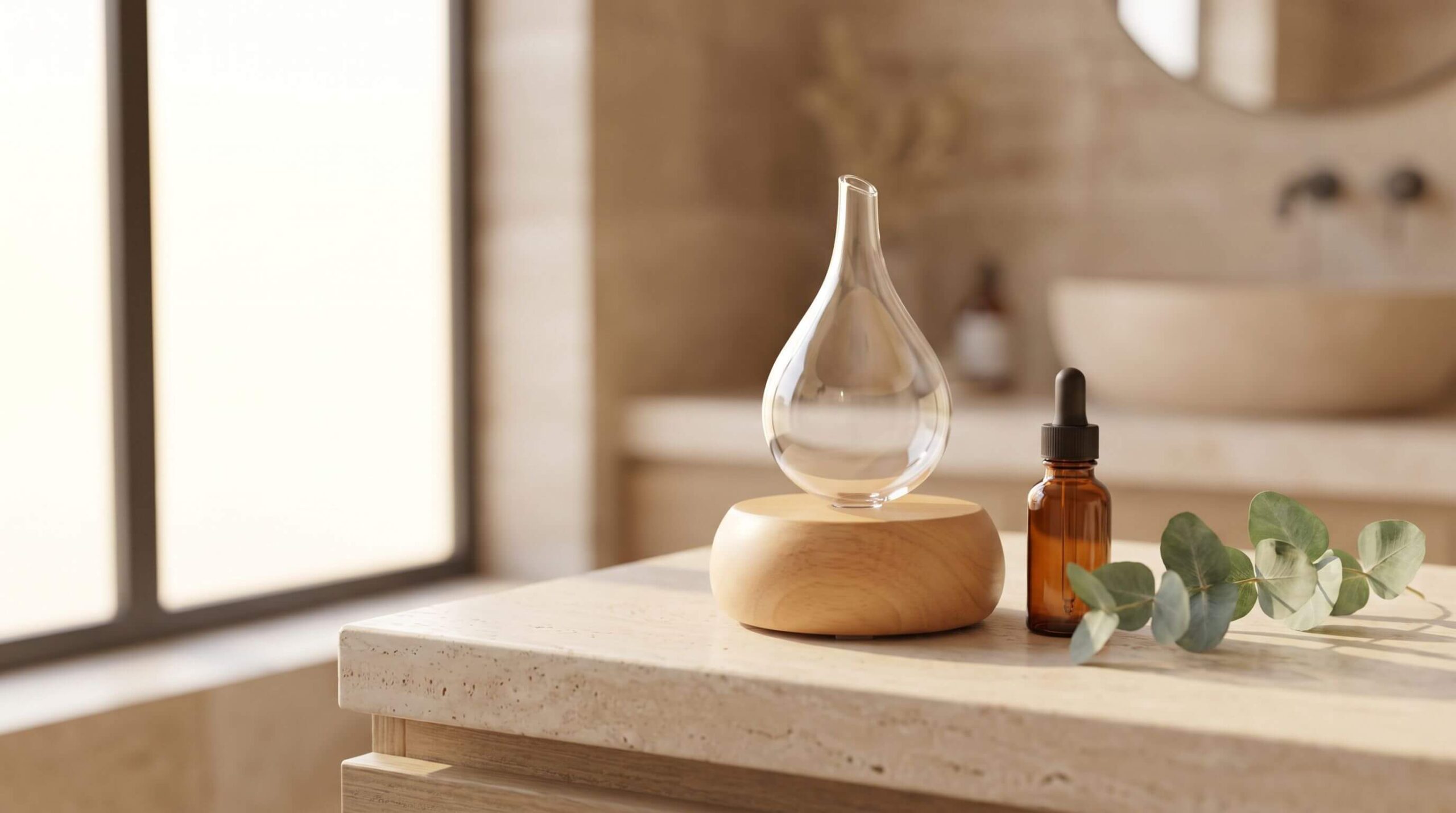
“Glass diffuser” is a style label, not a technology. When you read the specifications rather than the headline, almost every product falls into one of three groups.
1. Glass-cover ultrasonic diffusers
These are the most common. Inside sits a standard ultrasonic unit: a water tank, a small vibrating disc and a fan. The glass is a dome or shell that sits over it. One popular listing spells this out in its own title: “Glass Cover & Plastic Reservoir.” Others say “glass cover with wood base” in the specifications. The glass looks lovely, but your oil never touches it. It floats on water inside a plastic tank.
2. Glass-reservoir ultrasonic diffusers
A step up. The water bowl itself is glass, often hand-blown, and you fill it with tap water and a few drops of oil. Mist is still made by a disc vibrating at about 2.4 MHz, and the electronics sit in a base that listings usually describe as “BPA-free”, which tells you it is plastic. These are a real improvement over a plastic tank, but they are still water-based: what you breathe is mostly water vapor carrying a trace of oil.
3. Glass nebulizing diffusers
A nebulizer has no water at all. A small pump in the base pushes air across the tip of a glass micro-tube, the pressure drop described by Bernoulli’s Principle draws pure oil up a second tube, and the oil is sheared into a fine, dry mist inside the glass reservoir. Every Organic Aromas Nebulizing Diffuser® is built this way, with hand-blown, medical-grade Pyrex glass on a wood or ceramic base. If you want the physics in detail, read how a Nebulizing Diffuser® really works.
You’ll also see “glass diffuser” used for passive pieces: reed diffuser bottles, glass pendants and car vents. They have no motor, and the scent depends on evaporation. Reed liquids are usually mostly solvent with a little fragrance, so they’re a different product for a different job. This guide focuses on electric diffusers.
Why Glass Matters: What Plastic Does to Essential Oils
Most diffuser guides say glass is better because it “doesn’t absorb odors.” That’s true, but they rarely explain why or how much. The best evidence comes from an unexpected place: orange juice cartons.
Flavor scalping, measured
Food packaging scientists use “scalping” for aroma compounds that migrate out of a food and into its plastic container. Their favorite test molecule is d-limonene, the main aroma compound in orange, lemon and grapefruit oils. A widely cited review by Sajilata and colleagues in Comprehensive Reviews in Food Science and Food Safety (2007) gathers the results:
About 70% of the limonene in cold-pressed orange oil was lost after 4 days in contact with low-density polyethylene (LDPE), the soft plastic used in films and squeeze bottles. Against high-density polyethylene and polypropylene, the stiffer plastics used in most molded tanks, the loss was still about 30%.
Orange juice in LDPE-lined packaging lost about 50% of its limonene in two weeks (Durr and colleagues, 1981).
In a 2014 Food Chemistry study of white wine stored for six months, an LDPE bag-in-box scalped 31% of the limonene. The wine stored in glass kept the largest share of its aroma compounds.
The reason is chemistry. Limonene and similar terpenes are non-polar, oily molecules, and so are polyolefin plastics. To limonene, a polypropylene wall is somewhere to dissolve into. Glass is an inorganic network of silicon and oxygen with no spaces for an aroma molecule to settle, so there’s nothing to absorb into.
It isn’t just citrus
The same review notes that linalool, the soft floral alcohol behind lavender, bergamot and coriander, is even more soluble in polyethylene than limonene. That matters because linalool is often a minor component in a juice but a major one in your favorite evening oils. Our guide to why delicate esters don’t survive most diffusers explains why the soft top notes are always the first to go.
Why yesterday’s peppermint shows up in today’s lavender
Absorption works in both directions. What a plastic wall takes in, it slowly gives back. One study cited in the review found limonene still held in the walls of PET bottles after they had been washed with sodium hydroxide, the caustic used in industrial bottle cleaning. That’s the “ghost scent” plastic diffuser owners describe: a tank that never quite smells neutral again. Glass rinsed with alcohol goes back to smelling of nothing.
A fair caveat: these are food-packaging studies, not diffuser tests, and we aren’t aware of a published study that measures scalping in diffuser tanks. In an ultrasonic, the oil is also diluted in water, which slows the transfer. But the mechanism is the same, and essential oils are far more concentrated than juice. That’s why every Organic Aromas reservoir, tube and cap that touches your oil is glass. For the solvent side of the story, see our Friday FAQ on what citrus oils do to a diffuser.

Sign Up to Get Your FREE
e-Book ($9.99 Value)
Glass Cover vs Glass Reservoir vs Glass Nebulizer: What the Oil Touches
To compare the three designs, follow a single drop of oil from the bottle to the air.
Most oils float
Most essential oils are lighter than water. Limonene’s density is about 0.84 g/mL, and lavender oil is around 0.88. A few, such as clove and cinnamon bark, are slightly heavier and sink. In a water-based diffuser, your drops mostly spread into a thin film on the surface instead of mixing in. That film is where the oil is most concentrated, and the waterline is where it meets the wall of the tank.
In a glass-cover ultrasonic
The oil film rides on water in a plastic tank, touching the plastic walls at the waterline and the vibrating disc at the bottom. The glass dome above never touches the oil. Every point in the scalping research above applies here.
In a glass-reservoir ultrasonic
The waterline is glass, which is better. But the oil is heavily diluted. A typical dose of 5 drops (roughly 0.25 mL) in a 200 mL glass bowl comes to about 0.1% oil, so more than 99% of the mist is water. You also add a water-and-mineral cleaning routine, which we cover in our comparison of diffusers vs humidifiers.
In a glass Nebulizing Diffuser®
The oil goes into the glass reservoir neat, climbs a glass micro-tube, is atomized inside the glass, and leaves through a glass cap. About 95% of the mist exits through the hole at the top of the cap. The mist is 100% essential oil, with no water and no heat. The only non-glass part near the oil is the rubber grommet that holds the glass stem in the base, and oil only reaches it if a drop runs down the outside. That’s why we recommend filling the glass off the base, as explained in our guide on how to use a Nebulizing Diffuser®.
Each design has a place. An ultrasonic is quiet, inexpensive and adds a little humidity. But if what you want from a glass diffuser is purity, only the nebulizer delivers it. Our honest nebulizing vs ultrasonic comparison goes through cost, noise and oil use side by side.
How to Spot a “Glass” Diffuser That’s Mostly Plastic: A 5-Point Listing Check
Product titles are written to rank, not to explain. These five clues in a listing tell you what you’re really buying.
1. “Glass cover”, “glass dome” or “glass shell”. The glass is decorative. Look further down for the tank material.
2. “BPA-free” anywhere in the specifications. BPA-free is a claim about plastic. If a part is described this way, that part is plastic.
3. A capacity in milliliters (100 mL, 200 mL, 500 mL). That’s a water tank. A nebulizer’s capacity is measured in drops, usually 15 to 25 at a time.
4. “Ultrasonic”, “2.4 MHz”, “humidifier” or “cool mist”. All of these describe water-based technology, whatever the outside is made of.
5. No answer to “what does the oil touch?” Ask the seller directly. A good brand will name every material in the oil path. For ours, the answer is glass.
Two more things are worth checking while you’re reading. First, colored LED lights almost always mean an ultrasonic, because the light shines through the mist. Second, look for spare parts. A hand-blown reservoir is the part most likely to meet a hard floor, so a brand that sells a Replacement Glass Reservoir Set and a Glass Cap Replacement on their own expects you to keep the unit for years.
If you’ve been putting up with a plastic tank, our list of reasons to switch to a plastic-free diffuser covers the practical side of making the switch.

Join Now and Get a Coupon for 10% Off!
Choosing a Glass Nebulizing Diffuser®: Shapes, Bases and Oils

Each Organic Aromas reservoir is hand-blown, so no two are perfectly identical. The shape affects how the unit looks and, slightly, how the mist rises, but every model uses the same nebulizing principle. Here’s how the main designs differ.
Glass shapes
Teardrop: the Raindrop Nebulizing Diffuser® is a small rounded bulb rising to a slim neck. It’s our most minimal design and suits desks and nightstands.
Swirl: the Radiance wraps a hand-blown spiral around the micro-tubes, so you can watch the glasswork as it runs. It’s our all-time most popular design.
Ribbed iridescent: Aurora pairs ribbed glass with a rainbow sheen on a ceramic base.
Compact cylinder: Redolence stands just 6 inches tall for bathrooms and shelves.
Three reservoirs: The Attar runs three glass reservoirs on three pumps and covers 1,600+ square feet for open-plan homes and studios.
Bases
Classic models sit on hand-crafted plantation hardwood in light or dark finishes, or on kiln-fired ceramic. Rechargeable models run cordless, and the Smart line adds app scheduling over Bluetooth. Our roundup of the best Nebulizing Diffusers® matches models to rooms if you’re choosing between them. You’ll find every design in the Nebulizing Diffuser® collection.
Oils that suit glass, and the thick ones that need help
Glass is the ideal home for the oils plastic treats worst: bright citrus, mints and linalool-rich florals such as lavender and bergamot. Very thick oils are a different matter. Vetiver, patchouli, myrrh, sandalwood and frankincense can slow the mist or block the micro-tubes if they’re run alone. Blend them as a minority with thinner oils, or thin them with Augeo Clean Multi, a clear diluent made for nebulizers. Never use water or carrier oils in any nebulizer.
Caring for a Glass Diffuser: Cleaning, Switching Scents and Avoiding Breakage
Glass rewards a little care with a very long life. Here is the routine we’ve refined over 12 years of customer questions.
Clean with alcohol, weekly
Clean the reservoir about once a week if you use it daily, and always right after thick oils. Pour 6 to 8 mL of isopropyl alcohol (70% or stronger) into the glass, swirl it, and use the pipette from the box to push alcohol through the micro-tubes. Let it air dry completely before refilling. Alcohol leaves glass perfectly clear, while it can cloud or craze some clear plastics such as acrylic and polycarbonate. Our full waterless cleaning method shows each step.
Switch scents without ghosts
This is where glass really earns its place. Moving from a citrus morning blend to a woody evening one takes a quick alcohol rinse and a few minutes to dry. Because nothing has soaked into the walls, the new blend smells exactly as it should.
Handle it like stemware
Lift the reservoir straight up and press it straight down. If it feels snug, gently rock it rather than twisting, which strains the glass stem. One longtime customer’s tip is in our “rock, don’t twist” glass-care ritual. Keep the unit away from the edge of a shelf and out of reach of pets’ tails. Keep it off radiators and sunny windowsills too, since heat speeds up the oxidation of oil left in the glass.

Join Our Exclusive Member Club to get Big Discounts!
Glass Diffuser for Essential Oils: FAQs
Are glass diffusers better than plastic ones?
For aroma, yes. Food-packaging research shows plastics such as polyethylene and polypropylene absorb citrus and floral aroma compounds (up to about 70% of the limonene from orange oil in four days against soft polyethylene), while glass absorbs essentially none. Glass also cleans back to neutral, so scents don’t carry over from one blend to the next.
Do glass diffusers use water?
It depends on the design. Glass-cover and glass-reservoir ultrasonic diffusers use water and a few drops of oil. A glass Nebulizing Diffuser® uses no water at all and diffuses pure essential oil.
Is a glass-cover diffuser really glass?
Only the outside. In most glass-cover models the oil and water sit in a plastic tank under the glass dome. Check the specifications for the tank material, or look for “BPA-free”, which means the part is plastic.
Can I use citrus oils in a glass diffuser?
Yes. Glass is the best material for citrus, because limonene can soften some plastics and is absorbed by others. In a nebulizer, rinse the glass with alcohol now and then, because old citrus oil can turn sticky as it oxidizes.
How do I clean a glass essential oil diffuser?
For a nebulizer, swirl 6 to 8 mL of 70% or stronger isopropyl alcohol in the glass, push some through the micro-tubes with a pipette, then let it air dry completely. Do this about once a week with daily use. Don’t use water in a nebulizer.
Is a reed diffuser in a glass bottle the same thing?
No. A reed diffuser is passive: liquid travels up the reeds and evaporates slowly, with no motor. Reed liquids are usually mostly solvent with some fragrance, so they give a gentle background scent rather than a room full of pure essential oil.
So when you shop for a glass diffuser for essential oils, look past the dome and ask what the oil touches. If the answer is a plastic tank, the glass is decoration. If the answer is glass from start to finish, you’ll smell your oils the way they smelled in the bottle, blend after blend, for years. For the bigger picture on how the two technologies compare, read our Nebulizing Diffuser® vs ultrasonic guide.





Very interesting