

What Is a Hydrosol? The Real Oil Content, the Rose-Water Paradox, and Why It Never Goes in a Nebulizing Diffuser®
What is a hydrosol? A hydrosol is the fragrant water left over after plants are steam distilled for their essential oil. It’s mostly water, carrying a tiny amount of dissolved plant aroma, which is why it smells like a softer, rounder version of the plant. You’ll also see hydrosols sold as hydrolats, floral waters or aromatic waters. Rose water and orange blossom water are the two most famous.
Almost every article about hydrosols turns into a list of skin-care uses. This one doesn’t. Instead, we went looking for the numbers nobody quotes: how much oil a hydrosol actually holds (far less than the popular figure), why rose water smells more like a rose than rose oil does, and why a bottle of hydrosol can spoil in your fridge while the essential oil beside it lasts for years. Then we’ll cover the question we get from customers: can it go in your Nebulizing Diffuser®? (Short answer: never. Here’s why.)
What Is a Hydrosol? A Simple Definition
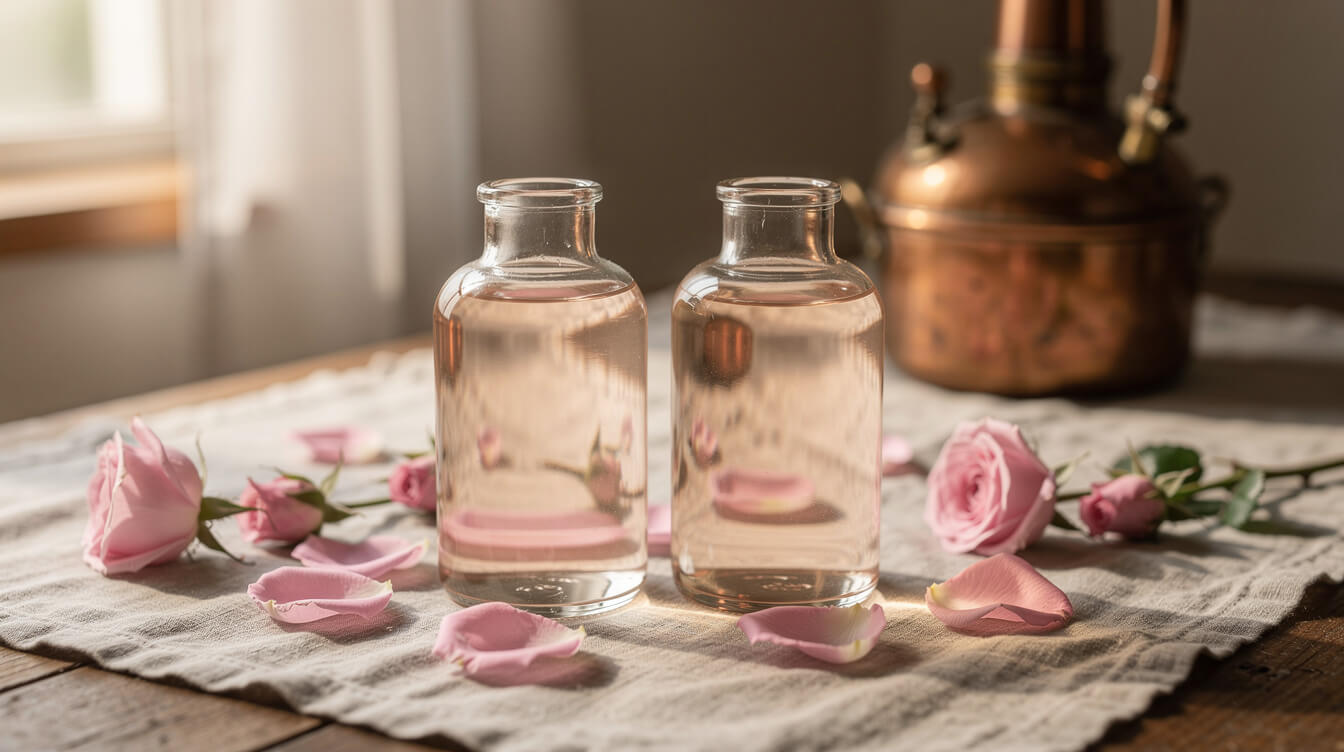
When a still pushes steam through plant material, the steam carries the plant’s aromatic molecules up and into a cooled coil. There, everything condenses back into liquid and runs into a separator. Most of the essential oil floats to the top and is drawn off. What remains below is the hydrosol: distillation water that has been in close contact with the oil and kept some of it. Our guide to how essential oils are made walks through the still and separator step by step.
Hydrosol, hydrolat, floral water: are they the same?
Mostly, yes. Hydrosol is the word you’ll see most in North America. Hydrolat is the term used in Europe and in much of the scientific literature. Aromatic water is the pharmacy term, and floral water or flower water is the traditional name for rose and orange blossom. All of them should mean the same thing: a co-product of distillation.
The catch is that “floral water” isn’t a protected term. Some products sold under that name are plain water with fragrance or a few drops of essential oil stirred in. We’ll show you how to tell the difference on the label further down.
Is a hydrosol just diluted essential oil?
No, and this is the most important idea in the whole post. A hydrosol isn’t essential oil plus water. It holds only the molecules that chose to stay in the water, and those are a very different crowd from the ones in the oil. That’s why lavender hydrosol doesn’t smell like lavender oil turned down. It smells like a different, softer, greener lavender. Two sections down, we’ll show exactly which molecules stay and which leave.
How Much Oil Is Actually in a Hydrosol?
If you’ve read about hydrosols before, you may have seen the figure “about 0.2% essential oil.” It’s the one number the top search results quote, and it appears to be several times too high.
The most useful measurement we found comes from a 2015 study in Food Research International (Labadie and colleagues, INRAE, France). The team analyzed 22 commercial hydrosols and measured how much essential oil was dissolved in each. The medians were:
Orange blossom (Citrus aurantium): 677 mg per liter, or about 0.07%
Damask rose (Rosa damascena): 205 mg per liter, or about 0.02%
Cabbage rose (Rosa centifolia): 116 mg per liter, or about 0.01%
So a typical hydrosol is roughly 0.01 to 0.07% oil, which means it’s 99.93 to 99.99% water. That lines up with our own distillation guide, which puts hydrosols at about 99.95% water. A separate analysis of Turkish rose water likewise found “below 0.1%” essential oil (Canbay, 2017).
What that looks like in drops
Numbers like 677 mg per liter are hard to picture, so here’s the conversion. One drop of essential oil is about 0.05 mL, or roughly 45 mg. That means:
A 100 mL bottle of orange blossom water holds about 68 mg of dissolved oil. That’s about one and a half drops.
A 100 mL bottle of cabbage-rose water holds about 12 mg. That’s about a quarter of a drop.
This is why a hydrosol is so gentle in the air and why you can mist it generously. It’s also why hydrosols are cheap compared with their oils. Rose otto is one of the most expensive essential oils in the world, but rose water is a supermarket staple. You’re buying the water the oil left behind, not a diluted version of the oil.
Sign Up to Get Your FREE
e-Book ($9.99 Value)
Why Rose Water Smells More Like Roses Than Rose Oil Does
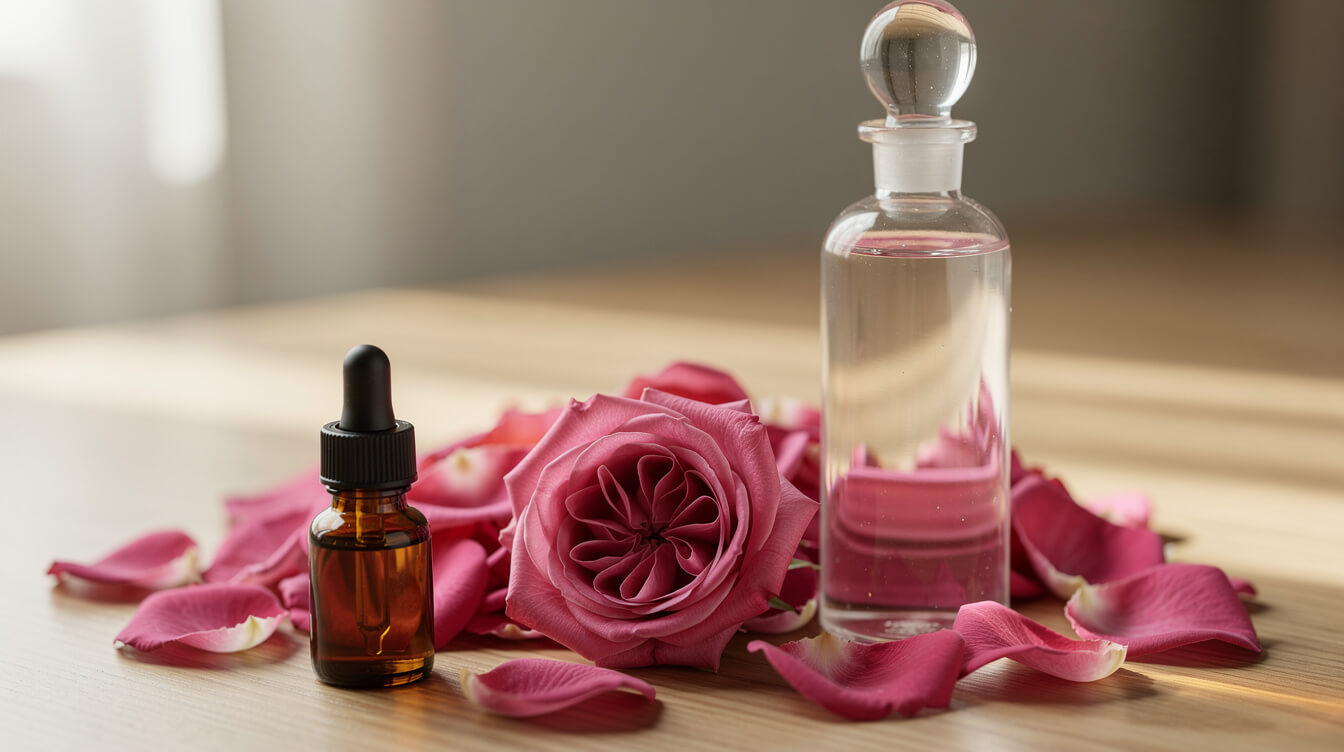
Here’s the jewel. Smell a fresh rose, then smell steam-distilled rose oil (rose otto). Many people are surprised: the oil smells greener, more lemony and more geranium-like than the flower. Now smell good rose water. It often smells closer to the living bloom. The reason is one molecule and its relationship with water.
The molecule that stays in the water
The classic honeyed, “fresh rose petal” note comes largely from 2-phenylethanol (also called phenylethyl alcohol). It’s unusually water-friendly for a fragrance molecule. Compare the water solubility of three common aroma molecules at room temperature:
2-Phenylethanol (rose): about 20 grams per liter
Linalool (lavender, orange blossom): about 1.6 grams per liter
Limonene (citrus peel): about 0.014 grams per liter
2-Phenylethanol dissolves about 1,400 times more readily in water than limonene does. So when rose petals are distilled, most of the phenylethanol never makes it into the oil layer. It stays behind in the water.
The standards show how lopsided that split is. ISO 9842, the international specification for damask rose oil, caps phenylethyl alcohol in the oil at 3.5% or less. The oil is dominated instead by citronellol and geraniol (20 to 34% and 15 to 22% respectively), the green, lemony, geranium-like rose notes. In rose hydrosol, it flips. One Croatian study of damask rose hydrosol measured 2-phenylethanol at about 76% of the volatile compounds.
In other words, the same flower gets split into two halves of its scent. The oil gets the bright citronellol-geraniol side. The water gets the sweet phenylethanol heart. Perfumers recover that heart with solvents instead, which is why rose absolute smells so much deeper and sweeter than rose otto. Our guide to absolutes vs essential oils covers how solvent extraction works.
Why other hydrosols smell different from their oils
The same rule applies to every plant. Hydrosols are enriched in water-friendly alcohols (linalool, α-terpineol, phenylethanol, citronellol) and depleted in hydrocarbons like limonene and pinene, which barely dissolve. The 2015 French study found orange blossom hydrosols were made up mainly of linalool and α-terpineol, while cabbage-rose hydrosols were mainly 2-phenylethanol and citronellol.
That’s why a citrus or conifer hydrosol often smells muted and floral-herbal rather than zesty or piney. The sparkling top notes of a citrus oil are mostly limonene, and limonene simply doesn’t stay in the water.
Hydrosol vs Toner vs “Floral Water” Sprays
Walk down any beauty aisle and you’ll see rose waters, facial mists and toners side by side. They can look identical, but they’re often very different products. A true hydrosol is a distillation co-product. A toner is a formulated product. A “floral water” spray might be either, or neither.
How to read the label
Turn the bottle around and look at the ingredient list (INCI):
A true hydrosol lists the plant’s distillate, such as Rosa damascena flower water or Citrus aurantium amara flower water, often first or alone. A gentle preservative may follow.
A made-up “floral water” usually starts with Aqua or Water, then lists Parfum or Fragrance, or an essential oil plus a solubilizer like polysorbate 20. That’s scented water, not a hydrosol.
A toner is a full formula that may contain a hydrosol alongside alcohol, glycerin, acids, extracts and fragrance.
None of these is “bad.” They’re just different things, and the price and the smell should match what’s actually inside. If you want to make your own scented room or linen spray from essential oils, the solubility problem works against you (oil and water don’t mix). Our room spray recipes explain what it takes to get oil to stay dispersed.
Where hydrosols shine in the home
Because they’re so light, hydrosols are lovely for scent jobs where essential oil would be too much: a fine mist over pillowcases and linens before bed, a spritz in a closet or a car, a softly scented ironing water, or a refresh for a room you’ve just aired out. Patch-test any fabric first, since some hydrosols are faintly colored.
Sign Up to Get Your FREE Essential Oils e-Book ($9.99 Value)
Can You Put a Hydrosol in a Diffuser?
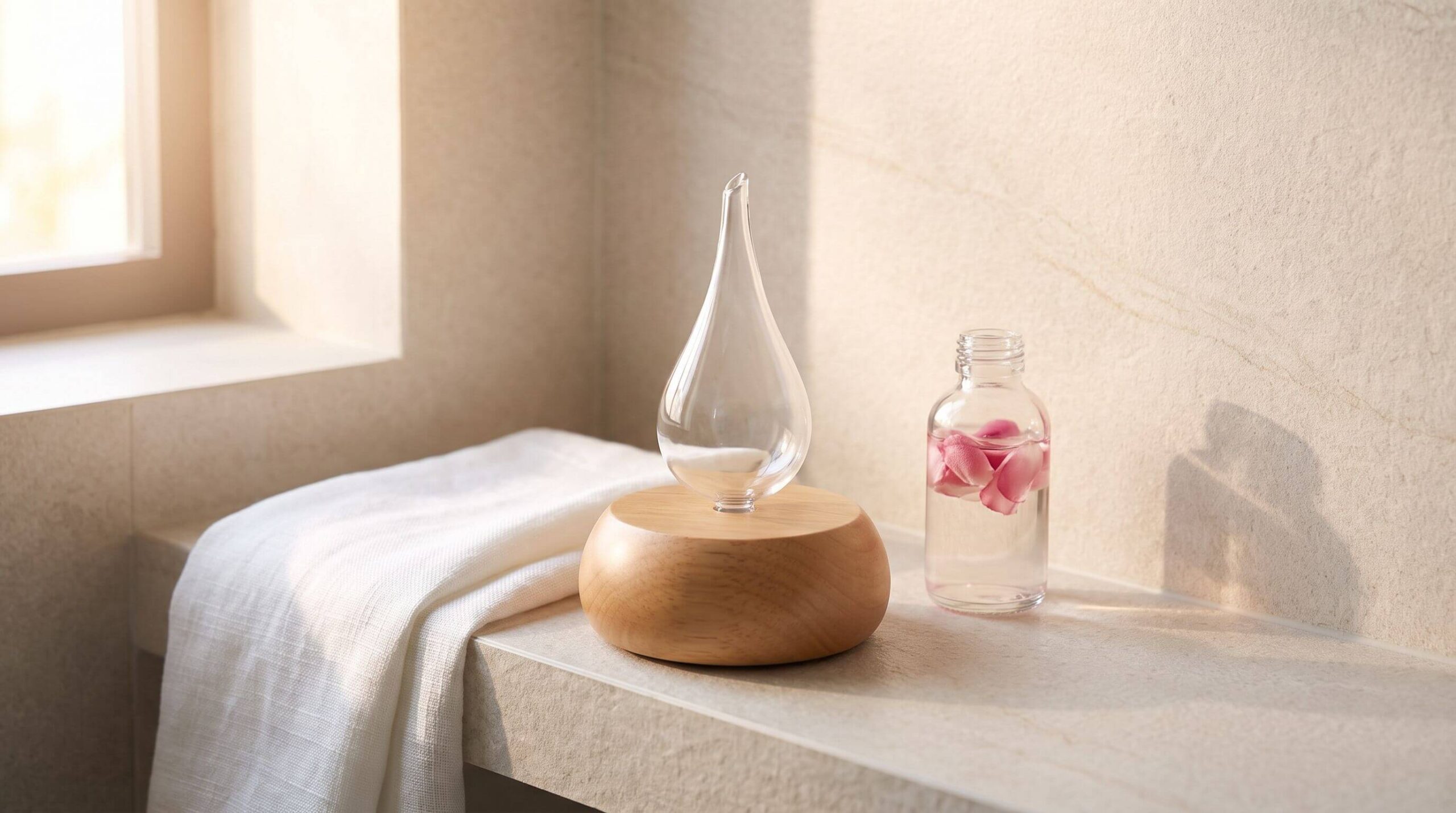
It depends entirely on the kind of diffuser, and for ours, the answer is a firm no.
Never in a Nebulizing Diffuser®
A Nebulizing Diffuser® is built to run on pure essential oil only. Our care instructions are blunt about it: never add water. A hydrosol is about 99.95% water, so it counts.
The reason is how nebulizing works. Using Bernoulli’s Principle, a fast jet of air passes over the tip of a fine glass tube, pulls oil up and shears it into a microscopic mist. That works beautifully with essential oils, which are thin and have low surface tension. Water is a different liquid entirely. Its surface tension is about 72 mN/m, roughly two to three times that of typical essential oil components, so it resists being broken into a fine mist. Instead of scenting the room, it tends to sit in the glass, wet the tubes and leave residue behind. Water and oil don’t mix, so you’d also be leaving a watery layer in a system designed to stay oil-clean.
If water ever does get into your unit, empty it, let the glass dry completely and follow the cleaning steps in our guide to using a Nebulizing Diffuser® before adding oil again. Our explainer on how waterless diffusers work covers the design in more detail.
What about an ultrasonic diffuser?
Ultrasonic diffusers already run on water, so a hydrosol won’t harm one mechanically. But be honest about what you’ll get. With 0.01 to 0.07% dissolved oil, the scent in a room is faint, and you’re mostly adding humidity. You’d also be turning the liquid into a breathable mist, so it matters what’s living in it (see the next section). If you try it, use only a fresh, refrigerated hydrosol with no cloudiness, and empty and wash the tank after every use.
How to get a soft, hydrosol-like scent from a Nebulizing Diffuser®
If what you love about hydrosols is their gentleness, you can recreate that feeling with oil. Pick soft, rosy, floral-alcohol oils, use less, and run short pulses. Try this “rose water” style blend, measured in parts so you can scale it:
Soft Rose Water: 3 parts Lavender, 2 parts Palmarosa, 1 part Rose Geranium. Palmarosa is rich in geraniol, one of the same rosy molecules found in rose oil, and rose geranium adds citronellol. Lavender’s linalool softens the blend, much like it does in a hydrosol.
Set your unit to its lowest setting and an intermittent cycle, and keep sessions short. A gentle, pulsed scent stays noticeable far longer than a constant one, as our guide to making your house smell good explains. Browse the full handcrafted Nebulizing Diffuser® collection to find your style.
Do Hydrosols Need to Be Refrigerated?
Yes, ideally. And the reason is the opposite of why essential oils keep so well.
Why hydrosols spoil and essential oils don’t
Pure essential oil is a hostile place for microbes: it has no water. A hydrosol is water carrying traces of plant compounds, and only a tiny amount of oil. That’s a growth medium, not a preservative.
The 2015 French study tested exactly this. In the 22 commercial orange blossom and rose hydrosols, bacterial counts reached about 10 million colony-forming units per milliliter (7 log CFU/mL). For comparison, the French Pharmacopoeia limit cited by the authors is 100 per milliliter. The bacteria included Pseudomonas, the Burkholderia cepacia complex and what appeared to be two new genera. The authors’ conclusion was blunt: the oil content of a hydrosol, or cold storage alone, is “not sufficient to insure microbiological stability.”
So the fridge slows spoilage. It doesn’t prevent it. Clean distillation, clean bottling and how you handle the bottle after opening matter just as much.
How long does a hydrosol last?
Hydrosol expert Suzanne Catty uses pH as a rough guide. In Hydrosols: The Next Aromatherapy (2001), she rates hydrosols with a pH of 5.0 or below at about two years, and those above 5.0 at about 12 to 18 months. She also suggests noting a hydrosol’s pH when you receive it, because a shift over time can be a sign of contamination.
Treat those as best-case shelf lives for a well-made, unopened hydrosol. Once a bottle is opened and used, especially with a pump or spray top, the clock speeds up.
Storage tips and signs of spoilage
Keep it cold and dark. The refrigerator is best. If not, a cool, dark cupboard away from heat.
Consider clear glass. Distiller Ann Harman recommends clear glass for storage because it lets you spot “blooms” (floating wisps or clouds of microbial growth) early. She also notes that HDPE plastic slowly absorbs the aromatic compounds, a problem we explored in our guide to glass vs plastic.
Don’t touch the opening. Pour or spray, never dip fingers or cotton pads into the bottle.
Throw it out if you see: cloudiness, floating strands or specks, slime, a sour or musty smell, or a scent that has gone flat or changed.

Join Our Exclusive Member Club to get Big Discounts!
What Is a Hydrosol? FAQs
What is a hydrosol good for?
Around the home, hydrosols are best for light scent jobs where essential oil would be too strong: misting linens and pillowcases, freshening a closet or car, scenting ironing water, or giving a just-aired room a soft finish. They’re gentle because they contain only about 0.01 to 0.07% dissolved oil.
What are hydrolats?
Hydrolat is the European name for a hydrosol. Both mean the aromatic water collected from steam distillation after the essential oil has been separated off. Aromatic water, floral water and flower water are other names for the same thing.
What is the difference between a toner and a hydrosol?
A hydrosol is a single ingredient, the water from distilling a plant. A toner is a formulated product that may include a hydrosol along with alcohol, glycerin, acids, extracts or fragrance. Check the ingredient list: a true hydrosol names the plant’s “flower water” or distillate, not “aqua” plus “parfum.”
Do hydrosols need to be refrigerated?
Refrigeration is recommended because hydrosols are water-based and can grow bacteria and mold. Cold storage slows spoilage but doesn’t stop it, so also keep the bottle clean, use it within its shelf life and discard it if it turns cloudy, slimy or smells off.
Is a hydrosol the same as an essential oil?
No. An essential oil is the concentrated, oil-based part of the plant’s aroma. A hydrosol is the water left behind, holding only the most water-soluble molecules in tiny amounts. They smell related but different, and they’re used in different ways.
Can I make a hydrosol by mixing essential oil with water?
Not a true one. Essential oil and water don’t mix, and stirring a few drops into water gives you scented water with oil floating on top, not a hydrosol. A real hydrosol comes from distillation, and its makeup (rich in water-soluble alcohols) can’t be copied by mixing.
So what is a hydrosol? It’s the water side of distillation: about 99.95% water, with a whisper of the plant’s most water-loving molecules. That’s why rose water smells like the rose petal and rose oil smells like the rose garden, and why hydrosols belong in the fridge, not the cabinet. Enjoy them as linen and room mists, keep them cold and clean, and keep your Nebulizing Diffuser® for what it does best: pure, undiluted essential oil.