


Is a Waterless Diffuser Better? How They Work, the 5 Types, and Which One to Buy
A waterless diffuser scents a room without mixing essential oil into water. Instead of floating a few drops on a tank of water, it turns the oil itself into airborne particles, using air pressure, a fan, gentle heat or a sealed cartridge. The result is a stronger, truer aroma with no water tank to clean.
But “waterless” covers five very different machines, and only one of them puts the whole oil into the air. The others release the lightest molecules first and leave the rest behind, which is why a waterless diffuser can smell bright for ten minutes and flat for the next hour. Below we explain how each type works, compare waterless and water diffusers side by side, do the honest math on oil use, and help you pick the right model.
Short answer: is a waterless diffuser better? For scent, yes. A waterless nebulizing diffuser puts the whole essential oil into the air at full strength, with no water to dilute it and no tank to grow mold. A water diffuser costs less to run and adds a little humidity, so it suits people who mainly want moist air. If you want the room to actually smell like the oil, go waterless. Shop waterless diffusers.
How Does a Waterless Diffuser Work?
The most effective waterless design is the nebulizing diffuser, and it runs on a principle from 1738. A small air pump pushes a fast stream of air across the top of a narrow glass tube that sits in your oil bottle or reservoir. Fast moving air has lower pressure (Bernoulli’s Principle), so the oil is drawn up the tube. When it meets the air jet it shatters into a fine cloud of micro droplets, which then drift out of the glass and into the room.
Three things never happen in that process. Nothing is heated, so delicate aroma molecules are not cooked off. Nothing is diluted, so you smell the oil at full strength. And there is no standing water, so there is nothing for mold or film to grow in. Our Nebulizing Diffuser® uses exactly this mechanism with a hand blown borosilicate glass reservoir on a wood or ceramic base. If you want the full engineering story, read how a Nebulizing Diffuser really works.

The 5 Types of Waterless Diffusers (and What Each Puts in the Air)
Most articles treat every waterless diffuser as the same thing. They are not. Here is what each type actually does to your oil:
| Type | How it works | What reaches the air | Best for |
|---|---|---|---|
| Nebulizing | Air pump and Bernoulli effect atomize liquid oil | The whole oil, all molecules at once, in their natural ratio | Pure essential oils at home or work, strongest true aroma |
| Cold air scent machine | Compressed air atomizes oil, often connected to a fan or HVAC | Fine mist, usually of blended fragrance oils | Hotels, retail, large commercial spaces |
| Fan / evaporative pad | A fan blows across a pad soaked with oil | Light top notes first, heavier notes linger on the pad | Cars and small rooms on a budget |
| Heat (warmers, aroma lamps) | A warm plate or candle evaporates the oil | Top notes fast, some molecules altered by heat | Ambience, not for delicate oils |
| Pod / cartridge | A sealed cartridge releases scent by evaporation or a small atomizer | Whatever is in the pod, usually a fragrance formula | Convenience, if you do not mind proprietary refills |
The key difference is something perfumers call fractional evaporation. An essential oil is a mix of dozens of molecules that evaporate at different speeds. In lavender, for example, light, fresh molecules such as ocimene and 1,8 cineole lift off quickly, while the soft floral linalool and linalyl acetate stay behind longer. Any diffuser that relies on evaporation (fan, pad, heat or most pods) releases those layers one after another, so the scent drifts as the session goes on. A nebulizer atomizes the liquid itself, so every droplet carries the full blend. That is why a nebulized lavender still smells like lavender an hour in.
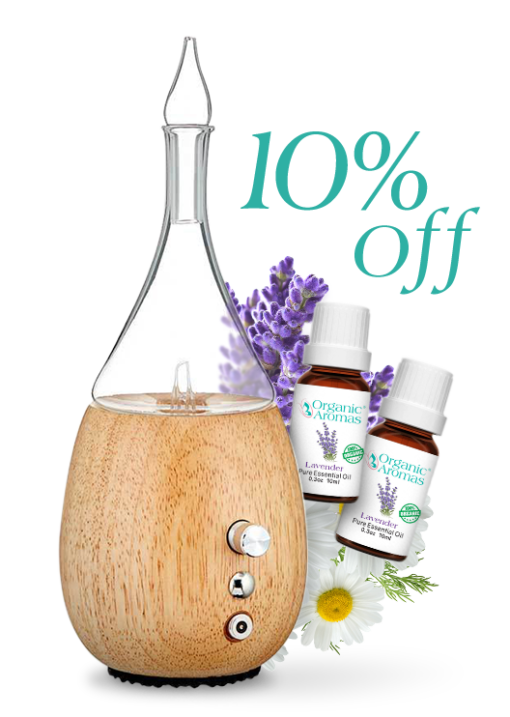
Join Now and Get a Coupon for 10% Off!
Waterless Diffuser vs Water Diffuser: Side by Side
Water diffusers (mostly ultrasonic) use a vibrating disc to turn water into mist, carrying a few drops of oil with it. They have real strengths, so here is an honest comparison with a waterless Nebulizing Diffuser®:
| Waterless (nebulizing) | Water (ultrasonic) | |
|---|---|---|
| Scent strength | Full strength, fills a room fast | Mild, oil is a few drops in a tank of water |
| What you smell | The oil as it is in the bottle | Oil plus warm humid air |
| Adds humidity | No | Yes, a small amount |
| Cleaning | Occasional flush of the glass | Rinse and dry the tank often to prevent film and mold |
| Materials | Glass with wood or ceramic base | Usually plastic |
| Sound | A gentle hum from the air pump | Quiet, with occasional bubbling |
| Oil use | Higher per hour | Lower per hour |
| Price | From about $98 | Often under $40 |
If you mainly want moisture in dry winter air, a water diffuser or a dedicated humidifier is the better tool. If you want a room to smell clearly of the oil you chose, without a tank to maintain, a waterless nebulizer wins. For the full head to head, see our Nebulizing Diffuser vs ultrasonic diffuser comparison.

Do Waterless Diffusers Use More Oil? The Real Numbers
Yes. Because a nebulizer releases pure oil instead of a few drops in water, it uses more oil per hour of running time. Here is what that looks like in practice, based on our customer service data from more than 200,000 customers:
On the low setting, 15 to 30 drops run for about one to two hours. A 10 ml bottle holds roughly 200 drops, so it gives you somewhere between 7 and 13 hours of diffusion. A 30 ml bottle gives about three times that.
Three habits stretch a bottle much further:
Use the built in cycle. The classic Raindrop runs 2 minutes on and 1 minute off, which cuts pump time by a third, and it shuts off on its own after 120 minutes.
Run shorter sessions. Because the scent is concentrated, 30 to 60 minutes usually scents a room for hours. You rarely need it running all day.
Schedule it. On Smart models you can set the app to run only when you are home or just before bedtime.
You can also blend your oil with Augeo Clean Multi, a dilution medium made for Nebulizing Diffusers, to soften very strong oils and make each bottle last longer. Compare that to a water diffuser running all day at low strength and the real cost gap is smaller than it first looks.
Sign Up to Get Your FREE
e-Book ($9.99 Value)
Is a Waterless Diffuser Safe?
A waterless nebulizer removes two common problems with diffusers: there is no standing water to grow mold or bacterial film, and no heat source to tip over. Glass and wood also hold up well to concentrated essential oils, which can soften some plastics over time.
Good diffusing habits matter more than the machine:
Diffuse in sessions rather than nonstop, and keep the room ventilated.
Mind your pets. Cats and dogs process some oils differently than people. Give them a way to leave the room, and check our list of which essential oils are safe around dogs before you diffuse.
Use pure essential oils only. Thick carrier oils and many fragrance oils can clog the glass nozzle.
Keep it out of reach of small children and away from the edge of a table.
If your unit ever stops misting, it is almost always a clog that a quick clean fixes. Our guide to fixing a Nebulizing Diffuser that is not working walks through it step by step.

Which Waterless Nebulizing Diffuser® Should You Choose?
Every Organic Aromas Nebulizing Diffuser® uses the same pure oil, no water, no heat principle and covers up to 800+ sq ft. The right one depends on where you will use it, and you can compare every model side by side in our waterless diffusers collection:
For the living room or bedroom: Raindrop ($98)
Our best selling design and the one that started it all. A plantation hardwood base, a hand blown glass reservoir, an adjustable intensity dial and the automatic 2 on, 1 off cycle. It plugs into any outlet worldwide. See the Raindrop Nebulizing Diffuser®.
For cordless use and app scheduling: Raindrop Smart ($109)
The same teardrop silhouette with a rechargeable battery (16 to 20 hours of use per charge) and Bluetooth app control for scheduling and intensity. Move it from the kitchen to the bedroom without hunting for an outlet. See the Raindrop Smart Nebulizing Diffuser® or browse the full Smart Nebulizing Diffuser® collection.
For a modern look: Zenara ($115)
A sleek ceramic base in white, black or metallic red, a rechargeable battery, two glass caps for vertical or directional diffusion, and a soft LED mood light. See the Zenara Nebulizing Diffuser®.
For the car and travel: Smart Mobile Mini ($119)
Anodized aluminum and borosilicate glass, sized to fit a cup holder, with a rechargeable battery and app control. The waterless design means nothing to spill on the road. See the Smart Mobile Mini.
Not sure which oils to start with? Our guide to the best aromatherapy oils for a diffuser ranks oils by how they actually perform in a nebulizer, and our tips on making your house smell good show where to place it. When you are ready, shop the Nebulizing Diffuser® collection. Diffusers ship free on orders of $130 or more.

Join Our Exclusive Member Club to get Big Discounts!
Frequently Asked Questions
Do waterless diffusers use more oil?
Yes. A waterless nebulizer releases pure oil rather than a few drops in water, so it uses more oil per hour. On a low setting, 15 to 30 drops last about one to two hours, so a 10 ml bottle gives roughly 7 to 13 hours. Interval cycles, shorter sessions and app scheduling stretch it further.
How does a waterless diffuser work?
The most common type, a nebulizing diffuser, uses a small air pump. Fast air passing over a glass tube lowers the pressure and draws oil up (Bernoulli’s Principle), where it breaks into a fine cloud of micro droplets. No water or heat is involved.
Is a waterless diffuser better than a water diffuser?
For scent strength and purity, yes: you smell the whole oil at full strength and there is no water tank to grow mold. A water diffuser is cheaper, uses less oil and adds a little humidity, so it suits people who mainly want moist air.
Are waterless diffusers safe?
Yes, when used sensibly. A waterless nebulizer has no standing water to grow mold and no heat source. Diffuse in sessions with the room ventilated, give pets a way to leave the room, keep it out of reach of small children and use pure essential oils only.
Are waterless diffusers noisy?
A nebulizing diffuser makes a gentle hum from its air pump. Most people describe it as near silent, and turning down the intensity or placing it on a soft surface makes it quieter still.
Can I use fragrance oils or carrier oils in a waterless diffuser?
Nebulizing diffusers are designed for pure essential oils. Carrier oils are too thick to atomize and many fragrance oils can clog the nozzle. To soften a strong oil, use a dilution medium made for nebulizers instead.
Do waterless diffusers add humidity?
No. They do not use water, so they do not change the humidity of the room. If you want moisture, pair it with a humidifier.
How long does a waterless diffuser last?
With regular cleaning, an Organic Aromas Nebulizing Diffuser runs for 2,000+ hours, and the glass reservoir can be replaced if it ever breaks.





I love my nebulizer, especially because the essentials oil used are not diluted and it’s very easy to. 10/10! The only difficulty is the cleaning process. You must use high quality essential oils otherwise it clogs becomes impossible to clean, even multiple deep cleans.
I love my nebulizer, exactly for the reasons they explained here! 10/10!
I think the nebulizer is way better.
Great summary of the advantages of using a waterless diffuser. Thanks!
Thanks for the information.
Thanks for this informative article. I never knew what the benefits of waterless diffusion was before.
I’m Sold!! I have a water one which drives me up the wall filling it every day. I used to carry it to the sink for months until I realised why don’t I use a jug! However I love essential oils and after reading the pro’s I will be going out to buy one or two!
Good to know that their are WATERLESS DIFFUSERS.
Wonderful info. Thank you for sharing!
No shortage of humidity around here!
I have never tried a waterless diffuser, but now I am interested!
I like the stronger aroma that a waterless diffuser gives.
Thank you for sharing this
Great read – lots of interesting facts
This was an interesting read! I think a waterless diffuser is a fab idea!
❤️
Interesting!
I love defusers
Very informative blog! Learned a lot of new and interesting stuff 💖
Anything to help me sleep better
I would ❤️ to try a waterless diffuser.
Oh wow, I’m excited to try this!
This is very interesting information. I would love to try a waterless deffuser.
Love the Aurora!
This is a very interesting article to read.
This is very interesting. I did not know there was such a thing as a waterless diffuser.
this is very interesting I want to look into both options.
This was a very informative blog. Learned much from it. Thank you
i would like to try a waterless diffusers, as they seem to offer more options that dont havae the need for the burdensome refilling the humidity adn i like that it puts out a more pure oil scent without it getting overheated or needing me to check it frequently. it saves time and money and is safer to use. since there is no heat or water involved. i hope to get one of those waterless diffusers in my area. ive been looking for a good device to use a mild choclate scented oil . it reminds me of Casino Rama. they use scents and aromas there as well. i find it is a comforting aroma that makes me feel safe and comfortable. good luck to everyone in the contest.
Never knew there were these two different types of diffusers. Thanks for in depth comparison between the two.
🔥🔥🔥
oh wow I never knew about that, that’s some interesting new information! thanks for sharing!
That’s actually pretty cool
Fascinating!! I had no idea there were such things as waterless diffusers!! Thank you for enlightening me.
Never knew that.
Thanks for the great info! Very interesting
Great blog post – thanks for the hard work!
I always thought the water was a must!
Thanks for the info.
I find it very interesting information.
Thank you for the detailed explanation. I will absolutely make the change
Now I’m definitely sold on trying a waterless diffuser. Sounds superior in just about every way.
This is a good idea! It can reduce the humidity that there would normally be in the room.
I like the idea of the waterless differ.
Oh YAY!! Finally! I live down in the South, and it is ALWAYS so humid here that regular diffusers just make my home feel like a jungle! Finally! A solution that also increases the benefits of essential oils! And the fact that the smell will be stronger is another huge plus for me. This just went to the top of my wishlist! Thx!!
I always thought you had to have the water. it makes sense to have no water.
I had no idea waterless diffusers were even a thing! But it seems like they’re the better option. Great article — super informational!
Thank you for the info!
Thanks for the information!
How unique looking! Love
I WILL BE LOOKING AT THESE FOR CHRISTMAS GIFTS. SO EFFICIENT AND CONVIENT!
Lots of useful information
Thanks for the info
Good to know!
I never heard of a waterless diffuser but would love to try
Thank you for this informative article. One of my concerns with plastics is the problem of off-gassing. I really like that water-less diffusers utilize glass instead. Although more expensive, they’re definitely worth it.
I have never tried a waterless diffuser but love to see how it works out! It sounds like less mess!
Thank you for the information, It will be very useful for me.
I have never used a diffuser before so it was interesting to learn about waterless diffusers.
Now i want to try a waterless diffuser
interesting thanks for the info
This is very intriguing. I would be willing to try, for sure!
Wow, I would love to try a waterless diffuser
I’ve never tried a waterless one. Cool.
Since purchasing a diffuser a few years ago, the thought to consider switching to a waterless diffuser had never crossed my mind, as I’d never before considered the existence of a waterless diffuser. I now have something to ponder over tonight. Thank you for this informative article!
I’ve never heard of a waterless diffuser. I have a diffuser that’s collecting dust right now because I got tired of constantly having to refill it, and then the scent is never strong and then I would have to clean it out to keep it functioning properly. These waterless diffuser’s sound promising…I’d like to get one for sure.
I think a waterless defuser is the best choice for me because I’m looking for a weaker scent not one that’s strong and overpowering ,something like lavender next to the bed to help with stress and sleep and with no water I don’t have to worry about bacteria growing inside ! Love all the many beautiful diffusers and awesome scents ! @MaryRod43
i love lavender oil
I have a allergic rhinitis and it’s really a hustle to be feeling down early in the morning. Knowing this product makes me wanna try it. ✨
would like to win one of diffusers
Who would have thought waterless would be better than water.
Didn’t know there was a water based diffuser
I didn’t seem to see anything about the cost differences between waterless and normal diffusers?
That’s a lot to take in. pretty interesting.
Such great information. I learned a lot! Thank you so much for shairng.
Very interesting!
thank you, i learned a lot
These diffusers look great!
Beautiful diffusers!
I love the Raindrop diffuser
Interesting post about waterless diffuser s. I especially like that it is environmentally safe.
I didn’t know any of this! I always assumed diffusers with water were better for some reason so I’m glad I saw this before I bought one!
I love these diffusers!
Didn’t know about waterless diffusers
Fascinating info! It’s definitely a consideration for my home due to our very high humidity.
I didn’t even know there were waterless diffusers and I especially didn’t know that it can fill a room full of scent much faster than other types of diffusers, I need one!
did not know that I have never owned a diffuser but the waterless is the way to go
I find that waterless is better!
There’s a lot I didn’t know. Good article, and waterless for me.
waterless
Waterless is so much better.
Great info. Thank you.
Good to know.
Too much humidity here so waterless is the way to go.
Thanks for the information. I had no idea that there were waterless diffusers and it makes sense that it is best for oils not to be broken down further.
I did not realize that waterless diffusers were better for larger spaces.
I don’t need any more humidity, so waterless is better.
Great read – I have a waterless diffuser and it’s great!
Thanks so much for sharing this– really great information!
Good to know! Thanks for sharing.
So rad. My differ has kicked the bucket so might need to look into this! Nothing better that a beautifully scented home!
Lots to consider here!
thank you. great infor
Definitely waterless!
Team waterless!
So many options thanks
Haven’t used one, but was looking into it
!!!!!!!!!!!!!!!!!!!!!
I would love to try it!
I DIDNT REALIZE THERE WAS SUCH A BIG DIFFERENCE HONESTLY
Interesting – I didn’t realize there was a difference!
I did not know there were waterless diffusers. Good information.
Thanks for the info!
So much great info here! I had no idea that the differences between water and waterless diffusers were so important. Thanks for the explanations!
Interesting- looks worth a try
I would love to try a diffuser thank you for this fabulous contest
Would really love one of these!
Very interesting! I never knew there was a waterless option. Love the fact there is no chance of mold. Will have to look into buying one soon!
I’ve never used a diffuser before, I think I want to!
I have a both kind and love them both. The waterless one we use downstairs and the one with water we use when the kids are sick.
Another worthwhile article, thx!
I never even knew this kind existed, thanks for the info!
I like a stronger scent, so I’ll probably go with waterless diffusers.
This is really solid information!
Good to know this. Would like to have one of these.
Great info
great info
Thanks for the information. I like that you get a stronger scent from a waterless diffuser!
Good info. Thanks for taking the time to investigate this
Great article!
Nice info
Thank you..very informative 😁😁😁👍👍👍❤❤
thanks for doing the research to make this article, best regards
Thank You for this useful information.
thanks for the article, never thought about it
this is a very good article with a good Examination
First I’ve ever really read anything about this before. Lots to consider.
Nice article!
I like the water think its a great idea
I’d never heard of waterless diffusers! They sound like a better option to me, but I’d have to weigh the costs.
thanks for all the info
Love this concept
Very good information!
thanks for all the info! they’re beautifully designed too
so elegant and beautiful…………….. and the oil is NOT watered down
It is all about the effectiveness of spreading the scent so waterless diffusers are the winners IMO. Great article!
Very informative article. Good to know. Thanks for sharing.
i found waterless is better
I think that the waterless diffusers are my personal favorite. I really like the benefits.
good explanation, I was looking for something like that.
First I’ve ever heard of a waterless diffuser! Thanks for all of the wonderful information!
Nice info, thanks
Waterless diffuser is better in summer time
Ok waterless diffuser
Love this concept !!
epic
Articles like these are what move the world
Think waterless is the way to go
I like that you get a stronger scent from a waterless diffuser, I use one in the car works great.
ok
I’ve been put off all diffusers since one was knocked over and took paint out of the furniture!
I didn’t even know there was a waterless diffuser. I have to look into getting one of these.
Good analysis!
Interesting read.
Very informative! Iliked the article!
nice info thx
Thanks for the info.
Thanks for the informative article
I didn’t know any of this. This makes me switch my water diffuser for a waterless one.
best info ever:D
So informative
Thanks for the information
Great article! Thanks
Each of them fit different environments. It’s nice to learn about this, didn’t know that there were two types.
Very good info
I have really enjoyed my waterless diffuser from organic Aroma.
Very good points. Thanks.
Waterless diffusers are the best for me!
Good article! Thanks for this!
Very informative article. The benefits of aromatherapy are amazing.
I did not realize that waterless diffusers were better for larger spaces.
Would like to own this.
I think they both have their advantages and disadvantages and that it is the person’s preference as to which they choose is better. Information here would make you choose the waterless one as the better one, but their prices can be the main leading factor to make you choose the water type.
Thanks for the great article. More people need to learn these important facts as many just go with the cheaper diffusers, which usually means heat and\or water that will destroy our EO’s.
Me encantan los difusores sin agua son lo mejor