

Aromatherapy Oils for Bath: Why They Float, How to Disperse Them, and 5 Gentle Blends
Choosing aromatherapy oils for bath time feels like the easy part: lavender for a slow evening, orange for a bright morning, a few drops under the running tap. But essential oils and bath water don’t mix, and almost every bath guide skips what that means. The oil doesn’t spread through the tub. It floats on top, and your skin meets it at full strength.
This guide covers the part the listicles leave out. We’ll show you the actual math of a few drops in a full tub, why bubble bath only helps if you use it in the right order, why a hot bath burns through your oils’ top notes in minutes, and which oils are better in the air than in the water. Then come five gentle bath blends and the simple pairing we use at home: gentle oils in the water, bolder ones in a Nebulizing Diffuser® just outside the splash zone.
Why Aromatherapy Oils for Bath Float Instead of Mixing
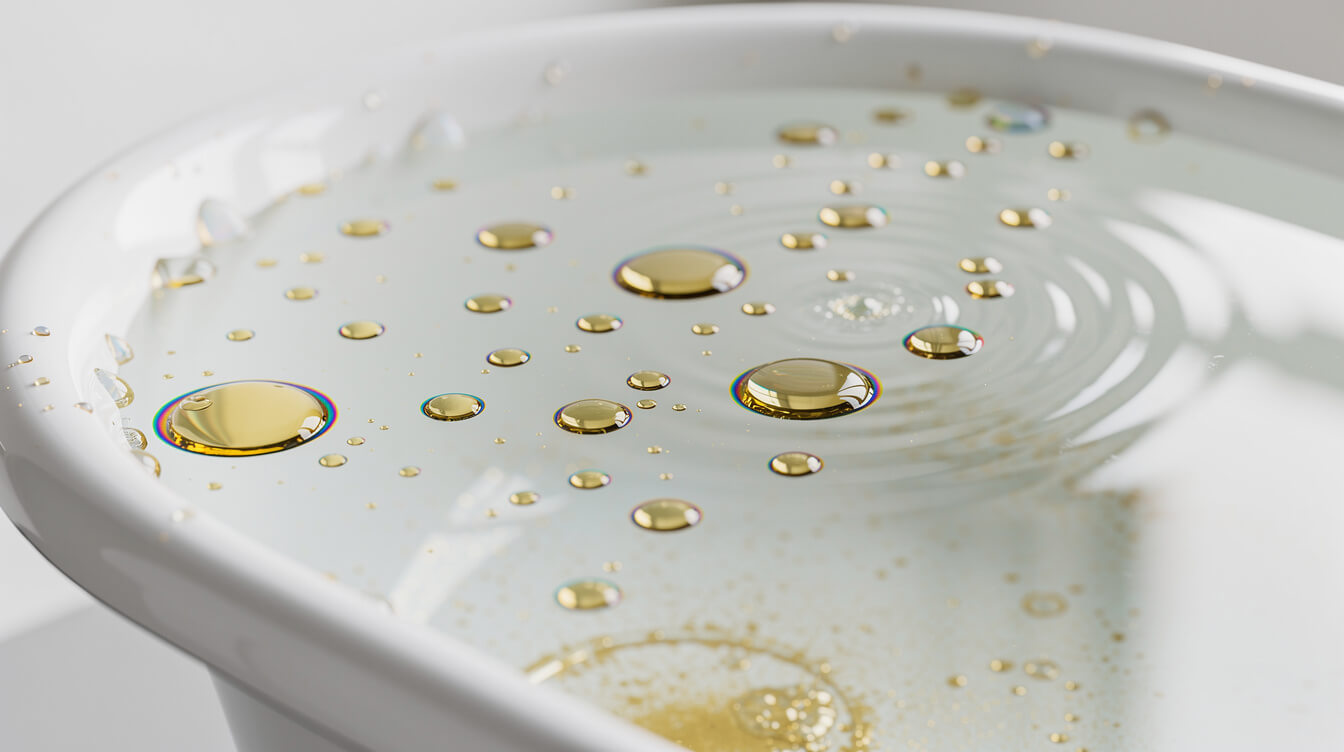
Essential oils are made of small, oily molecules: terpenes like limonene, alcohols like linalool, esters, phenols. They’re hydrophobic, so they cling to each other rather than to water. Most of them are also lighter than water. Put a few drops into a tub and they don’t dissolve. They bead up, float, and drift together into small lenses and a thin, glossy film.
The dose math nobody does
A typical soaking bath holds around 40 gallons, or about 150 liters. Eight drops of essential oil is roughly 0.4 ml (droppers vary, but around 20 drops per ml is a fair working figure; our guide to how many drops are in 1 oz explains why it’s never exact).
If those 8 drops truly spread through the water, the bath would contain about 0.4 ml in 150,000 ml: roughly 3 parts per million, or 0.0003%. For comparison, a gentle body oil for adults is usually around 1 to 2%, or 10,000 to 20,000 parts per million. A perfectly mixed bath would be thousands of times weaker than the mildest massage oil.
That’s the comforting picture most guides imply. It’s also why people assume a few drops straight into the tub can’t hurt. But the oil never reaches 0.0003%. It sits on the surface at close to 100%, and when you step in and sit down, your body breaks through that film. Droplets cling to your skin as you lower yourself in, collect along the waterline, and find the most delicate skin first.
So the real question in a bath isn’t how many drops. It’s what the oil is in when it touches you. Get that right and a bath is one of the gentlest ways to enjoy essential oils. Get it wrong and it’s one of the few ways people manage to put neat oil on sensitive skin without meaning to.
What about Epsom salt?
Salt is a lovely addition to a bath, but it does nothing to dissolve oil. Epsom salt (magnesium sulfate) and sea salt dissolve completely in water. Any oil you stirred into them is released as the crystals disappear, and it floats right back to the top, undiluted. Salt is a carrier for the trip into the tub, not a dispersant. Mix your oils into one of the bases below first, then stir that into the salt.
The Best Aromatherapy Oils for Bath: 8 Gentle Picks
The best aromatherapy oils for bath time share three traits. They’re gentle on skin at low dilution, they don’t overwhelm a steamy room, and they’re pleasant enough that you want to stay in the water. Here’s our shortlist, all chosen with those traits in mind:
Lavender. The classic for a reason. Linalool and linalyl acetate give it a soft, floral-herbal scent that rarely irritates when properly diluted. It’s the backbone of most evening blends. Our post on using lavender for a restful evening routine goes deeper.
Chamomile. Apple-sweet, gentle and expensive, so a single drop goes a long way. Its delicate esters are exactly the kind that fade fast, which we explain in our chamomile deep-dive.
Rose Geranium. Rosy and green, with geraniol and citronellol. It gives a bath a spa-like floral note for a fraction of the price of rose otto. Two or three drops are plenty.
Clary Sage. Musky, herbal and warm. It sits beautifully under lavender and bergamot. Use it in moderation, and skip it if you’re pregnant unless a qualified practitioner has said otherwise.
Frankincense. Resinous, soft and slightly citrusy. It’s a wonderful base note in the water, though it’s a thicker oil, which matters when you diffuse it (more on that below). Our guide to resin oils like myrrh explains why resins behave differently.
Cedarwood. Dry, woody and grounding, and one of the heavier, slower-evaporating oils, so it keeps a blend from vanishing in the first few minutes. See our cedarwood guide for more on its chemistry.
Sweet Orange. Bright and cheerful, and unlike some citrus oils, cold-pressed sweet orange isn’t considered phototoxic. It’s a good choice for a morning bath.
Bergamot. Floral citrus with a hint of spice, and a beloved evening note. Regular cold-pressed bergamot contains bergapten, which can make skin sensitive to sunlight, so keep it to evening baths or choose a bergapten-free (FCF) version. Our guide to phototoxic essential oils covers the details.
A note on eucalyptus and peppermint: both are popular in bath guides, but in a hot, enclosed bathroom their cooling compounds (1,8-cineole and menthol) can feel intense on the eyes and nose. If you love them, use a single drop in a blend, or enjoy them in the air instead.
Sign Up to Get Your FREE Essential Oils e-Book Here
How to Disperse Essential Oils in a Bath (and Why Order Matters)
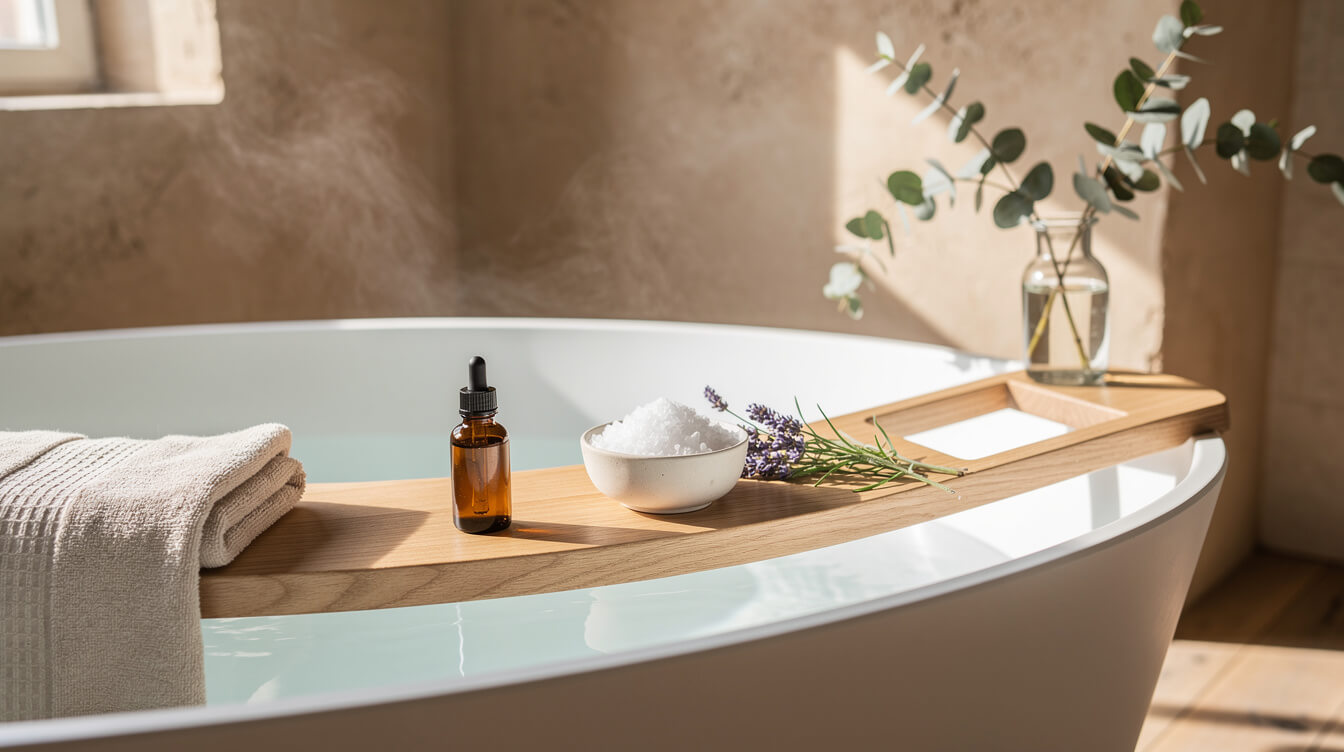
There are four common ways to get oils into a bath. They work very differently, and the difference comes down to a little chemistry.
1. Unscented bubble bath or body wash (the order trick)
Soap molecules called surfactants have an oil-loving tail and a water-loving head. In a concentrated product, they surround oil droplets and hold them in water. That’s why so many guides say “mix your oils with bubble bath”.
What they don’t say is that it only works if the oil meets the surfactant first. A typical bubble bath is roughly 10 to 15% surfactant, so a tablespoon carries about 2 grams of it. In a 150-liter tub, that’s around 0.013 grams per liter. Surfactants only form the tiny oil-holding clusters called micelles above a threshold concentration, and for common bubble-bath surfactants that threshold is on the order of a few tenths of a gram per liter. A tablespoon in a full tub sits roughly 20 times or more below it.
In other words, once bubble bath is in the water, it’s far too dilute to grab oil. If you drop your oils onto a bath that already has bubbles in it, they float just as they would in plain water. But if you stir the oils into a tablespoon of bubble bath before it goes in, the surfactant coats each droplet while it’s still concentrated. You’re then pouring in a fine emulsion, with the oil already broken into tiny coated droplets, and they stay spread through the water far better.
How to do it: 6 to 8 drops of essential oil into 1 tablespoon of unscented bubble bath or gentle body wash. Stir until it looks uniform, then pour it under the running tap so the turbulence spreads it.
2. A carrier oil (dilutes, but still floats)
Mixing essential oils into a carrier like jojoba, sweet almond or fractionated coconut oil doesn’t make them mix with water. The carrier floats too. What it changes is the concentration of what touches you. Six drops in a tablespoon (15 ml) of carrier is about 2%, so the film on the water is a 2% body oil instead of 100% essential oil. That’s a huge improvement, and it leaves your skin softer.
The trade-offs are an oily ring on the tub and a slippery floor of the bath, so step out carefully. Our guide to choosing a carrier oil compares the options.
3. A solubilizer such as polysorbate 20
Polysorbate 20 is a mild solubilizer used in cosmetics, and it’s the closest thing to making oil and water truly mix. Use at least equal parts polysorbate to essential oil, and more for heavy oils. Stir the oil into it first, then add the mix to the bath. We cover the ratios in detail in our room spray recipes, because the chemistry is identical.
4. Whole milk or cream (the old-fashioned way)
Milk baths are an old tradition, and there’s some sense in them: milk’s fat and proteins help coat oil droplets. It’s not as reliable as a surfactant or solubilizer, but a few drops of oil whisked into half a cup of whole milk or cream is far better than drops straight into the water.
What not to do
Don’t add drops straight to the water. Don’t rely on salt alone. Don’t add more oil because the scent faded: the next section explains why it fades so quickly, and why more drops make the first few minutes harsher rather than the bath longer-lasting. As a general guide, 6 to 8 drops per bath is plenty for adults. For children, during pregnancy, or for sensitive skin, use fewer drops and check with a qualified practitioner first.
5 Aromatherapy Bath Blend Recipes
Each recipe below uses 6 to 7 drops in total. Stir the drops into 1 tablespoon of unscented bubble bath, body wash or carrier oil (or a teaspoon or two of polysorbate 20) before adding to the bath, then stir that into a half cup of Epsom or sea salt if you like. For more pairing ideas, our essential oil blending chart shows how top, middle and base notes fit together.
1. Slow Evening
4 drops Lavender, 2 drops Chamomile, 1 drop Cedarwood. Soft, apple-sweet and woody. The cedarwood keeps the scent from disappearing once the lavender’s lighter notes have lifted off.
2. Soft Floral
3 drops Rose Geranium, 2 drops Lavender, 1 drop Ylang Ylang. A rosy, spa-like blend. Ylang ylang is very strong, so one drop is enough to make the blend feel luxurious without dominating it.
3. Bright Morning
4 drops Sweet Orange, 2 drops Frankincense, 1 drop Eucalyptus. Citrus over a soft resin, with just a breath of eucalyptus. It’s a cheerful start to a weekend morning, and the single drop keeps the steam comfortable.
4. Grounded
3 drops Frankincense, 2 drops Cedarwood, 2 drops Bergamot. Warm, woody and quiet, for the end of a long week. Because of the bergamot, enjoy this one in the evening, or use bergapten-free bergamot.
5. Clary Calm
3 drops Clary Sage, 2 drops Lavender, 2 drops Bergamot. Musky, floral and gently citrus. Skip it during pregnancy, and save it for evenings because of the bergamot.
If any blend feels prickly on your skin, get out, rinse with plain water, and next time use fewer drops or switch to the carrier-oil method. A bath should never sting.
Join Now and Get a Coupon for 10% Off!
Hot Water, Hot Oils, and the Nebulizing Diffuser® Pairing
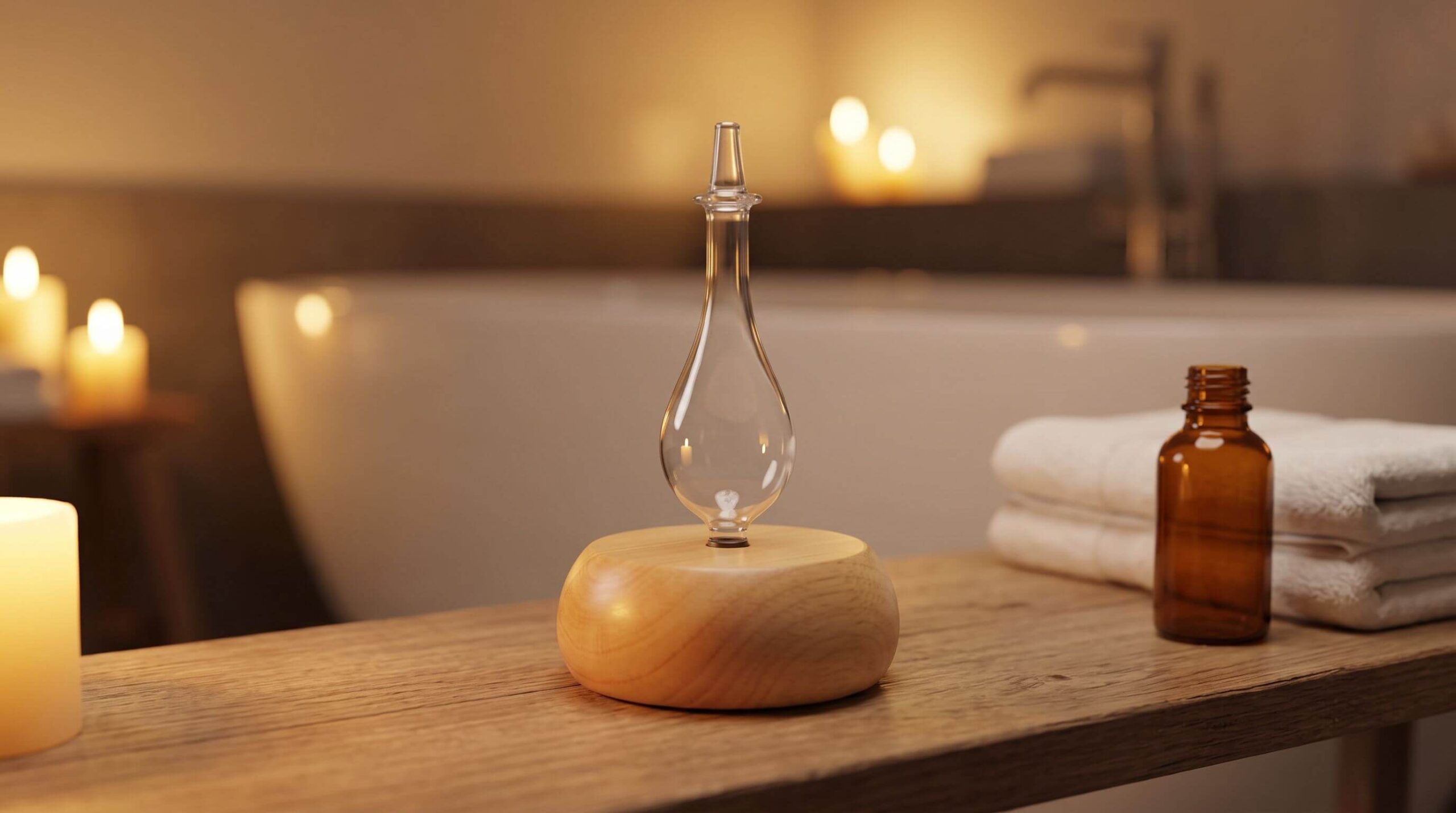
Why your bath scent fades in minutes
Have you noticed that a bath smells wonderful for the first few minutes and then barely at all? That’s not your imagination, and it’s not your oils. It’s the temperature.
Evaporation speeds up steeply with heat. For typical essential oil molecules like limonene, the vapor pressure (how readily a liquid turns into vapor) roughly doubles to triples between a 21 °C (70 °F) room and a 40 °C (104 °F) bath. Your bath is effectively a heat-driven scent source with a small, fixed dose. The lightest top notes rush off the surface in the first few minutes, the steam carries them up, and what’s left on the water is the heavier, quieter part of the blend.
That’s why adding more drops doesn’t make the scent last. It just makes the first five minutes stronger and harsher. It’s also why we build bath blends with a little cedarwood or frankincense: those heavier molecules evaporate more slowly and keep a soft scent in the water for longer.
The hot oils belong in the air
Some of the most beautiful oils are the worst choices for bath water. Cinnamon bark, clove, oregano and thyme are rich in compounds like cinnamaldehyde, eugenol, carvacrol and thymol, which are known skin irritants or sensitizers. In Essential Oil Safety (2nd edition), Robert Tisserand and Rodney Young suggest a maximum skin concentration of just 0.07% for cinnamon bark oil and 0.5% for clove bud oil. Remember that the floating film on bath water can be close to 100%, and you can see why these oils don’t belong in the tub.
But they’re wonderful in the air. A warm, spicy scent drifting in from the next room makes a bath feel like a winter spa, with none of the skin contact. (Our Cinnamon oil is cinnamon bark, the richer, sweeter type, which is exactly why we keep it out of the water. Our cinnamon pine cones guide has more on bark versus leaf.)
How to pair a bath with a Nebulizing Diffuser®
This is the ritual we come back to. The gentle oils go in the water, the bold ones go in the air, and the room is scented before you even step in.
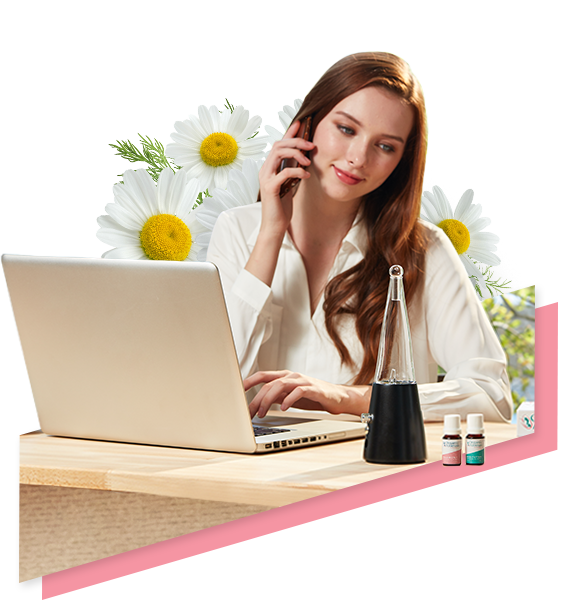
1. Start the Nebulizing Diffuser® 10 to 15 minutes before you run the bath. A Nebulizing Diffuser® uses Bernoulli’s Principle to draw pure essential oil up a fine glass tube and break it into a fine mist. There’s no water and no heat, so the whole blend reaches the room as you bottled it, rather than burning off top notes first the way hot bath water does.
2. Place it safely. Keep it on a dry shelf well away from the tub and any splashes, or set it just outside the bathroom door with the door ajar. Never set it on the edge of the bath.
3. Choose an air blend that complements the water. Try 3 parts Sweet Orange, 1 part Cinnamon and 1 part Clove Bud in the air with the Slow Evening bath blend in the water. Or keep it simple and diffuse lavender while you bathe in lavender. Avoid running thick oils like frankincense or sandalwood alone in a Nebulizing Diffuser®, because they can clog the fine glass tubes. Blend them with lighter oils.
4. Pure essential oil only. Never pour your bath mix (with carrier oil, bubble bath or polysorbate) into a Nebulizing Diffuser®. It’s designed for pure essential oil, and anything else will clog it.
The Raindrop Smart Nebulizing Diffuser® lets you set a timed session from your phone, so the room is ready when you are. Every model is in our handcrafted Nebulizing Diffuser® collection. For more ideas on turning a bathroom into a spa, read our guide to creating an aromatherapy spa at home, or our classic post on essential oils for the bath and shower for shower methods.
Aromatherapy Oils for Bath: Frequently Asked Questions
Can you put essential oils directly in bath water?
It’s best not to. Essential oils don’t dissolve in water, so they float on the surface at close to full strength and can cling to your skin as you get in. Mix them into unscented bubble bath, a carrier oil or a solubilizer first.
How many drops of essential oil should I put in a bath?
For adults, 6 to 8 drops in total is plenty, mixed into a dispersing base first. More drops don’t make the scent last longer. They just make the first few minutes stronger. Use fewer for children, during pregnancy, or for sensitive skin, and check with a qualified practitioner.
Does Epsom salt dissolve essential oils?
No. Salt dissolves completely in water and releases any oil you mixed into it, which then floats to the top. Mix the oils into bubble bath, carrier oil or polysorbate 20 first, then stir that into the salt.
Which essential oils should you not put in a bath?
Avoid “hot” oils such as cinnamon bark, clove, oregano and thyme, which can irritate skin even at low concentrations. Use strong cooling oils like peppermint and eucalyptus sparingly. Phototoxic citrus oils like regular bergamot are best saved for evening baths. The hot oils are lovely diffused in the air instead.
Why does the scent of my bath fade so fast?
Heat. Warm bath water speeds up evaporation, so the lightest top notes leave the surface within minutes. Adding a heavier base note like cedarwood or frankincense helps, and diffusing pure oil in the room keeps the whole space scented for the length of your bath.
Can I use bubble bath to mix essential oils?
Yes, but mix the oils into the bubble bath before it goes into the tub. Once it’s diluted in a full bath, there isn’t nearly enough soap to hold oil in the water.
Join Our Exclusive Member Club to get Big Discounts!
The best aromatherapy oils for bath time are the gentle ones, used in the right order. Choose soft oils like lavender, chamomile, geranium and cedarwood, mix them into a base before they meet the water, keep the drop count low, and let the bolder oils fill the air instead. Do that, and every bath smells as good on day one hundred as it did the first time, with nothing on your skin but what you meant to put there.