

What Does Myrrh Smell Like? Bitter, Earthy, and Not the “Sweet Myrrh” You Know
What does myrrh smell like? Bitter first, then warm. A drop of pure myrrh oil opens sharp, medicinal and a little resinous, then settles over an hour into something earthy, faintly mushroomy and leathery, with a dry amber glow that can linger on a scent strip until the next day.
If that doesn’t match what you expected, you’re not alone. Many people meet “myrrh” first in a candle, an incense stick or a perfume, and a lot of those smell sweet, honeyed and soft. There’s a reason for that, and it’s one of the best-kept secrets in the resin world: much of the sweet “myrrh” in perfumery comes from a different tree, sold under a name borrowed from a different plant entirely. Below, we’ll walk through the real smell of myrrh, why it changes in the bottle, how to tell it apart from “sweet myrrh,” and how to enjoy it at home without gumming up your Nebulizing Diffuser®.
What Does Myrrh Smell Like? Bitter, Warm and Earthy
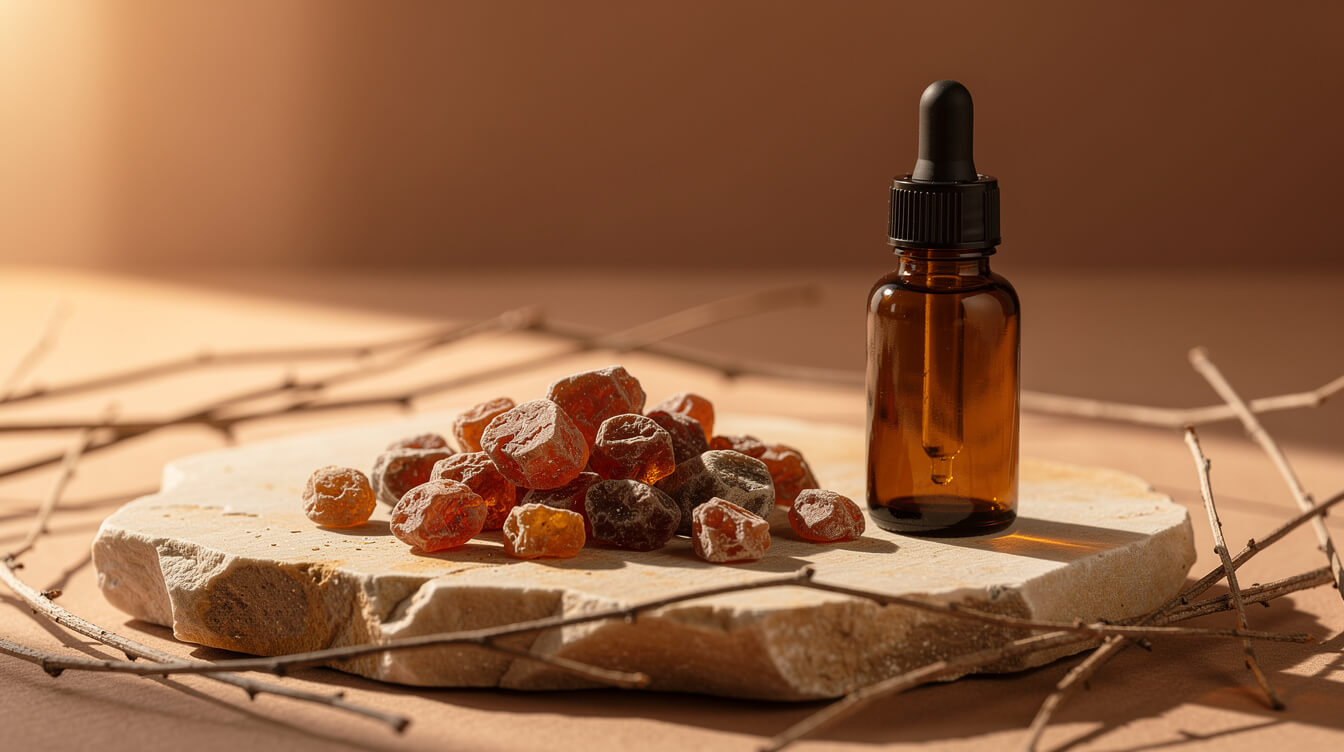
The short answer: myrrh smells bitter-balsamic, warm and earthy, with medicinal, mushroom-like and leathery facets and a long, resinous dry-down. It’s darker and less sweet than frankincense, and it reads as a base note rather than a top note. Even the name tells you what to expect. As we explain in our guide to myrrh vs frankincense, it comes from a Semitic root meaning “bitter.”
Perfumers and fragrance writers keep reaching for the same handful of words. Here’s how those descriptions map onto what you’ll notice over time on a paper strip.
The first minutes: sharp and medicinal
The opening is the most surprising part. Fresh from the bottle, myrrh oil can smell almost pharmaceutical: bitter, slightly camphor-like, with what some perfumers call an iodine or metallic edge. People who expect “Christmas” sometimes describe it as smelling like an old medicine cabinet. Give it a few minutes before you judge it.
The heart: earthy, mushroomy, a hint of licorice
After 10 to 20 minutes the sharpness fades and the warmth arrives. This is where you’ll hear the stranger comparisons: damp earth, mushrooms, licorice root, a splash of dark liquor. It’s the facet that makes myrrh smell “old,” like a stone church, a library of leather-bound books or a cedar chest that’s been closed for years.
The dry-down: leather and amber
Hours later, what’s left is soft, dry and resinous: warm leather and amber with a faint smoky edge. Myrrh’s heaviest molecules evaporate so slowly that a scent strip can still smell the next morning. That staying power is exactly why perfumers use it as a fixative, and why a little goes a long way in a blend.
Why Myrrh Smells Medicinal (and Why the Smell Changes in Your Bottle)
Myrrh’s signature comes from a family of molecules called furanosesquiterpenes, which are rare in other essential oils. German chemists Carl Heinz Brieskorn and Pia Noble identified the key ones in 1983, and a 2005 analysis in the Journal of Agricultural and Food Chemistry found that the oil of Commiphora myrrha was led by furanoeudesma-1,3-diene (about 35%), lindestrene (about 13%) and curzerene (about 8.5%). Our myrrh vs frankincense guide explains how these heavy molecules behave in the air compared with frankincense’s light pine notes. Here, we’ll focus on two things almost nobody mentions.
The main myrrh molecule doesn’t like air
In a 2003 review of myrrh chemistry in the journal Pharmazie, the authors describe furanoeudesma-1,3-diene, the single biggest contributor to the smell, as a colorless, unstable liquid that can be rapidly auto-oxidized in air to give a resinous substance. In plain terms, the molecule that makes myrrh smell like myrrh slowly reacts with oxygen and turns back toward resin.
That explains something many myrrh owners notice. As we say in our guide to myrrh essential oil, a bottle that darkens and thickens over a year is normal resin-oil aging, not spoilage. The chemistry adds a practical tip: the more air in the bottle, the faster the bright, medicinal top of the scent flattens into a dull, sticky warmth. If you buy a larger bottle, decant some into a small, full amber bottle for everyday use, cap it tightly after every pour, and keep it somewhere cool and dark.
Part of the smell is made by the still
Here’s a detail that changes how you think about “pure” myrrh. In the raw resin, much of the furanoid content exists as a molecule called furanodiene. When resin is heated during distillation, chemists have shown that furanodiene rearranges into curzerene, a more stable cousin. The same thing can even happen inside the hot injector of a lab’s gas chromatograph. So some of the curzerene listed on a myrrh oil analysis was never in the tree; it was created by heat on the way into the bottle.
That’s one reason myrrh oil, myrrh resin and burning myrrh all smell different, which we’ll come back to below. It’s also why steam distillation is so slow and costly for myrrh. In the same 2005 study, steam distillation gave just 0.4% oil by weight, against 2.8% for hydrodistillation of the same resin. Most of a myrrh tear is gum that never leaves the still.
Sign Up to Get Your FREE
e-Book ($9.99 Value)
Myrrh vs “Sweet Myrrh” (Opoponax): Two Trees, Two Smells
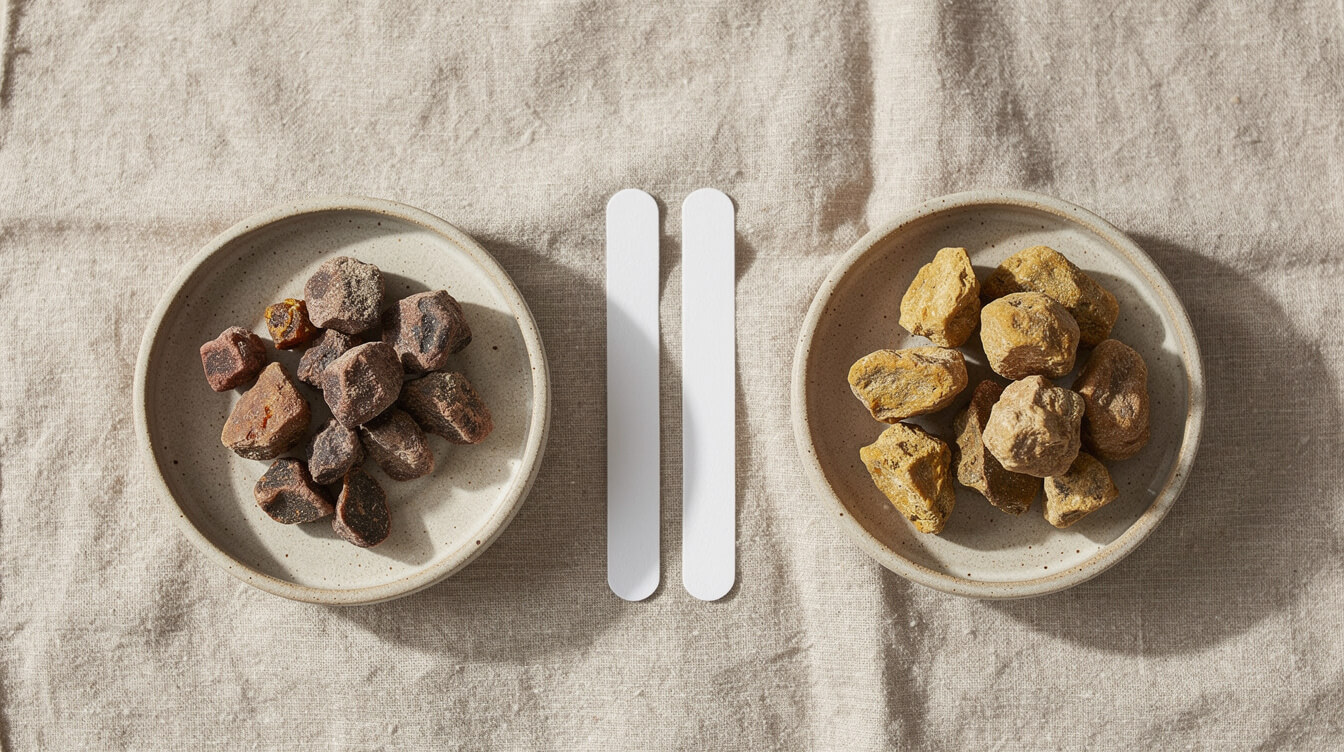
If you’ve ever smelled a “myrrh” perfume or incense that was soft, sweet and almost honeyed, there’s a good chance you were smelling opoponax, also sold as sweet myrrh, scented myrrh or bisabol myrrh. It’s a related resin, but it comes from a different tree and smells noticeably different.
A different tree from the same family
True myrrh comes from Commiphora myrrha. Opoponax comes mainly from Commiphora guidottii, a small thorny tree of Somalia and Ethiopia known in Somali as hadi, with the resin sold as habak hadi. Its botanical source was confused for decades and was only pinned down in Thulin and Claeson’s 1991 paper in Economic Botany. Some resin from a third species, C. holtziana (Somali habak hagar), is also traded as opoponax, and a 2002 study from Addis Ababa University analyzed that species among the resins that turn up as adulterants of true myrrh. In other words, the same lump of resin can be sold under either name depending on who is selling it.
How opoponax smells
Opoponax is sweet, balsamic and warm, with honey, caramel and soft spice where true myrrh has bitterness and medicine. The fragrance writer behind Bois de Jasmin described dipping a strip and smelling “aged whiskey, mahogany shavings and bitter caramel,” velvety and powdery at the same time. The chemistry backs up the difference: a GC-MS analysis from Cardiff University found bisabolene-type sesquiterpenes as the main constituents of opoponax oil, not the furanoid molecules that dominate myrrh. Opoponax is a classic ingredient in amber perfumes, including Guerlain’s Shalimar.
The name was borrowed from a plant that smells bad
Here’s the twist almost no guide mentions. The original opopanax wasn’t a resin from Africa at all. It was the dried gum of Opopanax chironium, a tall yellow-flowered plant in the carrot family from the Mediterranean, nicknamed Hercules’ all-heal (from Greek opos, “juice,” and panax, “all-healing”). According to the 1918 Dispensatory of the United States, that gum had a strong, unpleasant odor. In the early 20th century the perfume trade borrowed the name for the sweet Somali resin, and the spelling “opoponax” (with an o) is now often used for the perfumery material to tell the two apart.
How to tell which one you have
Read the botanical name. If the label says Commiphora myrrha (sometimes listed as C. molmol), it’s true myrrh and should smell bitter-balsamic. If it says C. guidottii, C. erythraea or simply “opoponax,” expect sweet myrrh. Our Myrrh Essential Oil is Commiphora myrrha, so it has the true bitter-earthy profile described above. One more difference worth knowing: opoponax is covered by its own IFRA Standard for skin sensitization, which caps it at well under 1% in fine fragrance. It’s a perfumer’s material rather than something to dab on skin, and that’s another reason “myrrh” perfumes and pure myrrh oil smell so different.
Oil, Resin Tear or Smoke: Three Different Myrrh Smells
“Myrrh” can mean three different things to your nose, and they don’t smell the same.
The resin tear
A dry, reddish-brown tear of myrrh smells surprisingly faint at room temperature. Most of its weight is gum, which has no smell, and the aromatic oil is locked inside. Warm a tear in your palm or crush a corner of it, and a soft, bitter-sweet, slightly fruity resin smell comes up. This is the gentlest version of myrrh, and many people find it the most pleasant.
The essential oil
The oil is the concentrated, volatile fraction: the part that rode the steam. It’s far stronger than the tear and more medicinal, because the bitter furanoid molecules are now front and center, and some, like curzerene, were reshaped by the heat of distillation. It has none of the gum and none of the smoke.
The smoke
Burning myrrh smells different again. Fire breaks molecules apart and creates new ones, a process we unpack in our piece on what frankincense smells like. And because myrrh is mostly gum, it tends to smoulder and char on a coal rather than melt cleanly, giving a darker, more bitter smoke than frankincense. If your idea of myrrh comes from incense, expect the oil to be cleaner, sharper and less smoky. If you love that incense mood, blending is the way to get closer to it.

Sign Up to Get Your FREE Essential Oils e-Book ($9.99 Value)
What Smells Like Myrrh, and What Blends With It
If you like myrrh, you’ll probably also enjoy other dark, slow, grounding materials. Sandalwood shares its soft, lingering woodiness. Cedarwood has the same dry, old-chest feeling without the bitterness. Benzoin brings the sweetness that myrrh lacks, and opoponax sits halfway between the two.
In a blend, myrrh works like a bass line. On its own it can feel heavy, but under a bright citrus or a crisp wood it adds depth and makes everything last longer. The classic pairing with frankincense, with tested ratios, is in our myrrh vs frankincense guide. Here are three different directions, given in parts so you can scale them to your glass.
Old Library: 5 parts Sweet Orange, 3 parts Cedarwood, 2 parts myrrh. Leather-bound books and a warm reading lamp; the orange keeps it from feeling dusty.
Amber Hour: 6 parts Sweet Orange, 2 parts Cedarwood, 1 part myrrh, 1 part Benzoin. This is our nod to opoponax: benzoin’s vanilla softens myrrh’s bitterness into something closer to sweet myrrh.
Winter Evening: 6 parts Sweet Orange, 2 parts Frankincense, 1 part myrrh, 1 part Clove Bud. Candlelight, spice and resin for the darkest weeks of the year. Keep the clove at one part; it takes over fast.
Notice that the thick resin oils (myrrh, frankincense, benzoin) never make up more than about a third of any blend. That’s deliberate, and it’s the subject of the next section. For more seasonal ideas, see our Christmas scents guide.
Pure Resin Oils, Diffused the Way They Deserve
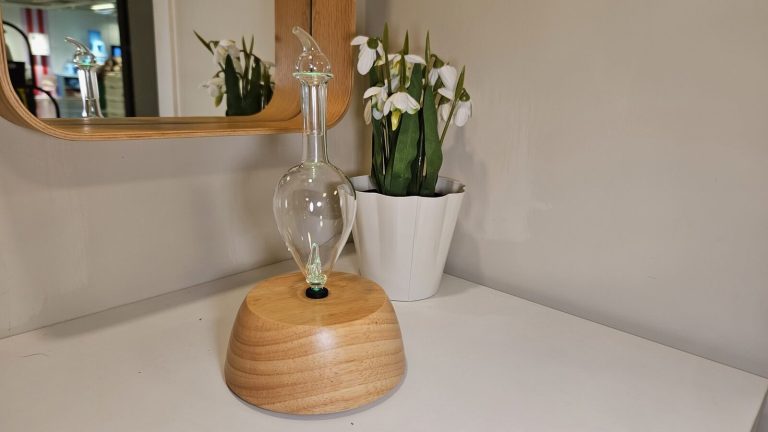
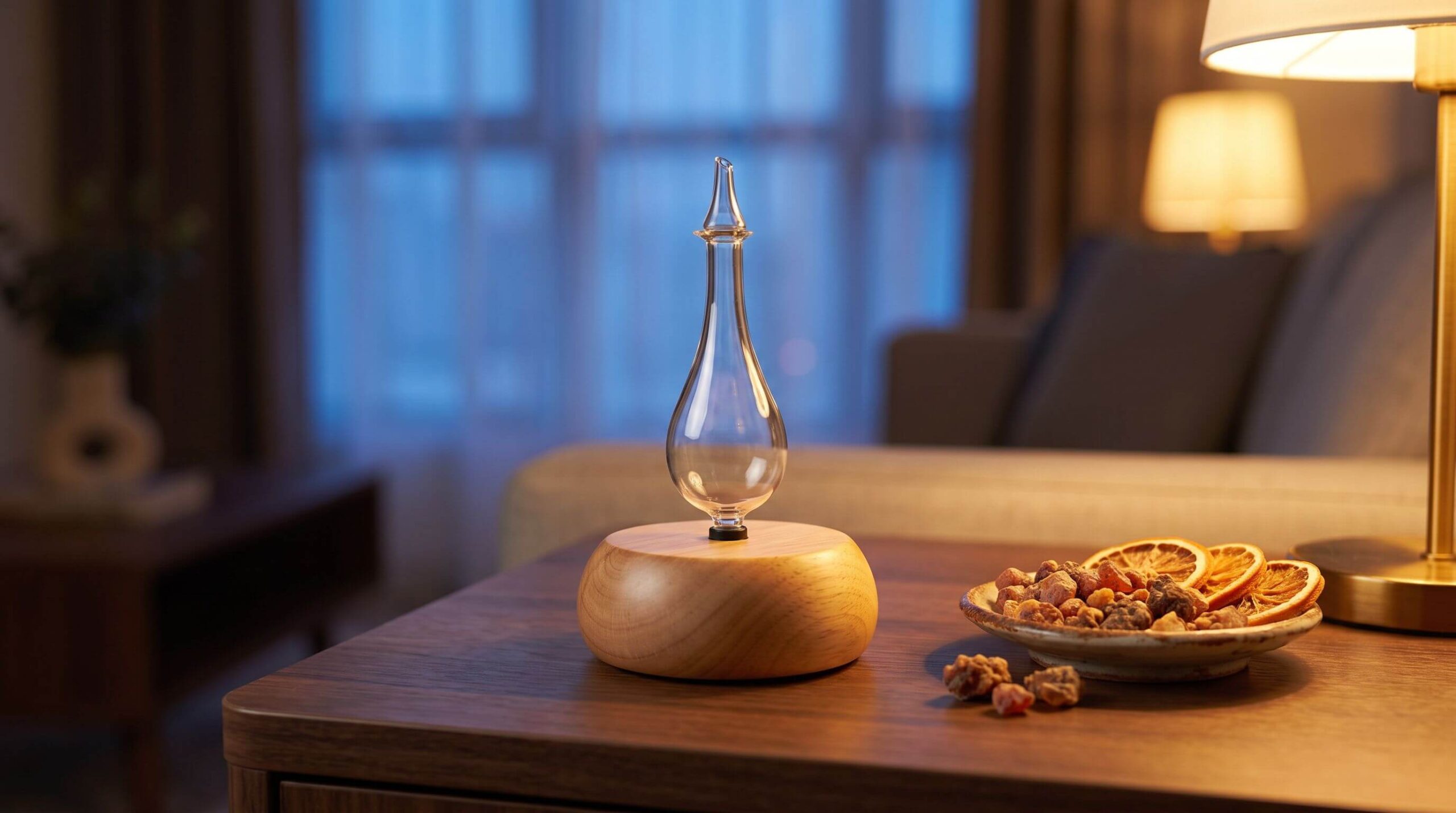
Handcrafted from real wood and medical-grade Pyrex glass, a Nebulizing Diffuser® turns pure essential oil into a fine vapor with no water and no heat, so myrrh’s dark, layered character reaches the room intact.
How to Diffuse Myrrh Without Gumming Up Your Nebulizing Diffuser®
Myrrh is on our list of thick oils, alongside frankincense, benzoin, vetiver, patchouli, sandalwood and cypress. A Nebulizing Diffuser® draws oil up through very fine tubes, and an oil that’s both viscous and slowly turning to resin in air can coat them over time. Our guide to using a Nebulizing Diffuser® covers the details, but the short version is simple.
Keep myrrh a minority. Blend it with thinner oils such as citrus, so the thick resins stay at about a third of the mix or less, as in the recipes above.
Use a warm room and warm oil. Cold oil is thicker, so let the bottle reach room temperature before you fill the glass.
Run short cycles. Because myrrh lingers, 15 to 30 minutes is plenty to scent a room for the evening.
Clean right after. Don’t leave a resin blend sitting in the glass for days. Our cleaning guide shows the quick alcohol rinse that keeps the tubes clear.
Follow those four habits, and myrrh is one of the most rewarding oils you can diffuse: a small amount changes the whole mood of a room. For a deeper look at why resin oils are hard on water-based units but work well in nebulizing ones, see our myrrh essential oil guide.

Join Our Exclusive Member Club to get Big Discounts!
What Does Myrrh Smell Like? FAQs
How would you describe the smell of myrrh?
Bitter, warm and balsamic, with earthy, medicinal, mushroom-like and leathery facets. It opens sharp and slightly pharmaceutical, then dries down over hours into soft amber and leather. It’s darker and less sweet than frankincense.
Does myrrh smell good?
Many people love it, but it’s an acquired taste on its own. Myrrh shines in blends, where a small amount adds depth and staying power to brighter oils like sweet orange or cedarwood. If you find it too bitter, try it with a little benzoin for a sweeter, amber effect.
Is opoponax the same as myrrh?
No. Opoponax, or sweet myrrh, comes mainly from Commiphora guidottii, while true myrrh comes from Commiphora myrrha. Opoponax smells sweet, honeyed and balsamic; true myrrh smells bitter and earthy. Check the botanical name on the label.
What does pure myrrh look like?
Raw myrrh resin forms irregular, reddish-brown tears or lumps, often dusty on the outside and translucent at the edges. The essential oil is a thick, amber to brownish liquid that pours slowly and darkens with age.
Why doesn’t my myrrh oil smell like myrrh incense?
Burning resin creates new smoke molecules and adds a charred note, and many incense blends use sweet opoponax or added fragrance. Pure myrrh oil is cleaner, sharper and more medicinal than the smoke.
What does smelling myrrh do?
Myrrh’s warm, grounding scent is often used to create a quiet, reflective atmosphere for reading, meditation or winding down in the evening. How a scent makes you feel is personal, and we don’t make health claims for it. Enjoy it for its aroma.
The bottom line: myrrh smells exactly like its name, bitter first and warm underneath, with an earthy, old-library depth that no other oil quite matches. If yours smells sweet, check the label for opoponax. And if you want to meet the real thing, a single part of myrrh under bright orange is the perfect introduction.