

What Does Rosemary Smell Like? Pine, Camphor and the Lab Report Answer
What does rosemary smell like? Fresh, piney and sharply herbal, with a cool, camphor-like lift that reminds many people of eucalyptus, a resinous pine-needle middle, and a faintly peppery, woody finish. Rub a fresh sprig between your fingers and it smells greener and brighter still, like a sunny hillside after rain.
Most descriptions stop at adjectives: “herbaceous,” “aromatic,” “like a forest.” They’re not wrong, but they can’t tell you why rosemary smells half like a eucalyptus leaf and half like a Christmas tree, or why the dried herb in your spice rack smells so different from a fresh sprig. So we went to the lab report. Below, we break rosemary’s scent down molecule by molecule using a real gas chromatography (GC) test of our own oil, then explain the classic mix-ups with eucalyptus, lavender and sage, the four different smells one plant can give you, and the pairings that make rosemary shine.
What Does Rosemary Smell Like? The Short Answer
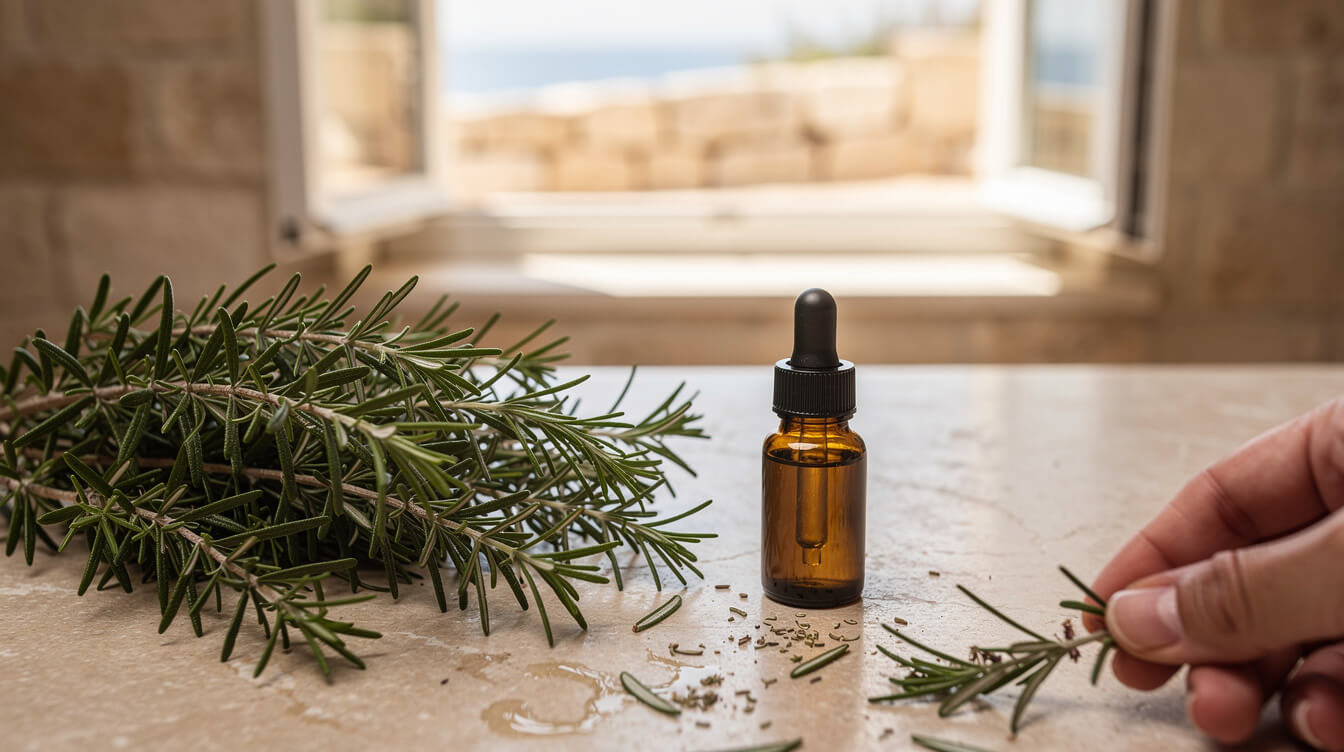
Rosemary (Salvia rosmarinus, still sold as Rosmarinus officinalis on most labels) is an evergreen shrub from the Mediterranean, a member of the mint family. Its scent comes from essential oil stored in tiny glands on its needle-like leaves. Put into words, this is what most noses pick up:
Cool and camphoraceous. The first hit. A clean, slightly medicinal coolness, the note rosemary shares with eucalyptus and camphor.
Piney and resinous. Right behind it, a green pine-needle and fir-like freshness. This is the part that makes rosemary feel like an evergreen.
Herbal and green. Strongest in a fresh sprig: sappy, leafy and alive, a little like crushed sage or thyme.
Woody and slightly peppery. The quiet dry-down, warm and faintly spicy, especially in dried rosemary and the last hour of a scent strip.
What rosemary doesn’t have is sweetness. There’s no floral softness, no fruit, no vanilla warmth. That dry, bracing quality is exactly why people describe it as “awake,” and why it reads as clean in a kitchen or entryway.
Is rosemary a good smell?
For most people, yes. It’s one of the most widely liked herbal scents, and it’s used in classic colognes, soaps and shampoos for its clean, fresh character. If you find it harsh, that’s usually concentration. Straight from the bottle, rosemary oil is intense. Spread thin through a room, or softened with citrus, it turns airy and pleasant. We’ll get to the pairings below.
The Smell of Rosemary, by the Numbers
Here’s the jewel most articles skip. Rosemary’s scent isn’t a mystery. It’s a recipe, and you can read the recipe on a GC report. Our Rosemary Essential Oil is a certified organic Tunisian oil of the 1,8-cineole chemotype. Its 2021 GC profile, run by an independent ISO 17025-certified lab, found no adulterant, contaminant or diluent. It also shows exactly which molecules make up the smell:
1,8-Cineole, 45.31%. Almost half the oil. Cineole (also called eucalyptol) is the cool, clean, eucalyptus-like note. This is the top-line “freshness” you notice first.
Camphor, 12.28%. About an eighth. Camphor adds the sharp, medicinal, slightly mothball-like edge.
α-Pinene 11.58%, β-pinene 5.55% and camphene 4.11%. Together, about a fifth of the oil. These are the same molecules that give pine needles and fir their resinous, forest-air smell. They’re why rosemary reads as an evergreen.
β-Caryophyllene, 2.96%. The peppery, woody warmth in the dry-down. It’s a major molecule in black pepper and clove.
Borneol 2.89%, α-terpineol 1.59% and bornyl acetate 1.01%. Small but important. Borneol adds an earthy, camphor-like depth, and bornyl acetate is the soft, balsamic “fir needle” note used to build pine scents in perfumery.
So if you wanted to describe rosemary as a formula, you could say it’s roughly half eucalyptus-cool, an eighth camphor, a fifth pine forest, plus a pinch of pepper and wood. That’s not just a nice metaphor. It’s very close to what’s in the bottle.
The tiny traces that make it smell “real”
The same report lists dozens of molecules below 1%. One worth knowing is octan-3-one at 0.13%, an herbal, slightly earthy, mushroom-like note. You’d never pick it out on its own, but traces like this are part of why a natural oil smells rounder and more alive than a single-note synthetic “rosemary fragrance.”
Rosemary also comes in other chemotypes. Camphor-type oils lean more medicinal, while verbenone-type oils are softer and greener. (Our cineole-type oil contains just 0.01% verbenone.) Our rosemary chemotype guide explains the three types and how to choose between them.

Sign Up to Get Your FREE
e-Book ($9.99 Value)
Fresh, Dried, Roasted, Distilled: Four Rosemary Smells

One reason people describe rosemary so differently is that they’re smelling different things. The same plant gives you at least four distinct scents depending on how it’s handled.
Fresh rosemary: green and bright
A fresh sprig sitting on the counter smells surprisingly faint. That’s because rosemary keeps its oil in tiny glandular hairs, mostly on the fuzzy underside of each leaf. Each one is a sealed pocket of oil. Run your fingers down the stem and you rupture them, which releases a sudden burst of scent. Fresh rosemary smells the greenest and sappiest of the four, with the pine and cool cineole notes front and center.
Dried rosemary: dusty, camphor and wood
Drying lets the lightest, most volatile molecules escape first, so the bright, green top of the scent fades. What’s left leans heavier: more camphor, more wood, a slightly dusty, hay-like quality. Dried rosemary still smells unmistakably like rosemary, but flatter and warmer. If your jar barely smells at all, crush a few needles between your fingers. If it still smells weak, it’s time to replace it.
Roasted rosemary: resinous and savory
Cooked rosemary is the smell most of us know best. It isn’t just the herb anymore. Heat drives off the sharpest top notes, fat and oil carry the heavier ones, and the browning food around it adds its own toasted, savory aromas. The result smells warm, resinous and almost smoky. That’s why roast-potato rosemary seems so different from the oil in a bottle. The oil has none of those cooking notes.
Rosemary essential oil: concentrated and cool
Steam distillation captures the leaf’s volatile oil without heat-browning it, so the essential oil smells closest to a freshly crushed sprig, only far more concentrated. The cool cineole and camphor notes dominate at first, and the pine and woody notes show up as it airs out. Because it’s so strong, rosemary oil smells much better spread thin through a room than sniffed straight from the cap.
Rosemary vs Eucalyptus, Lavender and Sage: Why Noses Mix Them Up
Rosemary gets compared to three other plants more than any others. The chemistry explains all three.
Rosemary vs eucalyptus
They share the same lead molecule. Classic eucalyptus oil is commonly 70% or more 1,8-cineole, and rosemary cineole-type is close to half. So the first impression, that cool, clean, open-air feeling, is genuinely the same molecule. The difference is what sits behind it. Rosemary adds a fifth of pine-family molecules plus camphor, which makes it greener, more resinous and more “herb garden.” Eucalyptus is cleaner, simpler and more straight-ahead cool. If you smell the two side by side on paper strips, rosemary is the one that smells like a forest. Eucalyptus is the one that smells like cold air. Our guide to what eucalyptus really smells like covers the other half of the comparison.
Rosemary vs lavender
Both are Mediterranean shrubs in the mint family, and both contain some camphor, cineole and borneol, which is why the Perfume Society calls rosemary “lavender-like.” But lavender’s scent is led by two different molecules, linalool and linalyl acetate, which in true lavender oil commonly run somewhere around 25 to 45% each. Those give lavender its soft, floral, slightly fruity sweetness. Our rosemary contains just 0.65% linalool, and its GC report doesn’t list linalyl acetate at all. That’s the whole difference in one line. Lavender is floral-herbal. Rosemary is herbal-woody, with almost none of lavender’s sweetness. They do share one subtle trace: lavender also contains small amounts of octan-3-one, the earthy note mentioned above. Wondering whether to blend the two? Our lavender and rosemary mini-FAQ has a tested ratio.
Rosemary vs sage
This one is family. In 2017, botanists moved rosemary into the sage genus, Salvia, so the two are now formally close relatives. Garden sage shares rosemary’s camphor and cineole, but its oil is also rich in thujone, which gives sage a heavier, more pungent, almost savory-medicinal smell. Rosemary is the brighter, piney cousin. Sage is the earthier, more brooding one.
There’s a fourth, less obvious cousin: chrysanthemum. Its flowers carry a strikingly similar mix of camphor, borneol, cineole and α-pinene, which we explored in our Double Ninth chrysanthemum blend.

Sign Up to Get Your FREE Essential Oils e-Book ($9.99 Value)
What Scents Go Well With Rosemary?
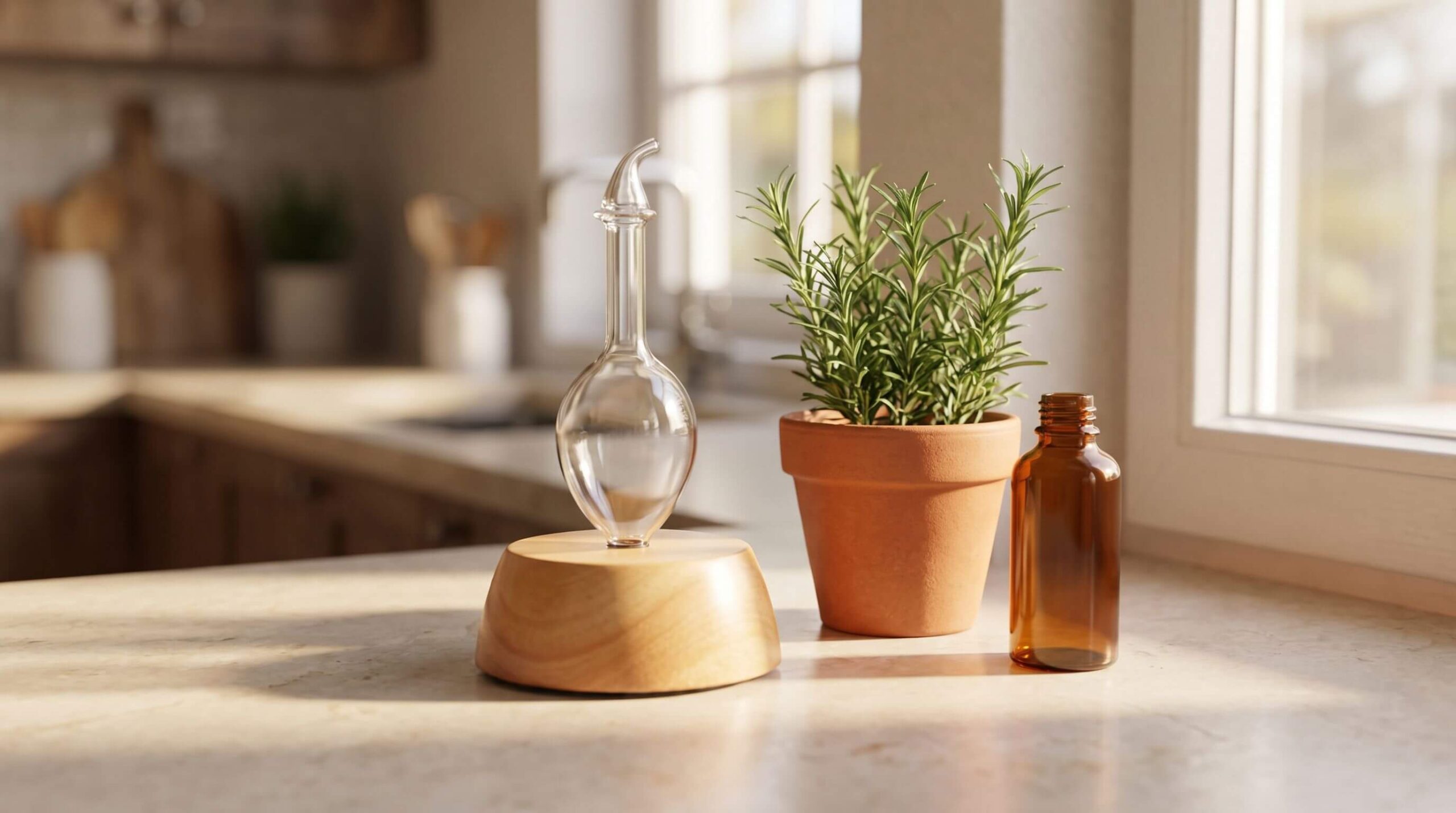
Rosemary is assertive, so the best partners either soften its camphor edge or lean into its freshness. These are the pairings we come back to most:
Lemon and Grapefruit: the easiest wins. Citrus brightens rosemary and takes away the medicinal edge, turning it sunny and clean.
Lavender: lavender’s floral sweetness fills in exactly what rosemary is missing. Keep rosemary the minority partner.
Peppermint: doubles down on coolness. Brisk and wide-awake, best in small amounts.
Cedarwood: a woody base that anchors rosemary’s fast-moving top notes and makes the blend last longer in the air.
Eucalyptus: a natural match, since the two share cineole. Together they smell like a eucalyptus grove next to a pine forest.
Three rosemary blends to try
Each recipe is in parts, so you can scale it to your bottle. Mix in a clean glass vial and let it rest for a day before diffusing.
Mediterranean Kitchen: 3 parts Lemon, 2 parts Rosemary, 1 part Sweet Orange. Bright, herbal and sunny, lovely after cooking.
Morning Garden: 3 parts Grapefruit, 1 part Rosemary, 1 part Cedarwood. Fresh and green with a woody anchor. A variation of our summer-morning grapefruit, rosemary and cedarwood trio.
Soft Herb Garden: 3 parts Lavender, 1 part Rosemary, 1 part Cedarwood. The gentlest way to enjoy rosemary, with lavender leading.
Want a spicier take? Our rosemary, lemon and cardamom blend adds a warm, spicy note.
Why a Nebulizing Diffuser® suits rosemary
A Nebulizing Diffuser® uses Bernoulli’s Principle: a fast stream of air passes over a fine glass tube, draws up pure oil and breaks it into a microscopic mist, with no water and no heat. Rosemary is a thin, free-flowing oil that nebulizes easily. Because the whole droplet is atomized at once, the cool cineole top, the pine middle and the woody dry-down reach the room together, so you smell the full recipe instead of just the lightest notes first.
Rosemary is strong, so keep it to short, intermittent cycles: a few minutes on, a longer pause off. Your nose adapts quickly to a constant scent, and pulsing keeps it noticeable. Our guide to making your house smell good and keeping it noticeable explains why. When you’re ready, browse the full handcrafted Nebulizing Diffuser® collection.
The Smell of Rosemary in Perfume History
Rosemary has been a perfume ingredient for centuries, and it explains why the smell feels “clean” to so many people. You’ve probably smelled it in a bottle without knowing.
Hungary Water
One of the earliest alcohol-based perfumes in Europe was “Hungary Water,” a distillation of rosemary in alcohol. Legend credits it to a 14th-century Queen of Hungary, though the earliest written recipes come much later and the story is likely more marketing than history. Either way, rosemary-in-alcohol was a fashionable toilet water for centuries, splashed on as a refreshing tonic and scent.
Eau de cologne and modern fragrance
When eau de cologne took off in the 1700s, rosemary was a natural fit. Classic cologne recipes pair citrus oils such as bergamot, lemon and neroli with herbal notes like lavender and rosemary. That bright, brisk, freshly-washed character is still the template for “fresh” fragrances today. The Perfume Society lists rosemary in perfumes including Guerlain’s Jicky and Diptyque’s L’Eau de Hespérides, and perfumers use it to add what one calls “a Mediterranean sensation.” It’s also why rosemary turns up in so many shampoos and soaps. To most noses, rosemary simply smells like clean.
That cultural memory matters. When you smell rosemary oil and think “fresh,” you’re partly smelling cineole and pinene, and partly three hundred years of cologne.

Join Our Exclusive Member Club to get Big Discounts!
What Does Rosemary Smell Like? FAQs
How would you describe the smell of rosemary?
Fresh, piney and herbal, with a cool, camphor-like lift up front, a resinous pine-needle middle and a dry, woody, slightly peppery finish. It has very little sweetness. A freshly crushed sprig smells greener and brighter than the bottled oil.
Does rosemary smell like eucalyptus?
Partly. Both are led by the same molecule, 1,8-cineole, which gives that cool, clean opening. Rosemary also contains about a fifth pine-family molecules plus camphor, so it smells greener, more resinous and more herbal than eucalyptus.
Do lavender and rosemary smell similar?
They’re cousins, but they smell quite different. Lavender is led by linalool and linalyl acetate, which make it soft and floral. Rosemary has very little of either, so it’s sharper, cooler and more woody. They share a herbal backbone, which is why they blend well.
Why does my rosemary plant not smell?
Rosemary stores its oil in sealed glands on the underside of its leaves, so an untouched plant can smell faint. Brush or rub the leaves and the scent comes right out. A rosemary plant smells strongest on a warm, sunny day.
Why should you keep rosemary in your bedroom?
It mostly comes down to scent preference. Many people love waking to a fresh, green smell, and a potted rosemary plant on a sunny sill is easy to care for. Because rosemary smells bright and brisk rather than soft, many people prefer it for daytime spaces and choose gentler scents like lavender for the evening.
Is rosemary oil safe to diffuse around pets and children?
Diffuse rosemary in a well-ventilated room for short, intermittent sessions, keep a door open so pets can leave, and never apply oils to pets. Keep cineole-rich oils like rosemary well away from young children’s faces. If you’re pregnant, nursing, managing a health condition or taking medication, ask your clinician before using any essential oil. Our guide to which essential oils are safe for dogs has more detail.
So what does rosemary smell like? Almost half eucalyptus-cool, an eighth camphor, a fifth pine forest, and a pinch of pepper and wood, with the green brightness of a sprig crushed between your fingers. Pair it with citrus to soften it, lavender to sweeten it or cedarwood to anchor it, and diffuse it in short bursts to keep it fresh. Start with our pure Rosemary Essential Oil (or the pre-diluted Rosemary Roll-on for on-the-go sniffing) and smell the recipe for yourself.