

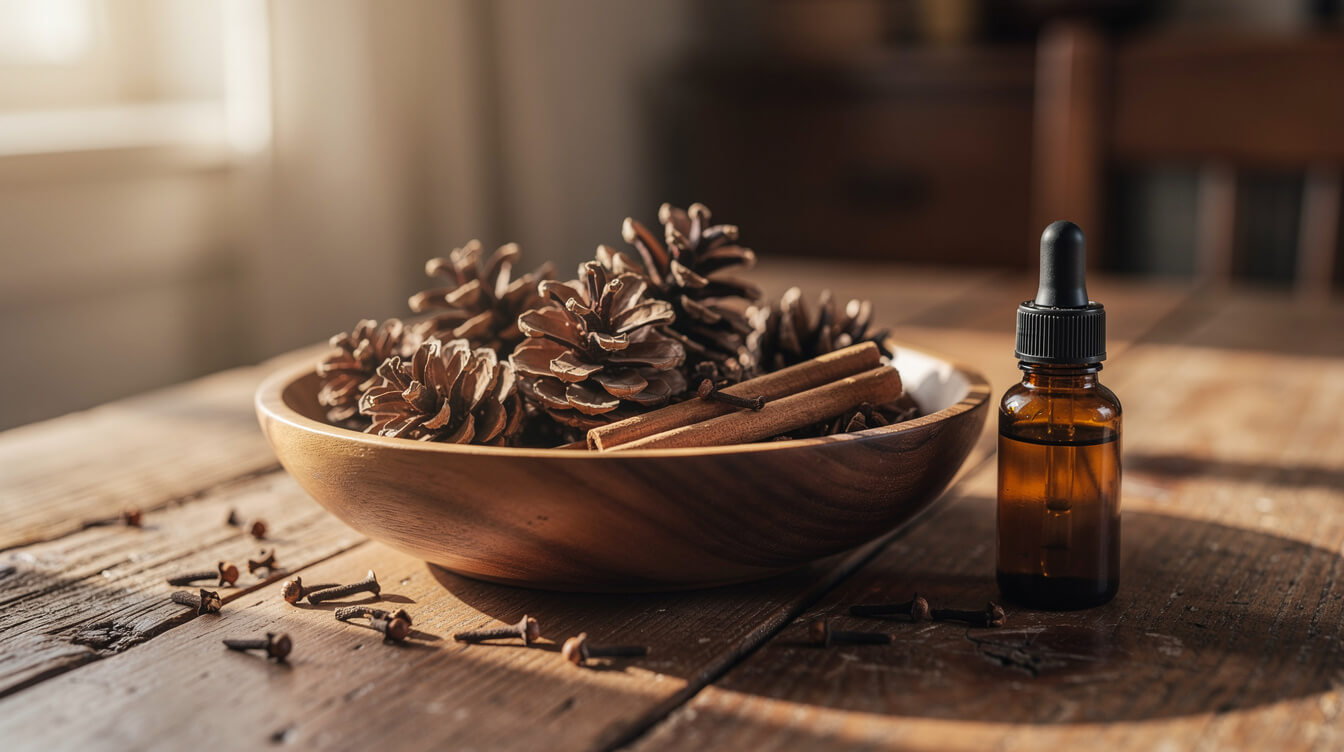
Cinnamon Essential Oil for Pine Cones: The Bake-First, No-Water Method (and the Bark-vs-Leaf Rule)
Using cinnamon essential oil for pine cones is one of the easiest autumn crafts there is: a bowl of foraged cones, a few drops of oil, a sealed bag, and a few days of patience. But most tutorials leave out three details that decide whether your cones come out beautiful and safe or closed up, sticky, and harsh on the hands. Which cinnamon oil is in the bottle matters. Water is the wrong carrier, and the reason is a small piece of botany. And the order of the steps matters, because one of them involves an oven.
This guide walks through all three, then gives you a tested bake-first, oil-second method, a refresh routine that doesn’t need re-soaking, and a no-contact way to get the same cozy cinnamon aroma with a Nebulizing Diffuser®. We finish with four blends that work on cones and in the air.
Cinnamon Essential Oil for Pine Cones: Bark or Leaf?
Look closely at a bottle labelled simply “cinnamon essential oil” and you’ll usually find one of three very different oils:
Cinnamon bark oil (Cinnamomum verum, also sold as C. zeylanicum) is distilled from the inner bark. It is dominated by cinnamaldehyde, typically somewhere around 60–75% of the oil. That compound gives it the sweet, red-hot, cinnamon-roll aroma everyone recognizes. It is also the reason bark oil is one of the most skin-reactive essential oils you can buy.
Cinnamon leaf oil comes from the leaves of the same tree, and it’s a different oil in practice. It is mostly eugenol, often 70–85%, the same compound that dominates clove. It smells warmer and drier, a little clove-like, and noticeably less sweet.
Cassia oil (Cinnamomum cassia) is the “Chinese cinnamon” behind most supermarket ground cinnamon. It’s even richer in cinnamaldehyde than true cinnamon bark, and it’s frequently sold simply as “cinnamon oil.”
Why it matters for a craft you do with your hands
Robert Tisserand and Rodney Young’s Essential Oil Safety, the standard professional reference, suggests a maximum skin concentration of just 0.07% for cinnamon bark oil and 0.05% for cassia. Their figure for cinnamon leaf oil is 0.6%, nearly ten times higher. Making pine cones isn’t a skincare recipe, but you are handling a concentrated oil, turning the cones over, and setting them in a bowl that people (and small hands) will pick up. That’s why cinnamon leaf oil is the gentler choice for the craft itself. Wear disposable gloves either way.
Bark oil isn’t a bad oil, just a better fit for the air than for your fingers. That’s why our own Cinnamon Essential Oil (true cinnamon bark) lives in our Nebulizing Diffusers, not in our craft basket. We go much deeper into the cinnamaldehyde-versus-eugenol chemistry in our complete cinnamon essential oil diffusion guide.
Why Pine Cones Close When You Spray Them: The Hygroscopic Hinge
Several popular tutorials mix cinnamon oil into a spray bottle of water, mist the cones, and then warn you that the cones “may close back up” for a day or so. They don’t explain why, and the explanation changes the whole method.
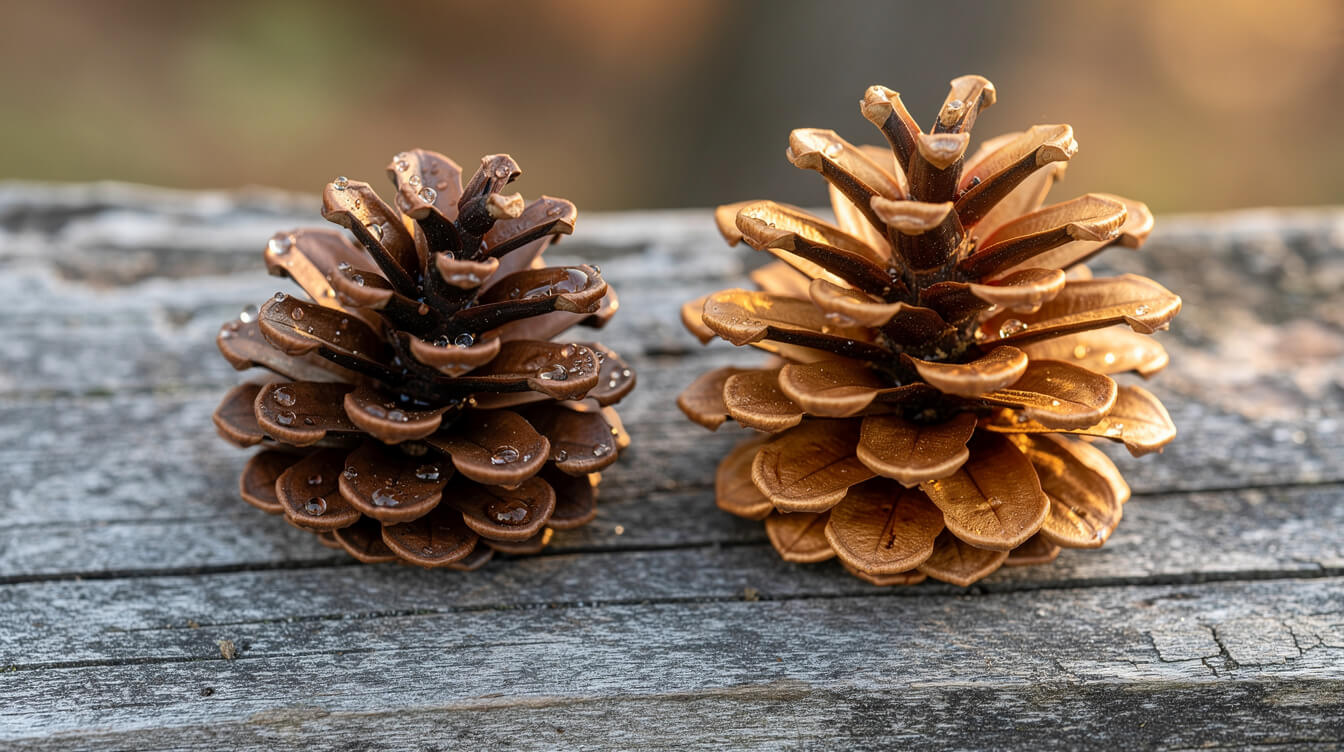
A pine cone scale is a two-layer hinge. In 1997, materials scientists Colin Dawson, Julian Vincent, and Anne-Marie Rocca published a short paper in Nature titled “How pine cones open.” They showed that the outer layer of each scale is packed with long, stiff fibres that swell and shrink lengthwise as they absorb or lose moisture. The inner layer barely changes. When the scale gets wet, the outer layer lengthens more than the inner one, and the scale bends inward and closes. When it dries, the scale bends back open.
Two things about that mechanism matter for crafters:
It is purely mechanical. The tissue is dead, so the movement runs on moisture alone, and a cone that fell years ago still opens and closes with the weather. (Your finished bowl of cones is, quite literally, a humidity indicator. Old-fashioned weather lore used them that way.)
Water is the trigger. Every water-based spray tells the scales to close. On top of that, essential oils don’t dissolve in water. In a spray bottle the oil floats as a film, so the first few sprays are oil-heavy and the last ones are mostly water. You end up with unevenly scented cones that need a full day to reopen.
The fix is simple: when you use cinnamon essential oil for pine cones, skip the water. Apply the oil neat, drop by drop, where the cone can absorb it, and the scales stay open the whole time. Some recipes swap water for rubbing alcohol to thin the oil. That avoids the closing problem, but it adds a highly flammable step to a craft that already involves an oven, so we don’t recommend it.

Sign Up to Get Your FREE Essential Oils e-Book Here
How to Use Cinnamon Essential Oil for Pine Cones, Step by Step
This is the method we’d hand a friend for using cinnamon essential oil for pine cones: no water, no alcohol, no glue, and the heat step always comes first.
1. Clean and bake the cones first, before any oil
Shake out loose debris and brush off dirt with a dry stiff brush (no washing, for the hinge reason above). Spread foraged cones on a foil-lined baking sheet and bake at about 200°F (93°C) for 30–60 minutes. The low heat dries the cones, softens sticky sap so it drips onto the foil, and deals with any insects hitching a ride indoors. Closed green-brown cones will often open in the oven, too. Stay nearby while they bake: dry cones are natural kindling.
Then let them cool completely to room temperature. Only now does oil come anywhere near them. Essential oils are flammable, and an oven is no place for oil-soaked kindling, so never bake or “re-dry” cones after they’ve been scented. (Our guide to whether essential oils are flammable explains the fire-safety basics.) Store-bought craft cones are usually pre-baked and can skip straight to step 2.
2. Drop the oil into the heart of the cone
Put on gloves. Holding each cone with tongs, place the drops at the base of the scales, close to the central stem, working around the cone in a spiral. The woody core and the scale bases are the most absorbent parts, they release scent slowly, and oil placed there stays away from the scale tips that fingers touch.
A good starting dose: 2–3 drops of cinnamon leaf oil for a small cone, 4–5 for a large one. Add 1 drop of clove bud for every three or four cones, and optionally a drop of sweet orange on every third cone for brightness. A tucked-in cinnamon stick or two in the bag adds depth.
Do the math before you start. At roughly 20 drops per millilitre, a bowl of 20 large cones at 5 drops each uses about 100 drops: around 5 mL, or half a standard 10 mL bottle. That’s one more practical reason to save your premium bark oil for diffusing, where a few drops scent a whole room.
3. Seal, wait, and air out
Transfer the cones with tongs into a large zip-top bag or a lidded glass jar. Don’t drip oil directly onto plastic, since concentrated oils can soften some plastics. Seal and leave somewhere cool and dark for 2 to 7 days. Inside the sealed space, the aroma molecules evaporating from the oil have nowhere to go except into the porous scales, so the longer the wait, the deeper the scent and the longer it lasts once displayed. Then lay the cones on a tray to air out for a couple of hours before styling them.
Refreshing scented pine cones without re-soaking
Cinnamon scent fades for two reasons: the oil slowly evaporates, and cinnamaldehyde gradually oxidizes in air and light into compounds with much less aroma. When the bowl goes quiet, usually after one to three weeks, add one or two fresh drops at the base of each cone, gloves on. There’s no need to re-bag. Keep the bowl away from radiators, heating vents, and sunny windowsills, which speed both processes. At the end of the season, store the cones in an airtight tin or glass jar in a dark cupboard, and they’ll be ready to wake up with a drop or two next autumn.
Safety First: Hands, Kids, Pets, and Flames
Cinnamon essential oil for pine cones is a wonderfully low-tech idea, but they put concentrated oil on an object people love to touch. A few sensible rules:
Protect your hands and eyes. Wear disposable gloves while applying the oil, wash your hands afterwards, and don’t touch your face or eyes mid-project. If oil gets on your skin, wipe it off with a little plain vegetable oil, then wash with soap. Water alone spreads it around. Never use cinnamon oil undiluted on skin for any reason.
Display above little hands and curious paws. To a toddler, a pine cone is a toy. To a dog it’s a chew. Place the bowl on a mantel, high shelf, or entry console rather than a coffee table. Cats deserve extra care: their livers process many aromatic compounds, including the phenols in clove and cinnamon leaf, much more slowly than ours do. Our pet-safe diffusion guide covers the chemistry.
Keep scented cones away from flame and heat. Pine cones make classic fire starters on their own, and an oil-scented cone only adds fuel. Never toss scented cones into a fireplace or wood stove, and don’t set them beside candles, on a radiator, or near a hot lamp. Commercial scented cones carry the same warning for good reason.
Ventilate. A freshly bagged batch can be intense when you first open it. Open the bag outdoors or by an open window, and if the room smells overpowering once the cones are displayed, move part of the bowl to another room.
Sign Up to Get Your FREE
e-Book Here…
The No-Contact Option: Diffusing Cinnamon for the Same Cozy Aroma
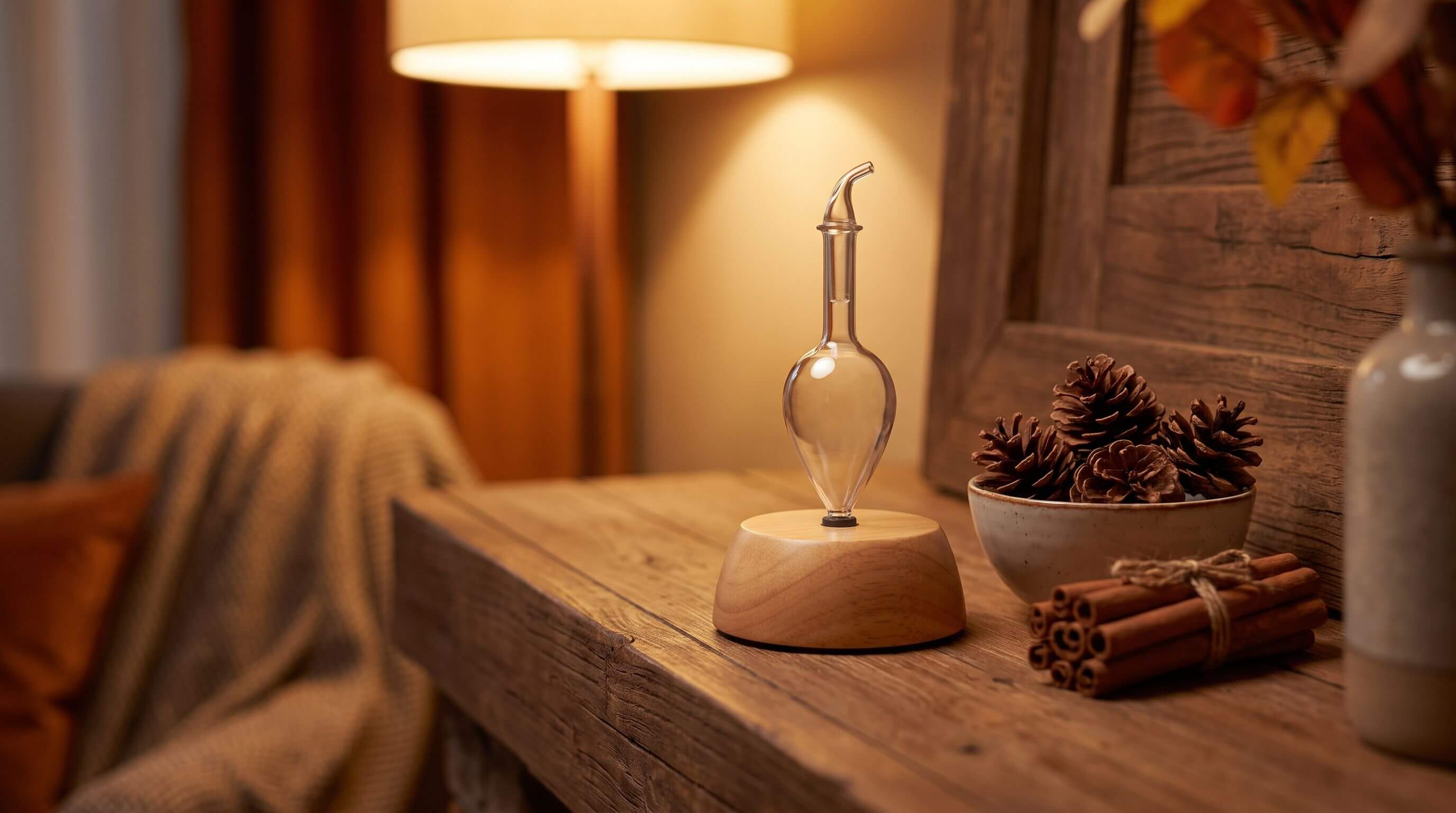
Scented pine cones are decoration first and fragrance second. They give a gentle, close-range scent that you notice when you walk past the bowl. If what you really want is the whole room smelling like a spiced autumn afternoon, with nothing for hands or paws to touch, diffusing does that job better.
A Nebulizing Diffuser® uses Bernoulli’s Principle: a fast stream of air across the top of a fine glass tube draws pure oil up and shears it into a micro-fine mist inside the glass reservoir. It works with no water, no heat, and no plastic in the oil path (our explainer on waterless diffusion goes deeper). For cinnamon, the no-heat part matters most. Warming cinnamaldehyde in a tealight burner speeds up the same oxidation that dulls a pine cone’s scent, and it changes the aroma as the session goes on. Atomizing it cold keeps the sweet bark character intact. We compared the two approaches in detail in Nebulizing Diffuser vs candle: the combustion chemistry.
Settings that suit cinnamon
Start low and run it intermittently. Cinnamon is one of the most intense oils on the shelf, so a few minutes on and a longer pause off scents a living room beautifully. A Smart Nebulizing Diffuser® lets you set that cycle in the app. Blend rather than solo. Cinnamon is a seasoning oil. It’s at its best as one part in four or five (see the blends below). Keep the glass clean. After a spice-blend week, give the reservoir and micro-tubes a rinse with 70%+ isopropyl alcohol using our step-by-step waterless cleaning method.
Our Cinnamon Essential Oil is distilled from true Cinnamomum verum bark, the rich, sweet cinnamon that shines in the air, and it pairs naturally with our Clove Bud Essential Oil. Both work in any piece from our handcrafted Nebulizing Diffuser® collection.
Four Cinnamon Blends for Pine Cones and Your Nebulizing Diffuser®
Each blend works two ways. For pine cones, use the ratio as a guide to how many drops of each oil go on the cones in one batch (with cinnamon leaf for the cinnamon part). For diffusing, multiply the parts into a small amber bottle (for example, 3 : 1 : 1 becomes 15 : 5 : 5 drops) and use our cinnamon bark oil if you like it sweeter. Ratios are in parts.
1. Hearth and Orchard: sweet orange, cinnamon, clove (3 : 1 : 1)
The classic. Bright orange peel on top, warm spice underneath, and a dry clove finish. It smells like mulled cider before anyone has opened the cider. If you love the citrus side, our orange essential oil guide explains how to keep it fresh.
2. Forest Floor: cedarwood, cinnamon, sweet orange (3 : 1 : 1)
Woody and grounded, the scent of a cabin porch in October. Cedarwood pairs naturally with the woody pine cones themselves. Our cedarwood guide explains why it anchors so many autumn blends.
3. Spice Market: cinnamon, ginger, cardamom, sweet orange (1 : 1 : 1 : 3)
Warm and a little exotic, with ginger’s spark and cardamom’s soft, almost eucalyptus-like lift. Excellent in an entryway, where guests catch it as they come in. For more crowd-friendly ideas, see our blends for entertaining.
4. First Frost: cinnamon, clove, tangerine (1 : 1 : 3)
Sweeter and softer than Hearth and Orchard, and lovely as the evenings turn cold. It’s a variation on our Tuesday cinnamon leaf, clove bud and tangerine blend. For a full season of spice combinations, browse our seven cozy fall blends, or work out your own pairings with the essential oil blending chart.

Join Our Exclusive Member Club to get Big Discounts!
Cinnamon Essential Oil for Pine Cones: Frequently Asked Questions
Which cinnamon essential oil is best for pine cones?
Cinnamon leaf oil. It is mostly eugenol and has a much higher suggested skin limit than cinnamon bark or cassia oil, which matters for a craft you handle. Bark oil smells sweeter but is better used in a Nebulizing Diffuser, where nobody touches it.
How many drops of essential oil do you put on a pine cone?
Start with 2–3 drops for a small cone and 4–5 for a large one, placed at the base of the scales near the center. A bowl of 20 large cones uses about 5 mL of oil in total.
Why did my pine cones close after I scented them?
They got wet. Pine cone scales are hygroscopic hinges that bend closed when they absorb moisture and reopen as they dry. Skip water-based sprays and apply the oil neat. If they’ve already closed, leave them somewhere dry and warm (not hot) and they’ll reopen within a day or so.
How long do cinnamon scented pine cones last?
After 2–7 days sealed in the bag, expect a noticeable scent for one to three weeks, depending on warmth and airflow. Refresh with a drop or two per cone whenever they fade, and store them airtight between seasons.
Can I put scented pine cones in the fireplace?
No. Pine cones are natural kindling, and oil-scented cones add fuel. Keep them away from fireplaces, wood stoves, candles, radiators, and hot lamps, and never bake cones after scenting them.
Are cinnamon pine cones safe around pets?
Display them where pets can’t reach or chew them, keep rooms ventilated, and take extra care with cats, which process the compounds in cinnamon and clove oils slowly. If you want the aroma without anything touchable, diffuse intermittently instead and leave a door open so pets can step away.
A bowl of homemade cinnamon pine cones is one of autumn’s small joys, and getting cinnamon essential oil for pine cones right comes down to a few simple choices. Choose leaf oil for the craft, keep water out of it, bake first and scent second, and display it somewhere safe. Then let your Nebulizing Diffuser® carry the same warm spice to every corner of the room, no handling required.