

Orange Essential Oil Benefits: The Research, the Freshness Problem, and How to Diffuse It Well
Most lists of orange essential oil benefits are written as if every bottle were identical and every claim were settled. Neither is true. The research that holds up is narrower and more interesting than the usual list of twelve miracles. It is mostly about mood and how a room feels, and some of it comes from dental waiting rooms. The bigger practical story is one most guides skip: orange oil goes stale faster than almost any oil on your shelf, and a tired bottle smells different and behaves differently.
This guide covers what is actually in the bottle, what the studies found (and what they didn’t), why freshness matters more for orange than for nearly any other oil, the sweet-versus-bitter sun-safety split, and how to diffuse it so you get the bright, juicy peel aroma you paid for. We close with four autumn blends that use orange as the lift. No cures, no disease claims: just chemistry, honest research, and good technique.
What Is Orange Essential Oil? Sweet, Bitter, and the “Wild Orange” Question
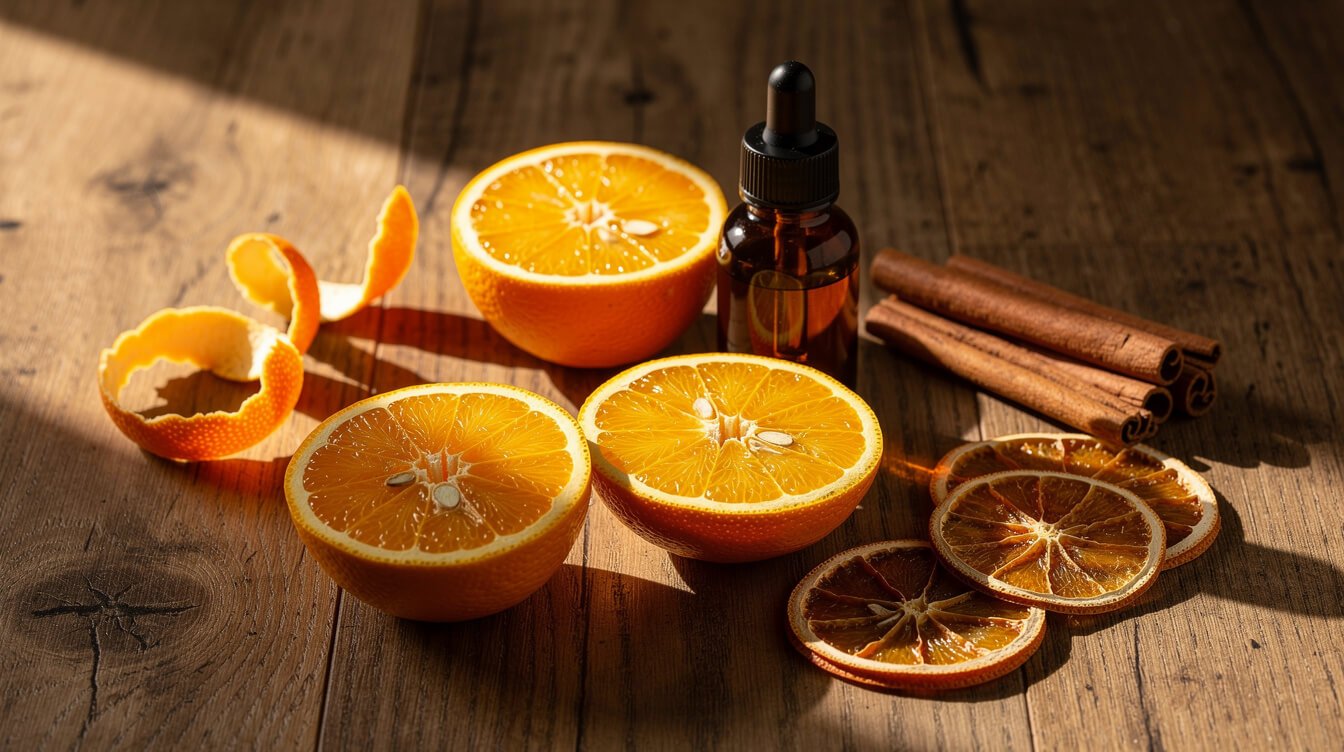
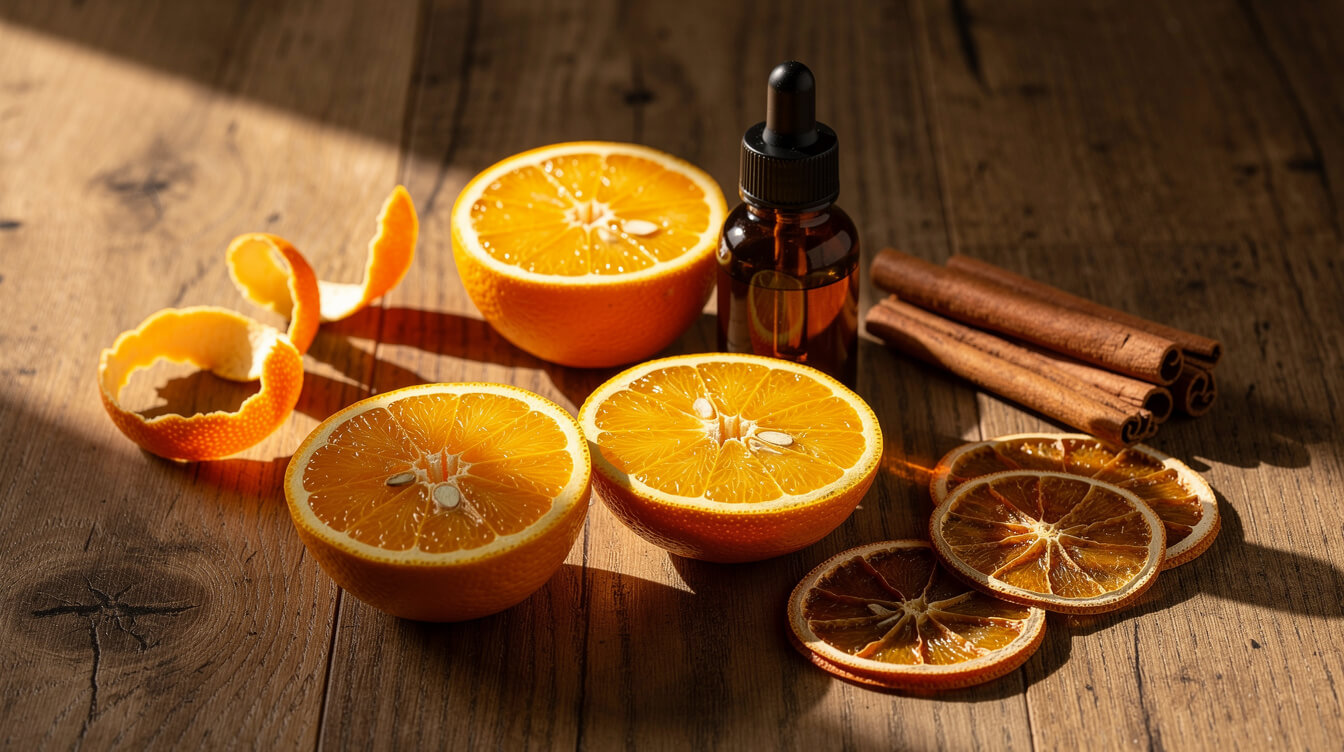
Orange essential oil is pressed, not distilled. The bright, sweet oil sold under that name almost always comes from the peel of Citrus sinensis, the same sweet orange you eat for breakfast. Tiny oil glands sit just under the skin’s surface (squeeze a strip of peel near a candle flame and you can see them spray). Cold-pressing ruptures those glands mechanically, and the oil is spun away from the juice and water. No steam is involved, which is a large part of why a good orange oil smells so much like a freshly cut fruit.
Two other names on labels are worth decoding:
Bitter orange (Citrus aurantium) is a different tree. Its pressed peel oil smells drier and more bitter, and it matters for sun safety (more on that below). The same tree gives us two famous oils from other parts of the plant: neroli from the blossoms and petitgrain from the leaves and twigs.
“Wild orange” is a brand name, not a different species. The best-known oil sold under it is Citrus sinensis, ordinary sweet orange. Blood orange is also a sinensis variety. If you’re comparing prices, compare the Latin name and the extraction method, not the adjective in front of “orange.”
The 5% of the Bottle That Actually Smells Like Orange
Here is the chemistry detail that changes how you think about this oil. Sweet orange oil is typically around 90–95% d-limonene. Yet pure limonene on a smelling strip is surprisingly faint and generic: vaguely citrus, a little like a cleaning product. The aroma you recognize as “orange peel” comes largely from the small remaining fraction: aliphatic aldehydes such as octanal and decanal, plus traces of linalool, valencene, and dozens of other minor compounds.
The flavor and fragrance trade knows this well. Commercial orange oil is often graded by its aldehyde content (usually expressed as decanal), not by its limonene percentage, because aldehydes are what separate a vivid, juicy oil from a flat one. Keep that 5% in mind. It is the part that fades first when an oil ages badly, and it is the part your diffusion method either preserves or blunts.
Orange Essential Oil Benefits: What the Research Actually Shows
Search results tend to stack antibacterial lab results, cancer cell-line experiments, and weight-loss claims into one list. Those studies were done in test tubes, on cultured cells, or on animals, often with concentrations no one would ever breathe at home. They tell us nothing about what happens when you diffuse orange in your living room, so we won’t pretend otherwise. What does exist is a small, consistent body of human research on orange scent and mood. It is genuinely charming.
The dental waiting-room studies
In 2000, a team in Vienna led by Johann Lehrner scented a working dental office’s waiting room with orange oil on some days and left it unscented on others (published in Physiology & Behavior). Patients filled in mood questionnaires while they waited. Women who waited in the orange-scented room reported a more positive mood and felt calmer than women in the unscented room. The interesting wrinkle almost nobody mentions is that the effect in men was not statistically significant. A larger 2005 follow-up from the same group, with around 200 patients, compared orange, lavender, music, and no stimulus. Both oils were associated with better mood than the control.
A 2013 study took the idea to a pediatric dental clinic. Children aged roughly 6 to 9 were seen at two visits, one with orange aroma in the room and one without. On the orange-scented visit they showed lower pulse rates and lower salivary cortisol, a common marker of stress, during treatment.
The tea tree control that makes one study stand out
A 2012 Brazilian study (Goes et al., Journal of Alternative and Complementary Medicine) had 40 male volunteers inhale sweet orange at several doses before a deliberately stressful task. The smart part of the design was the controls: one group inhaled plain water, and another inhaled tea tree oil. Volunteers who breathed sweet orange stayed calmer through the task than both control groups. Because tea tree is also a strong, distinctive smell, the result suggests the effect is not simply “any noticeable scent.” Something about orange specifically seemed to help people keep their composure.
A 2014 Japanese study (Igarashi et al., Complementary Therapies in Medicine) measured blood flow in the prefrontal cortex of 20 young women as they smelled orange or rose oil for 90 seconds. Both oils reduced activity in the right prefrontal cortex, a pattern the researchers link to physiological relaxation. Participants also rated themselves as more “comfortable” and “relaxed.”
How to read all of this honestly
These are small studies about how people feel in a scented room. That is exactly what aromatherapy is for. They do not show that orange oil treats any condition, and you should be wary of anyone who says it does. The fair summary: orange is one of the best-studied oils for creating a brighter, calmer atmosphere, and the effect shows up even in some of the least relaxing rooms people spend time in. For a kitchen on a grey October morning, that’s a pretty good résumé. (If you like this kind of evidence-first approach, our guide to geranium essential oil benefits takes the same lens to a very different oil.)

Sign Up to Get Your FREE
e-Book Here…
Why Orange Oil Goes Flat: Limonene Oxidation and Shelf Life
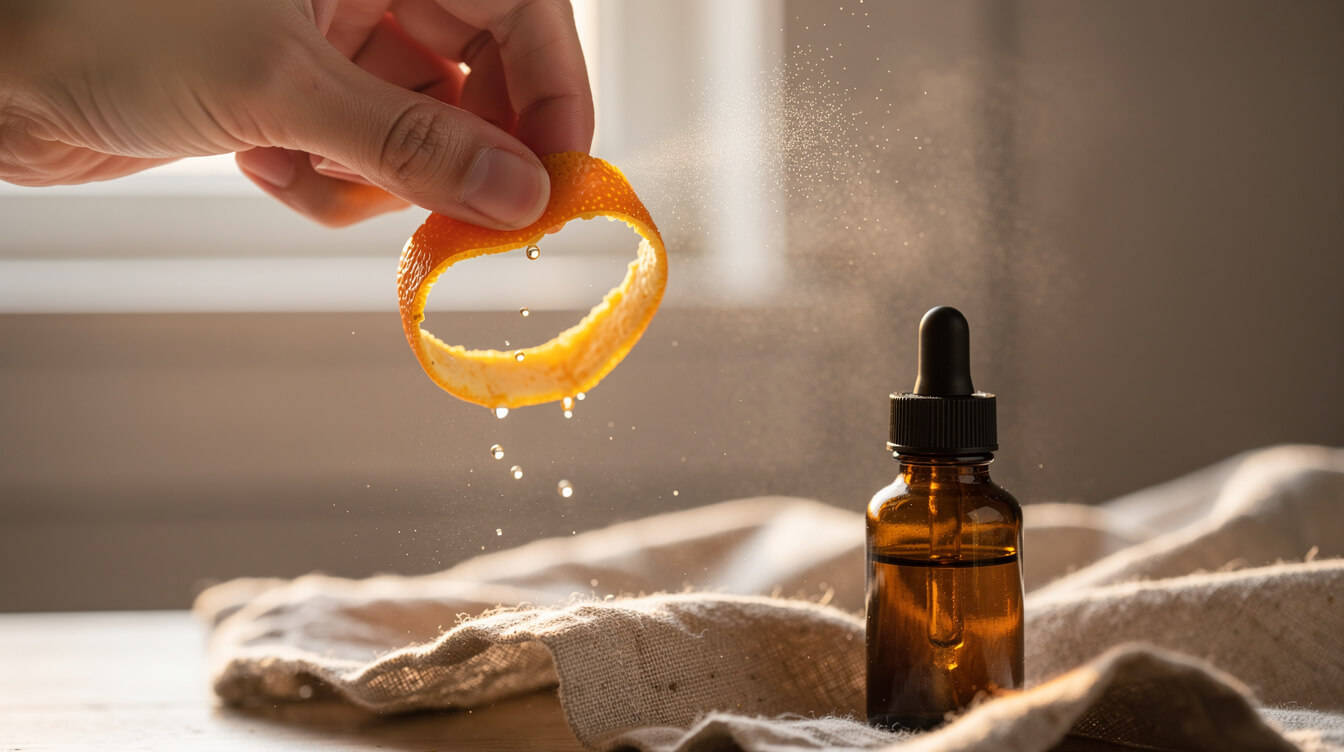
Freshness quietly decides how many orange essential oil benefits you actually get from a bottle. Every essential oil reacts with oxygen eventually, but citrus oils are among the fastest. Limonene has a reactive double bond that oxygen attacks readily, especially with heat, light, and air in the bottle to help it along. The first products are limonene hydroperoxides, which break down further into compounds such as carvone, carveol, and limonene oxide. Meanwhile, those precious aldehydes from the 5% fraction are oxidizing into their corresponding acids, which smell nothing like fresh peel.
You can usually smell the change before you can see it. Fresh sweet orange is juicy, sweet, and slightly zesty. An oxidized bottle smells thinner and sharper, sometimes faintly like turpentine or old marmalade, and the oil may look a little cloudy or feel more viscous. If your orange oil smells more like a cleaning product than like a peeled orange, oxidation is the likely reason.
Why freshness matters beyond the smell
This isn’t only an aesthetic issue. Fresh limonene rarely causes skin reactions, but its oxidation products are recognized contact allergens. Oxidized limonene is now included in patch-testing panels at many European dermatology clinics for exactly this reason. That is why the most important skin-safety rule for orange oil isn’t about sunlight at all: don’t put old, oxidized citrus oil on your skin.
How to keep orange oil fresh
Buy small. A 10 mL or 15 mL bottle you’ll finish this season is better than a big bottle that sits half-empty for a year. Keep the cap tight and the headspace small. As a bottle empties, the trapped air does more damage, so decant the last third into a smaller bottle. Store it cool and dark. Many aromatherapists keep citrus oils in the refrigerator. Date the bottle when you open it. A common rule of thumb is to use pressed citrus oils within about a year of opening, and sooner if the aroma has dulled. Our full guide to essential oil shelf life covers how other oil families compare.
Is Orange Essential Oil Safe? Sun, Skin, Plastics, and Pets
Sun exposure: sweet and bitter orange are not the same. Many articles tell you to avoid the sun for 12 hours after using “any citrus oil.” That rule is too broad. Phototoxicity in citrus oils comes mainly from furanocoumarins such as bergapten. Pressed sweet orange contains only trace amounts and is not considered phototoxic in the standard safety references. Pressed bitter orange is different. The usual guidance caps it at about 1.25% in products left on sun-exposed skin. Cold-pressed bergamot, lemon, lime, and grapefruit belong in the cautious group too. We map the whole citrus family in our guide to phototoxic essential oils.
None of this applies to diffusing, and none of the orange essential oil benefits described above require putting the oil on your skin. Phototoxicity is a skin reaction, and scenting the air with a Nebulizing Diffuser® doesn’t put a meaningful dose of oil on your skin. If you do use sweet orange topically, the usual starting point is a 1–2% dilution in a carrier oil (roughly 6–12 drops per 30 mL), with a patch test first, and only from a fresh bottle.
Plastics: the styrofoam trick is real. Limonene is such an effective solvent that it is sold commercially as a degreaser. A few drops of orange oil really will eat into a polystyrene cup. That is worth knowing if your diffuser, storage bottle, or dropper is made of certain plastics, and it is why we wrote a whole mini-FAQ on whether citrus oils damage a diffuser. In a Nebulizing Diffuser®, the oil only ever touches glass, which limonene can’t harm.
Pets. Cats process many aromatic compounds, including citrus terpenes, more slowly than people do. Diffuse orange in a ventilated room, keep the session short, and always leave a door open so pets can walk away from the scent. Our pet-safe diffusion guide explains the liver chemistry behind this.
Sign Up to Get Your FREE Essential Oils e-Book Here
How to Diffuse Orange Essential Oil (and Why a Nebulizing Diffuser® Suits Citrus)
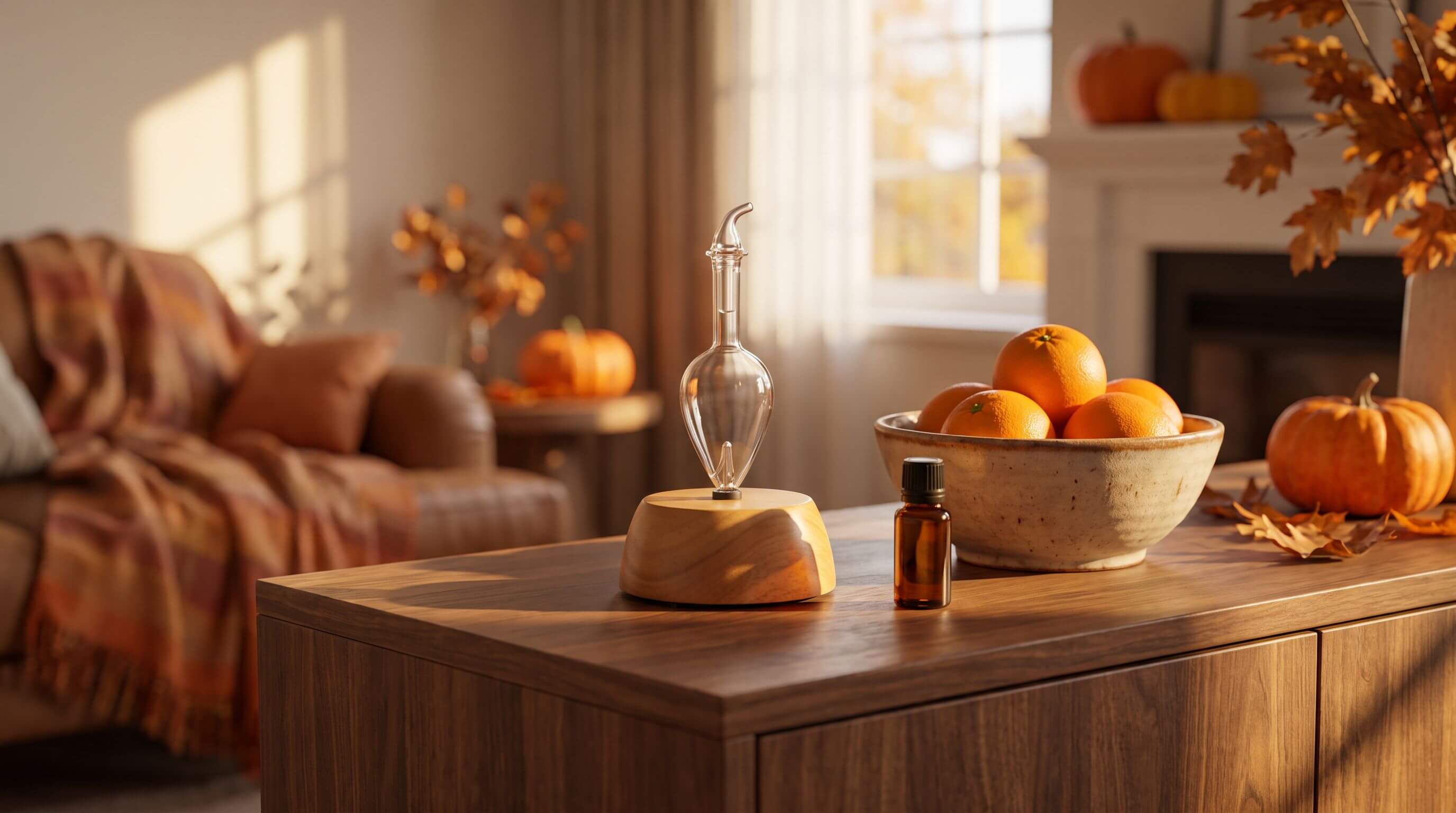
If you want the orange essential oil benefits described above, how you diffuse the oil matters more than it does for most oils. It all comes back to the chemistry.
Orange oil and water don’t mix. Limonene is practically insoluble in water (on the order of 14 milligrams per liter). In a water-based ultrasonic diffuser, the oil floats as a film on the surface and gets carried out in a mist that is overwhelmingly water. You smell a diluted, damp version of the oil, and the tank surface is in constant contact with a powerful solvent.
Heat speeds up the exact reaction you’re trying to avoid. Candle burners and heated pads warm the oil in open air, which accelerates oxidation and changes the aroma over the course of a session. With orange oil, that means you lose the fresh peel character first.
A Nebulizing Diffuser® uses neither. It uses Bernoulli’s Principle: a stream of air across the top of a fine glass tube draws the pure oil up and shears it into a micro-fine mist inside the glass reservoir. No water, no heat, no plastic in the oil path. (Our explainer on how Bernoulli’s Principle diffuses pure oil goes deeper.) There’s also a quieter advantage for blends. Because the oil is atomized rather than evaporated, the whole blend leaves the reservoir together. With evaporative methods, light top notes like orange flash off first and heavier notes linger, so a blend drifts as the session goes on. With nebulization, the ratio you mixed is much closer to the ratio you smell.
Practical settings for orange
Run it intermittently. Orange is one of the thinnest oils you can diffuse, so it atomizes easily and also gets used up faster than a thick base note. An on/off cycle scents the room well and stretches the bottle. If you have a Smart Nebulizing Diffuser®, set a gentle cycle in the app and let it handle the timing. Start low in small rooms. Orange reads as bright and friendly, but full output in a small bedroom can tip into sharp. Keep the bottle fresh. Everything in the oxidation section applies doubly when the oil is the only thing you’re breathing in. Clean weekly. Thin citrus oils aren’t the clog risk that resins and heavy woods are, but OA’s own care instructions still call for a weekly clean of the glass reservoir and micro-tubes with 70%+ isopropyl alcohol. Here’s our step-by-step waterless cleaning method.
If you’d like an orange oil that’s pressed for exactly this purpose, our Sweet Orange Essential Oil is 100% pure and organic, and it pairs naturally with any piece from our handcrafted Nebulizing Diffuser® collection.
Orange Essential Oil Blends for Autumn Evenings
Orange rarely needs to be the star. It works best as the lift: the bright top note that keeps heavier woods and florals from feeling dense. Our seven cozy fall blends already cover the classic orange-and-spice combinations (cinnamon, clove, cardamom, ginger). The four below take orange in different directions. Ratios are in parts. Multiply them into a small amber bottle (for example, 3:2:1 becomes 15:10:5 drops) and use the blend in your Nebulizing Diffuser® as usual.
1. The Lamp-Lit Library: orange, cedarwood, black pepper (3 : 2 : 1)
Dry, woody, and gently warm, like a reading chair beside a window on a cool evening. Cedarwood gives it structure (our cedarwood guide explains why it is the backbone of autumn blends), and a single part of black pepper adds a soft spark without tipping into spice-cabinet.
2. The Soft Landing: orange, lavender, geranium (3 : 2 : 1)
A rounded, floral-citrus blend for the hour after dinner. The orange keeps lavender from feeling sleepy-heavy, and geranium adds a rosy middle that ties the two together.
3. The Afternoon Clear-Head: orange, rosemary, peppermint (3 : 1 : 1)
For the 3 p.m. slump at a home desk. It is crisp and green with a sweet citrus finish. Keep peppermint at one part, because it dominates quickly in a small room.
4. Dusk Velvet: orange, ylang ylang, sandalwood (4 : 1 : 1)
Warm, creamy, and a little indulgent. Ylang ylang is intense, so one part is plenty against four of orange. Sandalwood is one of the thicker oils, so give the micro-tubes a clean promptly after this blend rather than letting it sit.
Want to design your own? Our essential oil blending chart lays out top, middle, and base notes so you can find orange’s best partners at a glance.

Join Our Exclusive Member Club to get Big Discounts!
Orange Essential Oil Benefits: Frequently Asked Questions
What are the main benefits of orange essential oil?
The best-supported benefit is atmospheric. In small human studies, orange scent has been associated with a brighter mood and a calmer state in settings ranging from dental waiting rooms to stressful lab tasks. It’s also a versatile, inexpensive top note that lifts almost any blend. Claims about treating illness come from lab and animal studies, not from diffusing at home.
Is sweet orange essential oil phototoxic?
Pressed sweet orange (Citrus sinensis) is not considered phototoxic. Pressed bitter orange (Citrus aurantium) is, so it should stay at or below about 1.25% in products left on sun-exposed skin. Diffusing either oil doesn’t raise a phototoxicity concern.
How long does orange essential oil last?
Pressed citrus oils oxidize faster than most essential oils. Store them cool, dark, and tightly capped, and aim to use an opened bottle within about a year. If it smells sharp, thin, or like turpentine instead of fresh peel, it’s past its best, and it should not go on your skin.
Is wild orange the same as sweet orange?
Generally, yes. “Wild orange” is a brand name, and the best-known oil sold under it is Citrus sinensis, the same species as sweet orange. Check the Latin name on the label to be sure.
Can I diffuse orange essential oil around my cat or dog?
Use care. Cats in particular metabolize citrus terpenes slowly. Diffuse intermittently in a ventilated room, keep sessions short, and make sure pets can always leave the room.
Will orange oil damage my diffuser?
Limonene can soften some plastics, which is why it’s sold as a degreaser. In a Nebulizing Diffuser®, the oil only touches medical-grade Pyrex glass, which citrus oils can’t harm. Just wipe any drips off the wood base.
The real orange essential oil benefits are simpler than the hype, and better. Orange earns its place on the shelf for an honest reason: it reliably makes a room feel brighter, and it makes every blend around it better. Keep it fresh, know which orange you’re holding, and let it atomize cold and pure. That’s when it smells like the fruit, not the cleaning aisle.