

Tea Tree Essential Oil: Why It Turns Harsh in the Bottle and How to Diffuse It Fresh
Tea tree essential oil has a reputation problem. Search for it and almost everything you find is about skin, scalps and cleaning sprays, as if this sharp, green, unmistakably Australian oil only belonged in the medicine cabinet. But tea tree is also one of the freshest scents you can bring into a home: crisp, herbal, a little woody, the smell of a eucalyptus forest after rain. And it has one quirk that almost nobody talks about. It changes in the bottle faster than most oils on your shelf.
This guide is about tea tree as an aromatherapy oil: what gives it that clean-air character, why two bottles labelled “100% pure tea tree” can smell noticeably different, what happens chemically as an opened bottle ages, and how to store and diffuse it so it smells bright and fresh instead of harsh and medicinal. We’ll finish with four blends that soften its edges and a short, honest safety section, because tea tree is one oil where the details really matter.
What Tea Tree Essential Oil Actually Smells Like (and Why)
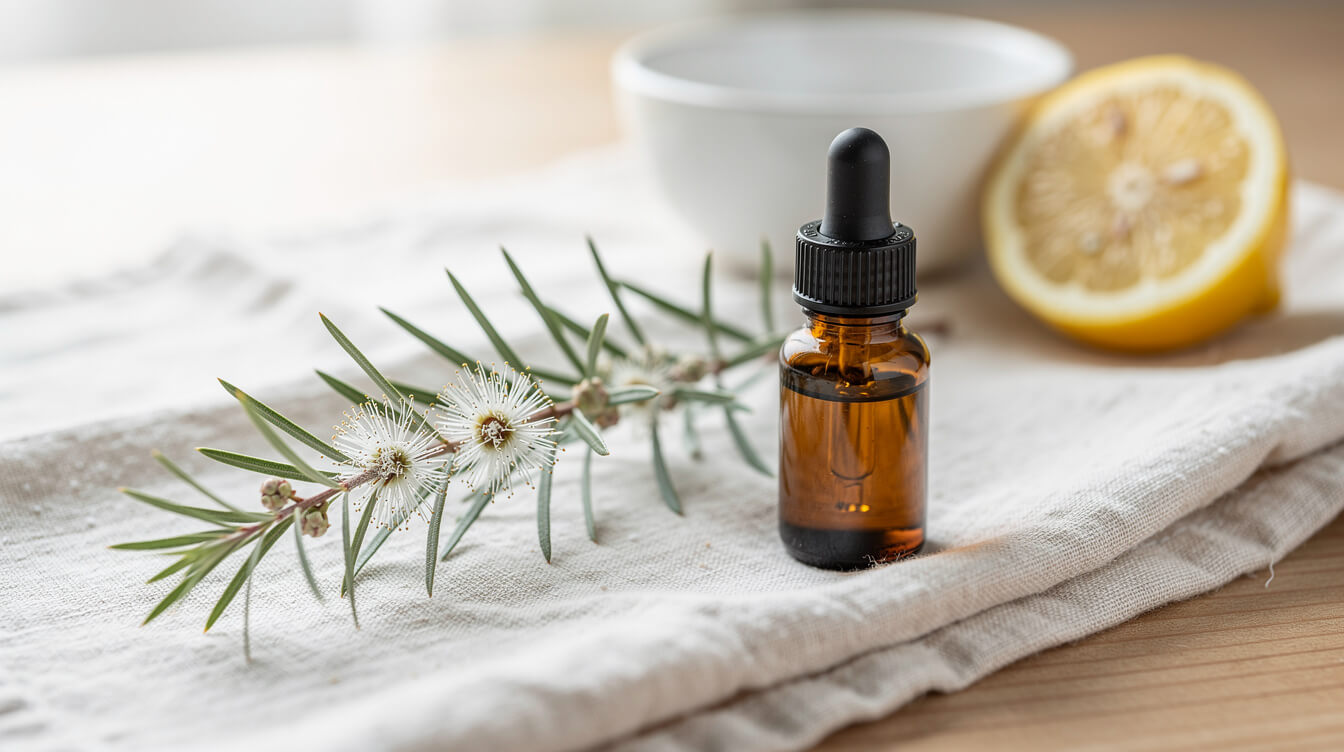
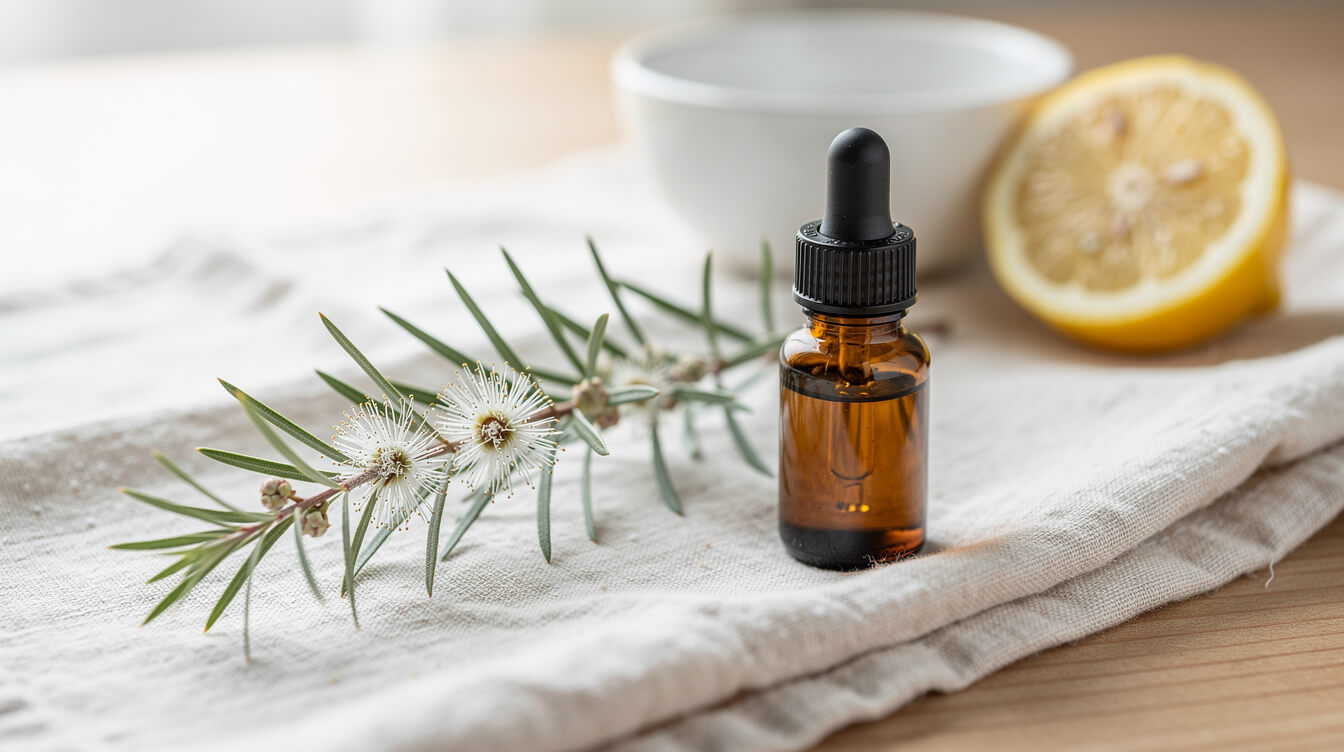
Tea tree oil is steam-distilled from the needle-like leaves of Melaleuca alternifolia, a papery-barked shrub native to the swampy coastal country of northern New South Wales, Australia. The Bundjalung people of that region used the crushed leaves long before Europeans arrived. The oil itself became famous in the 1920s, when Arthur Penfold, a chemist at Sydney’s Technological Museum, published his studies of it and turned a local bush plant into an export industry almost overnight. Most of the world’s supply still comes from plantations in the same river country.
Its scent is a layered thing once you learn to pull it apart:
Terpinen-4-ol, the signature molecule, gives the warm, woody-spicy, slightly peppery body. It’s the reason tea tree smells “green” and earthy rather than just sharp. Our guide to the active compounds in essential oils covers its laboratory story in depth; here we care about its smell.
γ-Terpinene and α-terpinene add a bright, herbal, faintly citrus lift at the top. They’re the first thing you smell when you open a fresh bottle, and, as you’ll see below, they’re the first thing to change as the oil ages.
1,8-Cineole, the main note of eucalyptus, brings the cool, camphor-like sharpness. Good tea tree keeps it low. The more cineole a tea tree oil contains, the more it reads as “medicinal” rather than “fresh.”
Put together, a fresh, well-made tea tree smells clean and lively, like crushed leaves, pine needles and a squeeze of lime. A tired or poorly made one smells like a first-aid kit. Most people who say they dislike tea tree have only met the second kind.
Six Chemotypes: Why Two “Pure” Tea Tree Oils Can Smell Different
Here is something even many aromatherapy enthusiasts don’t know: Melaleuca alternifolia isn’t chemically one plant. Botanists recognize six natural chemotypes, trees that look identical but produce different dominant molecules in their leaves. In a widely cited 2000 study in Biochemical Systematics and Ecology, Homer and colleagues described a terpinen-4-ol type, a terpinolene type, and four 1,8-cineole types. Later work at the Australian National University traced these differences to just a handful of enzymes (terpene synthases) in the leaf.
The chemotypes even cluster by geography. Terpinen-4-ol trees dominate around the Bungawalbin basin near Casino in northern New South Wales, high-cineole trees become more common further south toward Grafton, and terpinolene types appear more often in southern Queensland. That’s one reason the commercial plantations sit where they do.
What this means for your nose
The tea tree oil sold for aromatherapy is the terpinen-4-ol chemotype. The international standard for tea tree (ISO 4730) is literally titled “Essential oil of Melaleuca, terpinen-4-ol type,” and it sets a minimum for terpinen-4-ol and a ceiling for cineole. Oil from a high-cineole chemotype, or a blend padded with cheaper eucalyptus-type material, can still be sold as “natural” while smelling far harsher and more camphoraceous.
So if one bottle of tea tree smells soft and herbal and another smells like a cough drop, you’re not imagining it. Ask the seller for a GC/MS report: terpinen-4-ol should lead the list, and 1,8-cineole should sit comfortably under the standard’s ceiling, typically in the low single digits. Our guide to judging an essential oil brand’s real purity walks through how to read one.
Sign Up to Get Your FREE
e-Book Here…
The Freshness Problem: How Tea Tree Oil Changes After You Open It
This is the part of the tea tree story that the top search results skip entirely, and it changes how you should buy, store and use the oil.
Tea tree is rich in α-terpinene, γ-terpinene and terpinolene, monoterpenes that react readily with oxygen. Once a bottle is opened and air gets into the headspace, those molecules begin to oxidize. Light and warmth speed the process up.
The landmark study here is Hausen, Reichling and Harkenthal’s 1999 paper in the American Journal of Contact Dermatitis. The researchers deliberately left tea tree oil on a windowsill to see what light, air and warmth would do. Within days, peroxide levels in the oil climbed from under 50 ppm to more than 500 ppm. The α-terpinene broke down into p-cymene, ascaridole, isoascaridole and a crystalline compound identified as 1,2,4-trihydroxymenthane. In their sensitization tests, the oxidized oil was about three times more potent a skin sensitizer than fresh oil. Patients already sensitized to tea tree reacted most strongly to α-terpinene, terpinolene and ascaridole, the easily oxidized constituents and one of their breakdown products.
You can smell it happening
You don’t need a lab to notice oxidation. As the bright terpinenes disappear and p-cymene builds up, the oil’s fresh herbal-citrus top note fades and a flatter, harsher, almost solvent-like note takes over. Some people describe old tea tree as smelling like turpentine or a hardware store. If your tea tree used to smell green and now smells sharp and “chemical,” the bottle has aged, not your nose. (A rising p-cymene figure on a GC/MS report is one of the classic markers analysts use to spot old or poorly stored tea tree oil.)
How to store tea tree essential oil so it stays fresh
Buy small. A 10 or 15 mL bottle you’ll finish in a few months beats a large bottle that sits half-empty for a year. Every time you open it, the air space above the oil grows.
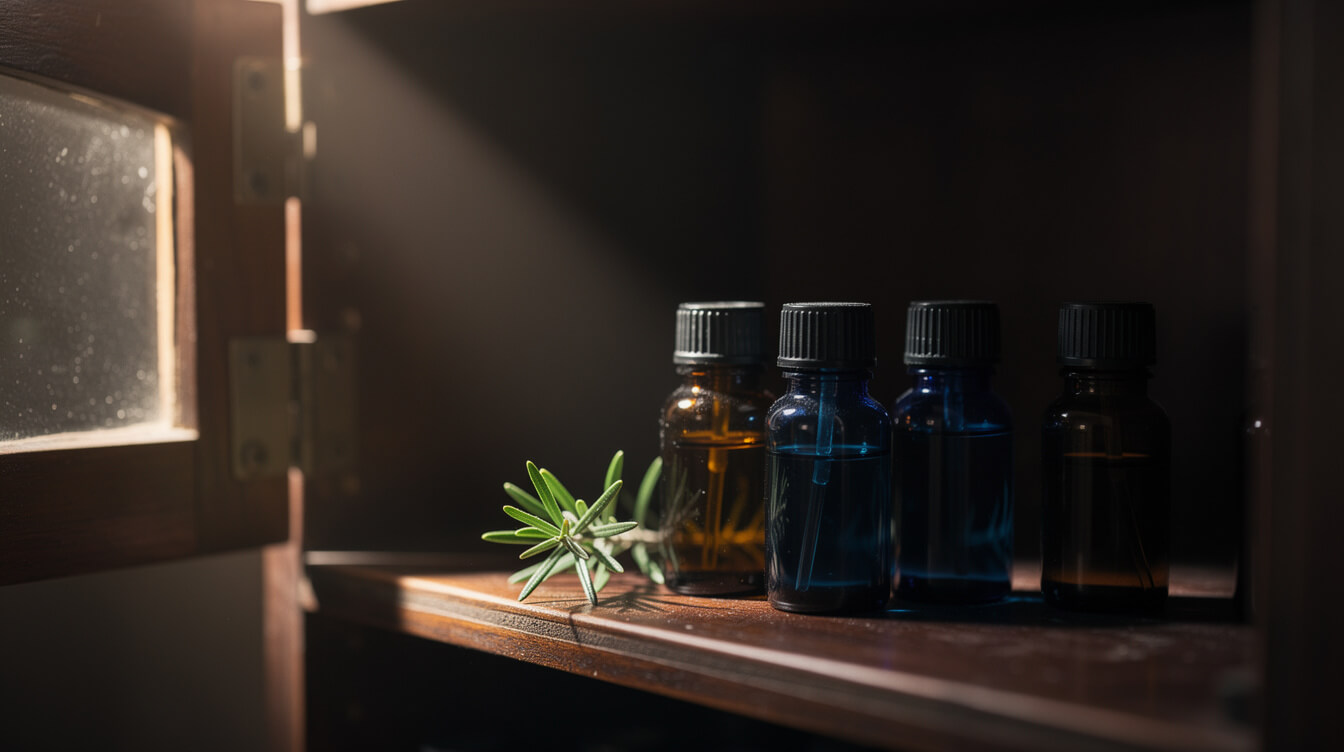
Keep it dark, cool and capped. Amber or cobalt glass, a tight cap put back immediately, and a cupboard away from sunny windows, stoves and steamy bathrooms. A refrigerator is fine too; let the bottle come to room temperature before opening so no condensation gets in.
Decant if you buy in bulk. Pour a small working bottle and keep the main stock sealed. Less headspace means less oxygen.
Use it within about a year of opening, and trust your nose before the calendar. This is a faster clock than you’d use for a base-note oil like sandalwood or patchouli. Tea tree belongs in the same “use it fresh” group as the citrus oils we discussed in our orange essential oil freshness guide. For the bigger picture on shelf life across oil families, see do essential oils expire?.
Why Heat and Water Work Against Tea Tree’s Fresh Top Notes
Oxidation is a chemical reaction, and like most reactions it runs faster when it’s warm. That has a direct consequence for how you diffuse tea tree.
Heat diffusers and tealight burners warm the oil for the whole session. The lightest, brightest molecules, the same terpinenes that give fresh tea tree its lift, evaporate first, and the oil left behind keeps cooking in open air. By the end of the evening the dish smells harsher than the bottle did.
Ultrasonic diffusers don’t use a flame, but they float a few drops of oil on a tank of water for hours, usually in a translucent plastic reservoir that lets in light. The scent reaches you diluted in water vapor, and the oil sitting on the surface is exposed to air, light and gradually warming water throughout the session. Terpene-rich oils like tea tree are also good solvents, which is one reason we prefer to keep them away from plastic altogether.
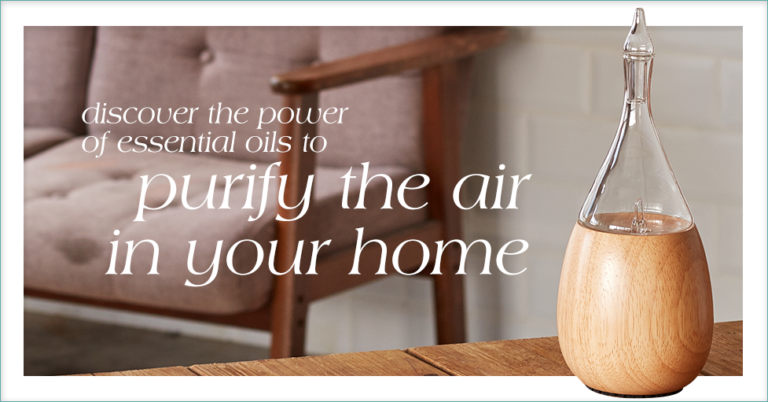
A Nebulizing Diffuser® works differently. Using Bernoulli’s Principle, a fast stream of air moving across the top of a fine glass tube draws pure, undiluted oil upward and shears it into a micro-fine mist inside a glass reservoir. There’s no water and no heat, and the oil only touches glass and air on its way into the room. (Our explainer on the Bernoulli’s Principle behind waterless diffusion shows the mechanism step by step.) The whole blend leaves as liquid microdroplets rather than evaporating lightest-first, so the bright top notes reach you in the same proportion as in the bottle.
The honest caveat
No diffuser can reverse oxidation that has already happened in the bottle, and oil left sitting in any open reservoir for days is still exposed to air. So the practical rule for tea tree is fill per session. Our care guide’s rule of thumb is that 15 to 30 drops gives roughly one to two hours of diffusion on a low setting, so add only what you plan to use, and don’t leave tea tree sitting in the glass reservoir between sessions. It’s the same reason our technicians say not to let any oil sit in the reservoir for long stretches.
Join Now and Get a Coupon for 10% Off!
How to Diffuse Tea Tree Essential Oil So It Smells Fresh, Not Medicinal
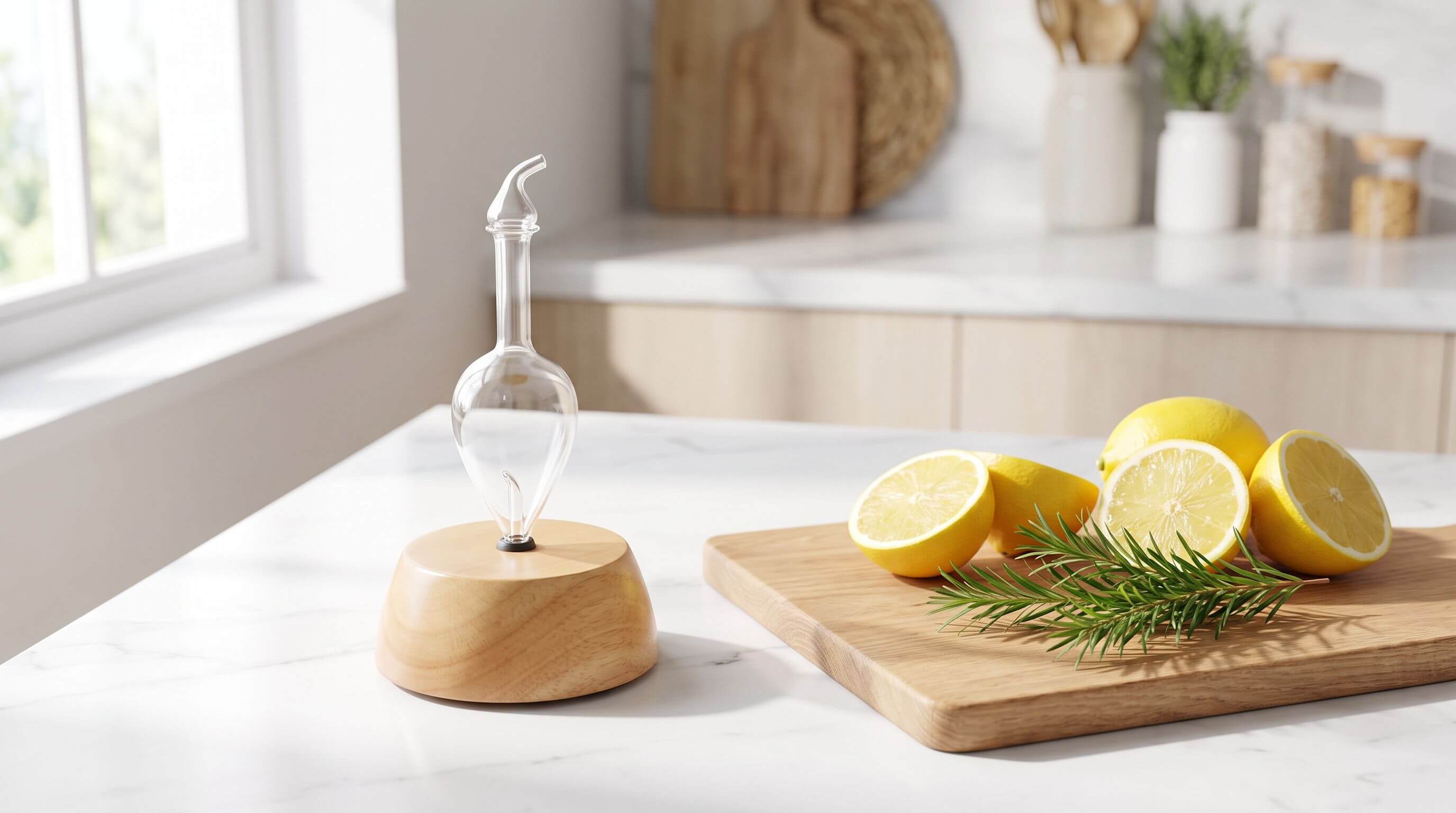
Tea tree is an assertive oil. Undiluted and nebulized, it fills a room fast, so the goal is a light, fresh accent rather than a wall of scent. Here’s how we suggest using it in a Nebulizing Diffuser®.
Start low and use intervals. Choose the lowest output setting and an on/off cycle (around 2 minutes on and 1 minute off on classic models, or a gentle schedule in the app on a Smart Nebulizing Diffuser®). Twenty to thirty minutes is plenty to refresh a kitchen or bathroom.
Make it the accent, not the lead. On its own, tea tree can tip toward “clinic.” In a blend, keep it to roughly one part in four or five, and let citrus, lavender or a soft wood carry the body. The essential oil blending chart explains why middle-note oils like tea tree work best supported by top and base notes.
Pick the right rooms. Tea tree’s clean, green character suits the spaces that need a reset: the kitchen after cooking, a laundry room, the mudroom on a wet day, a bathroom, a home gym or a closet that smells stale. It’s less suited to a bedroom at night, where softer oils feel more restful. For room-by-room ideas, see our essential oils for air freshener recipes.
Run it before you need it. Diffuse for 20 minutes before guests arrive or right after dinner, then switch off and let the room settle. A short, fresh burst lands better than hours of continuous output.
Our Tea Tree Essential Oil 100% Pure Organic is steam-distilled from Australian Melaleuca alternifolia leaves and arrives in dark glass, ready to go straight into a Raindrop Smart Nebulizing Diffuser® or any piece from our handcrafted Nebulizing Diffuser® collection.
Four Fresh Tea Tree Blends for a Clean-Smelling Home
These ratios are in parts. Mix them in a small, clean amber bottle (for example, 3 : 1 : 1 becomes 15 : 5 : 5 drops) and add only what you’ll use for one session to your Nebulizing Diffuser®. Make small batches, since tea tree is better fresh.
1. Linen Closet: lavender, tea tree, cedarwood (3 : 1 : 1)
Lavender’s soft florals round off tea tree’s edges, and a little cedarwood adds a dry, woody floor. It smells like freshly folded sheets in a cedar-lined cupboard. Lovely in a hallway or dressing room.
2. After-Dinner Kitchen: lemon, tea tree, lemongrass (3 : 1 : 1)
Bright and zesty, with lemongrass bridging lemon’s sparkle and tea tree’s green bite. Run it for twenty minutes after cooking to replace lingering food smells with something crisp.
3. Rainy Mudroom: sweet orange, cypress, tea tree (2 : 2 : 1)
Cypress brings an evergreen, forest-floor depth, and sweet orange keeps it cheerful. It’s a grounding blend for a wet-boots, damp-coat kind of day in late autumn.
4. Morning Bathroom: grapefruit, tea tree, peppermint (3 : 1 : 1)
Clean, cool and wide awake. Grapefruit’s pink-citrus brightness carries the blend, with peppermint for a cool lift. Keep sessions short, since both tea tree and peppermint are strong.
Pairing tea tree with eucalyptus is another classic. We cover that combination and its ratios in our eucalyptus essential oil guide.

Join Our Exclusive Member Club to get Big Discounts!
Using Tea Tree Safely at Home: Pets, Children and Skin
Tea tree is one oil where safety advice isn’t boilerplate, so we’ll be direct.
Pets. Tea tree is one of the most frequently cited essential oils to keep away from dogs and cats. Cats in particular process many aromatic compounds poorly. If you share your home with pets, we suggest leaving tea tree out of shared rooms entirely, or diffusing it only briefly in a well-ventilated room the animal can’t enter. Our guides to essential oils to avoid around dogs and pet-friendly diffusing go into detail.
Children. Tea tree oil must never be swallowed, and small bottles look tempting to small hands. Store it out of reach with the cap firmly closed.
Skin. This guide is about scent, not topical use. Never apply tea tree undiluted, and remember the Hausen findings above: old, oxidized tea tree is a much stronger skin sensitizer than fresh oil. If a bottle smells harsh or solvent-like, don’t put it on skin in any form, and consider replacing it.
Ventilation. As with any oil, diffuse in intervals, keep a door or window open, and stop if anyone in the room feels uncomfortable. Keep your glass clean too, using our guide to cleaning a Nebulizing Diffuser®.
Tea Tree Essential Oil: Frequently Asked Questions
What does tea tree essential oil smell like?
Fresh tea tree smells clean, green and herbal, with a woody, slightly spicy body and a bright top note, a little like crushed leaves and pine needles. Old or high-cineole oils smell harsher and more medicinal.
How long does tea tree essential oil last once opened?
Aim to use an opened bottle within about a year, and sooner if it’s half-empty or stored somewhere warm. Tea tree’s terpinenes oxidize faster than many oils. If the scent turns sharp, flat or solvent-like, the oil has aged.
Why does my new bottle of tea tree smell different from my old one?
Either the old bottle has oxidized, or the two oils come from different chemotypes or quality grades. Quality aromatherapy tea tree is the terpinen-4-ol type with low 1,8-cineole. A GC/MS report will tell you which you have.
Can I diffuse tea tree essential oil in a Nebulizing Diffuser®?
Yes. It’s a thin, free-flowing oil that nebulizes cleanly. Use a low setting with intervals, keep it to about one part in four or five of a blend, and add only as much oil as you’ll use in one session.
Is tea tree the same as niaouli or manuka?
No. Niaouli (Melaleuca quinquenervia) is a cousin in the same genus with much more 1,8-cineole and a softer, sweeter scent; see our niaouli oil of the day. Manuka (Leptospermum scoparium) is a different plant from New Zealand with its own distinct chemistry.
Is it safe to diffuse tea tree oil around pets?
Tea tree is one of the oils most often listed as unsafe for dogs and cats. We recommend not diffusing it in rooms your pets use, and always making sure animals can leave any scented space.
Tea tree deserves better than its first-aid-kit reputation. Choose the right chemotype, keep the bottle small, dark and tightly capped, and diffuse it cold and undiluted in short sessions, and tea tree essential oil becomes what it was in that northern New South Wales river country: the clean, green smell of leaves after rain.