

What Does Sandalwood Smell Like? The Molecule Behind the Scent, and Why Your Candle’s Probably Isn’t Real
What does sandalwood smell like? Soft, creamy and woody, with a faint milky sweetness and almost no sharp top note. Think of warm, freshly planed pale wood, a little warm milk and the quiet inside of an old temple box. It doesn’t arrive in a burst. It builds slowly and stays close, more like a texture in the air than a perfume.
That’s the short answer, and it’s the one every candle and perfume brand on the first page of Google gives you. This guide goes further. We’ll name the one molecule that actually carries the sandalwood smell. It isn’t the one that makes up most of the oil, and its mirror-image twin smells of nothing at all. We’ll explain why the sandalwood in most candles, soaps and perfumes is a lab-built molecule, often made from pine, and how one of them is detectable at about 0.02 billionths of a gram per liter of air. Then we’ll be honest about what we sell, which is not true sandalwood, and how to get that creamy-wood feeling into a room anyway.
What Does Sandalwood Smell Like, in Plain Words?
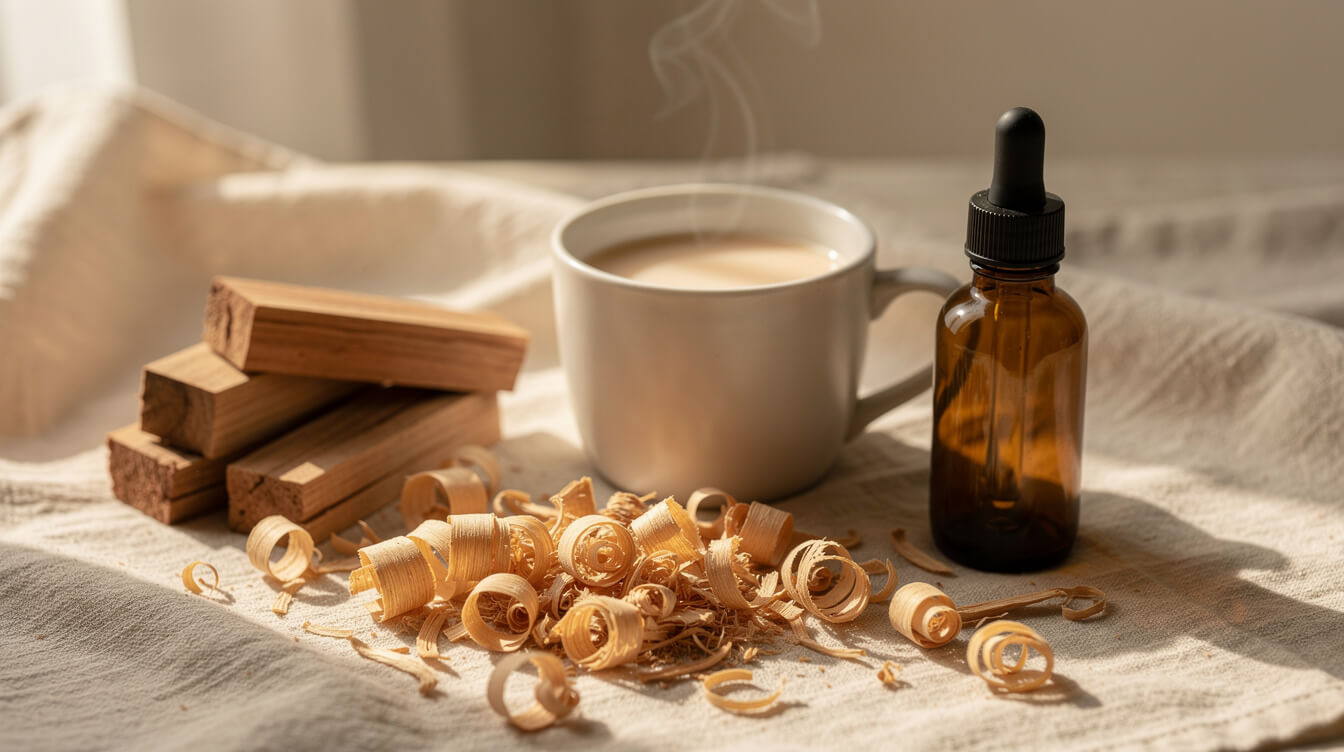
True sandalwood oil is steam-distilled from the heartwood and roots of slow-growing Santalum trees, most famously East Indian sandalwood (Santalum album). Perfumers describe it with a short list of words that keep coming back:
Creamy and milky. The signature. There’s a soft, rounded, almost lactonic smoothness, like warm milk or the inside of a fresh coconut, without any actual sweetness of vanilla.
Woody, but soft-edged. Not the dry, sharp pencil-shaving wood of cedar, and not the smoky wood of a campfire. Sandalwood is polished wood: sanded, oiled and warm to the touch.
Faintly sweet and balsamic. A gentle honeyed warmth underneath, more noticeable after an hour.
Slightly animalic or skin-like. At close range, good sandalwood has a warm, human, “clean skin” quality that is part of why it’s loved in perfume.
How sandalwood unfolds over time
Most essential oils open loud and fade. Sandalwood does the opposite. On a paper blotter the first sniff can feel almost faint, a little resinous and dusty. Over the next half hour the creaminess blooms, and hours later the blotter still smells softly of warm wood. That slow build is what makes sandalwood a base note and a natural fixative. A couple of drops under brighter oils help them linger, which we showed in our Unhurried Citrus blend.
What sandalwood does not smell like
It isn’t smoky (that’s incense, where burning changes everything), and it isn’t sharp or resinous like pine. If a “sandalwood” product smells loud, sweet, powdery and instantly obvious from across the room, you are almost certainly smelling a synthetic accord, not the oil. More on that below. For the three commercial species, their origins and how their chemistry differs, see our sandalwood species guide.
The Molecule That Actually Carries the Sandalwood Smell
Sandalwood oil is dominated by two closely related molecules, both 15-carbon alcohols called santalols. The International Standard for East Indian sandalwood oil, ISO 3518:2002, sets the expected ranges: (Z)-α-santalol at roughly 41 to 55% and (Z)-β-santalol at roughly 16 to 24%. So α-santalol is the majority by a wide margin. You’d expect it to be the smell.
It mostly isn’t. Fragrance chemists treat (−)-(Z)-β-santalol, the minority molecule, as sandalwood’s “character impact” compound: the one that makes your brain say sandalwood. α-Santalol is woody too, but in perfumery literature it’s β-santalol that gets described as the real thing. When chemists Andreas Krotz and Günter Helmchen synthesized the β-santalols from scratch (published 1990 and 1994), they reported that the natural (−)-(Z) form has a typical sandalwood scent identical to the natural product. Other evaluators describe it as “very strong, woody to animal, typical sandalwood” (E.-J. Brunke, 1983) and “sandalwood, natural, woody, milky” (Christian Chapuis, 2004).
The mirror-image twin that smells of nothing
Here is the detail that makes fragrance chemists smile. β-santalol is a chiral molecule: it exists in two forms that are mirror images of each other, like your left and right hands. Krotz and Helmchen made both. The natural (−) form smelled exactly like sandalwood. The (+) form, with exactly the same atoms, was odorless. Even switching the geometry of one double bond, from (Z) to (E), weakens the scent sharply. Your nose is reading the molecule’s precise 3D shape, not just its ingredients list.
Why this matters when you smell two “sandalwood” oils
This is why two sandalwood oils with similar total santalol can smell different. The proportion of β-santalol, and the trace companions around it, shape the creaminess more than the headline santalol number. It also explains why sandalwood is so hard to imitate. You need to copy a very specific shape, and that is exactly what the fragrance industry has spent fifty years trying to do. If you’ve ever noticed a blend smelling different at the end of a session than at the start, the same “heavy molecules last longest” logic is at work; our scent-drift FAQ explains it.
Sign Up to Get Your FREE
e-Book Here…
Real vs. Synthetic: What Your Candle, Perfume and Soap Are Actually Using
Here is the part none of the candle and perfume brands ranking for this question say out loud. Most “sandalwood” you’ve smelled in candles, soaps, detergents and many perfumes is not sandalwood oil. It’s one or more synthetic aroma chemicals designed to imitate β-santalol’s shape.
The reason is supply. East Indian sandalwood trees take decades to form fragrant heartwood. After years of overharvesting and illegal felling, Santalum album is listed as Vulnerable on the IUCN Red List, and Indian sandalwood oil became one of the most expensive materials in perfumery. From the 1970s on, fragrance houses raced to build molecules that hit the same receptors for a fraction of the cost.
The sandalwood synthetics, decoded
Sandalore (Givaudan, mid-1970s): one of the early workhorses. Soft, warm, slightly powdery wood. You’ll find it in soaps, lotions and laundry products.
Polysantol (Firmenich): rich, creamy and noticeably milky, prized for its natural-feeling sandalwood character.
Ebanol: a powerful, slightly musky-leathery sandalwood note.
Bacdanol: softer and more diffuse, often used to round out woody accords.
Javanol (Givaudan, discovered 1996, introduced 1997): the heavyweight. Its odor threshold is commonly cited at about 0.02 nanograms per liter of air. That’s roughly two hundredths of a billionth of a gram, enough to register in a liter of air. Perfumers describe it as creamy sandalwood with rosy and even grapefruit-like facets.
Many of these molecules share an unexpected starting point: campholenic aldehyde, made from α-pinene in pine turpentine. So the “sandalwood” note in a candle may well have begun life in a pine forest, not a sandalwood grove.
A whole perfume that is one synthetic molecule
If you want proof of how far this has gone, look at the cult niche fragrance Escentric Molecules Molecule 04. The brand describes it as built around Javanol: a single lab-made molecule, sold as an “abstraction” of sandalwood. People wear it and say it smells like sandalwood. For many of us, the “sandalwood” we learned from candles and perfume counters is a synthetic accord like this one.
Is synthetic sandalwood bad?
Not necessarily. These molecules took pressure off an endangered tree, and in a candle or detergent a synthetic is the only realistic option. But they’re not the same as the oil. A synthetic is usually one molecule doing one job very loudly. A natural oil is dozens of compounds in balance, which is why it smells quieter, rounder and more changeable. If transparency matters to you, our guide to how luxury home fragrance brands disclose (or don’t disclose) their ingredients shows which brands tell you what’s in the jar.
How to tell, at home
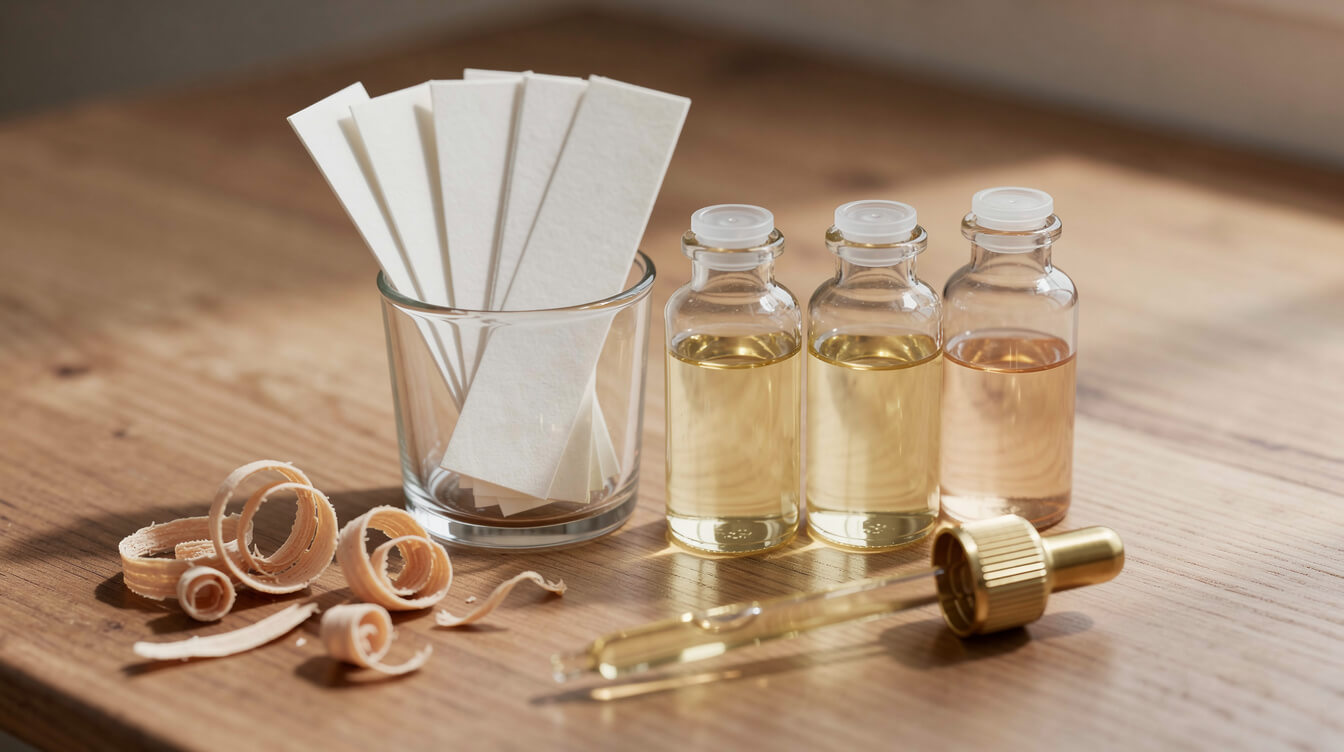
Put one drop of any “sandalwood” oil on a paper strip and leave it. Real sandalwood starts faint, blooms over 30 minutes and stays soft for hours. A strong synthetic is usually obvious immediately, and it smells the same at minute one and hour four. The price is a clue too. Genuine East Indian or high-santalol Australian sandalwood oil is never cheap, so an inexpensive “sandalwood essential oil” deserves a close look at its botanical name.
Oils That Smell Like Sandalwood: Amyris, Cedarwood, Ho Wood and Copaiba
We’ll be plain about this, because you deserve a straight answer from an essential oil company: Organic Aromas does not currently sell a true sandalwood essential oil. What we offer instead are pure oils that bring that soft, woody, grounding character to a room in their own way, and one of them comes surprisingly close.
Amyris: the closest stand-in
Our Amyris Essential Oil is steam-distilled from Amyris balsamifera wood from Haiti and is often sold as “West Indian sandalwood.” Botanically it is no relation at all; it sits in the citrus family. It reads as soft, creamy, warm wood with a balsamic, slightly vanilla-like sweetness. It is less milky and less skin-like than true sandalwood, but in a blend most people accept it as sandalwood-adjacent. Why does an unrelated tree smell similar? Our Sunday Reset on amyris explains the convergent chemistry. It’s also the “Sandalwood (West Indian)” listed in our Passion Blend, so if you’ve enjoyed that blend’s creamy base, you’ve been smelling amyris.
Cedarwood: drier and sharper
Cedarwood shares sandalwood’s base-note staying power but swaps creaminess for dry, clean, pencil-shaving wood. On its own it won’t fool anyone, but a small amount alongside amyris adds structure and keeps a woody blend from turning sleepy.
Ho Wood: soft, floral wood
Ho Wood is rich in linalool, so it smells soft, floral and lightly woody, a little like lavender’s gentle cousin. It brings the smoothness that sandalwood lovers look for and makes a lovely bridge between creamy woods and flowers.
Copaiba: a faint, warm balsam
Copaiba is a light, honeyed balsam with a whisper of pepper. It’s subtle, almost a background note, which makes it useful for softening a blend without adding sweetness.
Three sandalwood-style blends
Each recipe is in parts, so you can scale it to your bottle. Mix in a clean glass vial and let it rest a day so the notes settle.
Creamy Wood: 4 parts Amyris, 3 parts Ho Wood, 2 parts Lavender, 1 part Copaiba. The closest we can get to sandalwood’s soft, milky calm, with lavender lifting the top.
Golden Hour: 4 parts Sweet Orange, 3 parts Bergamot, 3 parts Amyris. Bright citrus over a creamy wood base. Amyris makes the citrus linger. Our guide to what bergamot smells like explains why bergamot pairs so well with woods.
Velvet Evening: 4 parts Amyris, 2 parts Ylang Ylang, 2 parts Cedarwood, 2 parts Sweet Orange. Floral, warm and grounded, with ylang ylang adding the richness true sandalwood often gets paired with in perfume.
For more on balancing top, heart and base notes, see our essential oil blending chart.

Sign Up to Get Your FREE Essential Oils e-Book Here
How Sandalwood-Type Oils Behave in a Nebulizing Diffuser®
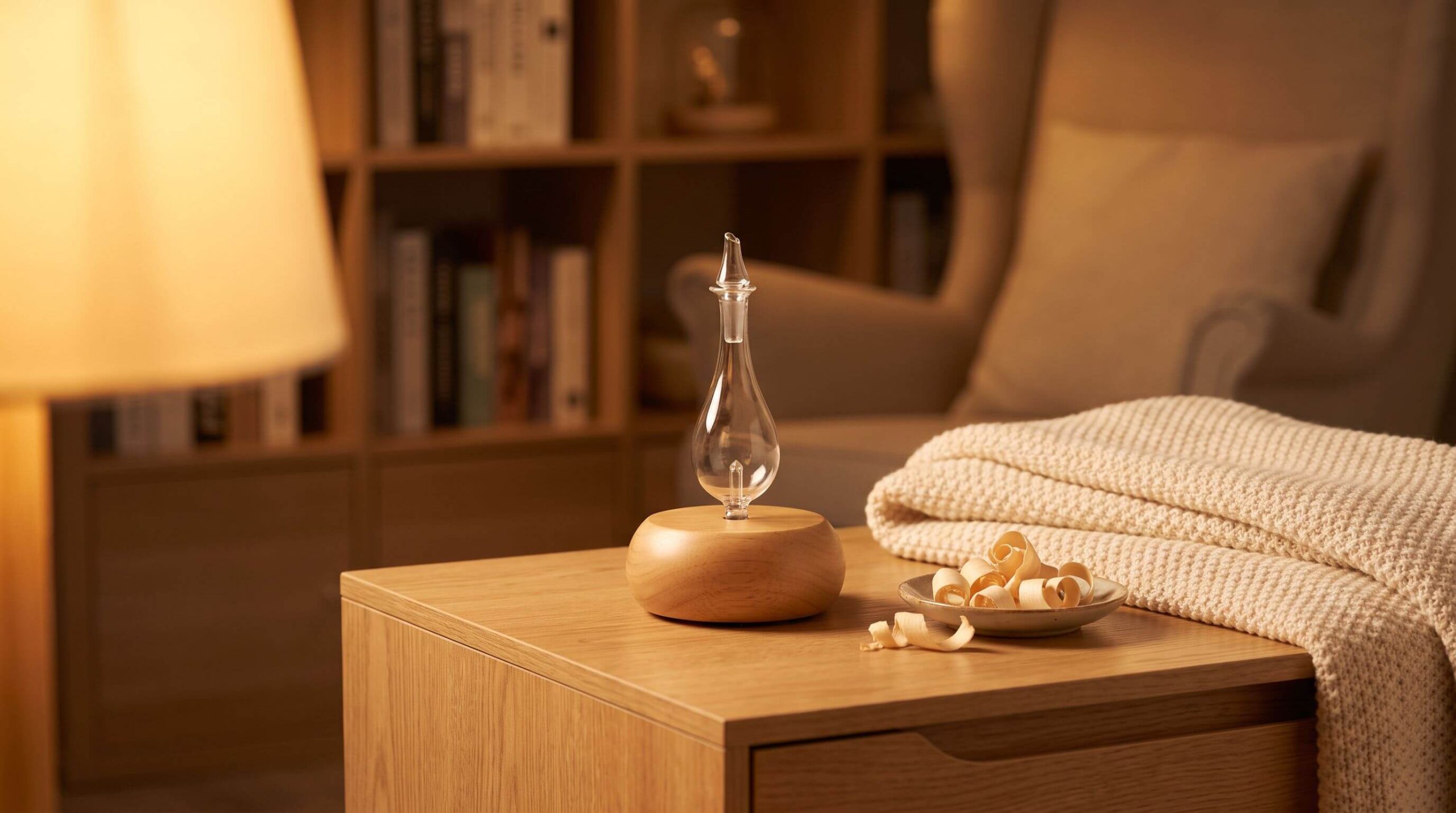
A Nebulizing Diffuser® works on Bernoulli’s Principle: a fast stream of air passing over a fine glass tube draws pure oil up and breaks it into a microscopic mist. There’s no water and no heat. For a creamy wood note that’s a real advantage. Heat would push off the lighter parts first and leave a flattened, cooked smell, and water would dilute a scent that’s already quiet by nature.
Thick oils need a thinner partner
The same heavy molecules that make sandalwood-type oils last so long also make them thick. Amyris, like true sandalwood and vetiver, flows slowly through the fine glass tubes of a Nebulizing Diffuser® when used alone. The practical fix is to let woods be the base of a blend rather than the whole bottle: keep them to roughly a third or less and pair them with thinner oils such as citrus or lavender, as in the recipes above. Our two FAQs on why sandalwood and vetiver barely nebulize and thick oils like sandalwood, vetiver and patchouli walk through the details.
Low and slow suits a quiet note
Because creamy woods build slowly, a low, intermittent setting works better than a long, intense run. Start a cycle, leave the room for ten minutes and come back in. You’ll notice the soft wood far more on arrival than you will sitting next to it. That slow, settle-in quality is the whole point of the oil, and our Sunday Reset on letting a single wood unfold is a lovely ritual built around it. You can browse every model in our handcrafted Nebulizing Diffuser® collection.
Is Sandalwood a Masculine or Feminine Scent?
Neither. Sandalwood is one of the most genuinely unisex notes in perfumery, and its history shows it.
In India, sandalwood paste and oil have been part of temple ritual, skin care and celebration for centuries, worn by everyone. The traditional attar makers of Kannauj in northern India still distill flowers such as rose or jasmine into a receiver of sandalwood oil. In that tradition, sandalwood isn’t a “note” in the perfume at all. It’s the canvas the perfume is painted on.
Modern Western perfumery uses it on both sides of the counter. Sandalwood is a backbone of classic men’s colognes, and it’s also the heart of celebrated feminine fragrances such as Guerlain’s Samsara (1989), famous for its rich sandalwood base. The difference is the company it keeps. Pair sandalwood with vetiver, cedar, leather and spice and it reads traditionally masculine. Pair it with rose, jasmine, ylang ylang and vanilla and it reads feminine. On its own, it just smells like warm, clean skin and soft wood. If you’re building a woodier, more classic-cologne style blend, our guide to essential oils for men has ideas.
Is sandalwood an attractive smell?
Many people find it so. Its warmth, creaminess and slightly skin-like quality make it feel intimate and comforting, which is why it so often sits at the base of perfumes. But attraction is personal and cultural, and there’s no scientific basis for treating sandalwood as a special attraction booster. Wear it, or diffuse it, because you love how it makes a room feel.

Join Our Exclusive Member Club to get Big Discounts!
What Does Sandalwood Smell Like? FAQs
How would you describe the smell of sandalwood?
Creamy, soft and woody, with a faint milky sweetness, a gentle balsamic warmth and a slightly skin-like, intimate quality. It has almost no sharp top note and builds slowly, lasting for hours as a base note.
What smells similar to sandalwood?
Amyris (often called West Indian sandalwood) is the closest natural match, with a creamy, balsamic wood. Cedarwood is drier and sharper, ho wood is softer and more floral, and copaiba is a light, warm balsam. In candles and perfumes, synthetic molecules such as Javanol, Polysantol and Sandalore are designed to imitate sandalwood.
Why can I barely smell my sandalwood oil?
Sandalwood is quiet by nature. Its main molecules are heavy and evaporate slowly, so it builds over 20 to 30 minutes instead of greeting you at the bottle. Noses also vary; some people are simply less sensitive to large, woody molecules. Try a drop on a paper strip and smell it again after half an hour, or diffuse it in a blend and step back into the room after a few minutes.
Is sandalwood a masculine or feminine smell?
Both. It’s a classic in men’s colognes and the heart of famous feminine perfumes. The oils it’s paired with decide which way it leans.
Is the sandalwood in candles real?
Usually not. Natural sandalwood oil is scarce and expensive, so most candle, soap and home-fragrance “sandalwood” comes from synthetic aroma chemicals built to imitate β-santalol. Check the brand’s ingredient disclosure if it publishes one.
Does Organic Aromas sell sandalwood essential oil?
Not currently. We offer pure Amyris (West Indian sandalwood), Cedarwood, Ho Wood and Copaiba, which bring a soft, woody character to a room. Our Passion Blend includes amyris as its “Sandalwood (West Indian)” base note.
Is it safe to diffuse woody oils around family and pets?
Diffuse in a ventilated room, keep sessions short and intermittent, and make sure pets can leave the room. If you’re pregnant, nursing, managing a health condition or taking medication, ask your clinician before using any essential oil. Never ingest essential oils.
So what does sandalwood smell like? Soft, creamy, polished wood carried by one small, precisely shaped molecule that the whole fragrance industry has spent decades trying to copy. Now that you know the real thing is quiet and slow, you’ll recognize it, and you’ll recognize its imitations. To bring that creamy-wood calm home, start with our pure Amyris Essential Oil, one of the blends above and a low, intermittent setting.