

Hotel Scents Decoded: What Luxury Hotels Really Diffuse, and How to Recreate the Feel With Pure Oils
Hotel scents are the reason a good lobby feels expensive before you’ve noticed the furniture. You walk in and the air smells calm, clean and a little bit grown-up, and somehow it’s the same on every floor. Then you get home and wonder why your living room never smells like that.
We wanted a real answer, not a list of candles. So we went to the source. Several big hotel brands now sell their signature scents to guests, and their official shops list the notes. We pulled every note for five of them, then asked a simple question about each one: can a pure essential oil actually make this smell? The answer explains a lot about what hotel scents really are, and it gives you an honest way to bring the same feeling home with a Nebulizing Diffuser® and a few bottles of pure oil.
What Are Hotel Scents?
The phrase means two different things, and it helps to keep them apart.
A hotel’s signature scent is the fragrance a brand chooses for its public spaces, so that a guest in Bangkok and a guest in Chicago walk into the same smell. Hotels treat it like a logo you breathe. It’s part of a bigger practice called scent branding, which we covered from the retail side in our guide to scent branding. Because guests started asking to take the smell home, many brands now sell it as candles, reed sticks, room sprays and oils.
“Hotel-inspired” fragrances are something else. They’re made by home-fragrance companies, often with names that point at a famous lobby or a city, and they’re sold as interpretations. Most of these companies say plainly that they aren’t affiliated with the hotels. The oils are blended fragrance, usually synthetic or a mix of synthetic and natural materials, designed to smell like a memory rather than to match a formula.
Both kinds are perfumes in the full sense of the word. Neither is an essential oil. That’s not a criticism, just a starting point, and it’s the part that most “make your home smell like a hotel” articles skip. If you want to know how to read the ingredient pages of the brands that sell this mood, we did that work in our review of luxury home fragrance brands.
How Luxury Hotels Diffuse Their Hotel Scents
The bottle is only half of it. The other half is delivery. Large hotels usually run a cold-air system that turns fragrance oil into a very fine, dry mist and often feeds it into the air handling, so the scent arrives evenly through the vents. That’s the same no-heat, no-water principle a cold air diffuser uses at home, scaled up to a whole floor.
What the hotels themselves stress is restraint. When Sunset magazine asked The Ritz-Carlton, Lake Tahoe how it scents the property, its Director of Rooms said, “The scent should be subtle but omnipresent.” The Waldorf Astoria Beverly Hills told the same writer that the foundation scent should be “season neutral,” and should “remain constant, even beneath a warm winter candle or fresh spring bouquet” (Sunset, January 2025).
Those two phrases are the whole technique behind great hotel scents. Subtle means you barely register the scent once you’re inside. Omnipresent means it’s never absent long enough to disappear, and never strong enough to announce itself. A candle can’t do that, because it’s strong near the flame and missing across the room. A spray can’t do it either, because it spikes and then fades.
At home you don’t need ductwork to get the same effect. A living room is a tiny fraction of a lobby’s volume, so one small device on a low setting is plenty, as long as it runs in short, regular cycles instead of all evening. Our guide to how long to diffuse essential oils covers the timing, and how to make your house smell good explains why pulsing keeps your nose from tuning a scent out.

Sign Up to Get Your FREE Essential Oils e-Book ($9.99 Value)
What Hotels Say Is in Their Signature Scents
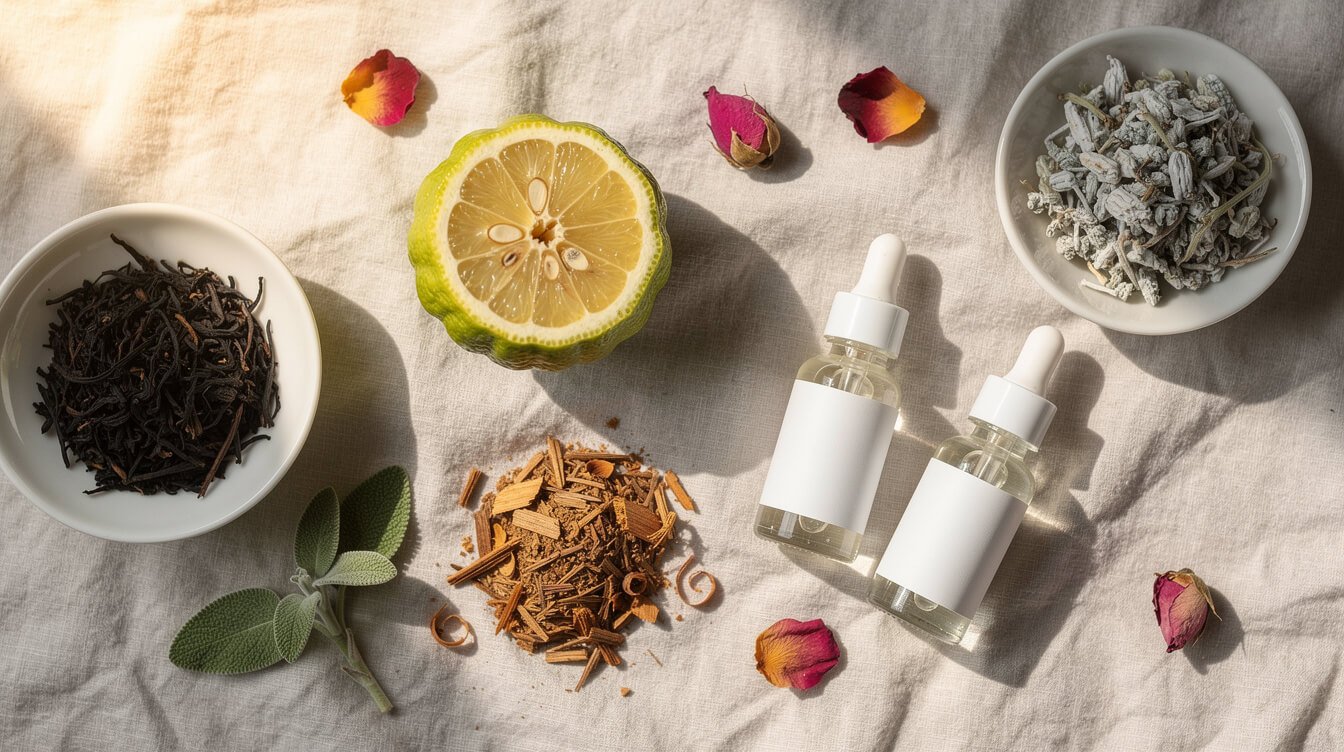
Here is what five hotel brands publish about their own hotel scents on the Marriott Bonvoy Boutiques shop. These are the brands’ own descriptions, quoted as written, not our guesses at a formula.
| Hotel brand | Scent | Notes the brand lists |
|---|---|---|
| Westin | White Tea | White tea, cedarwood and vanilla |
| EDITION | EDITION scent | Black tea, Sicilian bergamot and fresh cedarwood |
| JW Marriott | Rooted | Sycamore wrapped in sage, herbs, cedarwood, sandalwood, sweet tonka bean and amber |
| St. Regis | Signature scent | American Beauty roses, white lilies, green stems, quince, apple and cherry blossoms |
| Marriott Hotels | Attune | Cassis, Fuji apple, grapefruit, cyclamen, pink jasmine, rose, lily of the valley, mountain sage, white cedar and pale musk |
Read down the right-hand column and a pattern jumps out. Cedar shows up in four of the five. Westin, EDITION and JW Marriott list cedarwood, and Attune lists white cedar. Only the St. Regis rose-and-fruit scent skips it. Tea appears twice, white at Westin and black at EDITION. A bright fruit or citrus opening appears in three.
That cedar result is the most useful thing about hotel scents for anyone trying to copy the feel at home. Cedar is dry, quiet and clean. It doesn’t shout like citrus or sweeten like vanilla. It sits underneath everything and makes a room smell like polished wood and fresh linen, which is exactly the job a lobby scent is doing. If you’ve ever wondered why a hotel smells “expensive” rather than “nice,” a soft wood base is a big part of the answer. Our piece on what cedarwood smells like goes deeper into the oil itself.
The same Ritz-Carlton, Lake Tahoe interview gives a property-level example. Its scents draw on “pine, cedarwood, and fresh mountain air” blended with “white tea or warm vanilla.” Cedar and tea again.
Can Pure Essential Oils Make Hotel Scents? Our 29-Note Audit
Those five scents list 29 notes between them. We sorted every one into three groups: notes a pure essential oil can supply, notes that are a judgment call, and notes that no essential oil can produce. The result:
- 10 of 29 have a true essential-oil match. Cedarwood (three times), bergamot, sage, sandalwood, rose (twice), grapefruit and mountain sage.
- 2 are judgment calls. “Herbs” is too vague to pin to one oil, and “white cedar” in perfumery is usually a soft woody accord rather than the sharp leaf oil of the real white cedar tree.
- 17 of 29 can’t come from an essential oil at all. They’re accords, absolutes or synthetic materials.
That isn’t a knock on hotel perfumers. It’s how modern fragrance works. But it does mean that anyone promising a pure-oil “dupe” of a hotel scent is overselling. Here’s why each of those 17 notes is out of reach.
Tea has no essential oil to speak of
White tea and black tea are two of the most famous notes in hotel scenting, and tea leaves don’t give a usable steam-distilled oil. Perfumers build tea notes as accords from other materials, and where a natural tea extract is used it’s a rare, costly solvent extract rather than an essential oil. One trap to avoid: tea tree oil is not tea. It comes from an Australian shrub, Melaleuca alternifolia, and smells medicinal and camphor-like. Adding it to a blend will not make anything smell like Westin. If you want the “tea” impression, bergamot is the better tool, because it’s the scent that flavors Earl Grey (more on that in what bergamot smells like).
Some of the prettiest flowers are “mute”
Lily of the valley, cyclamen and white lilies are all in the table above. They’re also part of a group perfumers call mute flowers: they smell wonderful in the garden, but no commercial extraction method captures that scent. Every lily of the valley note you’ve ever smelled is built from aroma molecules. The classic one, hydroxycitronellal, went on sale in 1905.
There’s a footnote here that most hotel-scent articles have never mentioned. For years the workhorse muguet molecule was lilial (butylphenyl methylpropional). In 2021 the EU classified it as a reproductive toxicant, category 1B, and from 1 March 2022 cosmetics containing it could no longer be sold in the EU (Commission Regulation (EU) 2021/1902). That rule covers cosmetics, not every candle or reed stick, and it doesn’t mean any hotel product contains lilial. It’s simply a reminder that a “floral” note on a label can be pure chemistry, and that the chemistry gets re-evaluated.
Fruits, absolutes and accords
Apple, Fuji apple, quince, cherry blossom and cassis don’t give essential oils. Fruit notes are reconstructed. Vanilla, jasmine and tonka bean do come from real plants, but as absolutes or CO2 extracts rather than steam-distilled oils. They’re thick, dark materials that behave very differently in a Nebulizing Diffuser®. We cover one of them in our guide to jasmine. Finally, amber, musk, sycamore and “green stems” aren’t single materials at all. Amber in perfumery is a warm accord, and modern musks are synthetic.
So the honest promise is this: pure essential oils can evoke a hotel scent’s shape, but they can’t clone it. You can rebuild the bright opening, the soft floral or herbal heart and the dry wood base. You can’t rebuild a tea note or a lily of the valley note from plants. Once you accept that, the blends get much easier to design, and they smell more alive, because every molecule in them came from a plant.
Join Now and Get a Coupon for 10% Off!
6 Pure-Oil Hotel Scents to Blend at Home
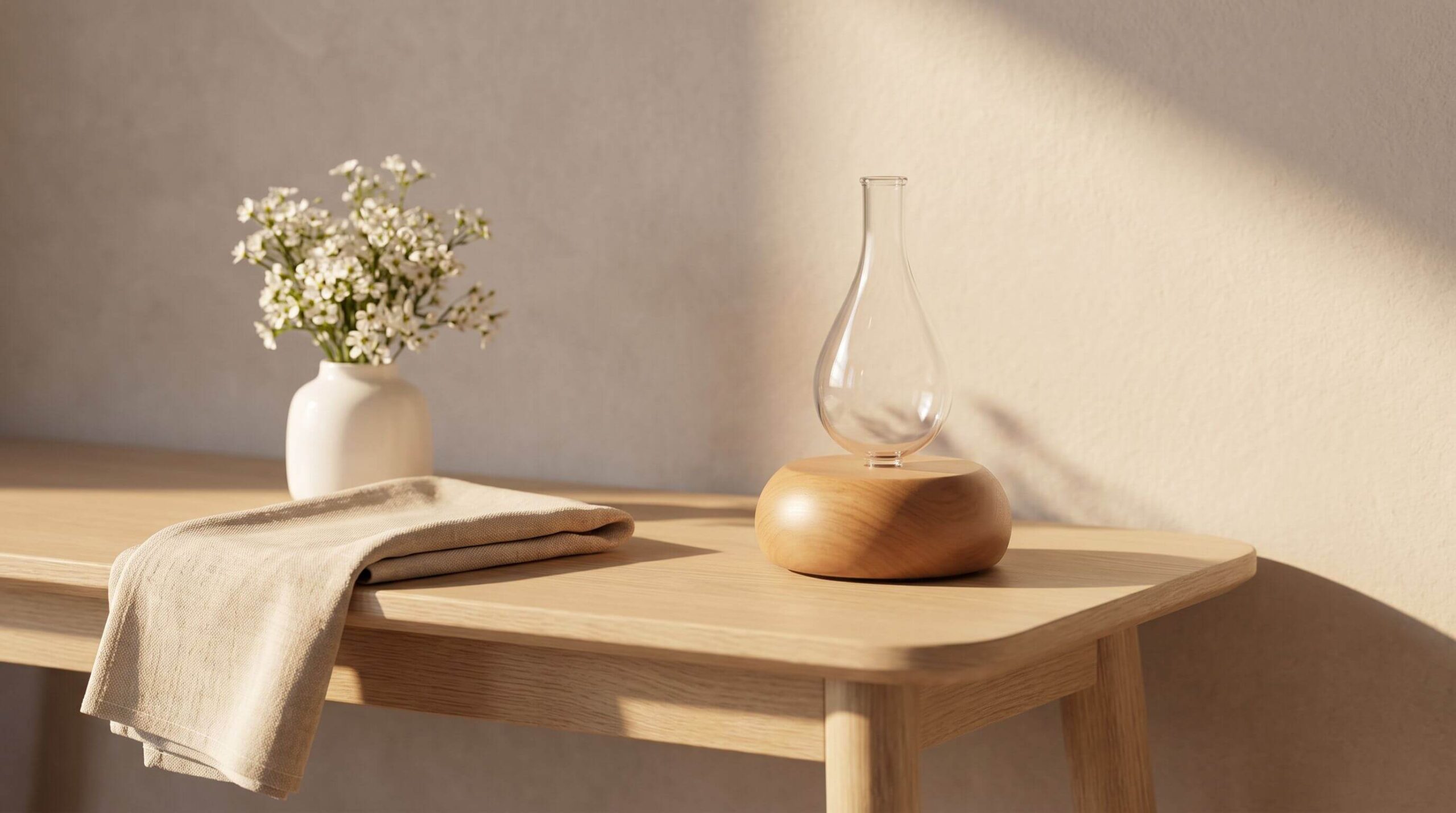
Each blend below follows the published notes of one family of hotel scents, using only pure essential oils we can vouch for. They’re inspired by those note lists. None of them is any hotel’s scent, and we’re not suggesting they are. Mix the drops in a clean, empty glass bottle, swirl, and pour into your Nebulizing Diffuser®. Each recipe makes about 1 ml.
1. Tea and Cedar Lobby (after the white and black tea scents)
10 drops Bergamot, 6 drops Petitgrain, 4 drops Cedarwood. With no tea oil available, we let bergamot carry the Earl Grey brightness and petitgrain add a green, slightly bitter, leafy dryness that reads as “tea” once the cedar settles underneath. This is the closest pure-oil cousin to the cedar-and-tea pattern in the table.
2. Rooted Library (after the sage and woods family)
8 drops Cedarwood, 6 drops Clary Sage, 6 drops Copaiba. Herbal on top, woody all the way through. Copaiba adds a soft, balsamic warmth that stands in for the “amber” and “tonka” feel without a heavy resin. We left sandalwood out on purpose: it’s one of the thick oils that can clog a nebulizer’s micro-tubes when used heavily.
3. Garden Suite (after the rose and green family)
10 drops Rose Geranium, 6 drops Grapefruit, 4 drops Petitgrain. Rose geranium gives a true rosy heart for a fraction of the price of rose otto. Grapefruit hints at the fruit notes no oil can make, and petitgrain plays the “green stems.”
4. Bright Arrival (after the grapefruit and white cedar family)
10 drops Grapefruit, 5 drops Ho Wood, 3 drops Clary Sage, 2 drops Cedarwood. Sparkling at the door, then soft. Ho wood is rich in linalool, the same floral-woody molecule found in many flowers, so it rounds out the citrus without sweetness. Use this one in daylight hours.
5. Spa Floor
8 drops Lavender, 6 drops Lemon, 4 drops Juniper, 2 drops Pine. Hotel spas lean fresher and more botanical than lobbies. This one smells like clean towels and a cool, quiet room. For more ideas in that direction, see how to create a spa experience at home.
6. Evening Turndown
10 drops Lavender, 6 drops Ho Wood, 4 drops Sweet Orange. Soft, round and low-key, for the hour before bed. Turndown is when hotels quietly change the mood of a room, and this blend does the same in yours.
A practical note: citrus oils such as bergamot, grapefruit and lemon are thin and lively, while cedarwood and copaiba are slower. If a blend seems to fade toward the wood over an evening, that’s the lighter oils leaving first, and it’s normal. Give the bottle a swirl before each refill.
How to Make Your House Smell Like a Hotel
Blends are the easy part of hotel scents at home. Most of what makes a hotel smell like a hotel is the routine around them.
- Clean the air before you scent it. Hotels are housekept every day, and the scent sits on top of a neutral room, not on top of yesterday’s dinner. Remove the source of any odor first, then add fragrance.
- Pick one foundation scent and keep it. The Waldorf Astoria’s “season neutral” advice is the key. Choose one of the blends above for the entry and living area and run it all year. Familiarity is what turns a pleasant smell into “the way your home smells.”
- Scent the arrival point. Hotels put the most effort into the lobby, because that’s where you form an impression. At home, that’s the entryway or the first room you walk into. One Nebulizing Diffuser® there does more than three scattered through the house.
- Zone the rest. Hotels use different moods for the lobby, the spa and the rooms. Use your foundation blend in shared spaces, something like Evening Turndown in the bedroom, and nothing at all in the kitchen.
- Keep it faint and steady. Run the lowest setting in short cycles. With a Smart Nebulizing Diffuser® you can schedule the cycles in the app so the scent is already there when you come home, the way a lobby always is.
- Treat linens separately. Westin sells a pillow spray for a reason: fabric is part of the hotel smell. Mist a room spray into the air above the bed rather than soaking the fabric, since pure oils can mark some textiles. Our room spray recipes show how to make one that actually mixes.
- Don’t chase a clone. You’ll be happier with a pure blend that has the same shape than with a perfume that copies one note perfectly and smells flat everywhere else.

Join Our Exclusive Member Club to get Big Discounts!
For Spa, Boutique Hotel and Wellness Owners
If you run a spa, a studio or a small hotel, the same rules that shape hotel scents apply at a larger scale: one signature scent, kept faint, delivered evenly. Plastic plug-ins and ultrasonic units look out of place in a premium space, and synthetic fragrance can bother guests who are sensitive to scent. A handcrafted Nebulizing Diffuser® in wood and glass suits a reception desk or treatment room, runs on pure essential oil with no water and no heat, and stays quiet enough for a relaxation space. If you’re scenting a business, contact our team and tell us about your space, and we’ll help you work out what fits.
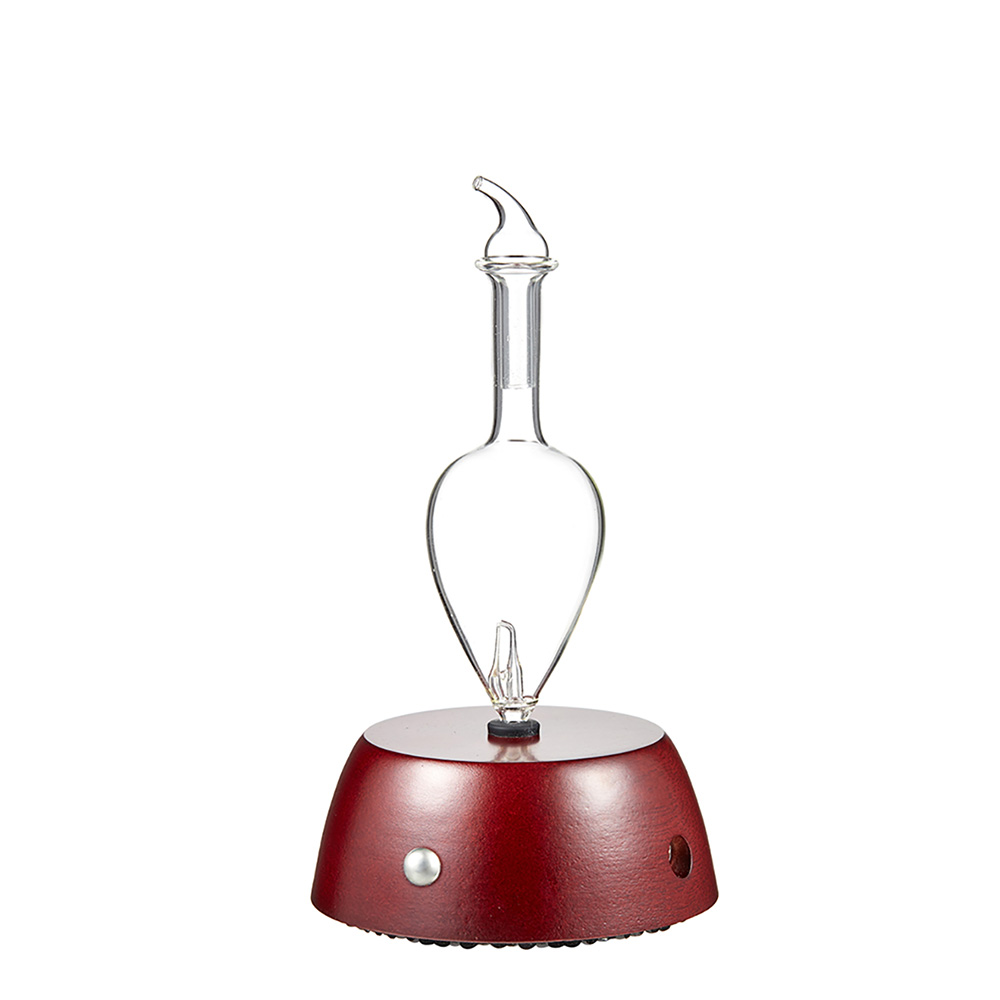
The Lobby Feeling, Without the Ductwork
Handcrafted from real wood and medical-grade Pyrex glass, the Nebulizing Diffuser® turns pure essential oil into a fine, dry mist with no water and no heat. Smart models let you schedule soft, steady cycles from your phone.
Hotel Scents: Frequently Asked Questions
What scent does the Westin use?
Westin’s signature scent is White Tea. The brand’s own shop describes it as white tea, cedarwood and vanilla. There’s no white tea essential oil, so a pure-oil version leans on bergamot, petitgrain and cedarwood to suggest the same clean, airy feel.
Why do hotel lobbies smell so clean?
Three things work together. The room is cleaned daily, so there’s no background odor to cover. The scent is usually built on a dry wood note such as cedar, which reads as fresh linen and polished wood. And it’s delivered at a low, steady level through a cold-air system, so it never spikes or fades.
Can essential oils make my house smell like a hotel?
They can recreate the feel, not the exact fragrance. In our audit of 29 published hotel notes, 10 have a true essential-oil match and 17 can only be made with accords, absolutes or synthetics. A blend with a bright citrus top, a soft floral or herbal heart and a cedar base gets you very close to the lobby impression.
Is white tea an essential oil?
No. Tea leaves don’t produce a usable steam-distilled oil, so white tea and black tea notes are accords made from other materials. Tea tree oil is a different plant entirely and smells medicinal, so don’t use it to fake a tea note.
How do I make my bedroom smell like a hotel room?
Start with fresh, well-aired linens, then use a soft, low-key blend such as lavender, ho wood and sweet orange in short cycles before bed. Mist a room spray into the air above the bed rather than onto the fabric, since pure oils can mark some textiles.
Hotel scents feel like magic, but they’re really three choices made well: a soft wood base, a scent kept faint and steady, and the discipline to keep it the same every day. Pure essential oils can’t copy a tea accord or a lily of the valley molecule, and they don’t need to. Pick one of the blends above, put it where you walk in, and let your home have a signature of its own.