


Top 5 Most Popular Roll-on Essential Oils
Every “best roll-on essential oils” roundup repeats the same blanket safety rule: dilute to 5% and you’re covered. That number isn’t wrong — it’s just incomplete. Aromatherapy’s own standard safety reference, Tisserand & Young’s Essential Oil Safety, sets dramatically different maximum dermal limits oil by oil. Some oils are fine well above 5%. Cold-pressed bergamot, meanwhile, tops out closer to 0.4% in a leave-on product because of a photoreactive compound most “top 5” lists never mention. A single universal percentage hides exactly the information you need before a roll-on touches your skin.
This guide covers how roll-on essential oils actually work on skin, why one blanket dilution number doesn’t apply equally to every oil, when a topical roll-on makes more sense than inhaling from a Nebulizing Diffuser® (and when it doesn’t), the five most popular Organic Aromas roll-on blends and what’s actually in them, how to apply them correctly, and two oils that genuinely need extra care — details most roundups skip entirely.
How Roll-On Essential Oils Actually Work on Skin
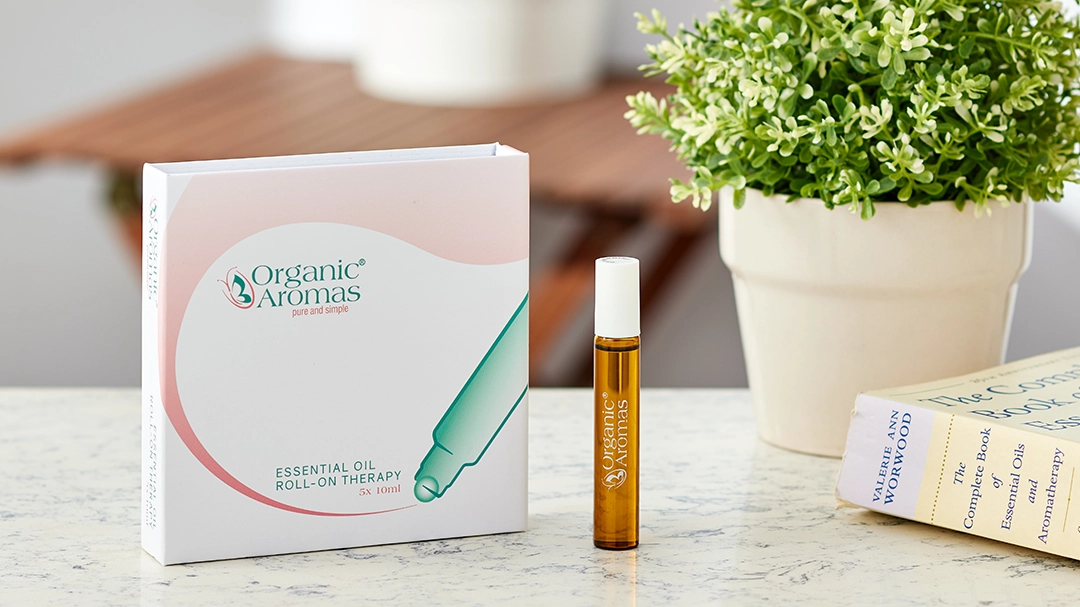
A roll-on essential oil is a carrier oil — typically fractionated coconut or jojoba oil — pre-mixed with essential oil at a set percentage and sealed behind a steel rollerball. The ball meters a small, consistent volume with every pass, which matters more than it sounds: it’s the main reason a pre-diluted roll-on is harder to over-apply than a dropper bottle of neat oil.
Once applied, the lipophilic (fat-soluble) aromatic compounds in the oil move through the stratum corneum — the skin’s outermost lipid layer — and into the capillary bed beneath it. That’s a fundamentally different route than inhaling an oil atomized by a Nebulizing Diffuser®, which reaches you through the nose and lungs instead of the skin. Both are legitimate aromatherapy delivery methods; they just put the same aromatic molecules into your body through two different doors.
Why a Universal “5% Dilution” Isn’t the Same for Every Oil
Most roll-on guides quote one number — usually 5% — as the safe dilution ceiling for adult topical use, as if every essential oil carried identical risk. It doesn’t. Essential Oil Safety (Tisserand & Young), the standard clinical safety reference the aromatherapy industry cites, sets maximum dermal-use levels per individual oil based on that oil’s own chemistry, not a flat rule.
The clearest example is bergamot. Cold-pressed bergamot oil contains bergapten, a furocoumarin compound that reacts with UV light and can cause a skin burn or lasting pigmentation change in sun-exposed areas — a reaction called phototoxicity. Because of this, the International Fragrance Association (IFRA) caps bergapten-containing bergamot at roughly 0.4% in any leave-on product that might see sun exposure. That’s more than ten times stricter than the “universal 5%” so many roundups repeat, for one specific, well-documented reason.
Potency varies just as much in the other direction. A single drop of peppermint essential oil is roughly equivalent, in aromatic constituent concentration, to 26–28 cups of peppermint tea — a comparison used in aromatherapy safety training to illustrate just how concentrated these oils are compared to the plant material people are used to. That’s not a reason to avoid peppermint; it’s a reason to respect the drop count on the label rather than assuming “a little extra won’t matter.”
The practical takeaway: read what a specific roll-on is diluted to, don’t assume every bottle on a shelf shares the same safety margin, and when you’re mixing your own blend, check the oil-specific guidance in our full dilution chart and ratios guide rather than defaulting to 5% across the board.
Sign Up to Get Your FREE
e-Book Here…
Topical Roll-On vs. Nebulizing Diffuser®: Choosing the Right Delivery Method
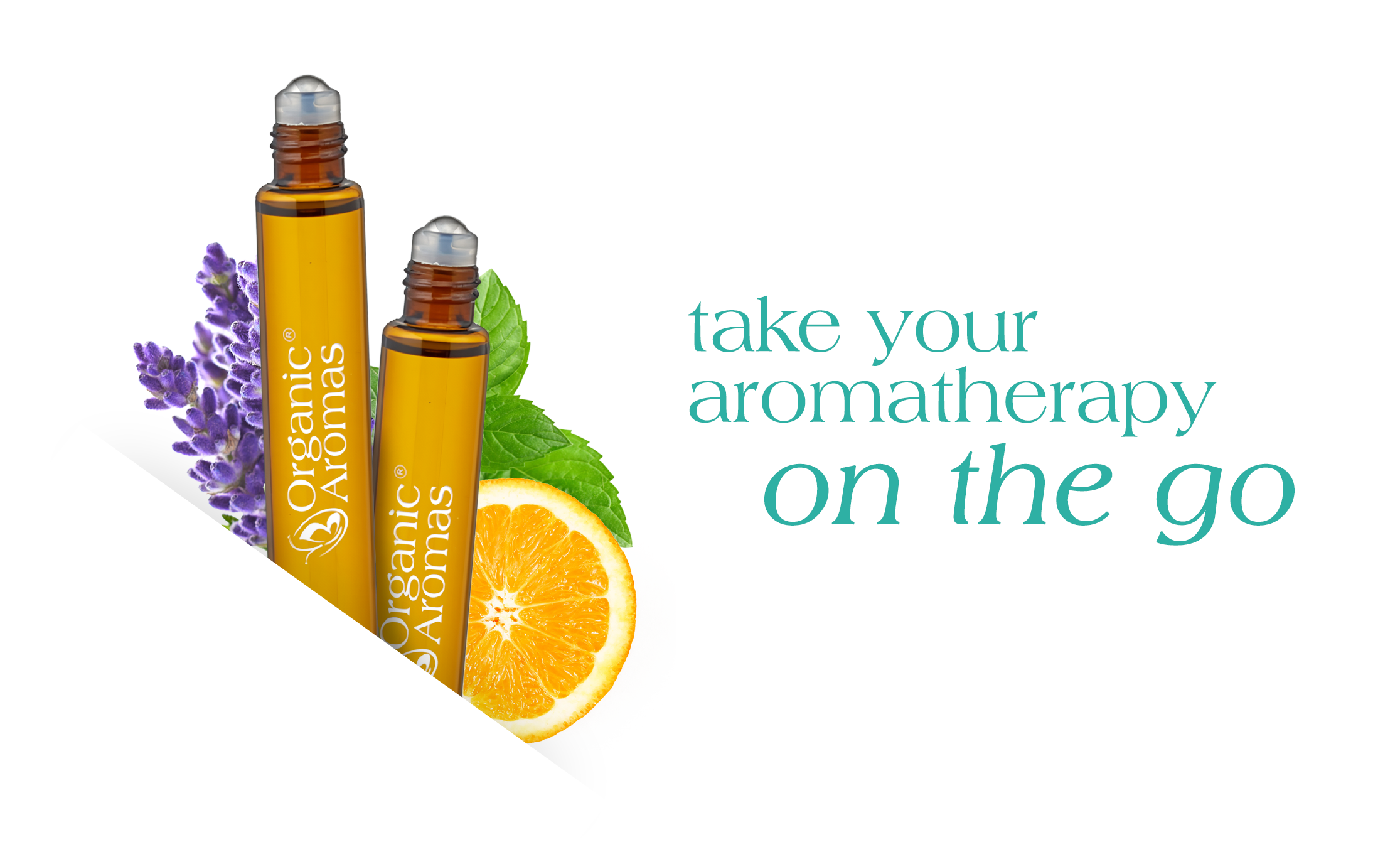
A roll-on is built for localized, portable, skin-level scent: a pulse point before a meeting, a dab on the wrists mid-flight, something that fits in a pocket with no batteries or outlet required. The trade-off is reach and duration — a roll-on scents the few inches of skin it touches, and it fades as the carrier oil absorbs.
A Nebulizing Diffuser® does the opposite job well: it atomizes 100% undiluted essential oil — no water, no heat, no carrier — using Bernoulli’s Principle, filling an entire room with aroma through inhalation alone, with zero skin contact. Neither method is “better” in the abstract; they’re suited to different moments. For a quick comparison of nebulizing against the other major diffusion method, see our Nebulizing Diffuser® vs. ultrasonic diffuser breakdown.
This distinction is also a genuine safety consideration, not just a preference. An oil like bergamot, with its strict 0.4% topical dermal limit, is often more practical to simply diffuse than to wear on skin at all — see our dedicated piece on why diffusing bergamot instead of applying it to skin unlocks the aroma safely. Inhalation sidesteps the phototoxicity question entirely, since nothing is touching sun-exposed skin.
The 5 Most Popular Organic Aromas Roll-On Blends
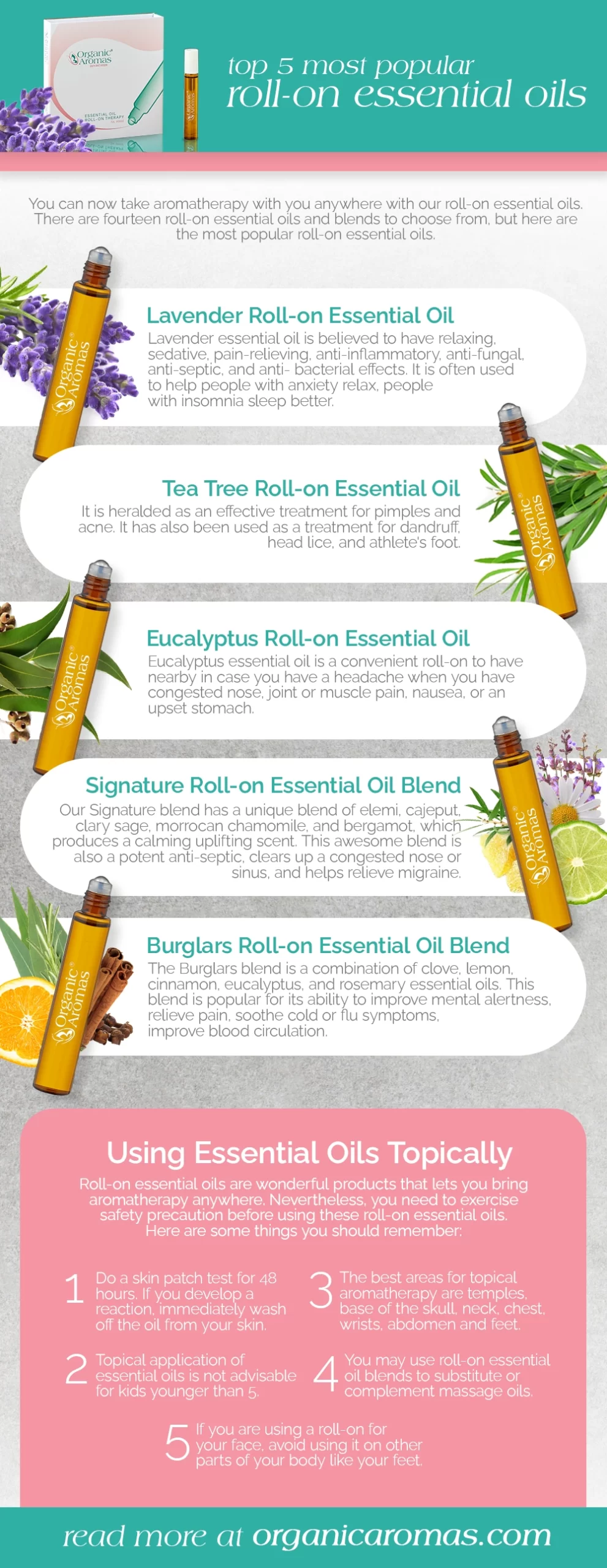
Here are the five roll-on blends our customers reach for most, and what’s actually in each one:
Lavender Roll-On Essential Oil
Lavender’s appeal in a roll-on comes down to versatility — its soft floral profile (driven by linalool and linalyl acetate) pairs easily with almost any other oil, which is why it shows up in so many blend combinations. It’s a reliable everyday pick for anyone easing into topical aromatherapy. For the full chemistry behind why lavender’s ratio of those two molecules matters, see our honest lavender safety guide.
Tea Tree Roll-On Essential Oil
Tea tree has become a household name in skincare culture, largely thanks to its terpinen-4-ol content — the compound responsible for its sharp, medicinal-green aroma. This roll-on is pre-diluted to 5%, a level chosen specifically to make it comfortable for everyday topical use. See our tea tree essential oil guide for more on its chemistry and uses.
Eucalyptus Roll-On Essential Oil
Eucalyptus owes its crisp, cooling aroma to 1,8-cineole (eucalyptol), one of the most recognizable notes in aromatherapy. As a roll-on, it’s a popular “fresh air” pulse-point pick for stuffy offices and long travel days. Read more in our complete eucalyptus essential oil guide.
Signature Blend Roll-On Essential Oil
Our Signature blend layers elemi, cajeput, clary sage, Moroccan chamomile, and bergamot into a calming, uplifting scent profile. Because it contains bergamot, it’s a good example of why the dilution math above matters: this blend is formulated with bergamot’s lower safety ceiling already accounted for, rather than treated like any other oil.
Burglars Roll-On Essential Oil Blend
Clove, lemon, cinnamon, eucalyptus, and rosemary combine into a warm, spicy, wake-you-up aroma. The name nods to the “Four Thieves” legend — a folk story about plague-era grave robbers said to have worn an aromatic vinegar blend of similar spices while looting homes untouched by illness. It’s a fun piece of aromatherapy folklore, not a documented protective effect, but it’s exactly why this blend reads as bold and invigorating rather than soft or floral.
Join Now and Get a Coupon for 10% Off!
How to Apply Roll-On Essential Oils Correctly
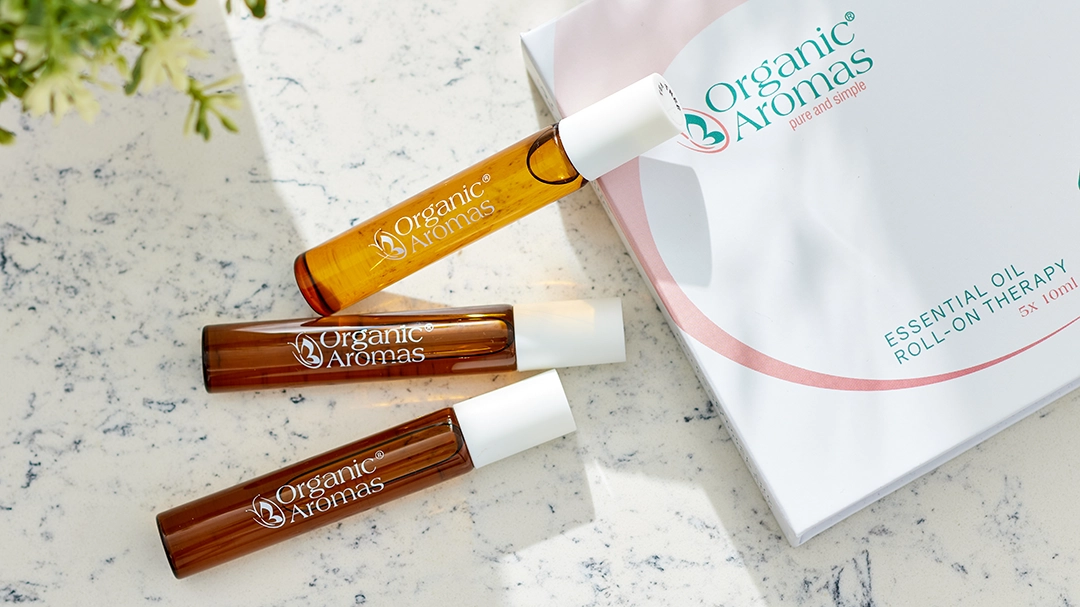
- Patch test first. Apply a small amount to your inner forearm and wait up to 48 hours before wider use. If redness, burning, or itching develops, wash the area and discontinue use.
- Apply to pulse points. Temples, the base of the skull, neck, chest, wrists, abdomen, and soles of the feet work best. Never apply near the eyes, nose, mouth, or any broken or irritated skin.
- Mind the sun after photosensitizing oils. Bergamot and other citrus-derived oils can increase skin sensitivity to UV light — avoid direct sun exposure on treated skin for about 24 hours.
- Be extra cautious with young children. Topical use on children under 5 isn’t advisable without guidance from a pediatrician or a qualified aromatherapist, since dosing and dilution needs differ significantly from adults.
- Practice basic rollerball hygiene. Don’t use the same roll-on on your face and your feet interchangeably — it’s an easy way to transfer bacteria from one area to another.
For a full oil-by-oil breakdown rather than general guidance, our dilution chart and ratios guide covers specific percentages across dozens of common oils.
Two Oils That Need Extra Care: Peppermint and Bergamot
Peppermint is one of the most potent oils in any roll-on collection — remember, one drop carries roughly the aromatic concentration of 26–28 cups of tea. Keep it away from eyes and mucous membranes, avoid it on children under 5, and ventilate the room if you’re applying it around cats, which metabolize certain aromatic compounds more slowly than humans or dogs.
Bergamot deserves its own callout because of bergapten, the furocoumarin compound responsible for its phototoxicity. Beyond the 24-hour sun-avoidance rule above, it’s worth knowing that “bergapten-free” or “FCF” (furocoumarin-free) bergamot oil exists — a version steam-processed specifically to remove the photoreactive compound for people who want bergamot’s aroma in daily topical use without the sun-exposure limit. It’s a lesser-known option worth asking about if bergamot is a blend you reach for often.
Sign Up to Get Your FREE Essential Oils e-Book Here
Frequently Asked Questions About Roll-On Essential Oils
What dilution percentage should a roll-on essential oil be?
It depends on the specific oil. Most commercial roll-ons are pre-diluted between 3% and 5%, but oils like bergamot carry a much lower safe ceiling (around 0.4%) due to phototoxicity. Always check the label rather than assuming one number applies everywhere.
Can I make my own roll-on blend at home?
Yes — combine your chosen essential oil(s) with a carrier oil like fractionated coconut or jojoba oil in a rollerball bottle. See our carrier oil guide for ratios and options.
Why does bergamot need a lower dilution than other oils?
Cold-pressed bergamot contains bergapten, a furocoumarin that reacts with UV light and can cause skin burns or pigmentation changes. IFRA caps it at roughly 0.4% in leave-on products exposed to sunlight.
Is a roll-on or a Nebulizing Diffuser® better for aromatherapy?
Neither is universally better — they serve different purposes. A roll-on gives portable, localized, skin-level scent; a Nebulizing Diffuser® fills an entire room with pure, undiluted aroma through inhalation only, with no skin contact at all.
Can children use roll-on essential oils?
Topical use on children under 5 isn’t advisable without guidance from a pediatrician or qualified aromatherapist. Older children generally need much lower dilutions than adults.
How long does a roll-on essential oil last once opened?
Most pre-diluted roll-ons stay fresh for 1–2 years when stored away from direct light and heat. The carrier oil, not the essential oil itself, is usually what degrades first.
Final Thoughts
The five roll-on blends above are popular for good reason — they’re portable, pre-diluted, and genuinely convenient. But “pre-diluted” isn’t a single safety number you can apply to every bottle; it means someone already did oil-specific math on your behalf, the same math worth understanding yourself (especially with bergamot in the mix). Patch test, respect the sun-exposure window on photosensitizing oils, and reach for a Nebulizing Diffuser® instead whenever you’d rather fill a whole room than touch your skin at all.
Shop our full collection of roll-on essential oils, explore the Nebulizing Diffuser® collection for whole-room aromatherapy, and review our complete essential oil safety guidelines before trying a new blend.
Very interesting.
So many oils to choose from. My favorite would be Lavender. I love the soothing smell and I can see why it might help me sleep. Just never tried it.
might need to try this
i know some oils can help with inflammation but i didn’t know that lavender was also used for inflammation as well as tea tree oil. its nice to have options i feel like Lavender essential oil would be my own personal favorite. ive tried tea tree oil before but i wasn’t very fond of the smell of it . i make my own juice for inflammation at home using turmeric ginger honey and lemon. my family and my friends with aches and pains love the taste of it and the health benefits it.
I did not know there was roll on essential oils.
I suffer from chronic daily migraine disease so I’m looking forward to trying the signature blend!
Thanks for this interesting article, I love essential oils primers.
Always learn new uses for essential oils. Great info
Lavender would be great for calmness
I’ve never used essential oils in a roll on, but I love the idea! Thanks!
Thanks for the useful information
Great Information ! The eucalyptus roll on sounds prefect for the colder season to have on hand.
Really informative piece, thanks for the information
Great gift for the female in your life
so relaxing
Thank you for the information. Lavender is my favorite – it’s very relaxing!
Such a neat way to do oils
Thanks for this useful information.
I love using essential oils! Ever since I was in labour with my first child 😍
great info
Great information thanks for sharing!
I love al of tgese especially lavender and eucalyptus at this time of year
These products are truly the best
I have both lavender and tea tree in roller bottles. Good for many things.
Very nice and informative
Lavender has always been a calming scent for me, never considered a roll on before. I like it!
I love that I can take aromatherapy with me anywhere with these roll-on essential oils.
Good information!
much better than any other diffuser I have seen yet
Love essential oils.
I love and use essential oils in my home. Thanks for sharing all the great tips and information.
Very interested…deff will have to try.thx
Thanks for the info
This is a great article,.It explains a lot.
I just love everything natural.
VERY INFORMATIVE
Good
Thanks for the info
Nice
This is useful information.
This is useful information.
I love organic fragrances.They make your house smell so good and fresh. Kills stale odors.
interesting combination of oils, good selection.
I find that Lavender oil is very calming and relaxing and use it at bedtime in a rollerball,
Sounds wonderful
Love the Lavender Roll-On! Thank You for the information !
I absolutely love lavender. I use it whenever I have the chance.
I like this idea of wearing the oils.
My favorite is lavender so I’m sure I would love your natural products
Thank you
I would like to try the signature roll on.