

What Is Menthol? The One Mirror-Image Molecule (Out of Eight) That Makes Mint Feel Cold
What is menthol? It is the waxy, crystal-clear molecule that makes peppermint, cough drops and chewing gum feel cold, even though none of them lowers the temperature of anything. Most answers stop there. The more interesting story is that menthol exists in eight mirror-image forms, plants make only one of them, and that one form happens to be the best at switching on a cold sensor in your nerves that scientists only found in 2002.
This guide covers what menthol is, where the world’s supply really comes from (hint: mostly not peppermint), how it fools your sense of temperature, and what that means when you diffuse a menthol-rich oil at home. We’ll keep it to chemistry, history and scent. We won’t make health promises, because menthol has plenty of genuine stories without them.
What Is Menthol? The Short Answer
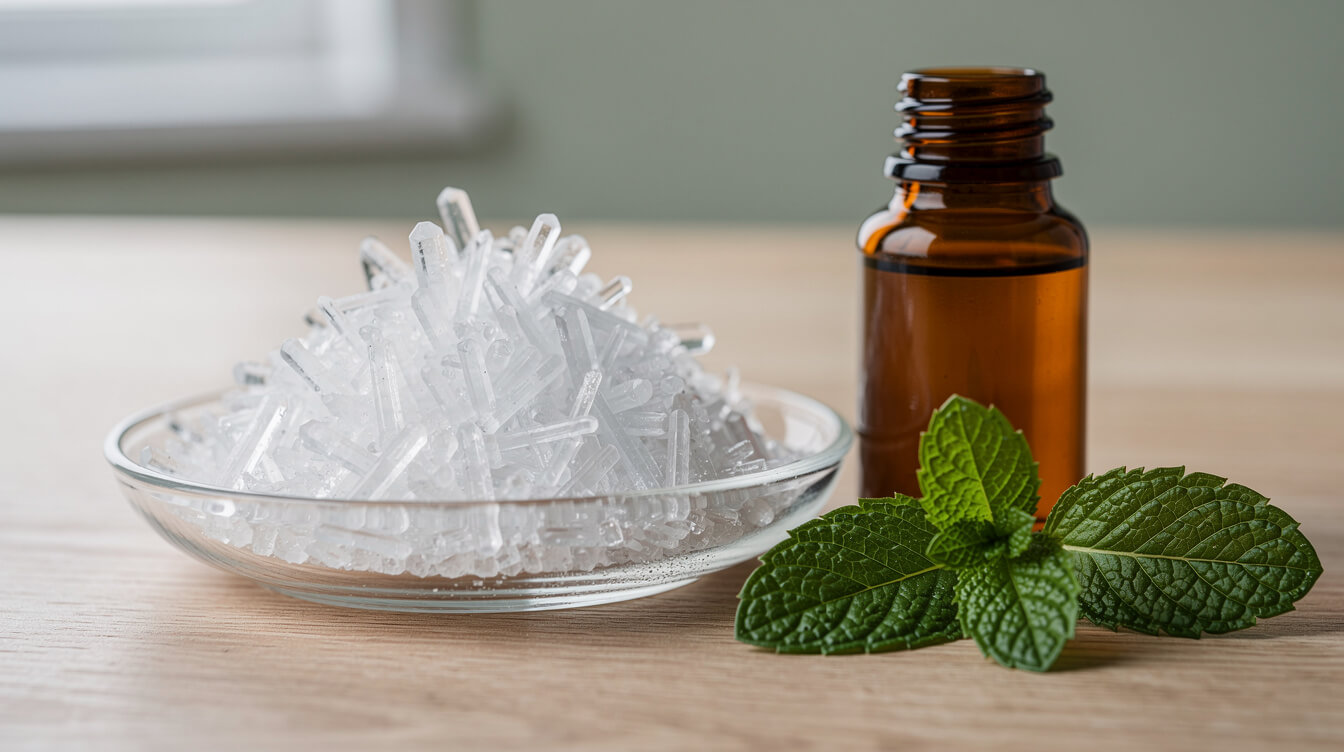
Menthol is a monoterpene alcohol with the formula C10H20O. In plain terms, it’s a 10-carbon molecule built from two isoprene units (the same building block behind limonene and linalool, which we explain in our guide to terpenes in essential oils), with a ring and an alcohol group attached. Peppermint and its relatives make it in tiny glands on the undersides of their leaves.
A crystal that melts just above body heat
Pure natural menthol is a solid at room temperature. Its most stable crystal form melts at about 42 to 45 °C (108 to 113 °F), according to standard reference data, which is only a few degrees above body temperature. Synthetic racemic menthol, a 50/50 mix of the two mirror-image forms, melts lower, at about 36 to 38 °C. It boils at around 215 °C, so in a room it evaporates slowly rather than flashing off like the lighter citrus molecules.
That’s why menthol shows up as long, needle-like crystals in a jar, and also why it hides inside a liquid oil. Dissolved in the other molecules of peppermint oil, it stays liquid. Chill a menthol-rich oil enough, and crystals start to grow out of it. That simple trick is the basis of the natural menthol trade, which we’ll get to below.
Who found it, and who named it
Menthol was first isolated in 1771 by the Leiden physician Hieronymus David Gaubius. It got its name almost a century later, in 1861, from the chemist F. L. Alphonse Oppenheim, who chose “menthol” because the crystals reminded him of borneol, a camphor-like alcohol. In his words, “the analogies with borneol allow me to propose the name menthol for this substance.” For much of the 19th century, these mint crystals were grouped with the “camphors” that crystallized out of other aromatic oils, a family resemblance that still shows in how similar menthol and camphor smell side by side.
Eight Mirror Images, One Natural Molecule
Here is the part almost no explainer covers. Menthol has three chiral centers, three spots in the molecule where the attached groups can point one of two ways. Three switches with two positions each give 2 × 2 × 2 = 8 possible shapes, called stereoisomers. They come as four mirror-image pairs: menthol, neomenthol, isomenthol and neoisomenthol, each in a (+) and a (−) form.
All eight share the same atoms and the same formula. Plants make almost exclusively one of them, (−)-menthol, which chemists label (1R,2S,5R). It’s also the most stable of the eight, because in its preferred shape all three bulky groups sit flat around the ring instead of jutting up or down.
Why the “hand” of the molecule changes how it feels
The mirror images don’t feel the same. According to the University of Bristol’s Molecule of the Month write-up, natural (−)-menthol is “fresh, sweet, minty, cooling, refreshing,” while its mirror twin (+)-menthol is “less minty, more herby” with “musty, bitter, phenolic and herbaceous notes,” and has only about a quarter of the cooling power. The other isomers, such as neoisomenthol, need much higher concentrations before you feel any cooling at all.
This is the same handedness theme that runs through other scent molecules. In our linalool explainer, the two hands of linalool differ in how strongly you smell them. In our limonene guide, the textbook claim that one hand smells of orange and the other of lemon turns out to be mostly a myth. Menthol is the clearest case of all: your cold sensor is shaped to fit the hand that mint makes, and the other hands fit it far less well.
What this means when you buy menthol or a mint oil
A plant oil gives you (−)-menthol automatically. Cheap synthetic menthol made by older routes starts as a racemic mix and has to be separated, which is why manufacturers advertise “l-menthol” (the older name for the (−) form). If a product says only “menthol,” you can’t tell which kind you’re getting. If it says “natural l-menthol” or lists a plant source, you’re getting the hand the plant makes.
Sign Up to Get Your FREE
e-Book ($9.99 Value)
Where Menthol Comes From: Cornmint Crystals and a Nobel-Winning Factory

If you assume the menthol in your toothpaste came from peppermint, you’re almost certainly wrong. The world’s menthol comes from two very different places, and neither of them is the peppermint oil in a typical aromatherapy bottle.
Natural menthol: chilling cornmint oil
Natural menthol crystals are made mainly from Mentha arvensis, called cornmint, field mint or Japanese mint. Its oil is far richer in menthol than peppermint’s: the Bristol write-up gives “up to 85%” (−)-menthol, and trade sources usually quote about 75 to 80%. Producers steam-distill the herb, dry the oil, then chill it so the menthol crystallizes out. The crystals are filtered or spun off, and the leftover liquid is sold as “dementholized” mint oil, which still carries a large share of menthol and smells broadly minty.
Most of that cornmint grows on the plains of northern India, with Uttar Pradesh the largest growing state. Industry estimates put India’s share of the world’s natural menthol at roughly three-quarters or more. In 1985 China supplied most of it, and India has since taken the lead.
That leftover dementholized oil matters to you as a shopper, because it’s cheaper than true peppermint and smells close enough to be used to stretch it. We cover how that shows up on a label in our peppermint oil guide, where the US pest-spray rules list peppermint oil and cornmint oil as separate ingredients.
Synthetic menthol: the Takasago route
The other half of the supply is made in factories. World menthol production in 1998 was about 12,000 tonnes, of which about 2,500 tonnes were synthetic, and synthetic output had nearly doubled by 2005. The most elegant route belongs to Japan’s Takasago International Corporation, which makes about 3,000 tonnes a year of (−)-menthol at 94% enantiomeric excess, meaning it’s overwhelmingly the natural hand.
Takasago’s process starts from myrcene, a common terpene, and uses a rhodium catalyst with a chiral ligand called BINAP to build the right hand of the molecule from the start, passing through citronellal and isopulegol on the way to menthol. The catalyst chemistry came from Ryōji Noyori, who shared the 2001 Nobel Prize in Chemistry for it. A second classic route, developed by Haarmann & Reimer (now part of Symrise), starts from m-cresol, makes thymol (the main molecule of thyme oil), hydrogenates it to a mixture of isomers, and then separates out the (−) form.
So the cooling in a stick of gum may trace back to an Indian mint field or to a Japanese reactor. In both cases it’s the same (−)-menthol molecule, which is why “natural” on a menthol label tells you about the source, not about a different chemical.
How Menthol Tricks Your Cold Sensor
Several OA posts mention that peppermint “feels cold without cooling the air.” Here is the fuller story of how scientists worked that out, because the timeline is better than the one-liner.
1951: menthol makes cold nerves fire at warmer temperatures
Long before anyone knew which molecule in the nerve was responsible, physiologists Herbert Hensel and Yngve Zotterman recorded cold-sensing nerve fibers in the early 1950s and found that menthol made them fire at warmer temperatures than usual. Menthol didn’t add cold. It moved the point at which the nerve said “cold.”
2002: two labs, one receptor
Half a century later, two research groups independently tracked down the receptor. David Julius’s lab at UCSF published “Identification of a cold receptor reveals a general role for TRP channels in thermosensation” in Nature in 2002, and Ardem Patapoutian’s group at Scripps published “A TRP channel that senses cold stimuli and menthol” in Cell the same year. Both had used menthol as the bait. The receptor is now called TRPM8.
TRPM8 starts to switch on as skin temperature drops below roughly 26 to 28 °C (79 to 82 °F), and its signal keeps rising as things get colder, down to about 8 °C. When menthol binds to it, the channel opens at warmer temperatures than normal. In lab recordings, menthol pushed the threshold up to around 30 °C, which is close to ordinary skin temperature. Your nerves then report “cool” in a room that hasn’t changed at all.
In 2021 the work earned the Nobel Prize in Physiology or Medicine, shared by Julius and Patapoutian “for their discoveries of receptors for temperature and touch.” The Nobel committee’s summary notes that each of them, independently, used menthol to identify TRPM8. Few molecules from an essential oil have a Nobel in their résumé, and menthol has two: one for how it’s made and one for how it’s felt.
Why the nose and mouth feel it most
TRPM8 sits on nerve endings in the skin, the lining of the nose and the mouth, which is why mint registers as “cold air” when you breathe it and “cold” on the tongue. That cooling feel is a separate channel from the smell itself: you can smell a mint oil through your olfactory receptors and feel it through TRPM8 at the same time. It’s one reason peppermint reads as more “present” in a room than a floral oil at the same strength.
Sign Up to Get Your FREE Essential Oils e-Book ($9.99 Value)
Menthol in Essential Oils, and How to Diffuse a Menthol-Rich Oil

Only a handful of essential oils carry much menthol, and the mint family is not as uniform as the word “mint” suggests.
Which oils contain menthol
Peppermint (Mentha × piperita) is the classic. Reference figures put it at around 41% menthol and 23% menthone, and our own lab report on our Peppermint Essential Oil lands right there, as we break down in our peppermint oil guide. How menthol balances against menthone shapes peppermint’s character, and that’s a story for a separate post.
Cornmint (Mentha arvensis) is much higher, often 75 to 85% before dementholizing, which is why it’s grown for crystals rather than for aromatherapy.
Spearmint is the surprise: it contains little menthol. Its sweet, gum-like smell comes from carvone, which is why spearmint feels much less icy than peppermint. Our limonene guide covers how spearmint builds its carvone, and our Spearmint oil is the gentler mint to try if peppermint feels too sharp.
A drop is more menthol than you think
Here’s a piece of kitchen math worth knowing. A typical drop of essential oil is roughly 0.03 to 0.05 ml, and peppermint oil weighs about 0.9 g per ml, so one drop is about 27 to 45 mg of oil. At around 41% menthol, that single drop holds roughly 11 to 18 mg of menthol. For comparison, US over-the-counter rules for menthol lozenges set 5 to 10 mg of menthol per lozenge. In other words, one drop of peppermint carries about as much menthol as one to three cough drops. That’s why a single drop changes the character of a whole blend, and why peppermint oil is never something to swallow or put on skin undiluted.
Diffusing a menthol-rich oil
A Nebulizing Diffuser® suits mint oils well because it doesn’t heat them or dilute them with water. A stream of air breaks the pure oil into a fine mist at room temperature, so the menthol you smell is the menthol that was in the bottle. Our Raindrop Nebulizing Diffuser® is a good size for a living room or home office.
A few practical habits make menthol-rich oils pleasant rather than overpowering:
Run short sessions. Ten to fifteen minutes at a time, with breaks, is plenty for peppermint. The cooling feel builds quickly, and your nose adapts after a while.
Use it as an accent in blends. In a blend, peppermint usually works best as a small part with citrus, rosemary or lavender carrying the rest. See our peppermint blends for a Nebulizing Diffuser® for ratios.
Keep it away from babies and young children. The US National Center for Complementary and Integrative Health advises that menthol should not be inhaled by or applied to the face of an infant or small child. Diffuse mint oils in rooms where little ones aren’t sleeping or playing.
Think about pets. Cats, dogs and especially birds have different sensitivities. Read our guides on diffusing around dogs and diffusing around birds before running a mint oil near them.
If you shower with mint, our guide to essential oils in the shower covers drop counts and the slip risk on wet floors.
Menthol in Cigarettes, Cough Drops, Gum and Skincare: What It’s Doing There
Menthol is one of the most widely used flavor molecules in the world, and it does a slightly different job in each product. Knowing which job it’s doing helps you read labels.
Cough drops and rubs: an FDA-defined ingredient
In the US, menthol is a named active ingredient in the FDA’s rules for over-the-counter cough and cold products, with fixed amounts: 5 to 10 mg per lozenge, 2.6 to 2.8% in an ointment and 3.2% in a steam-inhalation product. That’s a drug regulation, which is exactly why an essential oil brand can’t borrow those claims. A bottle of peppermint oil sold for aromatherapy is not a cough drop, and we don’t describe it as one.
Gum, toothpaste and skincare: flavor and feel
In gum, toothpaste and mouthwash, menthol supplies the “fresh” feel as much as the flavor. In skincare, it’s the tingle in cooling gels and after-sun products. Skincare formulators use it in small amounts, because higher levels can irritate, and anyone with sensitive skin may react to menthol-heavy products.
The cooling agents that aren’t menthol
Some products feel icy but barely smell of mint. Around 1970, the razor company Wilkinson Sword set out to find compounds that cooled like menthol without its smell or its eye-watering vapor. Researchers including Hugh Watson made and tested roughly 1,200 candidate molecules, and a handful were commercialized under “WS” code names, such as WS-3 and WS-23, according to Perfumer & Flavorist. These also act on TRPM8. WS-23 is now common in “ice” vape liquids, so a product that feels cold but smells faint is often using one of them instead of menthol.
Cigarettes: flavor that masks harshness
Menthol has been added to cigarettes since the 1920s and 1930s (early brands included Spud and Kool). It’s used for flavor and to reduce the throat irritation of smoke, which public-health researchers say makes smoking easier to start. The US FDA proposed banning menthol as a characterizing flavor in cigarettes in April 2022. The final rule was delayed indefinitely in 2024, and the proposal was formally withdrawn in January 2025, so menthol cigarettes remain on sale in the US. Several states and cities have their own restrictions. None of this has anything to do with diffusing a plant oil, but it’s the reason tobacco pages rank so high for this question.

Join Our Exclusive Member Club to get Big Discounts!
What Is Menthol? Frequently Asked Questions
What is menthol called?
Its chemical name is 2-isopropyl-5-methylcyclohexanol, and the natural form is (−)-menthol or l-menthol, also written (1R,2S,5R)-menthol. In older texts it was sometimes called peppermint camphor.
Is menthol natural or synthetic?
Both. Natural menthol is crystallized from chilled cornmint oil, mostly grown in India. Synthetic menthol is made in factories, for example from myrcene by Takasago or from m-cresol and thymol by the Haarmann & Reimer route. The (−)-menthol molecule is the same either way.
How are menthol crystals made?
Cornmint is steam-distilled, the oil is dried and then chilled until menthol crystallizes out. The crystals are separated by filtering or spinning, and the remaining oil is sold as dementholized mint oil.
Is menthol the same as peppermint oil?
No. Menthol is one molecule. Peppermint oil is a mix of dozens of molecules, with menthol at around 40% alongside menthone and others. Spearmint oil contains very little menthol.
Does menthol actually cool you down?
No. Menthol activates the TRPM8 cold receptor in your nerves and makes it fire at warmer temperatures than usual, so you feel cool without any real drop in temperature.
Who should not use menthol?
Keep menthol and menthol-rich oils away from the faces of infants and young children, never swallow essential oils, and dilute properly before any skin use. People with sensitive skin may react to menthol products. Diffuse mint oils away from pets, especially birds, and ask your doctor if you have a specific health question.
So, what is menthol? It’s one molecule out of eight possible mirror images, the one plants make and the one your cold sensor fits best. It reached your toothpaste from an Indian mint field or a Nobel-winning reactor, and it feels cold because it moves the line where your nerves say “cold.” Used with a light hand, a menthol-rich oil is one of the brightest, crispest scents you can bring into a room.
Diffuse Mint the Pure Way
Our handcrafted Nebulizing Diffusers® turn pure essential oil into a fine mist with no water and no heat, so peppermint smells the way it does in the bottle.