

Sandalwood Essential Oil Benefits: The Species Guide and Why Alpha-Santalol Percentage Determines Your Diffuser Results
Sandalwood essential oil benefits get written about constantly, but almost every list treats sandalwood as one thing — a single calming, woody oil you add a few drops of to whatever diffuser you own. That framing misses the chemistry entirely. Sandalwood’s aromatic character is defined by a compound called alpha-santalol, and the percentage of alpha-santalol in your bottle depends on which species you bought, where it was grown, and how old the tree was when it was harvested. That percentage — not the word “sandalwood” on the label — determines what you actually smell.
This guide covers the three commercial sandalwood species and their alpha-santalol ranges, why sandalwood’s heavier molecules behave differently from a bright citrus top note, what the honest research says about inhaling it, why a Nebulizing Diffuser® is the only diffuser type built to carry those heavier molecules intact, three tested autumn blend ratios that use sandalwood as a fixative, and how to avoid the adulteration problem that plagues this specific oil more than almost any other.
The Three Sandalwood Essential Oil Species (and Why Each Gives You a Different Result)
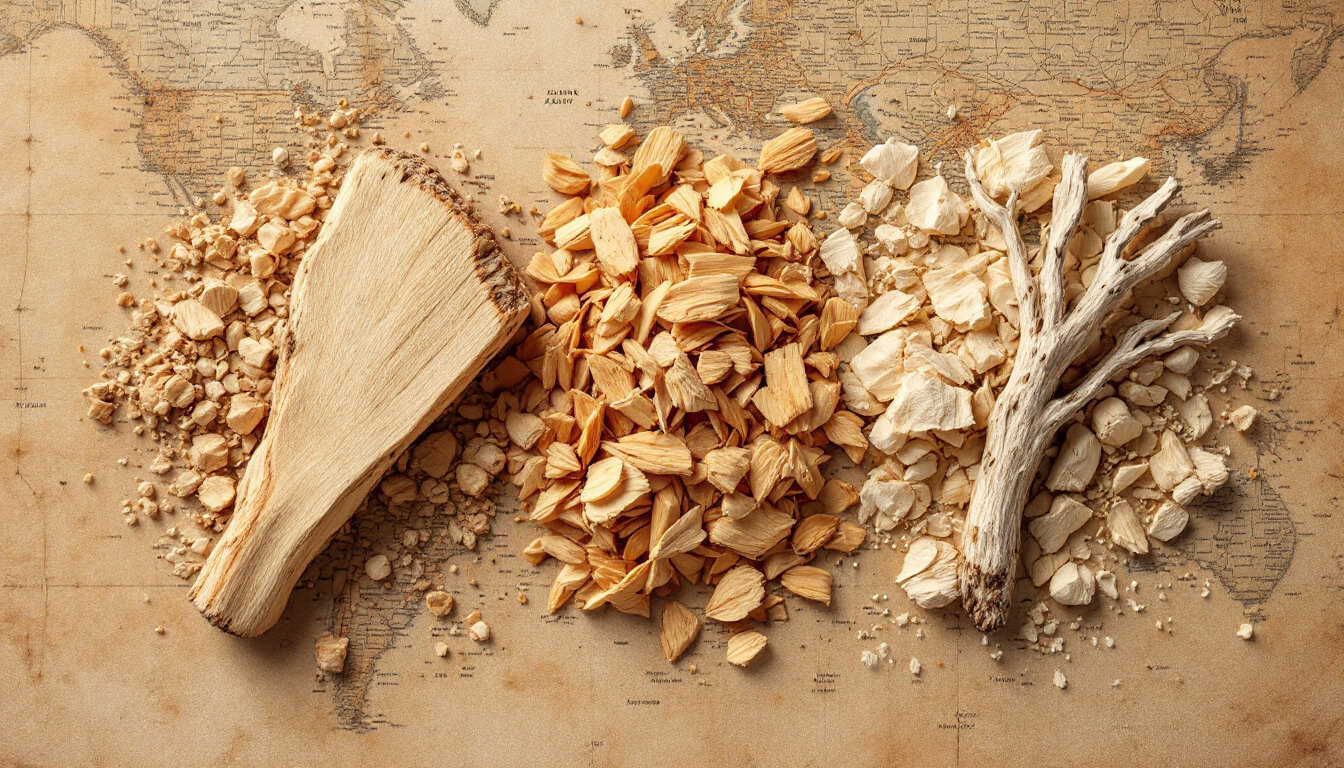
“Sandalwood essential oil” is a category, not a single plant. Three species dominate the commercial market, and they are not interchangeable:
- Mysore sandalwood (Santalum album) — native to India, historically the benchmark for aromatherapy sandalwood. Alpha-santalol content runs 50–60%, the highest of the three, which is why Mysore has the richest, creamiest, most “classic sandalwood” profile. Centuries of over-harvesting nearly emptied India’s wild sandalwood forests; the species is now protected, and legitimate Mysore oil today comes from managed plantations in India and increasingly from cultivated trees elsewhere, not wild harvest.
- Australian sandalwood (Santalum spicatum) — the most widely available and sustainably farmed option, grown on managed plantations in Western Australia. Alpha-santalol sits lower, around 25–40%, giving a drier, sharper, slightly less sweet aroma than Mysore. It is the most consistent, most ethically uncomplicated choice for everyday diffusing.
- Pacific sandalwood (Santalum austrocaledonicum) — grown primarily in Vanuatu and New Caledonia, alpha-santalol typically falls between 45–55%, closer to Mysore’s richness but from a distinct regional lineage with its own sustainability story tied to Pacific island agroforestry programs.
None of the major consumer guides on the first page of Google mention alpha-santalol percentage at all — they discuss sandalwood as a single undifferentiated ingredient. But the percentage is the whole story: it is the direct chemical measure of how much of the aroma-active compound is actually in your bottle. A bottle at 25% alpha-santalol and a bottle at 58% will diffuse into two noticeably different rooms, even though both labels say “sandalwood.” When you shop for the best aromatherapy oils for a diffuser, species and percentage matter as much as the plant name on the front label.
The Mysore sandalwood story is worth understanding before you buy, because it explains why prices vary so widely. India placed export and harvest restrictions on wild Santalum album starting in the late 1990s after decades of unmanaged extraction pushed the tree toward scarcity in its native forests. What reaches the market today under the Mysore name is increasingly plantation-grown — in India, but also in newer cultivation programs in parts of Africa and the Pacific — from trees that take fifteen years or longer to develop enough heartwood oil to be worth distilling. Australian sandalwood sidesteps that scarcity story almost entirely: Santalum spicatum plantations in Western Australia are managed on rotation specifically for oil production, which is a large part of why Australian sandalwood is both more available and less expensive than genuine Mysore. Neither species is “better” in an absolute sense — they are different chemical profiles at different price points, and knowing which one is in your bottle lets you actually compare like with like instead of comparing a label.
What’s Actually in Sandalwood Oil: The Sesquiterpene Profile
Alpha-santalol and its close relative beta-santalol belong to a class of aromatic molecules called sesquiterpene alcohols — and that classification explains almost everything about how sandalwood behaves in a diffuser.
Most essential oil chemistry education focuses on monoterpenes: the light, fast-evaporating molecules in citrus and mint oils that make up a “top note.” Sesquiterpenes are structurally different — one and a half times the molecular size of a monoterpene, with a correspondingly higher boiling point (santalol boils near 300°C, compared to roughly 175°C for limonene, the dominant molecule in orange oil). That size difference has a direct, practical consequence: sesquiterpenes evaporate slowly and travel through the air less readily than lighter molecules. This is precisely why sandalwood is classified as a base note in perfumery and aromatherapy — not as a marketing term, but as a description of its evaporation rate.
It also means sandalwood is disproportionately sensitive to how it is delivered into the air. Heavier, slower-evaporating molecules need a delivery method that can actually lift them off the surface of the liquid and suspend them as an aerosol — simple evaporation from an open bottle, or from a passive reed diffuser, barely moves them at all, which is why open sandalwood bottles smell faint compared to a diffused Mysore oil. The mechanism that lifts oil into the air matters more for sandalwood than it does for a light, volatile oil like grapefruit, which evaporates readily under almost any conditions. We cover exactly how that lift happens — Bernoulli’s Principle — in our explainer on how a Nebulizing Diffuser® actually works.
This is also why cheap sandalwood-scented candles and reed diffusers rarely smell like real sandalwood oil: synthetic santalol substitutes are engineered to be lighter and more volatile specifically so they perform in low-energy delivery systems, at the cost of the authentic sesquiterpene depth.
There’s a useful comparison inside the essential oil world itself: sweet orange oil is almost entirely limonene, a single light monoterpene that evaporates so readily you can smell an orange peel from across a kitchen with zero mechanical assistance. Sandalwood is the structural opposite — a complex mixture dominated by two heavy sesquiterpene alcohols that barely move at room temperature without help. That is not a flaw in sandalwood; it is exactly why perfumers and aromatherapists reach for it as a foundation rather than a burst of immediate scent. But it does mean that if your delivery method can’t generate enough energy to lift those molecules off the surface of the oil, you are technically diffusing sandalwood while barely smelling any of it.
Sign Up to Get Your FREE
e-Book Here…
Sandalwood Essential Oil Benefits — Specifically for Diffusing
Most competing articles list sandalwood’s benefits as a single undifferentiated block — “reduces stress,” “improves focus,” “aids meditation” — borrowed from its Ayurvedic and Buddhist ceremonial history without distinguishing between topical, ingested, and inhaled use. We’ll stay narrow and honest here: this section covers what happens specifically when sandalwood is inhaled.
Sandalwood has been burned as incense and diffused in temples and meditation halls across South and Southeast Asia for thousands of years, almost always in a grounding or focus-oriented context rather than an energizing one. That pattern is not incidental — it lines up with what we know about how the nose perceives heavy sesquiterpene molecules versus light citrus monoterpenes. Bright top notes (orange, grapefruit, peppermint) are consistently rated as energizing and uplifting in fragrance-psychology research; deep, slow-releasing base notes like sandalwood, vetiver, and patchouli are consistently rated as calming, grounding, and conducive to stillness. A small number of published inhalation studies measuring self-reported relaxation and heart-rate variability after exposure to santalol-rich sandalwood aroma support this pattern, though the body of clinical evidence remains limited and preliminary.
We’ll frame this the way it should be framed: sandalwood may support a sense of calm, grounding, and settled attention when diffused during meditation, wind-down rituals, or focused work — not as a treatment for any diagnosed condition, and not as a substitute for medical or mental health care. If you are drawn to sandalwood specifically for its grounding character, you’ll find it pairs naturally with other heavy base-note oils; our guide to cedarwood essential oil benefits covers a close aromatic cousin with a similar sesquiterpene backbone.
Worth noting honestly: much of the enthusiasm around sandalwood’s psychological effects traces back to centuries of ceremonial association rather than a large body of modern clinical trials. Sandalwood incense has been part of Hindu, Buddhist, and Ayurvedic practice for so long that the scent itself has become culturally coded as “meditative” — which is a real and legitimate reason to use it (scent-based ritual and association are a genuinely effective way to cue a mental state), even independent of any direct pharmacological action. You don’t need a clinical trial to validate that lighting the same grounding scent every time you sit down to meditate or wind down for the evening trains a useful association over time.
Why Sandalwood Needs a Nebulizing Diffuser® (Not Just Any Diffuser)
Here is the gap almost every sandalwood article skips entirely: they’ll tell you to “add 3–5 drops to your diffuser” as if all diffusers treat sandalwood the same way. They don’t, and the sesquiterpene chemistry above explains why.
Ultrasonic diffusers use water and high-frequency vibration to create a fine mist. The oil is diluted into that water before being aerosolized — heavier sesquiterpene molecules like alpha-santalol are less water-soluble and less readily carried into the ultrasonic mist than light monoterpenes, so a meaningful fraction of your sandalwood oil is left behind, coating the water reservoir rather than reaching your nose. Over a diffusing session, users often notice the top and middle notes of a blend arrive first and strong, while the sandalwood base note underneath feels thin or arrives late.
Heat-based diffusers (candle warmers, plug-in heat diffusers) create the opposite problem: they volatilize the lightest molecules almost instantly and can begin to degrade or alter the heavier sesquiterpene structures at sustained heat, changing santalol’s aroma character rather than preserving it.
A Nebulizing Diffuser® uses neither water nor heat. It works on Bernoulli’s Principle — air is forced through a narrow venturi tube at high velocity, creating a pressure drop that draws pure, undiluted essential oil up a straw and shears it into a fine aerosol mist, cold. Because there is no water to dissolve into and no heat to volatilize selectively, the aerosol carries the oil’s full molecular range — light top notes and heavy sesquiterpene base notes alike — in roughly the same ratio they exist in the bottle. For an oil like sandalwood, where the entire value proposition is its heavy alpha-santalol fraction, that is the difference between diffusing sandalwood and diffusing a thin approximation of it. Our full nebulizing vs. ultrasonic diffuser comparison walks through the mechanism side by side in more depth.
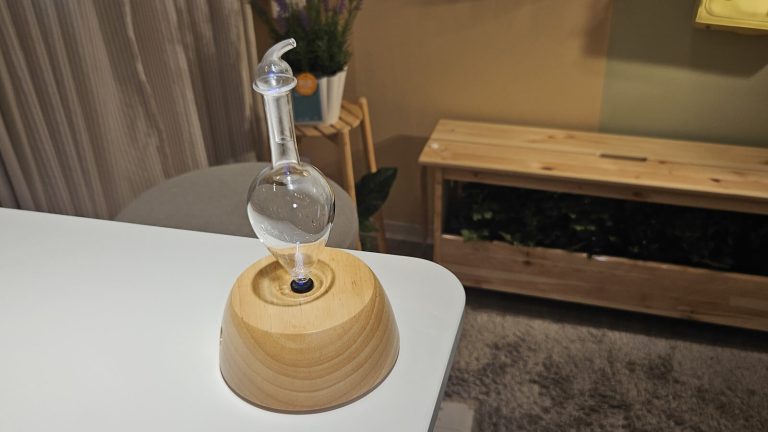
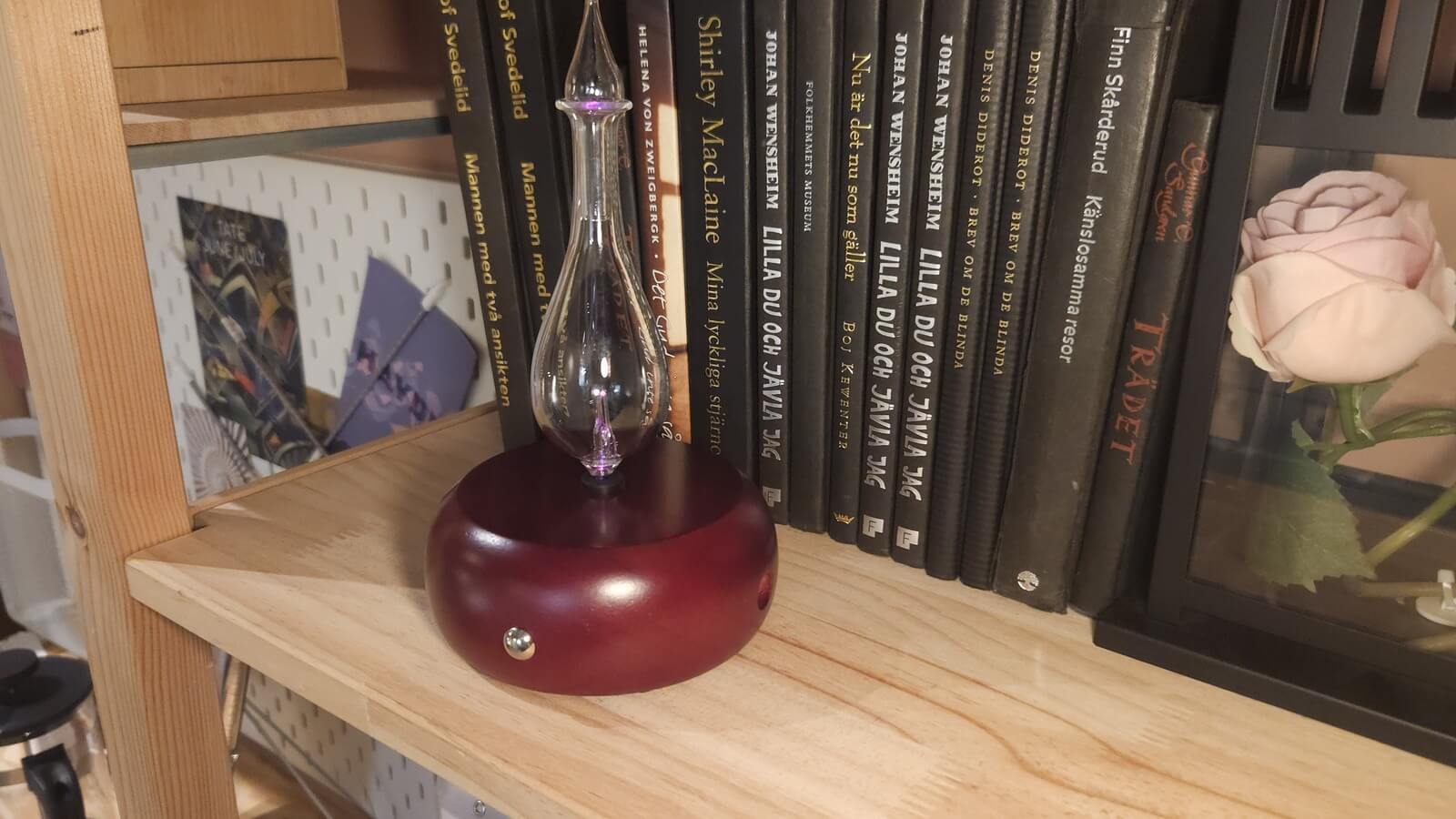
If you’re diffusing sandalwood regularly as an autumn or winter grounding ritual, a compact Elegance Smart Nebulizing Diffuser® in a dark wood finish suits the mood of the oil itself — but the mechanism matters more than the finish. Any genuine Nebulizing Diffuser® will outperform a water-based or heat-based unit for this specific oil.
A pattern shows up repeatedly in the customer feedback Organic Aromas has collected over more than a decade of aromatherapy support conversations: people who switch from an ultrasonic unit to a Nebulizing Diffuser® specifically for a heavy oil like sandalwood, vetiver, or patchouli almost always describe the same thing — “I didn’t realize how much I was missing.” It’s rarely framed as the new diffuser being stronger overall; it’s framed as the base notes finally showing up at all. That anecdotal consistency lines up exactly with the water-solubility mechanism described above, which is a good sign that the mechanism, not just marketing, is doing the explaining.
Join Now and Get a Coupon for 10% Off!
Sandalwood as the Autumn Base Note: A Fixative Blending Guide
The same slow evaporation rate that makes sandalwood a “grounding” scent also gives it a practical job in blend-building: it is a fixative. Because sandalwood’s sesquiterpenes linger in the air far longer than a citrus or herb top note, blending even a small amount of sandalwood into a lighter blend extends how long the whole composition is perceptible — the sandalwood essentially “holds down” the brighter notes that would otherwise fade first.
Three ratios pulled from Organic Aromas’ twelve years of customer blending feedback, all sized for a standard nebulizing reservoir:
- Autumn Grounding — sandalwood 3 drops, bergamot 3 drops, cedarwood 2 drops. A warm, settled blend for late-afternoon wind-down.
- Meditation Focus — sandalwood 4 drops, frankincense 2 drops, lavender 2 drops. Heavier on sandalwood for sustained, low-key diffusion during longer sits.
- Warm Amber Evening — sandalwood 3 drops, sweet orange 3 drops, ylang ylang 1 drop. The sandalwood extends the orange’s bright top note well past when it would normally fade alone.
A practical timing note for any of these three: because sandalwood releases so slowly, you’ll notice the blend “opens” differently than a citrus-forward mix. The bergamot or orange top notes announce themselves in the first few minutes, then fade — but the sandalwood base is still quietly present twenty or thirty minutes later, after the brighter notes have moved on. That lingering quality is the entire reason fixatives exist in perfumery, and it’s the same reason a sandalwood-anchored blend tends to make a room feel “held” rather than just briefly scented.
For a broader reference on drop ratios and note pairing across the whole collection, see our essential oil blending chart and seven cozy blend recipes for fall.
How to Choose and Store Sandalwood Oil for Maximum Diffusion Quality
Sandalwood is one of the most frequently adulterated essential oils on the market, for a simple economic reason: real Mysore sandalwood, grown for fifteen to thirty years before the heartwood is mature enough to distill, is expensive, while synthetic santalol substitutes and cheaper “sandalwood-scented” wood oils are not. A few practical checks before you buy:
- Ask for GC/MS documentation. A reputable supplier can show you a gas chromatography report confirming the alpha-santalol percentage and botanical species. If a seller can’t produce one, treat the “sandalwood” label with skepticism.
- Check the Latin name, not just “sandalwood.” Santalum album, Santalum spicatum, and Santalum austrocaledonicum are the legitimate species. Anything listed simply as “sandalwood oil” with no botanical name attached is a red flag.
- Be suspicious of bargain pricing. Given the maturation time required, genuine sandalwood — especially Mysore — is priced accordingly. A 5ml bottle priced like a citrus oil is very unlikely to be pure.
Unlike citrus oils, which oxidize and lose their top-note brightness within one to two years, sandalwood’s heavy sesquiterpene structure is comparatively stable — properly stored in a dark glass bottle away from heat and direct light, quality sandalwood oil can hold its character for several years, and some aromatherapists report it mellowing and improving with age, similar to a fine fragrance base note. For more on separating genuine oils from synthetic blends before they ever reach your diffuser, see how to tell pure oil from a synthetic blend.
As a rough price sanity check: expect genuine Australian sandalwood to sit noticeably above common single oils like lavender or tea tree per milliliter, and expect Mysore sandalwood to sit above Australian by a meaningful margin given its scarcity and slower maturation. If you find a “Mysore sandalwood” priced at or below what you’d pay for a common single oil, that price alone is reason enough to ask for GC/MS documentation before you buy.

Join Our Exclusive Member Club to get Big Discounts!
Quick FAQ: Sandalwood in Your Diffuser
How many drops of sandalwood should I use in a Nebulizing Diffuser®?
Start with 2–4 drops on its own, or as the base-note component in a blend (see the ratios above). Because sandalwood is potent and slow to fade, less is usually more.
Can I mix Mysore and Australian sandalwood in the same blend?
Yes — some aromatherapists blend a smaller amount of high-santalol Mysore with a larger amount of Australian to balance cost against richness. Just be aware you’re blending two different alpha-santalol concentrations, not doubling up on an identical oil.
Does sandalwood essential oil ever go bad?
It degrades far more slowly than citrus oils, but it isn’t immortal. Watch for a sharp, sour, or “off” smell replacing the normal creamy-woody aroma — that’s your sign to replace the bottle.
Sandalwood essential oil benefits are real, but they depend on three things almost nobody talks about together: which species is actually in your bottle, how much alpha-santalol that species delivers, and whether your diffuser can lift those heavy molecules into the air at all. Get the species and the delivery method right, and sandalwood becomes exactly what it’s been used for across centuries of ceremonial and meditative practice — a grounding, lingering base note that anchors a room.
Explore the full range of Nebulizing Diffusers® built to carry sandalwood’s heaviest molecules intact, and pair your next bottle with our seasonal blend guide for more autumn base-note ideas.