

Wellness Gifts Worth Giving: How to Spot a Real One (2026 Guide)
Wellness gifts are the fastest-growing corner of every holiday gift guide, and almost every one of those guides is a product grid: a candle, a sleep mask, a massage gun, a 49-item scroll. What none of them tells you is that the word “wellness” carries no legal meaning on a US label, so anything can wear it. This guide does the opposite of a grid. It gives you a five-question test for telling a real wellness gift from a wellness-washed one, then picks by the person you’re buying for.
We’ll also cover the part most guides skip completely: the tax rules for giving to a team or to clients, including the reason a gift card to your staff is treated differently from a boxed gift of the same value. And because this is the season for it, there’s a shipping checklist at the end so the gift actually arrives.
What Makes a Gift a Wellness Gift? (And Why the Word Means Nothing on a Label)
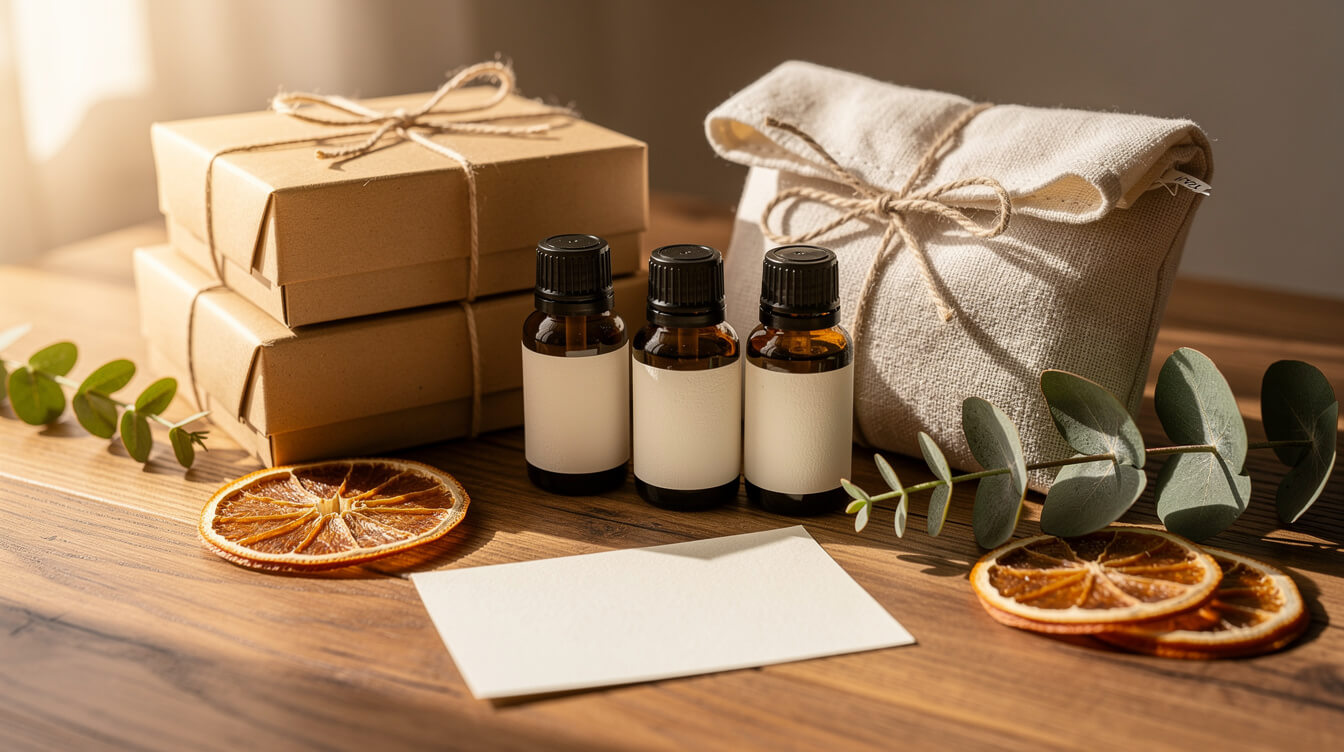
A good working definition is simple: a wellness gift is something that makes a person’s ordinary days feel a little calmer, slower or more cared for, and that they will actually reach for after the wrapping paper is gone. A bath ritual, a walking-shoe upgrade, a scent for the evenings, a good journal. The problem is that the label can’t tell you which products deliver that, because the key words are unregulated.
“Wellness” isn’t a regulated claim
No US agency defines “wellness” for a consumer product. The closest the FDA comes is a guidance document on low-risk “general wellness” devices (think fitness trackers), which describes what those gadgets may say without being treated as medical devices. It isn’t a quality standard, and it doesn’t cover a candle, a bath soak or a bottle of oil. A brand can print “wellness” on anything.
“Fragrance” can hide dozens of ingredients
The second word to watch is “fragrance.” Under FDA cosmetic labeling rules, a company can list “fragrance” as a single ingredient without naming the chemicals inside it, because the mix is treated as a trade secret. Congress tried to narrow that gap. The Modernization of Cosmetics Regulation Act of 2022 (MoCRA) told the FDA to propose a rule requiring fragrance allergens to be named on labels, with a statutory deadline of June 2024. As of the FDA’s latest MoCRA updates, no such rule has been published, so in the US there is still no federal requirement to list fragrance allergens individually. (California’s own disclosure law is a partial exception, which we unpack in our luxury home fragrance brand audit.)
That’s why a scented “wellness” gift can be anything from a single pure plant oil to a fully synthetic blend, and the front of the box looks the same. The only way to know is to ask the brand to name every ingredient and show you a test. We’ll turn that into a checklist next.
The 5-Question Test for Wellness Gifts Worth Giving
Run any candidate through these five questions. A gift doesn’t need a perfect score, but two or more “no” answers usually means you’re paying for the word on the box.
1. What is it made of?
Real materials feel better in the hand and last longer: wood, glass, ceramic, stone, natural fibers. Plastic isn’t automatically bad, but plastic that touches concentrated oils is a known weak point, because some essential oils attack certain plastics over time. We cover why plastic reservoirs crack and cloud with oils and which “glass” diffusers really keep oil off plastic in detail.
2. What’s actually in it?
Look for named ingredients rather than “fragrance,” “essential oil blend” or “proprietary aroma.” Then go one step further and ask for proof. For essential oils, the proof is a GC-MS report (gas chromatography with mass spectrometry, the standard lab test that separates an oil into its molecules). We publish ours on the product pages. Open our Frankincense oil, for example, and you’ll find the independent lab reports in a tab beside the description. If a brand selling “pure” oils can’t show you one, that tells you something.
3. What does it promise?
This is the quickest filter of all. A gift that claims to cure, treat or fix a health condition is a red flag, not a selling point. The FTC’s Health Products Compliance Guidance (December 2022) says that health-benefit claims generally need randomized, controlled human clinical trials behind them, and that applies to any product making them, not only supplements. The FDA’s aromatherapy page makes a similar point from the other side: an aromatherapy product sold to treat a condition is legally a drug, not a cosmetic. A good wellness gift talks about the experience: how it smells, how it feels, how it fits a routine. Honest brands stop there.
4. What does it need to keep working?
Turn the box over and look for the refill. Some home-scent devices run only on sealed cartridges or vials made for that one machine. That’s a convenience for some people, but it means the recipient is buying from one brand for as long as they use the gift. A pure-oil Nebulizing Diffuser® runs on any single essential oil or blend, from any source, with nothing to dilute it. A gift that runs on things the recipient can choose keeps working on their terms.
5. Can it be repaired?
Glass breaks, cables get lost, batteries age. Ask whether parts are sold separately. For our own Nebulizing Diffusers®, a replacement glass reservoir set is a standalone part, so a knocked-over reservoir doesn’t send the whole gift to a landfill. Repairability is one of the clearest signs a brand expects its product to be used for years, not one season.
Join Now and Get a Coupon for 10% Off!
Wellness Gifts for Teams and Clients: The Tax Rules Nobody Mentions
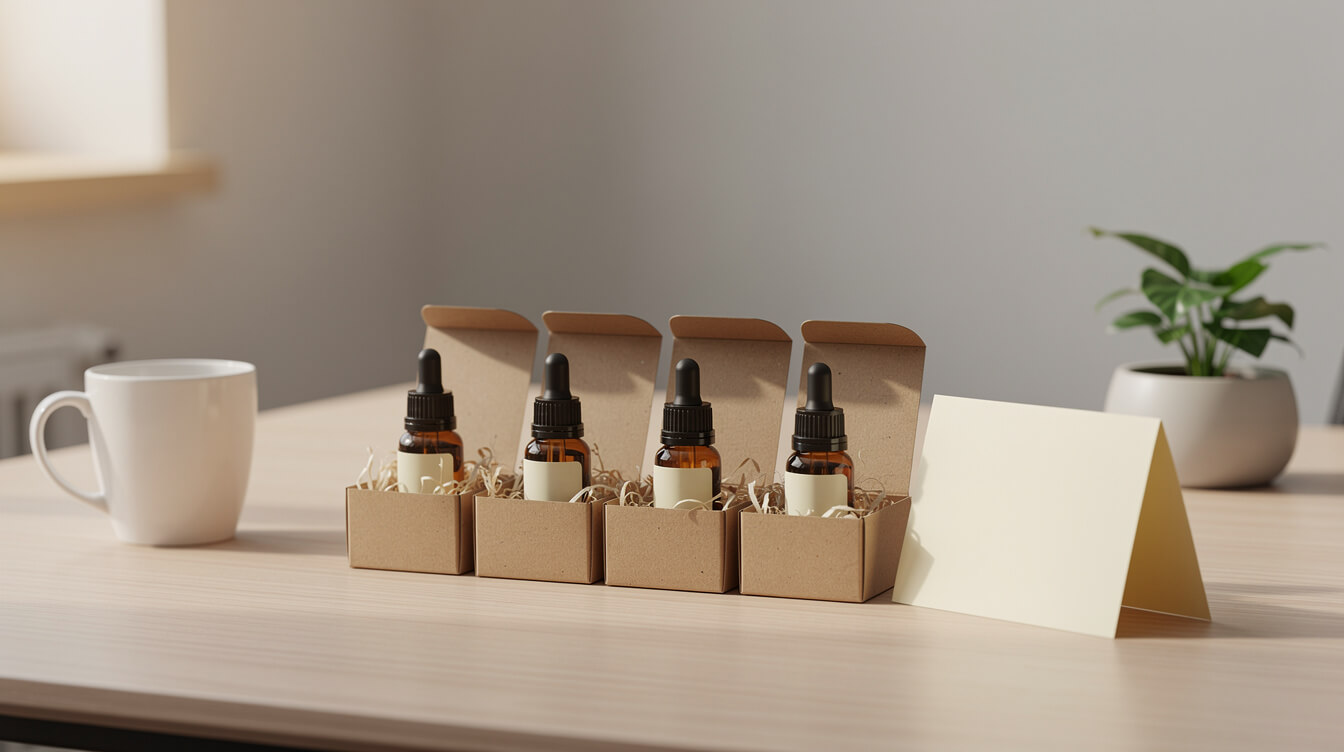
Corporate wellness gifts are a big part of this search in December, and every guide stops at “here are 30 ideas.” Before you order 30 of anything, two IRS rules are worth knowing. One applies to your employees and one to clients, and they work differently. (This is general information, not tax advice. Your accountant has the final word.)
Gifts to employees: the de minimis rule (and the gift-card trap)
Small, occasional gifts to staff, such as a holiday gift of low value, can usually be left out of their taxable wages as a de minimis fringe benefit. There’s no fixed dollar cap in the rule; the test is whether the item is small enough and rare enough that tracking it would be unreasonable. The catch sits in plain sight in IRS Publication 15-B: cash and cash equivalents, which explicitly includes gift cards and gift certificates, are never de minimis, “no matter how little.” A $25 gift card to an employee counts as wages. A $25 boxed gift usually doesn’t. If you’re gifting your own team, a physical item is the simpler choice.
Gifts to clients: the $25 deduction limit
The number everyone half-remembers, $25, is a different rule. Under IRS Publication 463, a business can deduct at most $25 per recipient per year for gifts to clients, customers and other business contacts. Three details make that limit friendlier than it sounds:
Wrapping and shipping don’t count. Incidental costs like gift wrap, engraving, insurance and postage aren’t added to the $25, as long as they don’t add real value of their own.
Small branded items are exempt. Items costing $4 or less with your business name permanently imprinted, handed out widely, don’t count toward the limit at all.
A gift to a company for one person counts as a gift to that person. Sending one box to an office meant to be shared is treated differently from a box addressed to a single client.
Practical picks for a team
For a group, choose one item everyone can use and nobody has to decode: a single bottle of a widely liked oil, a set of refillable personal inhalers for desks and commutes, or a AromaCurious™ Starter Kit so each person picks their own five 2 ml oils. For larger orders, contact our team and we’ll help you plan quantities. We don’t publish bulk pricing in posts.
Wellness Gifts by Recipient: Host, Coworker, New Home, Far Away
Our self care gift guide sorts ideas by budget. This one sorts by the person, because a gift for a dinner host and a gift for someone across the country have different jobs to do.
The host
A host gift should be ready to enjoy that evening or the next morning, without assembly or a learning curve. A single full-size bottle of a crowd-pleasing oil, wrapped with a handwritten note suggesting when to use it, works better than a gadget they have to set up mid-party. If the host loves games, the Aroma™ board game turns 20 pure oils into a smelling challenge for the whole table.
The coworker or office gift swap
Keep it small, scent-light and personal-space friendly. Not everyone wants a strong scent in a shared office, so a personal inhaler is the polite choice: the scent stays with the person who chose it. Pair a pack of refillable personal inhalers with a small bottle for refilling.
The new home
A first scent for a new home is one of the few gifts that gets used daily. A Nebulizing Diffuser® with a starter set of blends gives the recipient a whole season of choices. Our Smart Holiday Set pairs the rechargeable Raindrop Smart Nebulizing Diffuser® with the six-blend Designer Series Essential Oil Blends Luxury Gift Set. It’s a limited holiday set, available until December 24.
The person far away
For a long-distance gift, choose something that survives the trip and doesn’t need you there to explain it. A sampler travels well: the Discovery Collection holds 40 oils in 2 ml vials, enough for months of exploring. And mind the delivery rules in the shipping section below, because a gift that bounces back is worse than a late one.
The scent skeptic
Some people say they “don’t like scents” when what they dislike is heavy synthetic fragrance. A gentle introduction, one light citrus or herb oil diffused for 10 to 15 minutes at a time, is a very different experience from a plug-in that runs all day. If you’re not sure, a Organic Aromas gift card lets them choose for themselves.
Sign Up to Get Your FREE
e-Book ($9.99 Value)
Scent Wellness Gifts Done Right: Pure Oils, Real Materials, No Cartridges
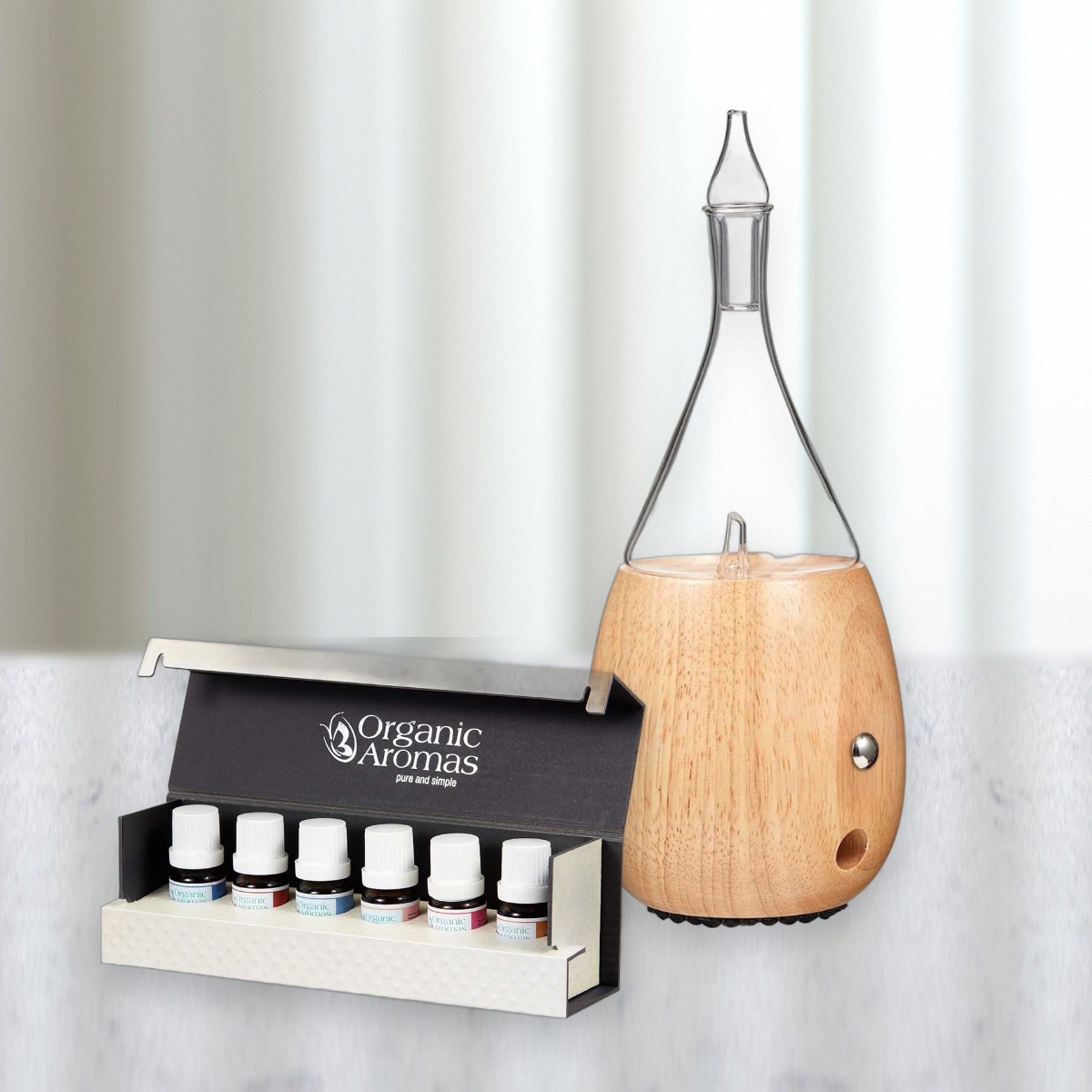
Scent is one of the most popular categories of wellness gifts, and it’s also where the five-question test matters most. Here is how a pure-oil setup answers it.
Materials: our Nebulizing Diffusers® are handcrafted from real wood and medical-grade Pyrex glass, so the oil travels through glass rather than a plastic tank.
Ingredients: one ingredient per single oil, named on the label, with independent lab reports on the product page.
Claims: we describe scent, mood and atmosphere, and we don’t make health claims.
Refills: any pure essential oil works, no proprietary cartridge, no water and no heat.
Repair: glass, cables and bases are sold as separate parts.
How a Nebulizing Diffuser® works is worth knowing before you give one: it uses a small stream of air to break pure oil into a fine, waterless mist, so what fills the room is the oil itself rather than a diluted or heated version. That’s also why sessions can be short. Our guide to using a Nebulizing Diffuser® covers setup, and our non-toxic home fragrance guide explains why short, intermittent sessions suit indoor air better than all-day scent.
For someone who travels or works from several rooms, the cordless Smart Mobile Mini is the portable option. For a first Nebulizing Diffuser® at home, the classic wooden models in the Nebulizing Diffuser® collection are the long-term centerpiece. If you’d like to compare kits and starter sets first, our aromatherapy kit buying guide walks through what each kind includes.
Make It Last Past January (and Arrive on Time)
The real test of a wellness gift is whether it’s still in use in February. Two things decide that: how it’s given, and whether it arrives in good shape.
Give it a ritual, not just a box
A note that says when to use the gift (“Sunday mornings with coffee,” “the first ten minutes after you get home”) does more for its lifespan than the gift itself. We wrote a whole piece on how to give a scent so it becomes their ritual, including the first-pour idea: set it up together rather than handing it over sealed.
A shipping checklist for wellness gifts
Know the cutoff. For the Smart Holiday Set, the product page says to order by December 15 for delivery before Christmas within the US. For other items, order early, because our orders ship on Mondays, Wednesdays and Fridays.
Plan for the signature. Our shipping policy requires a signature on delivery, and we may decline parcel lockers, PO boxes and other addresses where a signature isn’t possible. If the recipient won’t be home during the day, ship to yourself or to their workplace and hand it over.
Use the free-shipping thresholds. Shipping is free on Nebulizing Diffuser® orders of $130 or more and on oil and accessory orders of $65 or more. A Nebulizing Diffuser® plus a few oils often clears the line on its own.
International gifts: the recipient may owe import duties, so warn them not to refuse the package. Refused parcels aren’t refunded.
Looking for something more traditional for the holidays? Our older Christmas gift ideas are still a good starting point.

Join Our Exclusive Member Club to get Big Discounts!
Wellness Gifts: FAQs
What are good wellness gifts?
Good wellness gifts are things the person will use regularly that make ordinary days feel calmer or more cared for: a scent ritual, a comfortable robe, a journal, a quality tea set. Choose real materials, named ingredients, no health claims, refills they can choose, and parts that can be replaced.
Is “wellness” a regulated term on products?
No. No US agency defines “wellness” for consumer products. Judge the product by its materials, its ingredient list and whether the brand can show a lab test, not by the word on the box.
Can I give employees gift cards as wellness gifts?
You can, but the IRS treats gift cards to employees as cash equivalents, so they’re taxable wages no matter how small. A low-value physical gift given occasionally can usually be left out of wages as a de minimis benefit. Check with your accountant.
How much can a business deduct for client gifts?
Up to $25 per recipient per year under IRS Publication 463. Incidental costs such as wrapping and shipping aren’t counted toward that limit.
Is an essential oil diffuser a good wellness gift?
It can be one of the most-used gifts on the list, especially a pure-oil Nebulizing Diffuser® paired with a few oils they’ll enjoy. Avoid models that only run on proprietary cartridges unless the recipient already uses that brand.
What wellness gift works for someone who doesn’t like strong scents?
Try a personal inhaler, so the scent stays with them, or a single light citrus oil diffused in short sessions. Heavy synthetic fragrance is often what people dislike, not scent itself.
The best wellness gifts aren’t the ones with the word printed largest on the box. They’re the ones that pass a simple test: honest materials, named ingredients, no medical promises, refills the recipient chooses, and a way to repair them. Pick by the person, add a note that turns it into a ritual, and order early enough that the signature can be collected.
A Wellness Gift That Passes the Test
Handcrafted from real wood and medical-grade Pyrex glass, our Nebulizing Diffusers® run on any pure essential oil, with no water, no heat and no cartridges.