

Terpenes in Essential Oils: The Isoprene Rule, the Volatility Ladder, and Why Flavor Houses Remove Them
Terpenes in essential oils are the reason a pine forest, an orange peel and a patchouli leaf smell nothing alike, yet behave like members of one family. Search the term and you land in two camps: cannabis shops selling terpene blends by the gram, and medical reviews listing what each molecule might do in a lab dish. Neither tells you the useful part, which is how a terpene’s size decides how an oil behaves in your room, and why the flavor industry pays good money to remove most of them.
This is the plain-language version. We’ll build terpenes from their five-carbon blocks, put real vapor-pressure numbers on the idea of top, middle and base notes, read our own lab reports to sort our oils by class, and look at the patent on page one of Google that is, quite literally, a process for getting terpenes out of essential oils.
What Are Terpenes in Essential Oils?
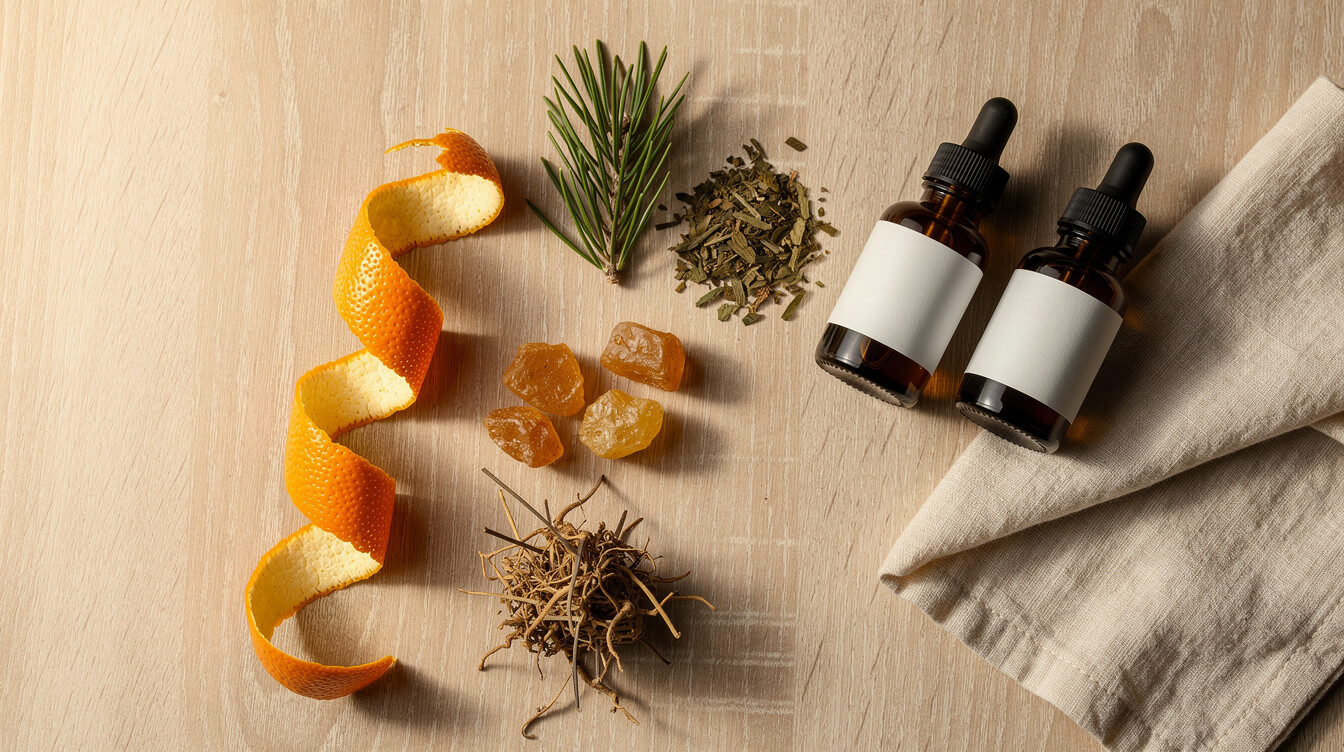
A terpene is a molecule a plant builds from repeating five-carbon units called isoprene units (C5H8). Snap two together and you get a 10-carbon monoterpene such as limonene or α-pinene (C10H16). Three units make a 15-carbon sesquiterpene (“one and a half” terpenes) such as β-caryophyllene (C15H24). Four make a 20-carbon diterpene. The pattern is so regular that chemists call it the isoprene rule, and it lets you guess a lot about an unfamiliar molecule from its carbon count alone.
Plants make enormous amounts of the basic unit. Trees and shrubs give off about 600 million tonnes of isoprene gas a year (estimates run from 500 to 750), according to Guenther and colleagues’ global estimate. Most of that isoprene never becomes perfume. The fraction a plant links into bigger rings and chains, and stores in oil glands, ducts and resin canals, is what we distill.
Terpene vs terpenoid: the oxygen test
Strictly, a terpene is a pure hydrocarbon, made only of carbon and hydrogen: limonene, α-pinene, myrcene, β-caryophyllene. Once the plant adds oxygen, as an alcohol, ketone, ester or ether, chemists call it a terpenoid. Linalool, menthol, 1,8-cineole (eucalyptol), camphor, carvone and linalyl acetate are all terpenoids. Everyday writing, including labels and most of this article, lumps both together as “terpenes.” The difference matters for scent: oxygen usually makes a molecule smell stronger and stick around longer. That’s why a few percent of an oxygenated molecule can matter more to an oil’s character than 90% of a hydrocarbon. Limonene, which is almost all of an orange oil but surprisingly faint on its own, is the classic case.
The molecules that aren’t terpenes at all
Not every scent molecule in an essential oil is a terpene. A second family, the phenylpropanoids, is made by a completely different route in the plant: from the amino acid phenylalanine, which plants make through the shikimate pathway, rather than from isoprene units (see this 2022 review of phenylalanine-derived aroma compounds). The warm, spicy, sweet end of the essential oil shelf belongs to this second family: eugenol in Clove Bud, cinnamaldehyde in cinnamon bark, anethole in anise and fennel, and methyl chavicol (estragole). One surprise from our own lab reports: our Sweet Basil oil is the methyl chavicol type, which makes it mostly a phenylpropanoid oil, not a terpene oil. So “all essential oils are terpenes” is close, but not true.
Where the word came from
The name comes from turpentine, the pine resin oil that was the first terpene-rich material chemists studied. The word “terpene” is generally credited to August Kekulé, who used it in his 1866 organic chemistry textbook for “turpentine oil and the numerous hydrocarbons isomeric with it,” according to Gildemeister and Hoffmann’s classic The Volatile Oils. Otto Wallach spent decades sorting out which “different” oils actually contained the same terpenes, and won the 1910 Nobel Prize in Chemistry for that work on alicyclic (ring) compounds. Leopold Ružička won the 1939 prize “for his work on polymethylenes and higher terpenes,” and in 1953 published the biogenetic isoprene rule, which explains how plants actually build them.
The Terpenes You Already Know by Smell
You don’t need a chemistry degree to recognize the big names. You’ve been smelling them for years. Here is a short field guide, with the percentages taken from the independent GC-MS lab reports linked on our own product pages. (GC-MS is gas chromatography with mass spectrometry, the standard test that separates an oil into its molecules and weighs each one.)
Limonene (monoterpene hydrocarbon). 94.15% of our Sweet Orange oil. Fresh and faint by itself; the orange “pop” comes from trace aldehydes riding along.
α-Pinene, β-pinene and camphene (monoterpene hydrocarbons). The resinous, needle-crushed smell of Pine and the forest edge of Rosemary, where they add up to roughly 21%.
α-Thujene (monoterpene hydrocarbon). 60.94% of our Frankincense (Boswellia serrata) oil, the bright, peppery lift you smell before the resin.
1,8-Cineole (oxygenated monoterpene). 45.31% of our Rosemary. Cool, airy, eucalyptus-like.
Menthol and menthone (oxygenated monoterpenes). 41.16% and 22.72% of our Peppermint. Menthol is the cooling one; menthone adds the sharper, minty edge.
Carvone (oxygenated monoterpene). 71.19% of our Spearmint, the reason it smells like chewing gum rather than peppermint.
Linalool and linalyl acetate (oxygenated monoterpenes). 26.2% and 58.4% of our Clary Sage. Floral, soft, a little fruity. Our linalool deep-dive follows this one molecule through 200+ plants.
β-Caryophyllene (sesquiterpene hydrocarbon). Woody, peppery and dry. Usually the main molecule in Copaiba and a supporting note in black pepper, clove and rosemary (2.96% in ours).
Patchoulol (sesquiterpene alcohol). The damp, earthy core of Patchouli.
Sclareol (diterpene alcohol). Just 0.28% of our Clary Sage oil, and we’ll see below why it’s so scarce.
How to read a lab report for terpene class
Most GC reports group results by class before they list single molecules: monoterpene hydrocarbons, oxygenated monoterpenes, sesquiterpene hydrocarbons, oxygenated sesquiterpenes, and sometimes phenylpropanoids and “others.” Read those subtotals first. A citrus oil that is 95% monoterpene hydrocarbons will be bright, fast and short-lived. An oil that is mostly sesquiterpenes will be quiet at first and still be on a blotter tomorrow. Then read the conclusion page, which tells you whether the lab saw signs of adulteration. That single paragraph says more about quality than any marketing word on the label. Our rosemary smell guide and frankincense smell guide both walk through a real report line by line.

Sign Up to Get Your FREE
e-Book ($9.99 Value)
Mono, Sesqui, Di: How Terpene Size Predicts How an Oil Behaves
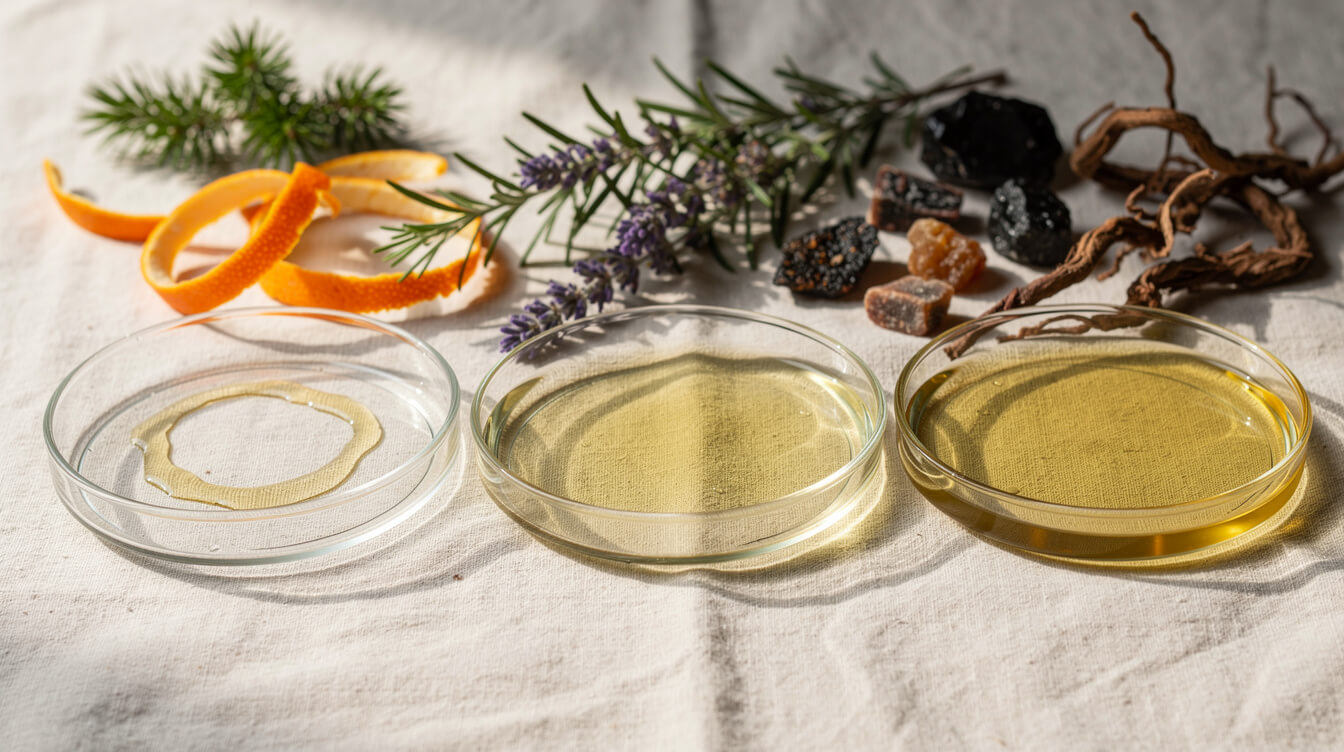
Here is the jewel the cannabis charts and pharmacology reviews skip. Every carbon a plant adds makes a molecule heavier and stickier, so it escapes into the air more slowly. Chemists measure that with vapor pressure: how hard a liquid pushes molecules into the air above it at a given temperature. Higher means it evaporates faster. Put the published numbers side by side and the old perfumer’s idea of top, middle and base notes turns out to be mostly a carbon count.
Vapor pressure at about 25 °C (higher = evaporates faster)
α-Pinene (monoterpene, C10): 4.75 mmHg; boils at 155-156 °C
1,8-Cineole (monoterpenoid, C10): 1.90 mmHg; boils at 176-177 °C
Limonene (monoterpene, C10): 1.55 mmHg; boils at 175-176 °C
Linalool (monoterpenoid, C10): about 0.16 mmHg; boils at 198 °C
β-Caryophyllene (sesquiterpene, C15): about 0.013 mmHg (estimate); boils at 256-259 °C
Patchoulol (sesquiterpenoid, C15): about 0.0003 mmHg (estimate); boils at 287-288 °C
Sources: PubChem for the C10 molecules; The Good Scents Company estimates for the C15 molecules, which PubChem doesn’t list.
Read down the list and the gaps are huge. Limonene evaporates roughly 120 times faster than β-caryophyllene at room temperature. α-Pinene evaporates about 17,000 times faster than patchoulol. Adding oxygen slows a molecule too: linalool and limonene both have 10 carbons, but linalool’s alcohol group cuts its vapor pressure about tenfold. That’s why a citrus or pine top note is gone from a blotter within the hour, a linalool-rich middle lasts the afternoon, and copaiba, vetiver or patchouli still smell the next day. The notes pyramid isn’t mystique. It’s mostly molecular weight and oxygen.
Why this is about evaporation, not thickness
It’s easy to blur two different properties. Vapor pressure is about how fast molecules leave the liquid. Viscosity is about how thick the liquid is to pour, and we cover that, and why thick oils can slow a nebulizer, in our carrier oil explainer and our guide to using a Nebulizing Diffuser®. A thin oil can still be slow to evaporate, and a sesquiterpene-rich oil like copaiba pours easily but lingers for hours. Volatility decides how long the scent lasts on the air. Viscosity decides how easily the oil travels through the glass.
Putting the ladder to work in a blend
Because the classes leave the air at such different speeds, a blend changes over a session in a predictable order. The monoterpene hydrocarbons arrive first and fade first. The oxygenated monoterpenes carry the middle. The sesquiterpenes remain once the rest have gone. A simple, reliable structure follows from that: roughly 3 parts of a bright monoterpene oil (orange, pine or rosemary), 2 parts of an oxygenated middle (clary sage or lavender), and 1 part of a sesquiterpene anchor (copaiba, vetiver or patchouli). The anchor stops the blend from collapsing once the citrus has gone. Our essential oil blending chart has more ratios built on the same logic.
Why diterpenes barely make it into the bottle
Diterpenes, with 20 carbons, sit at the bottom of the ladder. Sclareol, the diterpene alcohol in clary sage, has no measured vapor pressure we could find, but a standard model estimates it at about 0.003 mmHg, roughly 500 times lower than limonene. It barely moves with steam. That’s why clary sage’s sclareol mostly stays behind in the distilled straw and is recovered by solvent instead. Steam distillation is a filter that favors small, light terpenes. What reaches the bottle is already sorted by size.
Why Flavor Houses Pay to Strip Terpenes Out
Search “terpenes in essential oils” and one of the top results isn’t a blog at all. It’s a patent: US 5,061,502, “Process for the removal of terpenes from essential oils”, filed by the German company SKW Trostberg and granted in 1991. Its method runs the oil over a polar adsorbent such as silica gel, washes the terpene hydrocarbons away, then recovers the flavor-rich fraction with compressed carbon dioxide. It sounds backwards, so why would anyone pay to remove the main ingredient?
The patent spells out the reasons. Terpenes, it says, “have only a limited storage stability and are thermolabile” (they break down with heat) and “display a smaller aroma intensity” than the aldehydes, ketones and esters that really carry a flavor. It notes that some essential oils are up to 95% terpenes, and that removing the non-polar terpene hydrocarbons improves water solubility, “which is of particular importance for the beverage industry.” A hydrocarbon like limonene simply doesn’t dissolve in a soft drink; it floats, clouds and oxidizes. The industry’s answer is the folded or terpeneless oil. Remove 80% of an orange oil’s volume, mostly limonene, and the 20% left is a “5-fold” oil, as one supplier explains its fold math. The numbers show what that does. The USP standard for ordinary orange oil requires just 1.2% to 2.5% total aldehydes, while one 10-fold orange oil spec lists more than 4.5% aldehydes with limonene still at 80-85%. Concentrate the oil tenfold and the flavor molecules roughly double or triple, while the terpenes still dominate.
For a cola or a clear lemon soda, that’s exactly what a formulator wants. But in the bottle you diffuse, those terpenes aren’t a flaw to fix. They are the bright opening of the scent, and they’re part of what makes an oil smell whole rather than thin. We sell whole, single-fold oils, so what you smell is what the plant made, in the proportions it made it. The honest takeaway is that in many oils, the terpenes are the bulk, not always the character. Orange is the clearest example, and our orange oil guide covers how its trace aldehydes do so much of the work.
Why the bulk still matters
Monoterpene hydrocarbons do two quiet jobs in a whole oil. They lift the heavier, more characterful molecules into the air with them, and they dilute those molecules to a level the nose reads as pleasant rather than harsh. Take them out and you get a stronger, narrower, more “flavoring” note. That suits a recipe. It doesn’t suit a room.

Sign Up to Get Your FREE Essential Oils e-Book ($9.99 Value)
Keeping Terpenes in Essential Oils Fresh (and Diffusing Them Well)
The same double bonds that make terpenes useful also make them reactive. In the bottle, monoterpene hydrocarbons slowly react with oxygen, which is why old citrus and pine oils go flat or sharp. We explain the limonene side of that in our orange oil guide and the linalool side in our linalool guide. In room air, terpenes also react with ozone, which is the reason we recommend short sessions rather than all-day saturation (the full explanation is here).
Simple habits follow from the chemistry. Store oils capped, cool and dark. Buy citrus and conifer oils, the most monoterpene-heavy bottles on your shelf, in sizes you’ll finish within a year or so. Decant to a smaller bottle once one is half empty so less air sits above the oil. Sesquiterpene-rich oils such as patchouli, vetiver and copaiba are far more stable, and aged patchouli is even prized for its deeper smell.
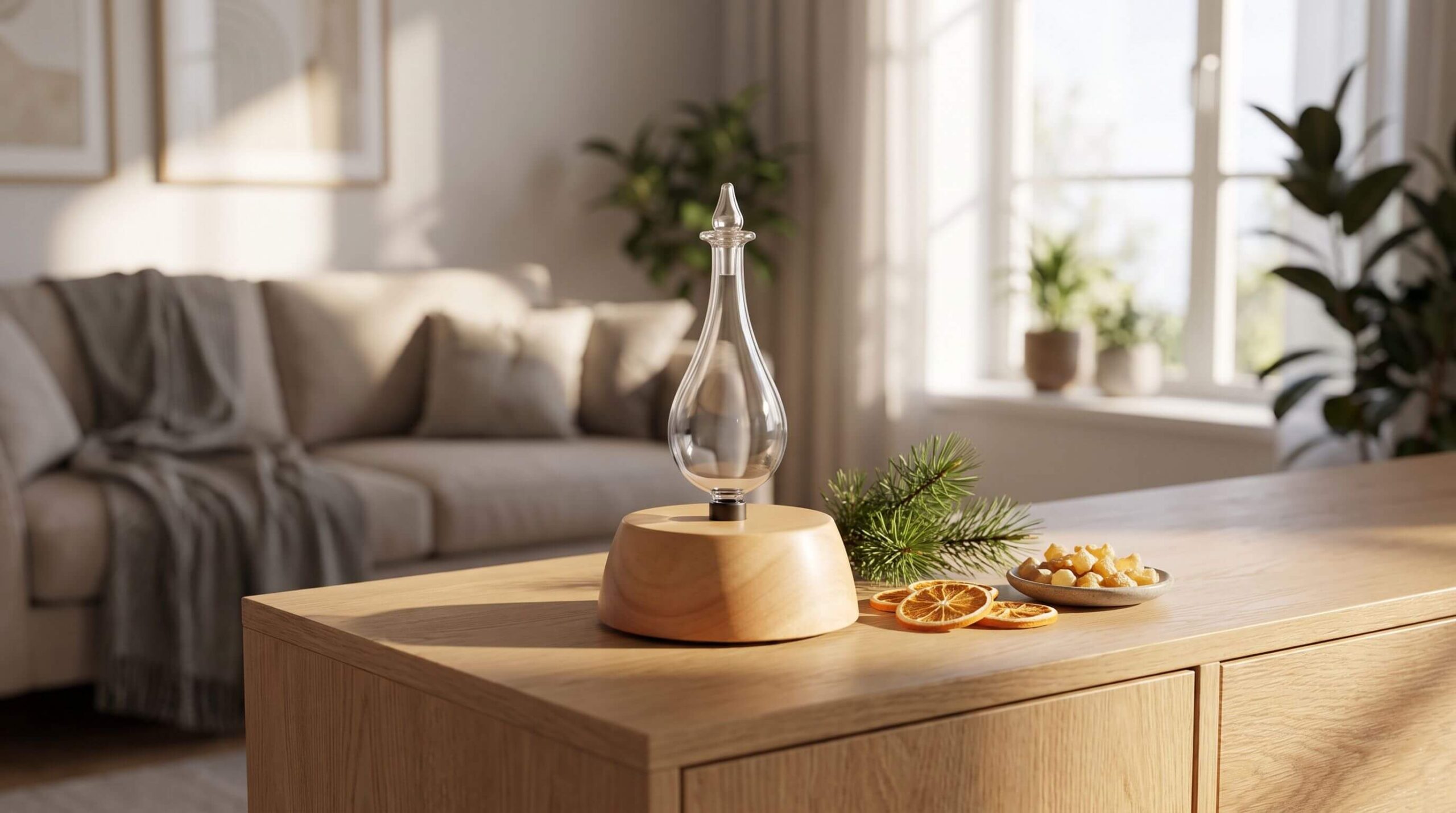
Then there’s how you diffuse. Heat drives off the lightest monoterpenes first and can change fragile molecules. Water dilutes and scatters them. A Nebulizing Diffuser® does neither: it breaks pure oil into a fine aerosol using air pressure alone, so the whole spread of the volatility ladder reaches the room in the plant’s own proportions. A compact Raindrop Nebulizing Diffuser® running 10 to 20 minutes at a time is our favorite way to enjoy a three-tier blend like the one above.
Terpenes vs Essential Oils: The Cannabis Marketing Question
Half the search results for this topic sell “terpene blends” or ask whether terpenes are better than essential oils. It’s a false choice. Limonene is limonene, whether it came from an orange tree, a mint plant or cannabis. Pinene, myrcene, linalool and β-caryophyllene are the same molecules in every plant that makes them.
Many of the “botanical terpene” products sold in cannabis markets openly say they don’t come from cannabis at all. One major supplier, Abstrax, defines botanically derived terpenes as “terpene isolates or profiles that have been extracted from legal, non-cannabis plants,” with examples like myrcene from hops and mango, limonene from citrus peel, linalool from lavender and α-pinene from pine. In other words, they’re largely fractions of the same essential oils on our shelf, recombined to imitate a cannabis strain’s aroma.
So a “cannabis terpene profile” and an essential oil often share many of the same molecules, just sourced, isolated and mixed differently. A whole essential oil gives you one plant’s complete chemistry. A terpene blend gives you a recipe of selected molecules built to imitate another plant. Neither is “more natural” by default; read the spec sheet. One clear line from us: we don’t support vaping essential oils or terpene blends, and our vaping guide explains what a hot coil does to these molecules.

Join Our Exclusive Member Club to get Big Discounts!
Terpenes in Essential Oils: FAQs
Do all essential oils contain terpenes?
Almost all do, but not all are mostly terpenes. Clove bud, cinnamon bark, anise and methyl-chavicol basil are dominated by phenylpropanoids, a separate family made by a different pathway in the plant.
Which essential oils are highest in terpenes?
Cold-pressed citrus oils (orange, grapefruit, mandarin) and conifer oils (pine, fir, cypress) are the most monoterpene-heavy. Our Sweet Orange is about 94% limonene alone. Copaiba, patchouli, vetiver and cedarwood are rich in heavier sesquiterpenes.
Is it healthy to breathe in terpenes from essential oils?
We don’t make health claims. In normal home use, keep sessions short, ventilate, and avoid diffusing all day in a small closed room, especially around pets, babies or anyone sensitive to scent. Our guide to non-toxic home fragrance covers dose and indoor air in detail.
What’s the difference between a terpene and a terpenoid?
A terpene is a pure hydrocarbon (only carbon and hydrogen), like limonene. A terpenoid has oxygen added, like linalool or menthol. Most labels call both “terpenes.”
What does “terpeneless” or “5-fold” mean on an oil?
Some of the terpenes, mostly the monoterpene hydrocarbons, have been removed, usually for food and drink flavoring. A 5-fold oil has been concentrated to one fifth of its original volume. These oils are made for formulators, not for diffusing.
Do terpenes go bad?
Monoterpene hydrocarbons oxidize in air over months, which is why citrus and pine oils have the shortest shelf life. Store them capped, cool and dark, and finish them within about a year of opening. Sesquiterpene-rich oils keep much longer.
In short, terpenes in essential oils are a family built from five-carbon blocks, and the number of blocks tells you most of what you need to know. Small ones open the scent and leave first; big ones arrive late and stay. Read the class totals on a lab report, keep the light oils fresh, and diffuse them cold so the whole ladder reaches the room.
Diffuse the Whole Oil, Top Note to Base
Our handcrafted Nebulizing Diffusers® use air pressure alone, with no water and no heat, so the light monoterpenes and the deep sesquiterpenes reach your room in the proportions the plant made them.